STT 231 Exam 1
0.0(0)
Studied by 6 people Call Kai
 Learn
Learn Practice Test
 Spaced Repetition
 Match
Match Flashcards
 Knowt Play
Card Sorting
1/23

Earn XP
Description and Tags
Terms and Definitions
Last updated 10:51 PM on 2/28/23
Name | Mastery | Learn | Test | Matching | Spaced | Call with Kai | Chat |
|---|
No analytics yet
Send a link to your students to track their progress
24 Terms
1
New cards
Why is this statement not a variable?
"Average amount of sleep in the past 24 hours among students in our class."
"Average amount of sleep in the past 24 hours among students in our class."
A variable represents something measured for each case. The italicized quantity summarizes ALL cases simultaneously.
2
New cards
For a right-skewed test, is the mean or median greater
The mean is greater
3
New cards
For a left-skewed test, is the mean or median greater
The median is greater
4
New cards
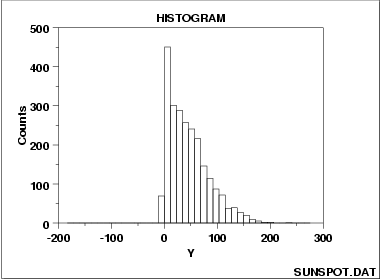
what kind of distribution is this
Right Skewed
5
New cards
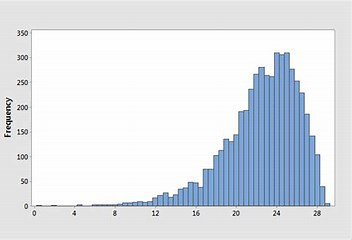
What kind of distribution is this
Left Skewed
6
New cards
What symbol represents the proportion measured for a sample?
pi hat
7
New cards
What symbol represents the proportion measured for a population?
pi
8
New cards
What symbol represents the mean measured for a sample?
X bar
9
New cards
What symbol represents the mean measured for a population?
Mu
10
New cards
What symbol represents the median measured for a sample?
X\~
11
New cards
What symbol represents the median measured for a population?
Mu bar
12
New cards
What symbol represents the standard deviation measured for a sample?
S
13
New cards
What symbol represents the standard deviation measured for a population?
lowercase sigma
14
New cards
Can the standard deviation ever be negative?
Never
15
New cards
Can the Z-Score be negative?
Sometimes
16
New cards
Can the IQR be negative?
Never
17
New cards
Can the P-Value be negative?
Never
18
New cards
Can the correlation coefficient be negative?
Sometimes
19
New cards
What is a nominal variable
A nominal variable is a type of categorical variable that consists of values that have no inherent order or numerical significance. Nominal variables are typically used to classify data into distinct groups or categories based on some characteristic or attribute.
Example of nominal variables:
* Gender: Male, Female, Non-binary
Example of nominal variables:
* Gender: Male, Female, Non-binary
20
New cards
What is a discrete variable
A discrete variable is a type of quantitative variable that can only take on a finite or countable set of values. Discrete variables can only assume certain numerical values, and the values cannot be subdivided into smaller units or intervals.
Examples of discrete variables include:
* Number of children in a family (can only be a whole number)
* How many problems did you get right on an exam (can only be a certain number, up to the number of questions on the exam)
Examples of discrete variables include:
* Number of children in a family (can only be a whole number)
* How many problems did you get right on an exam (can only be a certain number, up to the number of questions on the exam)
21
New cards
What is a continuous variable
A continuous variable is a type of quantitative variable that can take on any value within a certain range. Unlike discrete variables, continuous variables can be subdivided into smaller and smaller units or intervals, and can assume an infinite number of possible values.
Example of continuous variables:
* Height of individuals (can be measured to any degree of accuracy)
Example of continuous variables:
* Height of individuals (can be measured to any degree of accuracy)
22
New cards
What is an ordinal variable
An ordinal variable is a type of categorical variable that consists of values that can be ordered or ranked based on some inherent property or characteristic. Unlike nominal variables, ordinal variables have a meaningful order or sequence between categories, but the differences between categories are not necessarily equal.
Example of ordinal variables:
* Educational level: High school, Associate’s Degree, Bachelor's degree, Master's degree, PhD
Example of ordinal variables:
* Educational level: High school, Associate’s Degree, Bachelor's degree, Master's degree, PhD
23
New cards
What symbol represents the number of members measured for a sample?
n
24
New cards
What symbol represents the number of members measured for a population?
N