Intelligence theory and measurement
 Studied by 0 people
 Call Kai
 Learn
Learn Practice Test
 Spaced Repetition
 Match
Match Flashcards
 Knowt Play
1/55

There's no tags or description
Looks like no tags are added yet.
Name | Mastery | Learn | Test | Matching | Spaced |
|---|
No study sessions yet.
56 Terms
What was Plato’s view on knowledge and intelligence
he wrote that knowledge wasn’t given by the senses but acquired through them
it was intelligence through reason that made out sense of what was perceived
Who was Hobbes and what was his view on mental processes
suggested that all mental processes were the result of the movement of brain atoms activated by interaction with the mental world and the external world
What was Kant view on intelligence
talked about intelligence in terms of the mind consisting of qualities such as causality, unity, and totality that allow it to order and make meaningful raw sensory information
When did the foundations of the intelligence theory and tests begin and by who
began just before the end of the 19th century and with two men, Galton and Binet
What was Galton’s view on intelligence people and sense
he felt that intelligent people respond to a large range of information through the senses
he felt that people of low intelligence would show less response to sensory information, such as distinguish between heat and cold, being unable to recognise pain
What did Galton believe you could show intelligence through
to determine intelligence through responsiveness to stimuli
reaction time, keenest of sight and hearing, the ability to distinguish between colours, eye judgement
What did Binet create
created the first intelligence test
In 1905, what did Binet and Simon produce
the Binet-Simon scale
the first intelligence test
Simon described it as “practical, convenient, and rapid”
What was Binet and Simon’s approach classed as
it was seen as pragmatic (realistic, practical)
it was concerned with facts or actual occurrences
Give an example of some of what were the short tasks that were involved in the Binet and Simon intelligence test
following a lighted match with your eyes
shaking hands
naming parts of the body
counting coins
naming objects in a picture
recalling the number of digits a person can recall after being shown a long list
word definitions
How was the intelligence test arranged
it was arranged so as to be of increasing difficulty to indicate levels of intelligence
so the easiest task, (i.e. whether a child can or cannot follow a lighted match with their eyes) it was expected to be completed by all children
slightly harder tasks (i.e. asking a child to name certain body parts, repeat a simple sentence, and repeat back a series of 3 digits)
a more difficult tasks comprised children asking to reproduce a drawing of something or construct sentence from three words (i.e. ball, room, and Paris)
the most hardest items included children being asked to repeat back seven random digits and number of rhymes for difficult words
What else could the intelligence test be used to determine
the level of tests matched a specific developmental level of children (3 to 10 years old)
could be used to determine children’s mental ages and whether a child was advanced or backward for their age
e.g. a child of 7 passed the test designed for a 7 year old, but failed the test for an 8 year old, so they would be assigned a mental age of 7
What did Terman do
he used the Binet-Simon test in the USA among Californian school children
What did Terman find
he found that age norms that Binet and Simon had devised for Paris children didn’t work well for Californian school children
so Terman revised the test, adapting some of the times, and wrote 40 new items
In 1916 what did Terman introduce
the Stanford-Binet test
it is applicable for use for children aged from 4 to 14, as well as a now upper age limit to ‘superior adults’
What did Stern introduce
the Intelligence Quotient (IQ)
What did Stern observe
that mental age changes proportionally with chronological age
example:
age 6 = mental age 5 (- 1 year)
age 10 = mental age 8 (- 2 years)
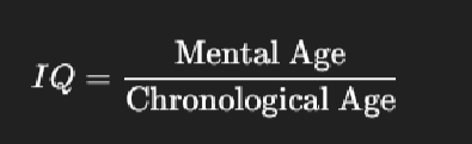
What is the ratio that Stern created
IQ = mental age / chronological age
examples:
10 year old mental age and 10 years old.
10 / 10 = 1. IQ = 100
7 year old mental age and 10 years old.
7 /10 = 0.7. IQ = 70.
15 year old mental age and 10 years old.
15/ 10 = 1.5. IQ = 150
Why was there a demand for intelligence tests in 1917
because of World War 1
Why was the American Psychological Association asked to help with war effort
to consider ways that psychology can help the war effort
Why couldn’t APA use the tests developed by Binet and Terman for WW1
because they were time intensive
Since, tests developed by Binet and Terman couldn’t be used what did Yerkes (Head of the committee of APA) do
Yerkes and 40 more psychologists developed a group intelligence test
known as Army Alpha and Army Beta tests
Army alpha was for the literate groups
Army beta was for the illiterates, low literates or non-English speaking
but this was developed late into the war so it had little effect on the war effort, but it did raise the status of psychology and the potential usefulness of intelligence testing
What was used in the Alpha test
oral directions
arithmetical problems
practical judgment
synonyms-antonyms
disarranged sentences
uncompleted series of numbers
analogies
information
What was used in the Beta test
maze task
cube analysis:
digit symbols
number symbols
picture completion
geometrical construction
In 1927 what did Spearman introduce
introduced another way of conceptualising intelligence, based on the factor analysis of data that has already been collected
What did Spearman do, describe his study in 1904
he wanted to estimate the intelligence of 24 children in the village school
at first he set out with intelligence tests of memory, light, weight, and sound in which participants were asked to identify changes in illumination, weight and pitch
but over time he started to collect more data from a wider group of individuals, using data from early experiments and later studies
he examined how results from different intelligence tests were related to each other by analysing them with a statistical method called factor analysis
What did Spearman find
he found that there was a trend of positive correlations between intelligence tests in his data
that a person who does well on one intelligence test, perform as well on a variety of intellectual tests, (and vice versa)
What is factor analysis
statistical analysis technique - data reduction
instead of looking at 2 variables, FA looks at the relationship between many variables
attempts to find patterns of association in a set of variables
What were Spearman’s two factors of intelligence
specific abilities ‘s’:
name given for each type of intelligence which was needed for performing well on each different intelligence task that Spearman had observed
skills unique to particular tasks
general ability ‘g’:
a general intelligence underlying all tasks, explaining positive correlations between tests. Spearman viewed ‘g’ as a kind of mental energy that supports and influences all specific abilities
What two tests are used to measure ‘g’
Wechsler tests
Raven progressive matrices
both tests used overall scores on a number of items to measure general intelligence
these scores are referred to as IQ scores
What was the Wechsler test based on
modelled on Spearman’s two factor model, and Spearman’s central positive that intelligence covered a huge range of specific abilities (e..g arithmetic, comprehension, object assembly, etc)
What was Ravens progressive matrices based on
Raven testes Spearman’s abstract reasoning that its possible to see relationships between objects, events information and draw inferences from those relationships
thus Raven tested this by developing a test that was free of cultural influences, particularly language
How did Thurstone see Spearman’s work
he agreed with Spearman’s hypothesis of a general factor of intelligence
but Thurstone viewed ‘g’ differently to Spearman because Spearman saw ‘g’ as a central factor of intelligence underlying and informing all aspects of intelligence, including specific abilities
but the reason why Thurstone disagreed with Spearman is because he couldn't see how Spearman from his studies shown that there was a general factor of intelligence influencing all single aspects of intelligence
Thurstone argued that all Spearman had shown was that intelligence tests correlate positively together and that there was no evidence for Spearman’s theoretical description of ‘g’
What did Thurstone do/argue
used factor analysis to inform his findings
he argued that ‘g’ results from 7 primary mental abilities, which were:
associative memory
number
perceptual speed
reasoning
space (spatial visualisation)
verbal comprehension
word fluency
How did Cattell see Spearman’s work
Cattell acknowledged Spearman’s work in accepting there was general intelligence, but suggested that ‘g’ comprised two related but distinct components:
crystallised intelligence (‘Gc’)
acquired knowledge and skills, such as factual knowledge
generally related to a person’s stored information and their cultural influences
therefore, knowledge of vocabulary, comprehension, and general knowledge would be tests of an individual’s crystallised intelligence
fluid intelligence (‘Gf’)
it’s a primary reasoning ability, the ability to solve abstract relational problems
this component is defined by intelligence abilities such as acquisition of new information, understanding new relationships, patterns and analogies in stimuli
How did Guilford see Spearman’s work
Guilford disagreed with the stance of Spearman and didn’t acknowledge the existence of ‘g’
What did Guilford (1977) propose
that intelligence was the result of 150 independent abilities
his theory was called the structure of intellect (SI) theory
In Guilford (1977) Structure of Intellect (SI) theory what was it organised into