PSYB51 - midterm 2
 Call Kai
 Learn
Learn Practice Test
 Spaced Repetition
 Match
Match Flashcards
 Knowt Play
1/180

There's no tags or description
Looks like no tags are added yet.
Name | Mastery | Learn | Test | Matching | Spaced | Call with Kai | Chat |
|---|
No analytics yet
Send a link to your students to track their progress
181 Terms
number of muscles involved in eye movement
six
What are the 3 pairs of eye muscles involved in movement?
1. Inferior/superior rectus
2. lateral/medial rectus
3. Inferior/superior Oblique
Why do we need six muscles?
b/c muscles can only contract (they can't push) thus we need 6 muscles to achieve 3D perception.
Identify the different muscle pairs:
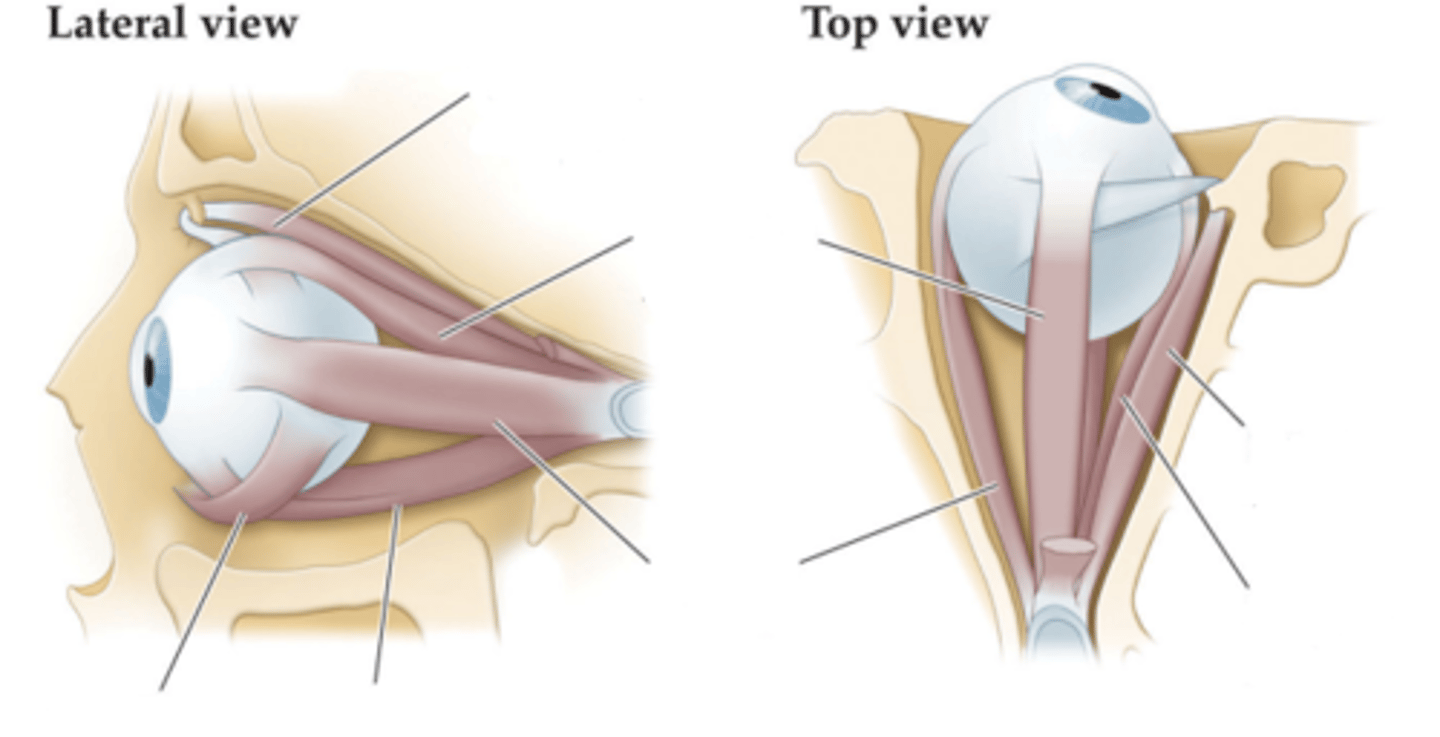
What are the eye muscles controlled by?
3 cranial nerves
What are the cranial nerves responsible for eye muscle control called?
1. Cranial nerve III (oculomotor nucleus)
2. Cranial nerve IV (Trochlear nucleus)
3. Cranial nerve VI (Abducens nucleus)
Oculomotor Nucleus
Cranial nerve III; controls most eye muscles
Trochlear Nucleus
Cranial nerve IV; controls the superior oblique muscle
Abducens Nucleus
Cranial nerve VI; pulls the eye away from the notes and controls the lateral rectus
Cranial nerves start in the ________________ and are controlled by several other ___________ for ________________ and _____________ vertical eye movements.
brainstem; nuclei; horizontal; vertical
Motor nuclei are situated next to higher ____________ nuclei that _______________ them.
order; control
Superior Colliculus
Structure in midbrain; plays important role in imitating and guiding eye movements.
Cerebral Cortex
Frontal and Parietal eye fields
Path of oculomotor control:
Starts in cerebral cortex -> goes to superior colliculus _> brain stem
types of eye movements
1. Smooth pursuit
2. Saccade
3. Vergence
4. Fixational (micro saccades)
5-6. Keep retina stable during (self)-motion
Smooth Pursuit
Eyes move smoothly to follow object. Can only occur when tracking a moving objects.
Saccade
Rapid eye movement that change fixation from one object or location to another.
Vergence movement
Type of eye movement in which two eyes move in opposite direction.
Micro-saccade and it's function:
Small eye movements; attention; refreshes retina
Function of Smooth Pursuit
Keep object of interest stable on the fovea. Can only make smooth pursuit with visual stimulus that you follow.
Function of Saccade
move fovea to object of interest as quickly as possible to reduce travel time when vision is blurred.
Yarbus (1967)
- Presented participants with pictures of faces
- Scan paths revealed intentions and interests (eyes, nose and mouth)
- 3-4 saccades/sec
What do the dots in scan paths represent?
The dots/knots are when they eye is in "fixation"; eye movement depend of attention and intention.
Function of Vergence
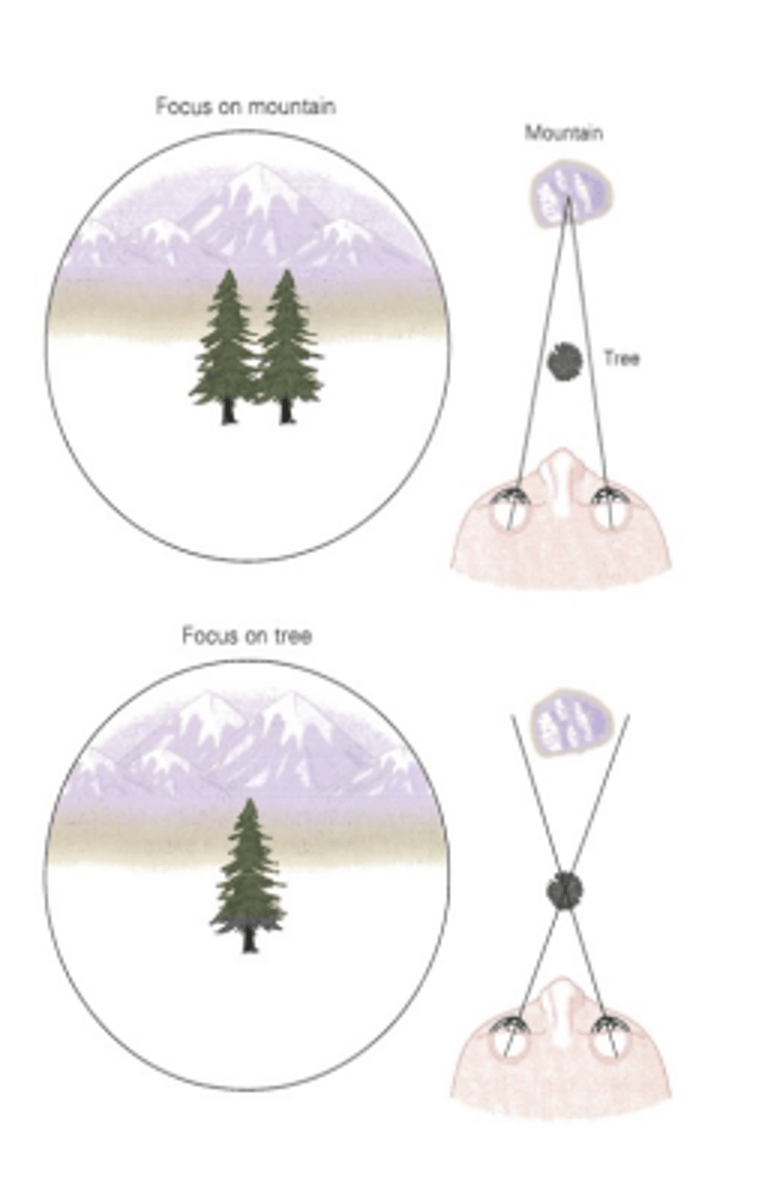
looking at objects in depth so that retinal images are overlapping (stereo/double vison); deliberate
Smooth Pursuit Task
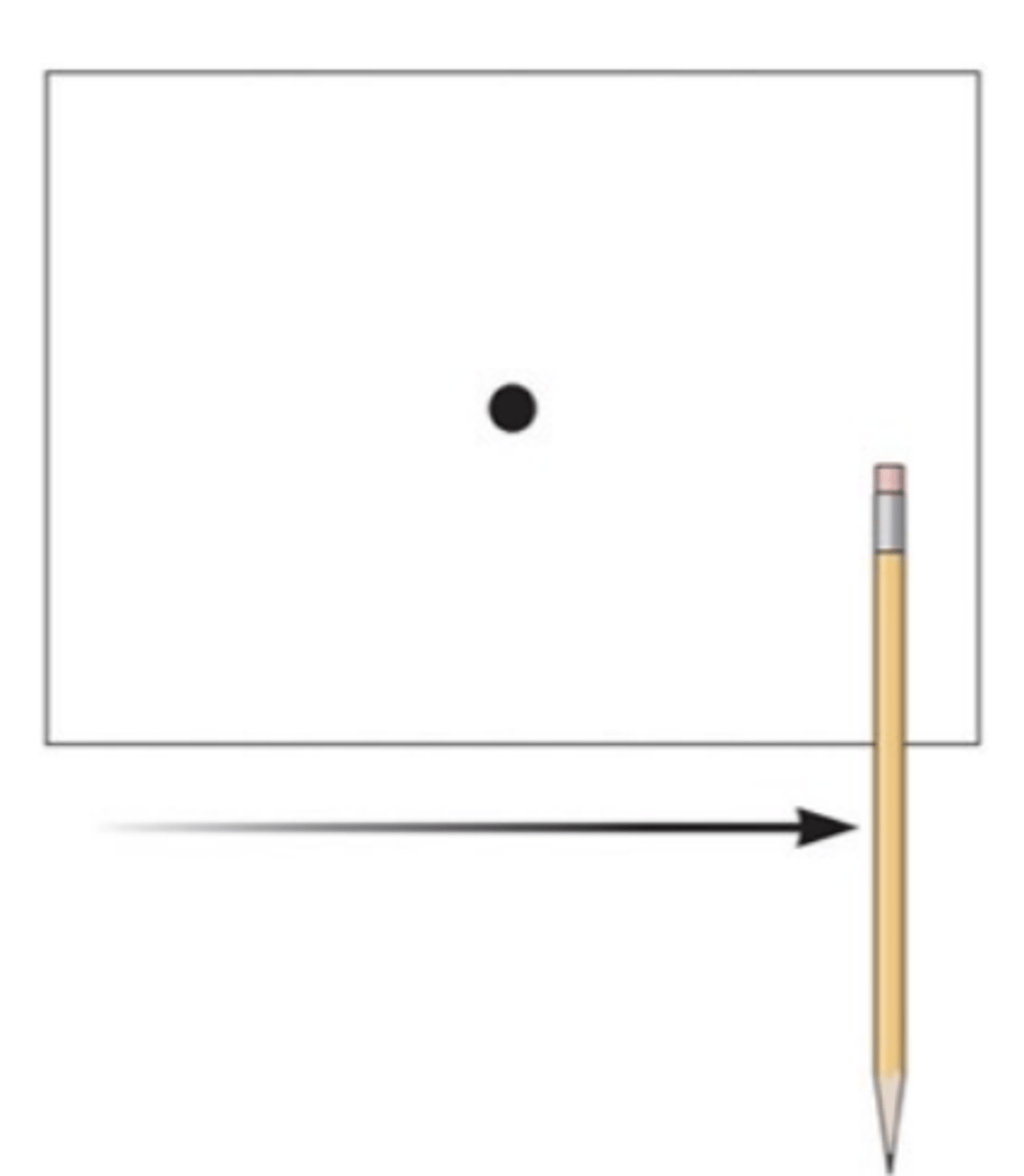
focus on pencil as it moves -> dot seems to move while pencil seems stable. Happens because dot changes position in retina and pencil stays projected on fovea.
What does the smooth pursuit task suggest?
Retinal image along doesn't tell us what(motion) is happening.
Spatial Constancy
Ability to perceive the world a stable and continuous despite eye movements.
Function of Spatial Constancy
Enables us to discriminate motion across the retina due to eye movement vs. object movement.; tell where things are.
Compensation Theory
Perceptual system receives info abt eye movement and discounts changes in retinal image resulting from it. Explanation for spatial constancy.
How does the Compensation Theory explain Spatial Constancy?
1. motor system sends motor command to eye
2. copy (efference copy / corollary discharge) sent to comparator
3. Comparator compensates for image changes caused by eye movement, inhibiting any attempts by other parts of the VS to interpret changes as object motion.
How does the comparator make it's decision?
if corollary discharge signal resulting from eye movement is the reason for image movement signal, then comparator declares no motion has occurred.
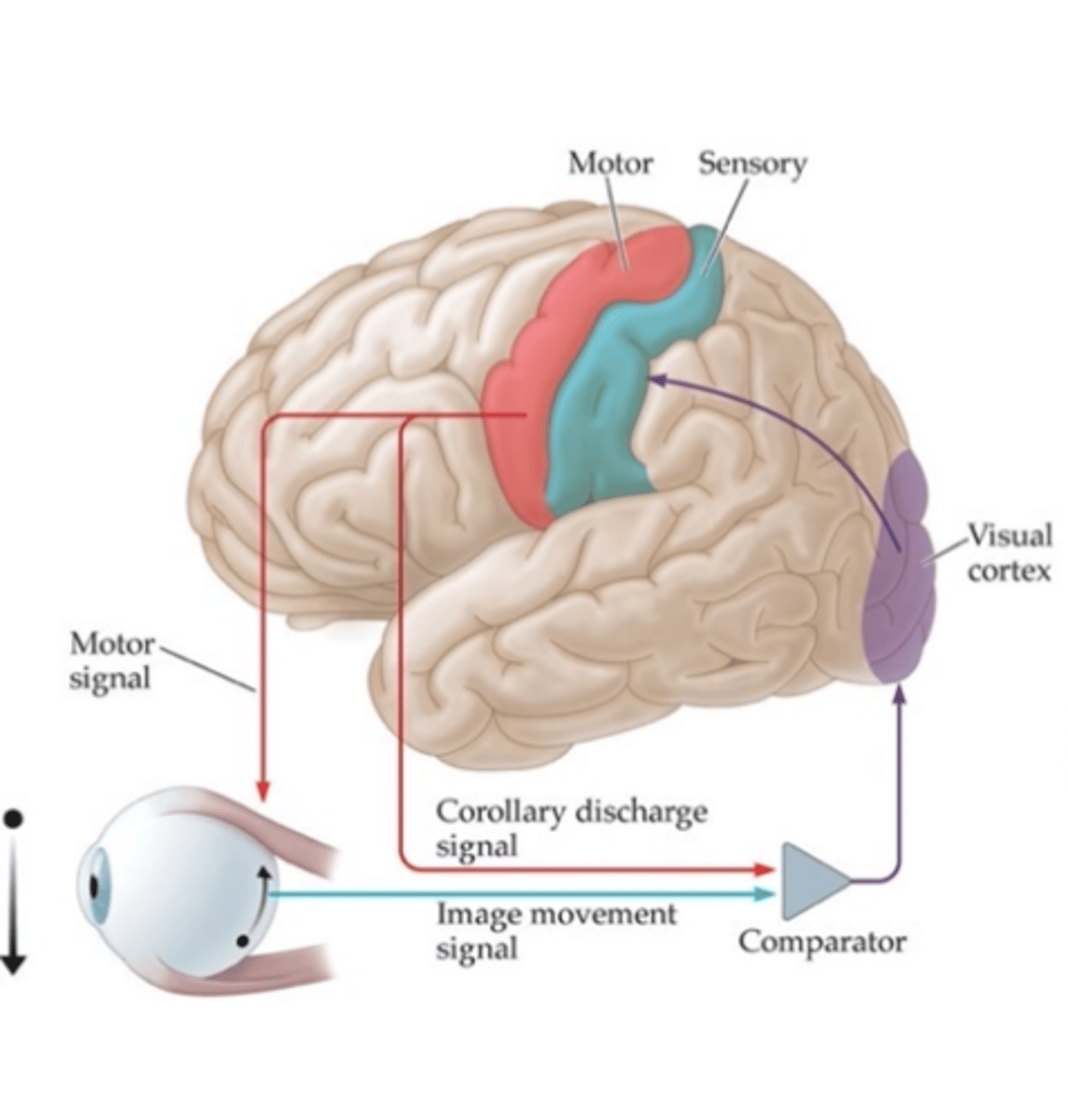
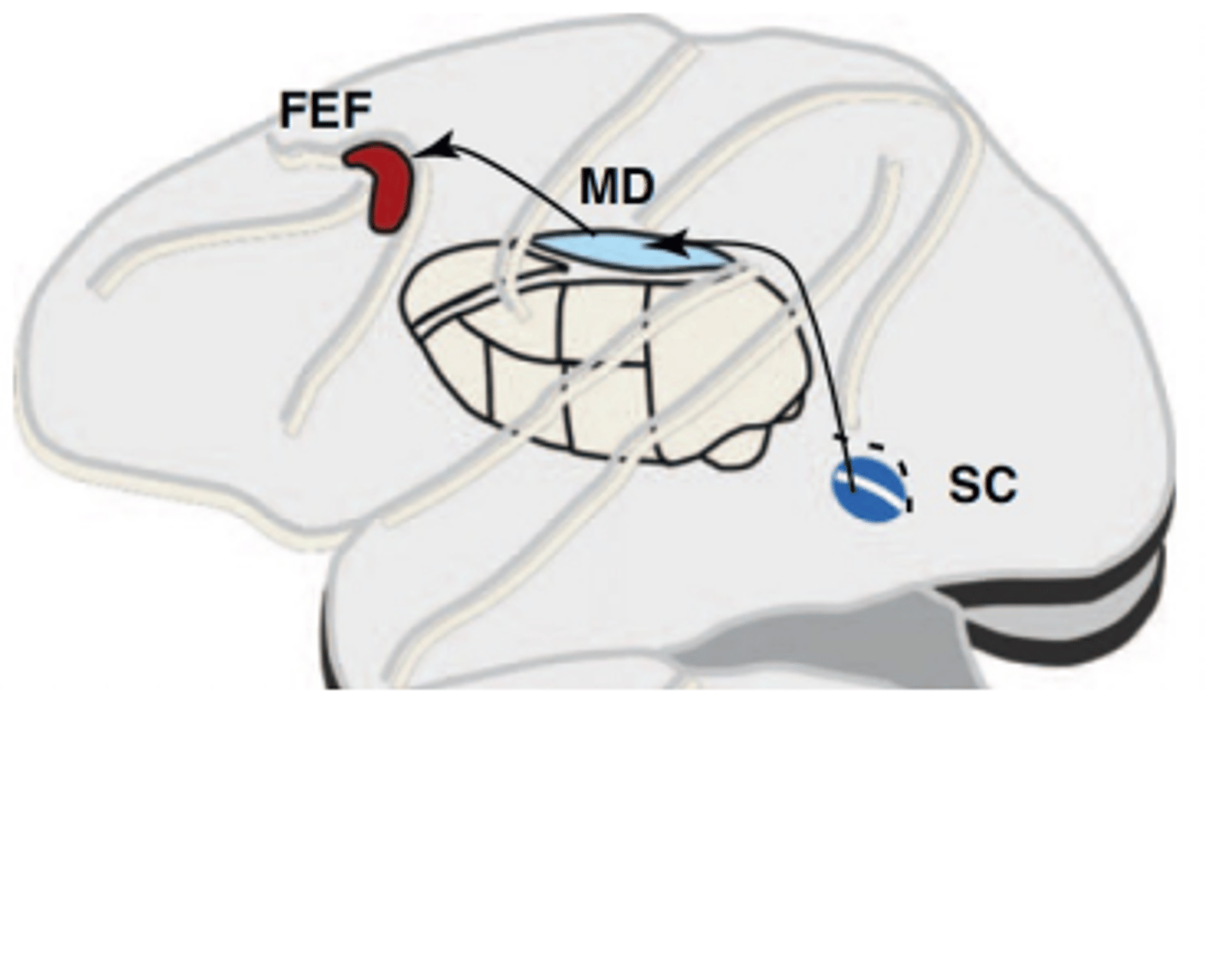
What is the pathway taken by the corollary discharge for eye movements?
1. Superior Colliculus
2. Medial Dorsal Nucleus
3. Frontal Eye Field
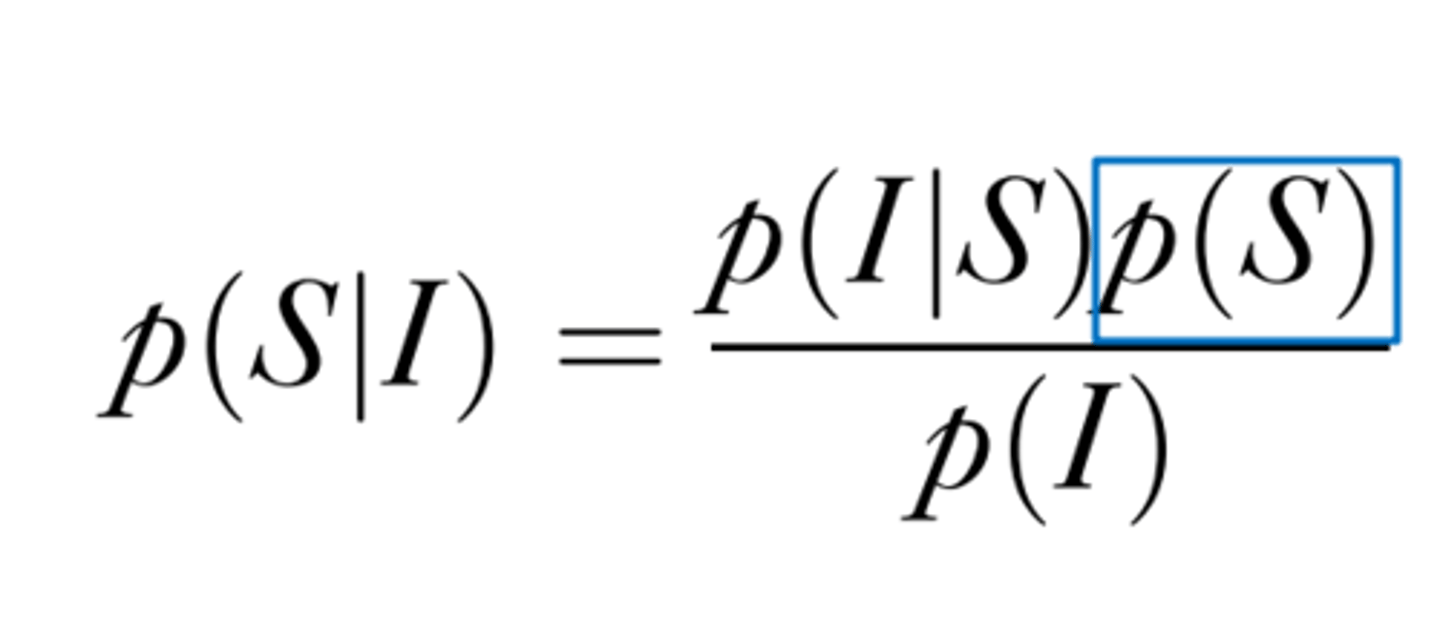
Bayesian Inference
Compensation not precise enough:
- brain achieves spatial consistency b/c it assumes a priori that world is moving very little
- Small movements coinciding with saccades are ignored.
Saccadic Suppression
Reduction of visual sensitive that occurs when one makes a saccadic eye movement; eliminates smear during an eye movement.
Grey out
Caused by saccadic suppression; everything is frozen (happens every 3/4 sec). Saccades start -> shuts down motion actively.
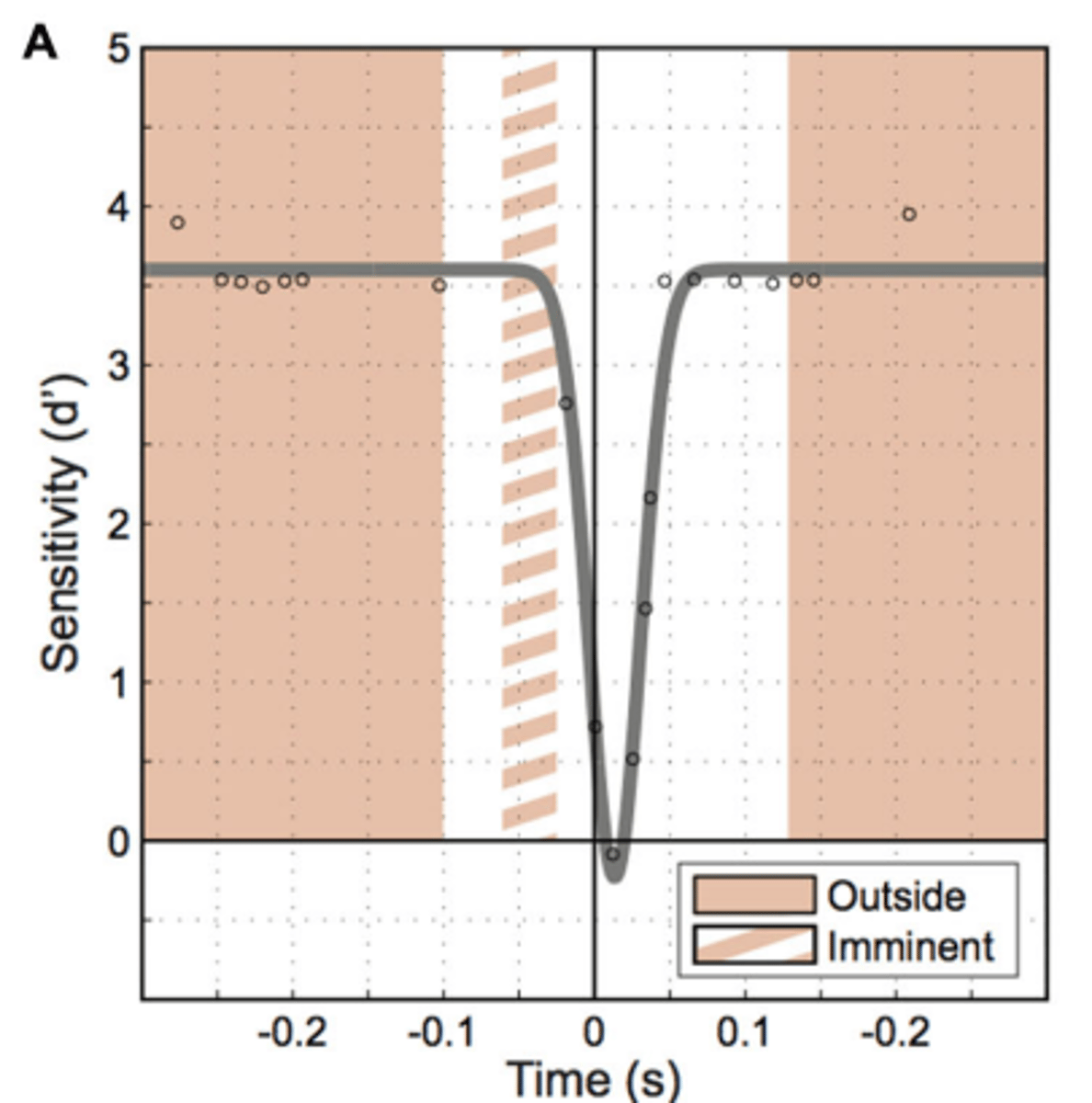
Function of grey out
Time perception distorts around time of saccades -> stretch in fabric of time is compensated via grey out.
Which sense is governed by Euclidian geometry?
Touch
Euclidian Geometry
Parallel lines remain parallel as they are extended in space; objects maintain the same size and shape as they move around in space.
Problem for vision:
Recover 3D info form 2D projection
Most ________ cues can be derived from ________________ consequences of the _________________.
depth; geometrical; projection
Parallax
the apparent change in position of an object when seen from different places
Consequence of parallax for vision
Two retinal images of 3D world are not the same b/c 2 retinal vision are not the same causing binocular disparity.
Binocular Disparity
The differences between 2 retinal images of the same scene
Stereopsis
Vivid perception of the three dimensionality of the world that is not available with monocular vision. (popping out in depth)
Our retinas are ________ projection surfaces
2D
The brain creates a ___________ image from the projections
3D
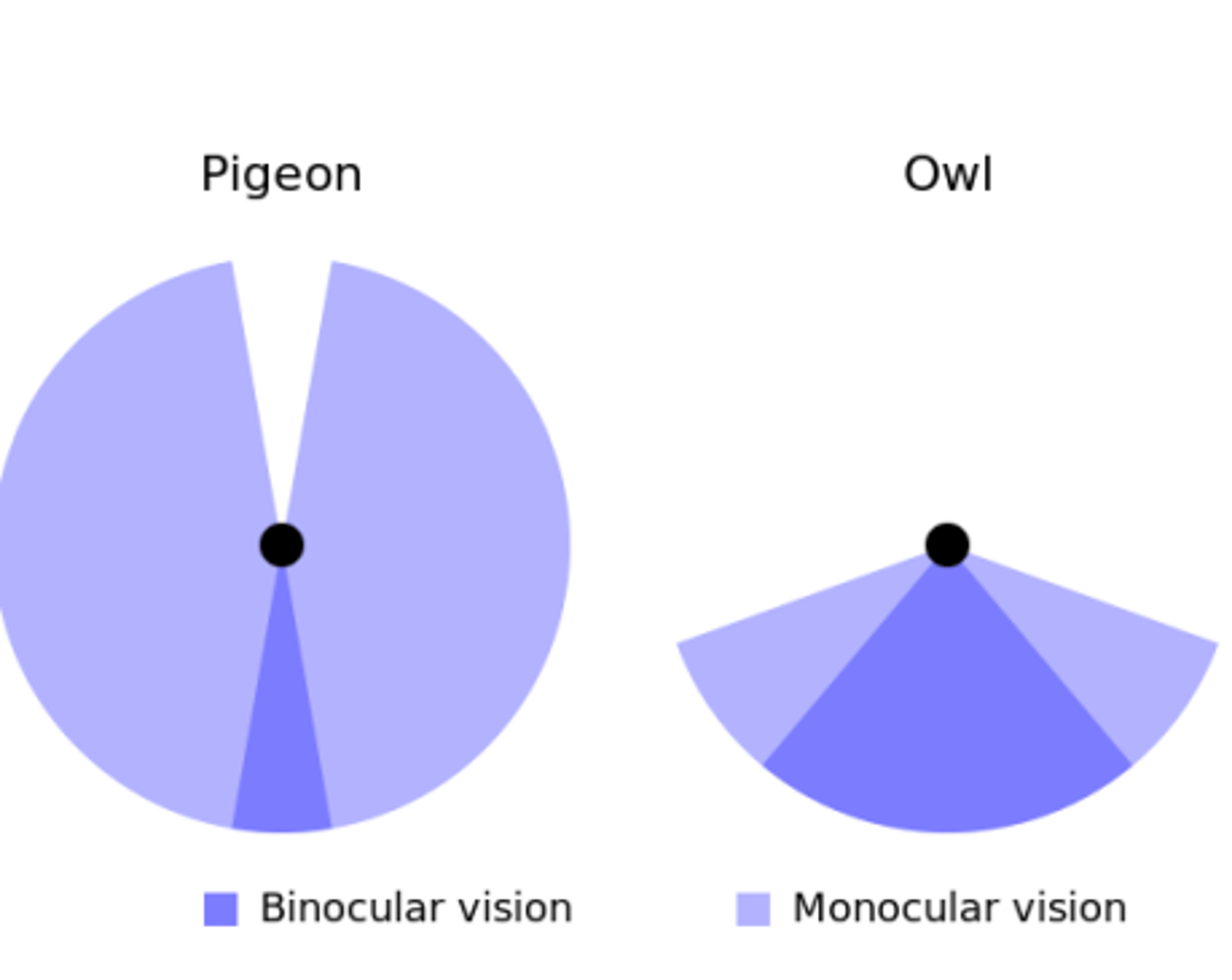
Binocular depth cues from overlapping visual fields provide:
- Convergence
- Stereopsis
- Ability of 2 eyes to see more of an object than one eye
Monocular Cues to 3D space
1. Occlusion
2. Relative size
3. Position cues
4. Familiar size
5. Aerial perspective
6. Linear perspective
7. Motion cues
Occlusion
A cur to relative depth order when one object obstructs view of another.
Nonmetrical Depth Cue
Provides information about depth order but not magnitude
Metrical Depth Cue
Provides quantitative information about distance
Relative Size
A comparison of size b/w items w/o knowing the absolute size of either one. Relates to position.
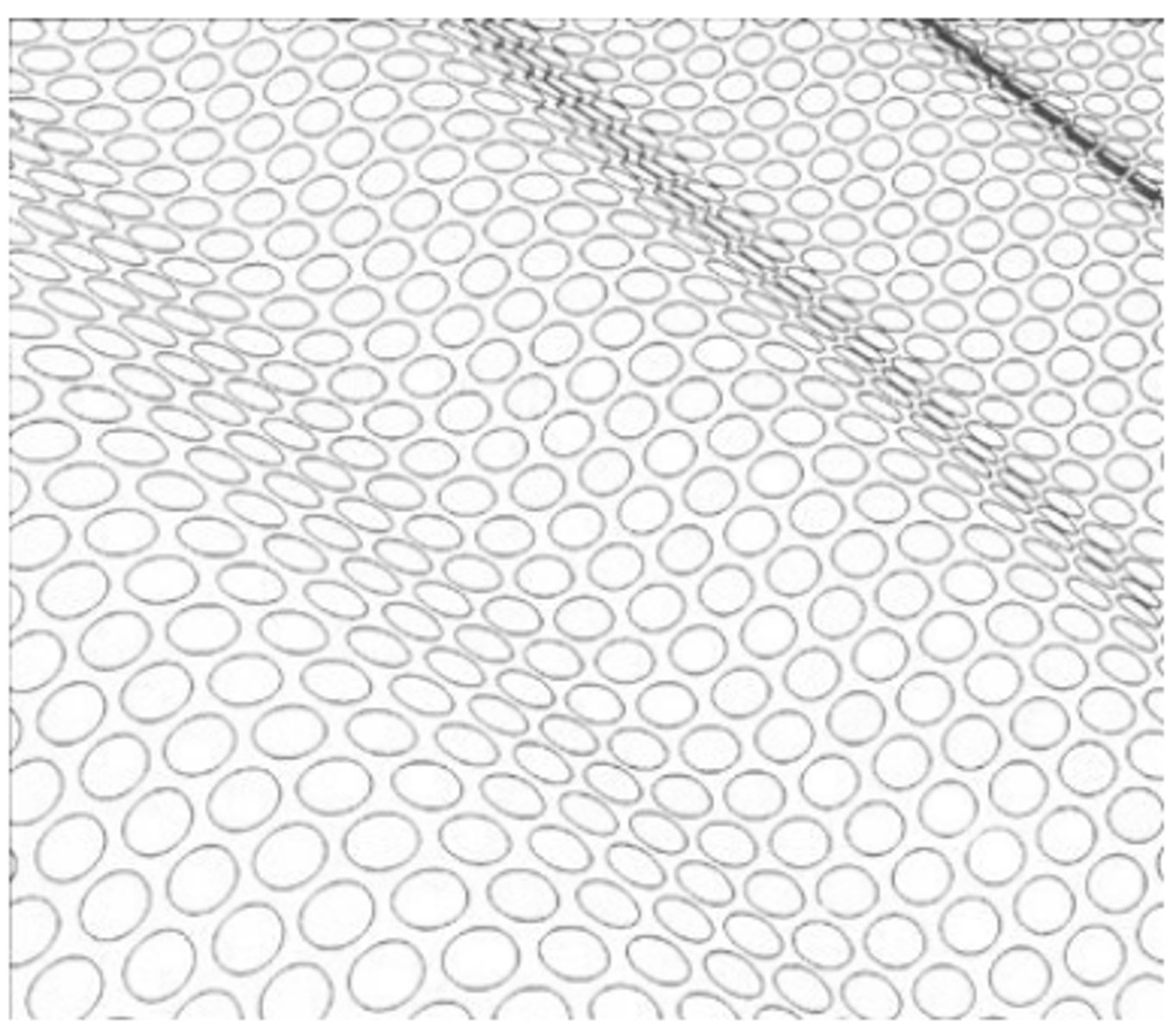
Texture Gradient
A depth cue based on the geometric fact that items of the same size from smaller images when they are farther away.
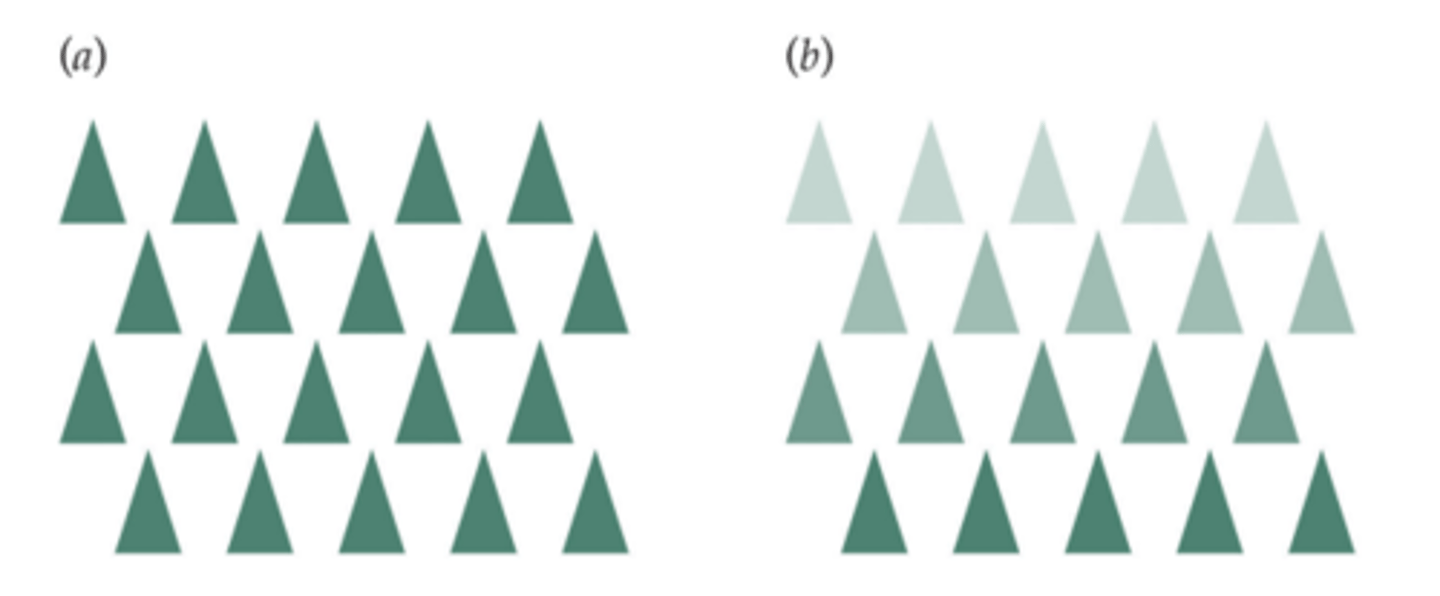
Relative Height
Object at diff distances from the ground the viewer on the ground plane will form images at diff heights in the retinal image (lower -> closer; further -> higher).
Familiar Size
Depth cue based on knowledge of the typical size of objects.
Aerial Perspective
A depth cue that is based on the implicit understanding that light is scattered by the atmosphere.
Linear Perspective
A depth cue based on the fact that lines that are parallel in the 3D world will appear to converge in a 2D image.
1415, Filippo Brunelleschi
Rediscovered the principles of linear perspective
Vanishing point
The apparent point at which parallel lines receding in depth converge.
3-point perspective
Discovered after the invention of photo cameras
Foreshortening
Refers to the visual effect that an object or distance appears shorter than it actually is b/c it is slanted toward (away from) the projection screen/retina/picture plane.
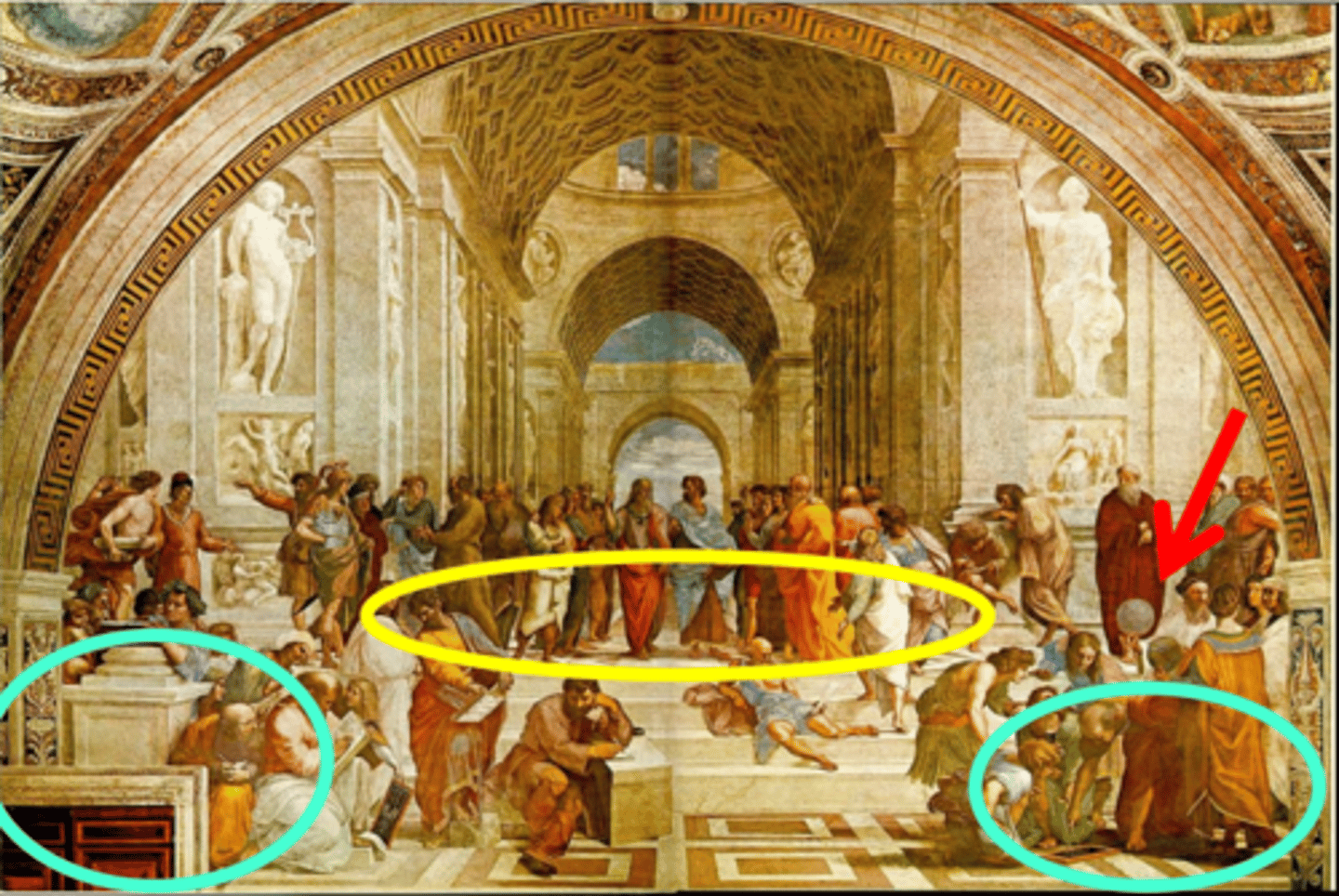
Raphael's Trick
School of Athens painting:
- hid tiles that looked weird from linear perspective by putting ppl or stuff Infront
- notice the sphere should be distorted from this perspective but it is completely spherical
Anamorphosis
Distorted projection or perspective requiring the viewer to use special devices or occupy a specific vantage point to reconstitute the image (example painting with skull, would probably be mounted on a stairway so that the skull would only be visible on an acute angel).
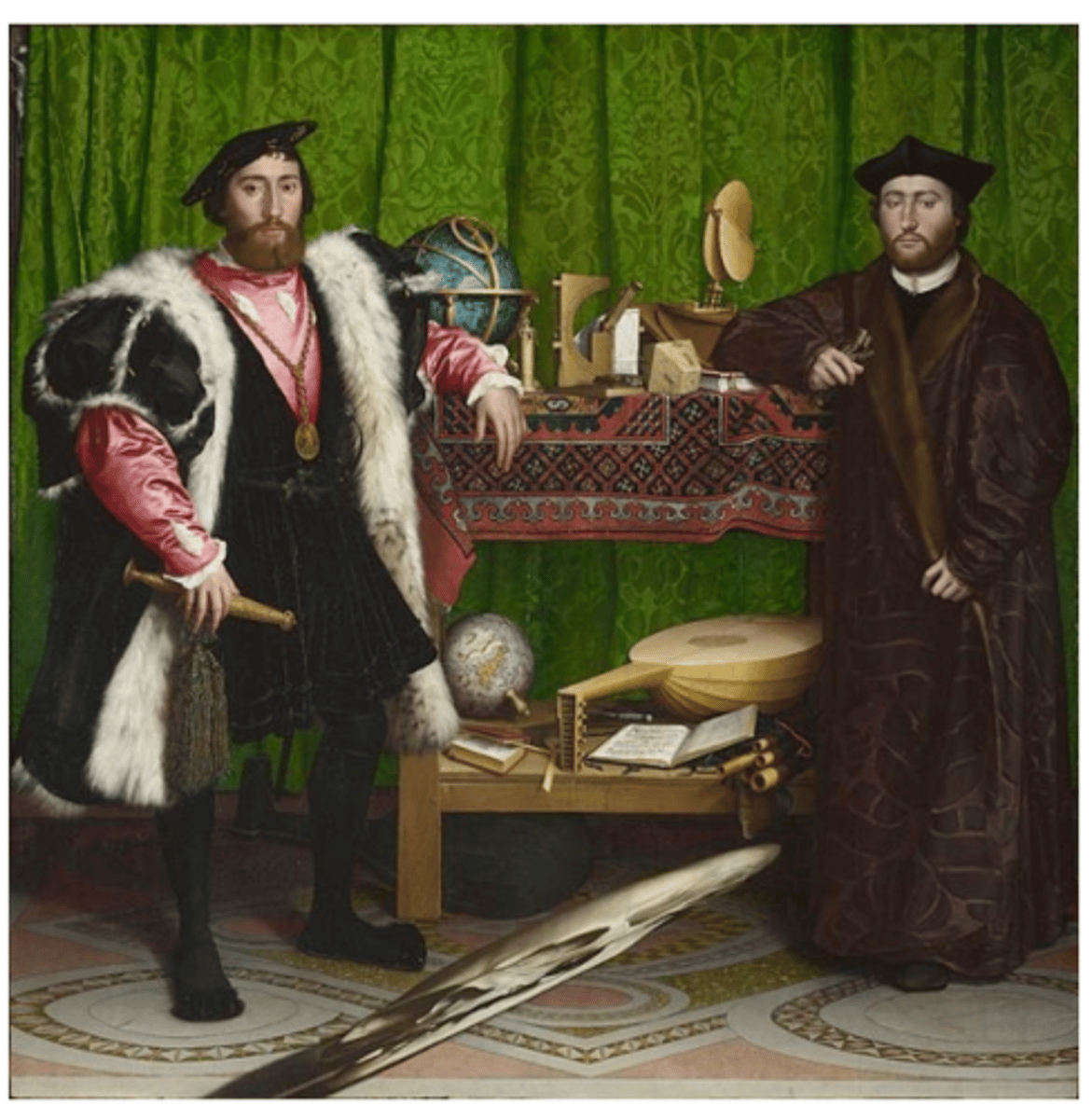
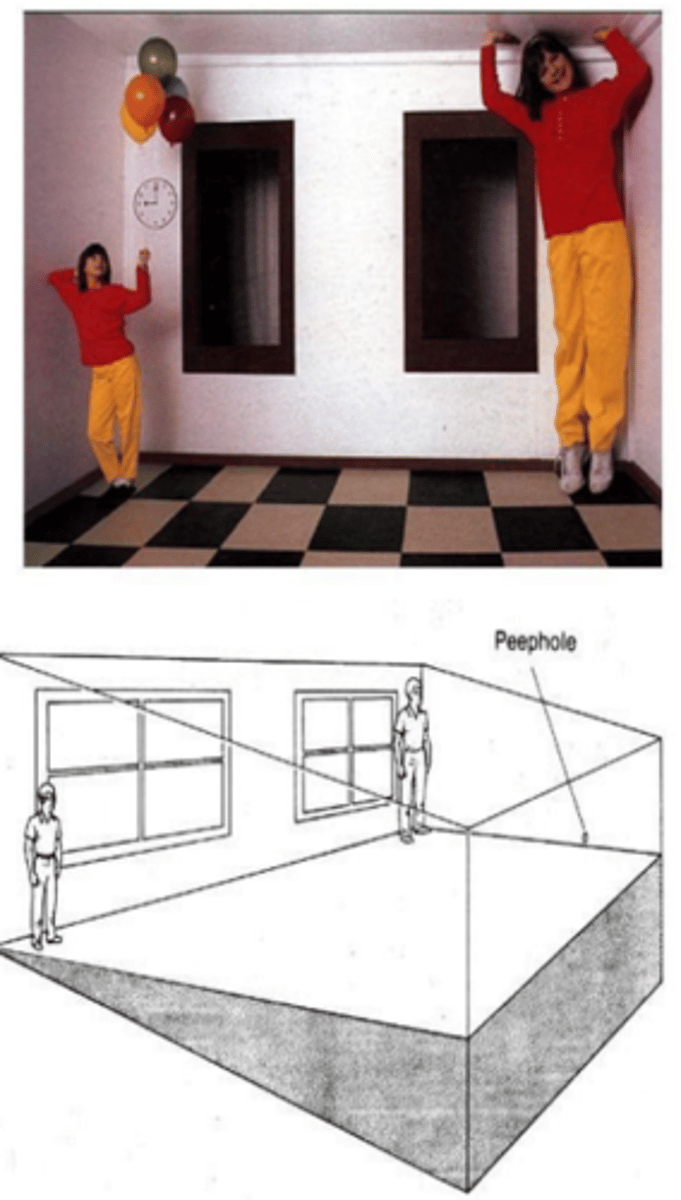
Examples when monocular cues fail:
Ames room:
- depth cues removed
- girl on the left is much further away but the perspective cues are manipulate
- Only works from a single vantage point and from one eye only! (done through a peep hole)
Motion parallax
Objects moving at constant speed across the retina will appear to move a greater amount/faster if they are closer to an observer (eg. the ground when you're in the car looks to be moving much faster than the surrounding scenery)
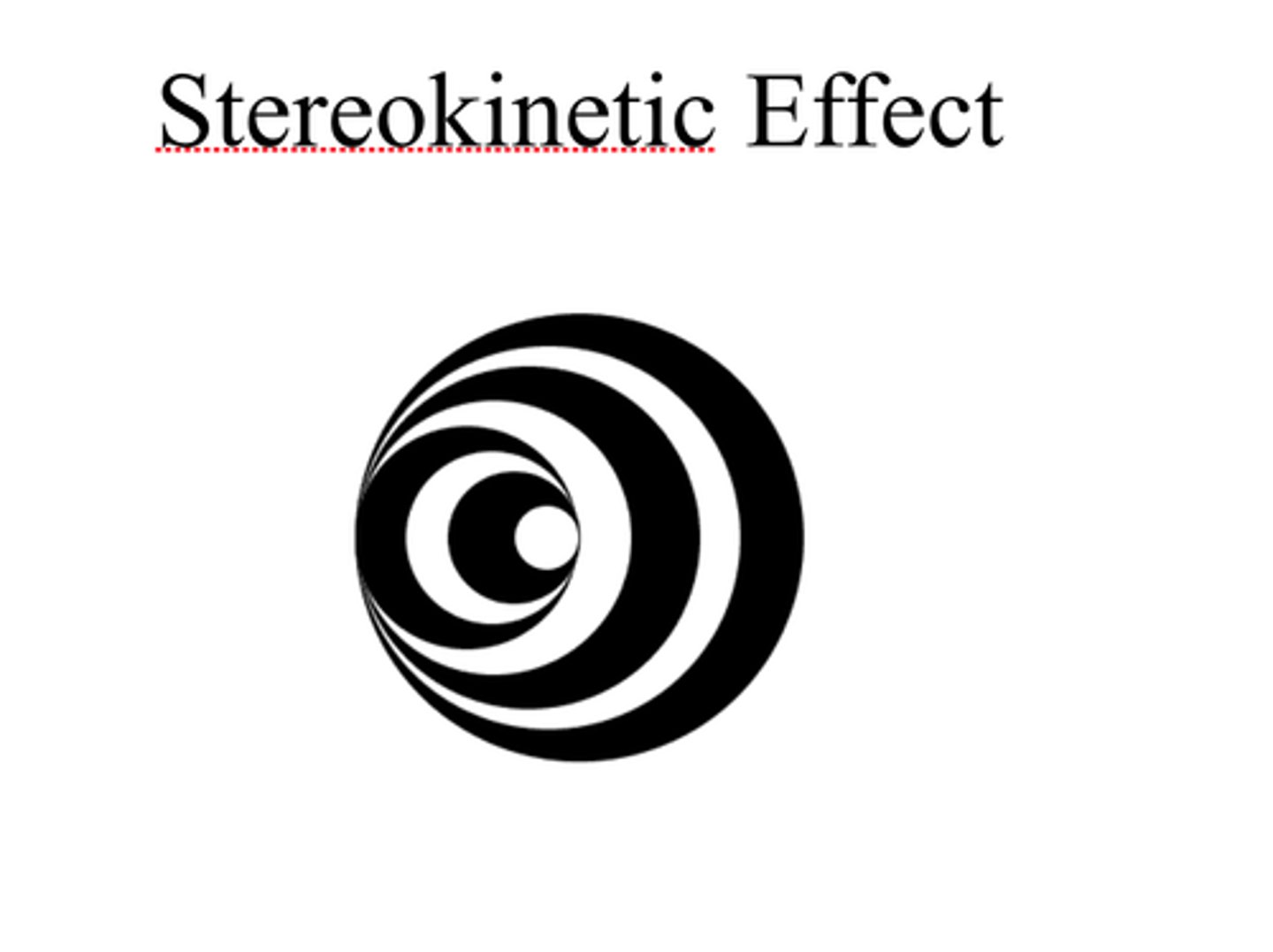
Stereokinetic effect
Rotation of adequate figures creates a three-dimensional illusion.
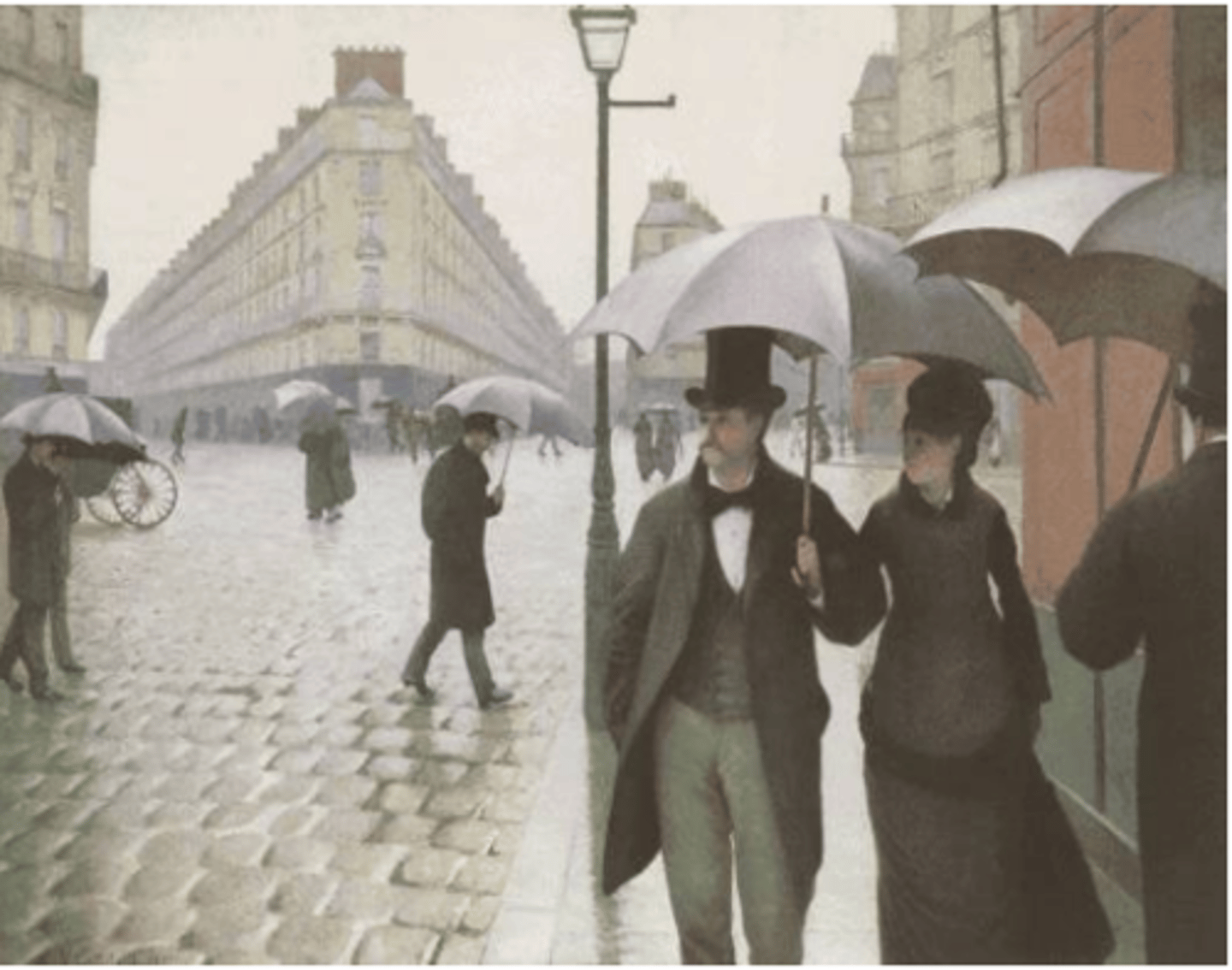
Most scenes have multiple cues:
1. Texture gradient
2. Relative height
3. Aerial perspective
4. Linear perspective
_______________________ and _______________________ help eyes perceive depth.
Accommodation; vergence
Accomodation
Eye changes its focus (monocular). Not visual info but info abt how our eye muscles contract.
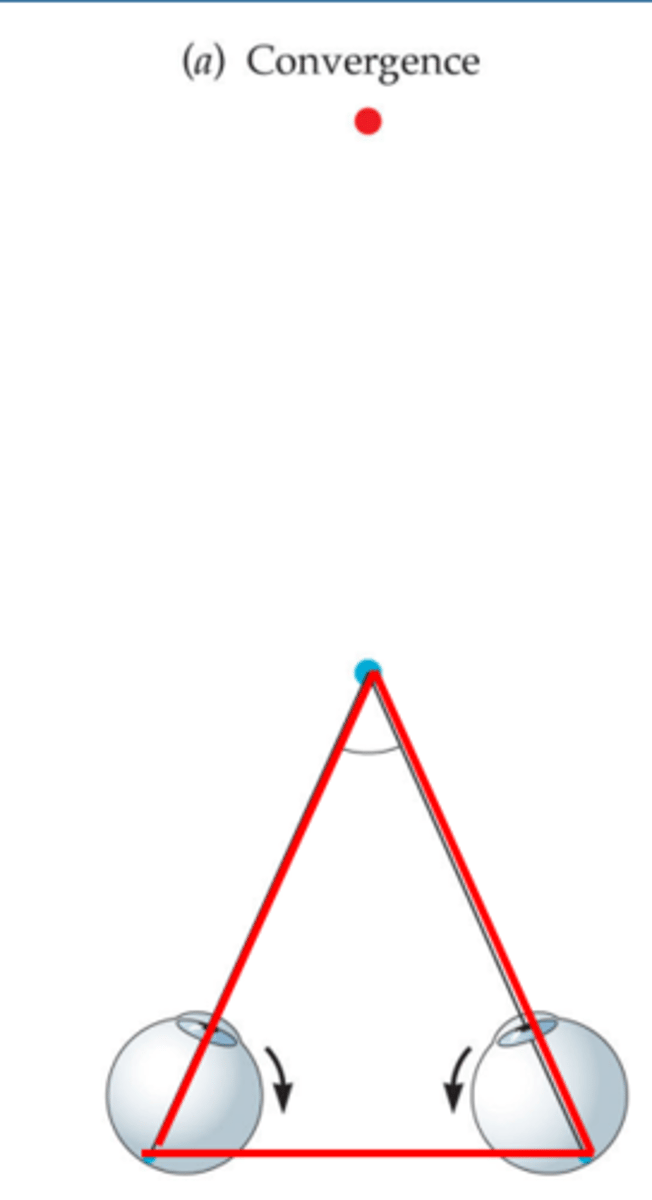
Convergence
Ability of the two eyes to turn inward; reduces the disparity of a feature to (near zero). (binocular but not stereo)
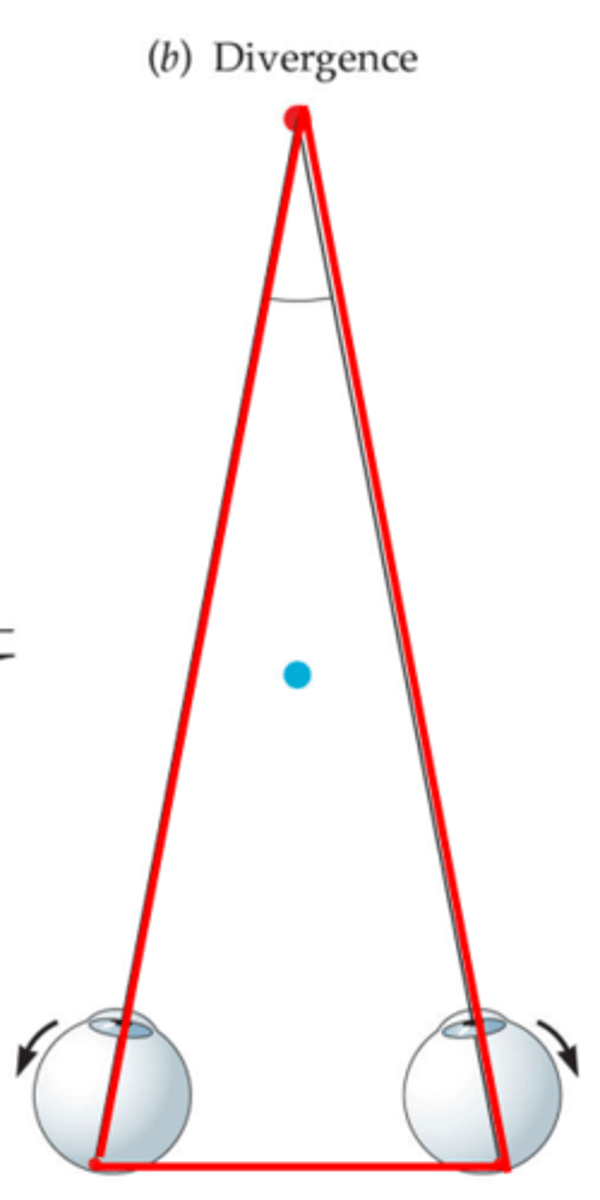
Divergence
Ability of the two eyes to turn outward; reduces the disparity to the feature to (near) zero. (binocular but not stereo)
Vergence
Angles of eye positions
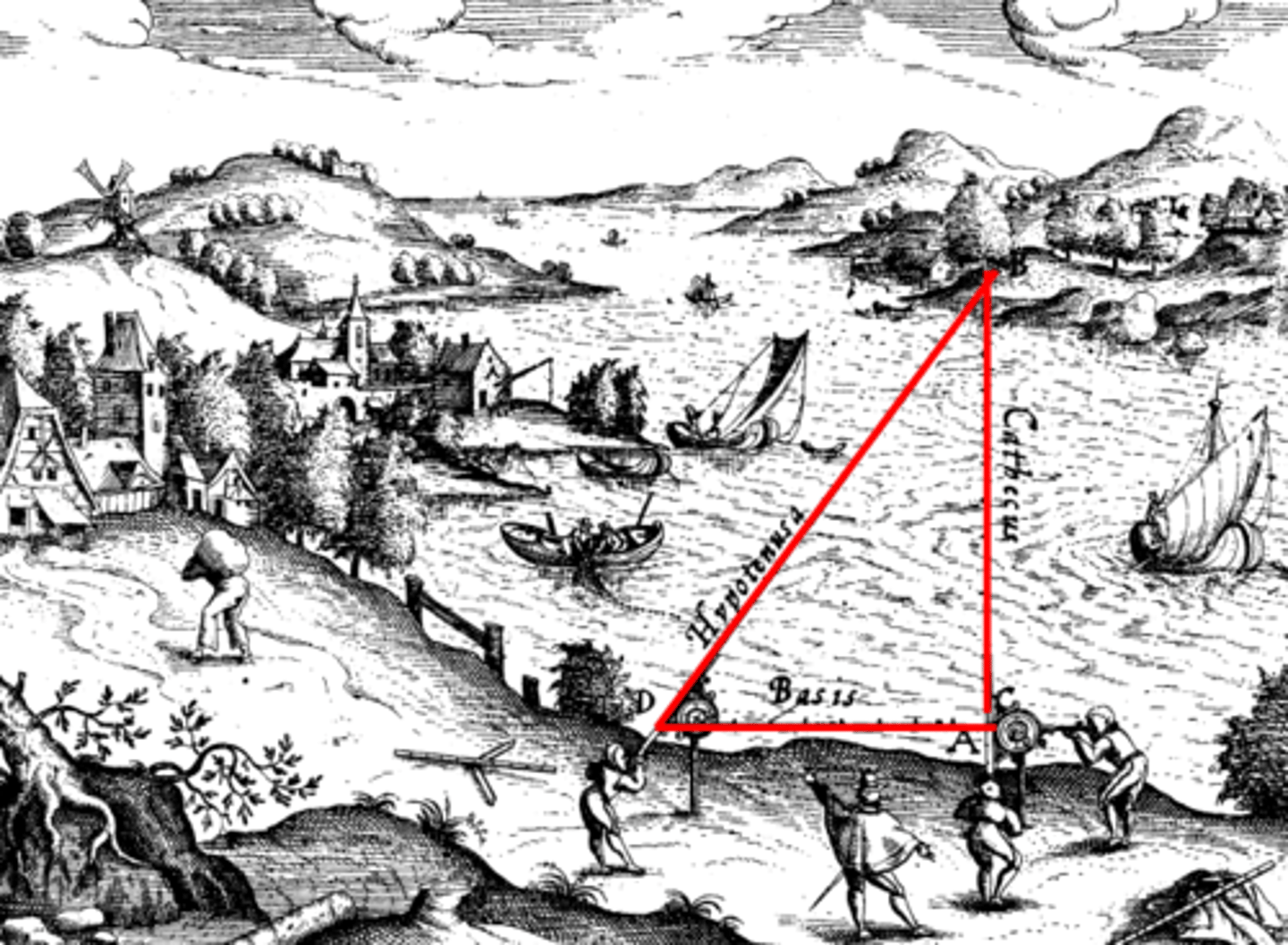
Triangulation
a mathematical method of estimating positions of objects at a location such as a crime scene, given locations of stationary objects.
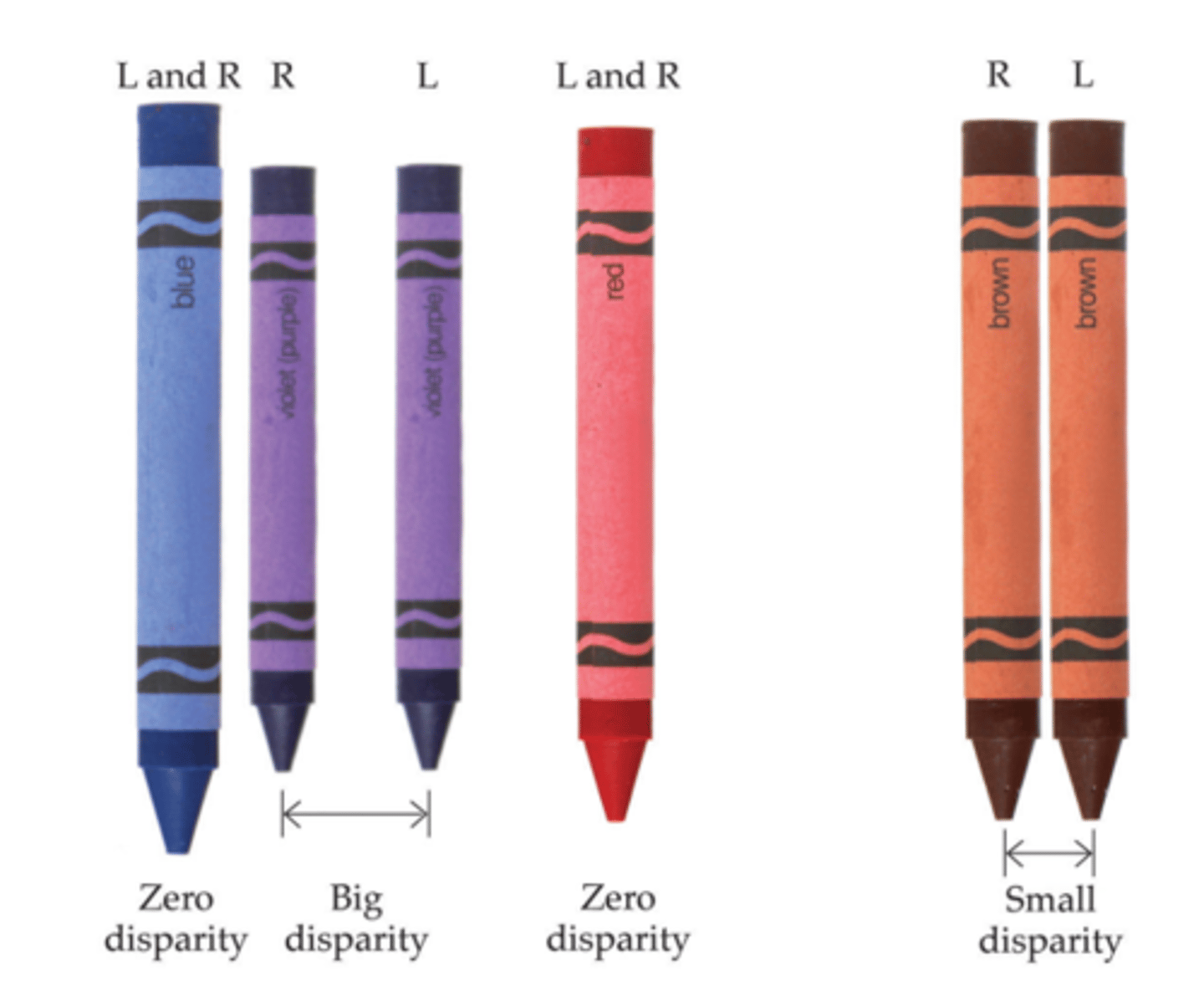
Crayon Task
- Crayons are arranged in particular order
- participant fixates on red crayon (zero binocular disparity)
- same happens to be true for the blue crayon
- but the distance of the purple and brown crayon in relation to the blue and red crayon changes
Horopter
Location of objects in space whose images lie on corresponding point; surface of zero disparity.
Diplopia
Double vision for points outside the horopter (Panum's fusion area).
Panum's fusion area
Region of space in front and behind the horopter within which binocular single vision is possible.
What does disparity tell us?
Provides info abt distance of object from horopter
Crossed Disparity
Points that are closer to us than the horopter
Uncrossed Disparity
Points that are farther from us than the horopter
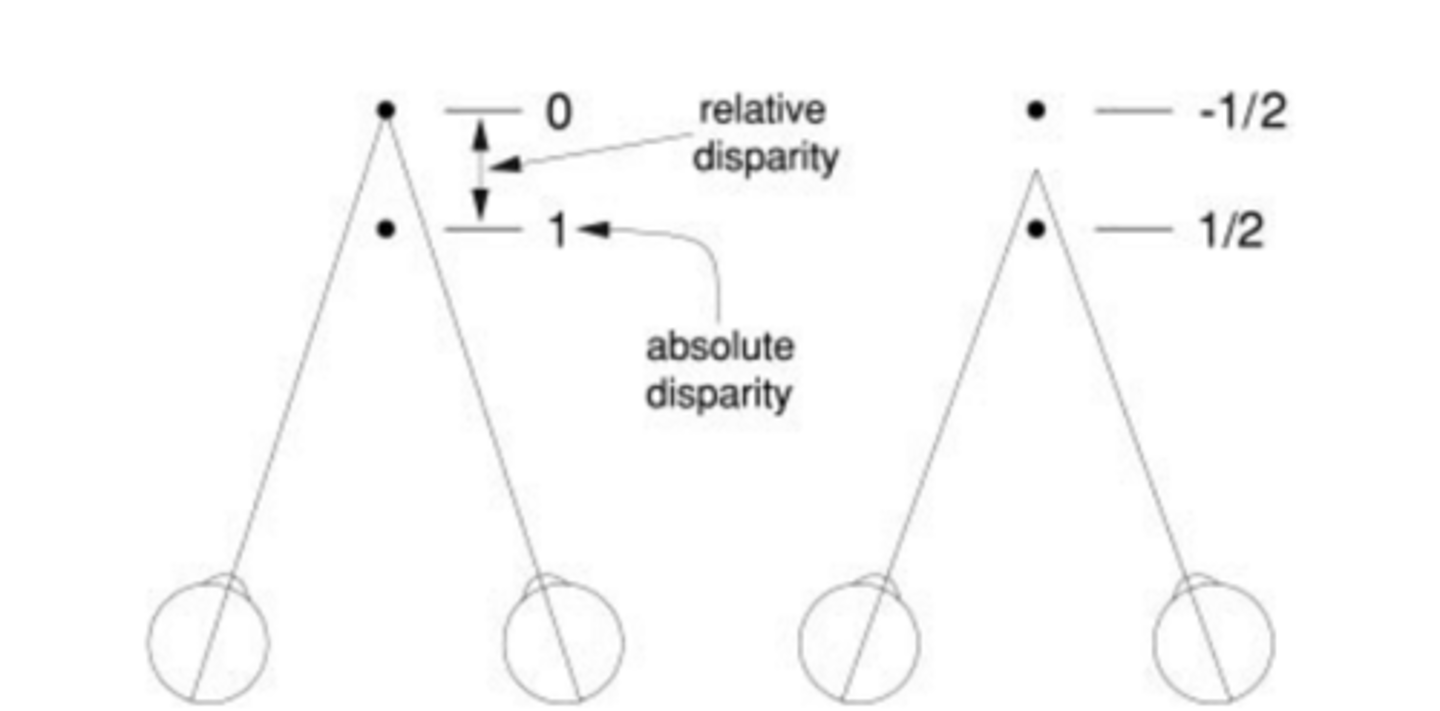
Absolute Disparity
A diff in the actual retinal coords in the left & right eyes of the image of a feature in the visual scene.
Relative Disparity
The diff in absolute disparities of two elements in the visual scene
Free Fusion
The technique of converging (crossing or diverging the eyes in order to view a stereogram without a stereoscope).
Stereo-blindness
An inability to make use of binocular disparity as a depth cue. Can result form a childhood visual disorder, such a strabismus.
Julesz
Random dot stereograms that can only be seen with binocular cues; they contain no monocular depth cues.
What do Julesz give evidence for?
Evidence that disparity I sufficient for stereopsis. No need for cues from object perception.
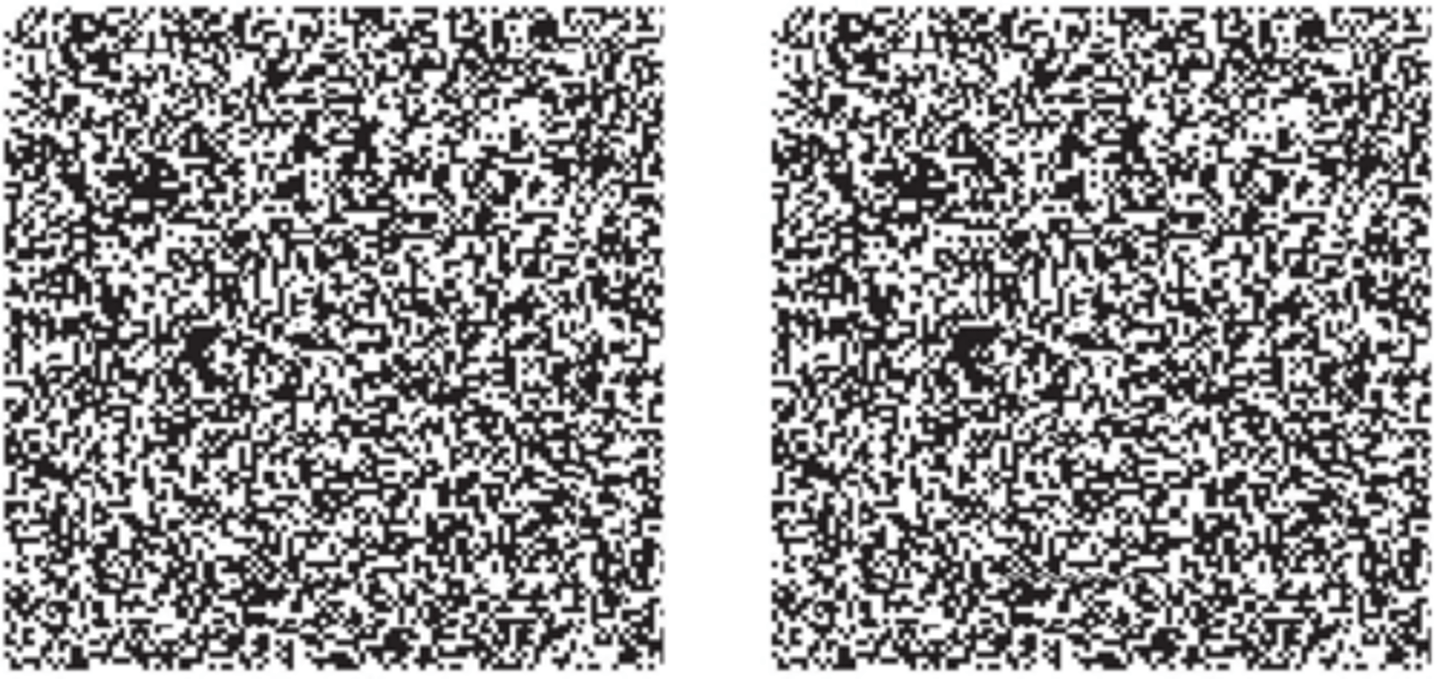
Correspondence problem
Figuring out which bit of the image in the left eye should be matched with which bit in the right eye.
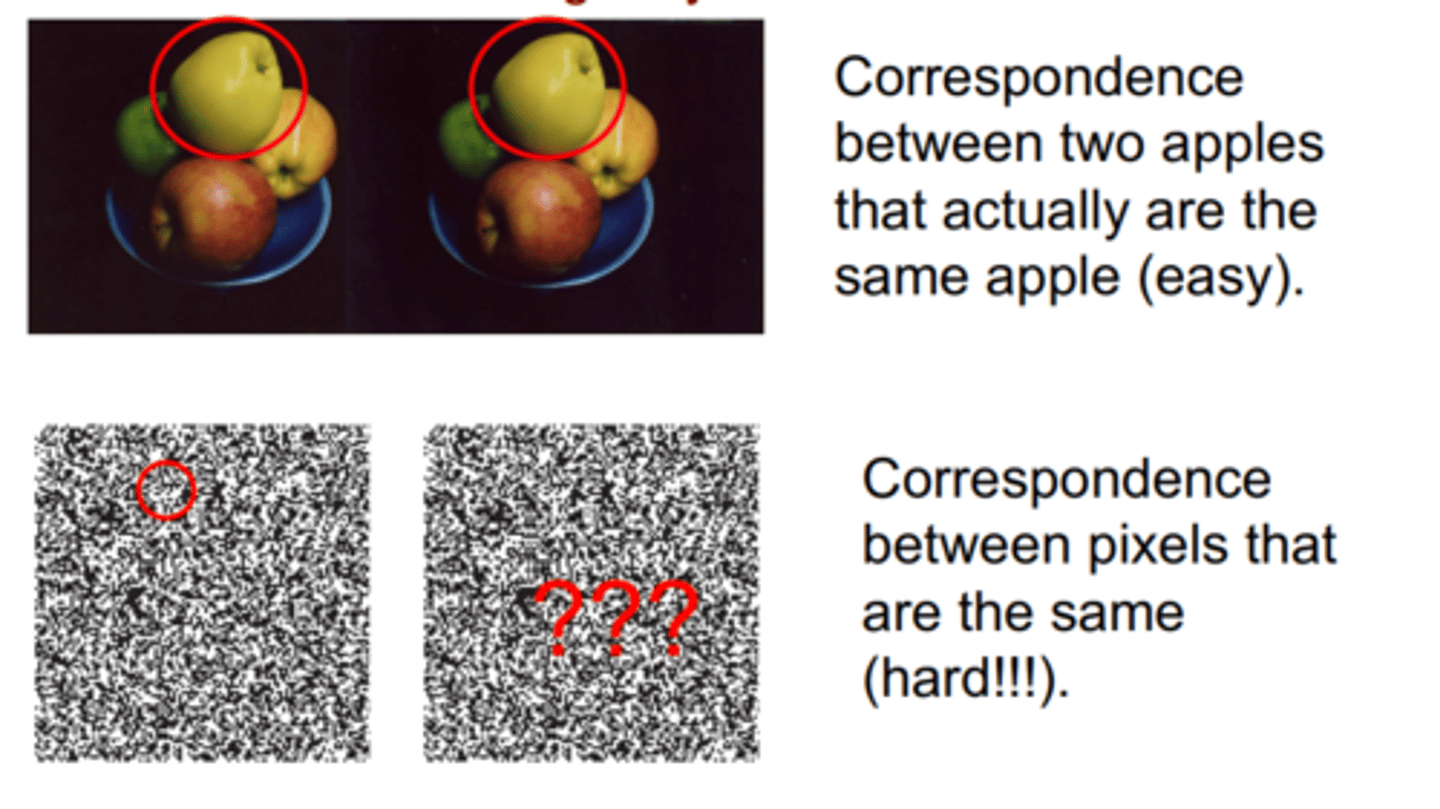
Solutions to Correspondence Problem
1. Blurring the image
2. Uniqueness Constraint
3. Continuity Constraint
Blurring the Image
Focusing on low-spatial frequency information
Uniqueness Constraint
A feature in the world will be represented exactly once in each retinal image (1 feature in one eye paired 1 feature in the other eye)
Continuity Constraint
Except at the edges of objects, neighboring points in the world lie at similar distances from the viewer.
How is stereopsis implemented in human brain?
1. Input from 2 eyes converge into same cell (V1 or later)
- there are also cells that have diff RF, disparity isn't exactly zero
2. Neurons have RFs for both eyes
3. Binocular neurons respond best when retinal images are on corresponding points in the 2 retinas (rmbr horopter)
4. Binocular neurons respond best when similar images occupy slightly diff positions on the retinas of 2 eyes (tuned to particular binocular disparity)
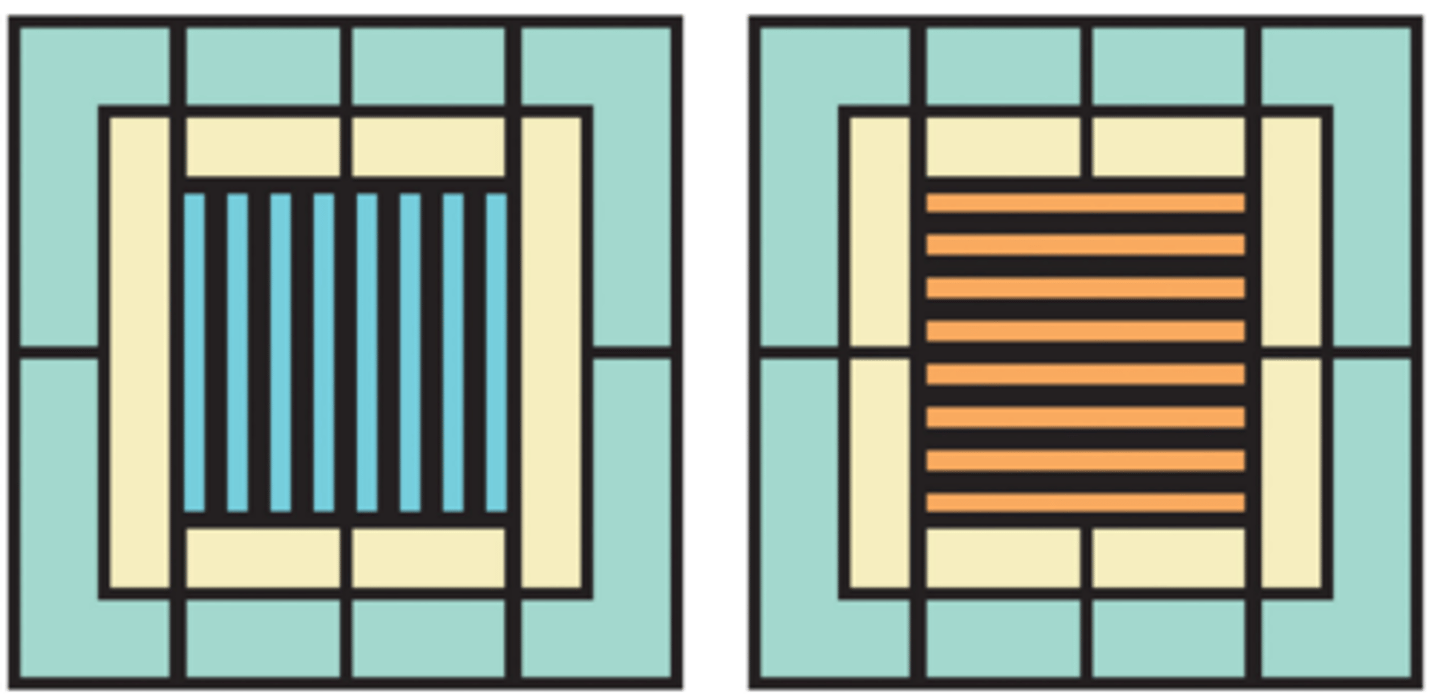
Binocular Rivarly
Competition b/w two eyes for control of visual perception, evident when completely diff stimuli are presented to the two eyes.
Bayesian Approach
Statistical model based on Reverend Thomas Bayes' insight that prior knowledge could influence your estimates of the probability of a current event.
Optimal Inference from cues
Perception should choose the solution depending on which one is most likely.
Very often ________________ comes close to what is ____________________ possible
perception; optimally
How does the visual system decide what you are actually seeing?
- Which interpretation is most likely? ( Bayesian approach)
- Familiar size cue + familiar shape cue: prior knowledge (works even in cases when there is absolutely no depth perception at all)
Specific Distance Tendency
When a simple object is presented in an otherwise dark environment, observer usually judge it to be at a distance of 2-4 m (possibly b/c of natural scene statistics).
Equidistance tendency
Under the same conditions, an object is usually judged to be abt the same distance from the observer as neighboring objects (eg a starry sky).
What happens when our guesses are wrong?
Illusions (eg Ponzo illusions)