Exam 3 Neu 534
 Call Kai
 Learn
Learn Practice Test
 Spaced Repetition
 Match
Match Flashcards
 Knowt Play
1/41

There's no tags or description
Looks like no tags are added yet.
Name | Mastery | Learn | Test | Matching | Spaced | Call with Kai | Chat |
|---|
No analytics yet
Send a link to your students to track their progress
42 Terms
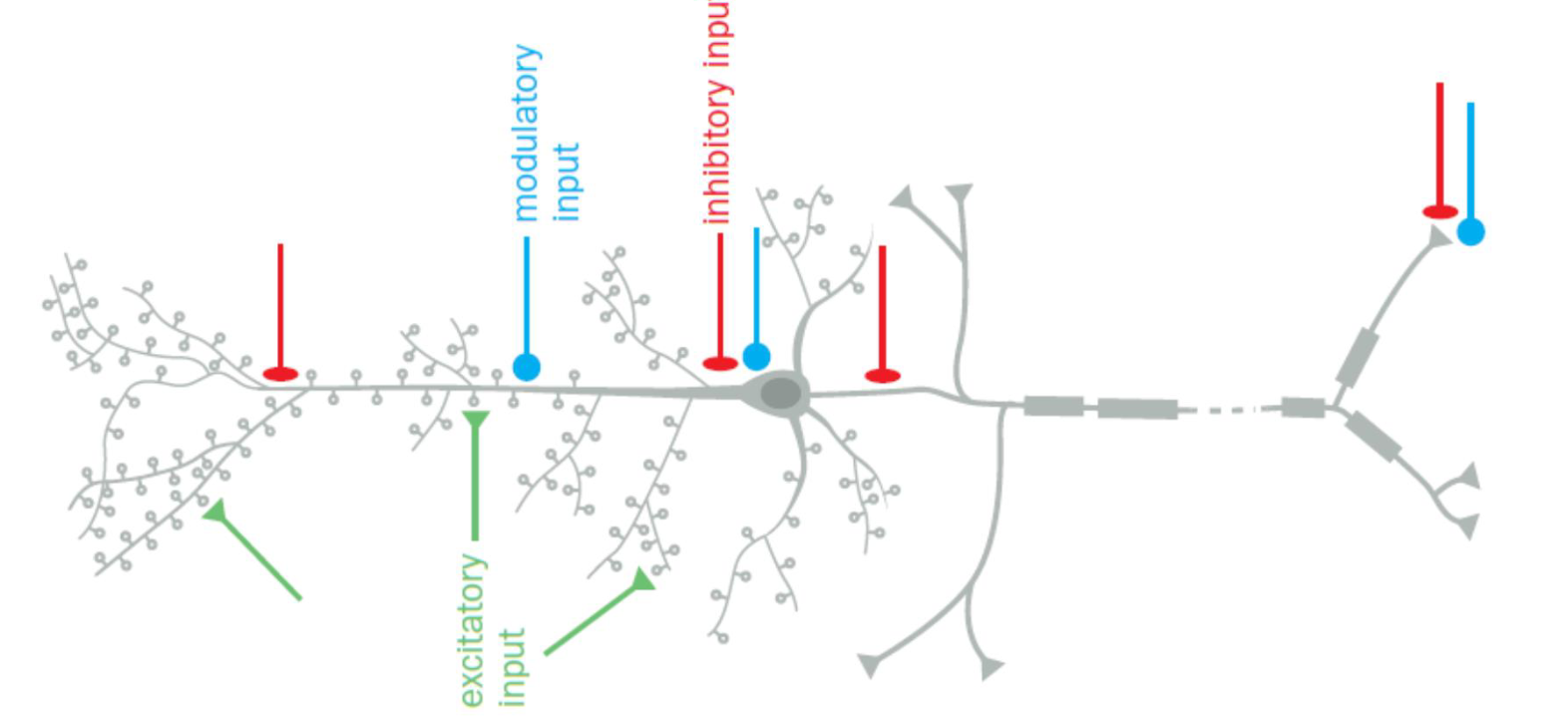
Locations of synapses
axosomatic
axodendritic
axo-axonic
Two types of axodendritic synapses
spine synapse
shaft synapse
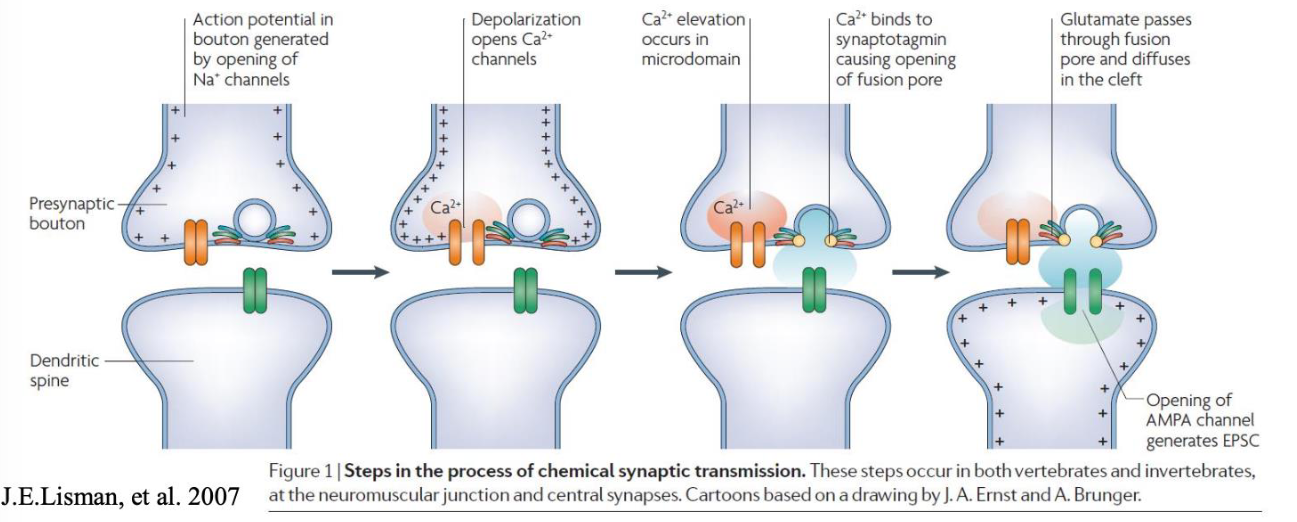
Basic scheme of synaptic transmission
Acetylcholinesterase (AChE)
breaks down acetylcholine in synapse
Choline acetyltransferace (ChaT)
Converts choline and acetyl COA into acetylcholine
Nicotinic receptor
Ach
ionotropic
always excitatory
Muscarinic receptor
Ach
metabotropic
can be excitatory or inhibitory
Acetylcholine neurons in the brain
Basal forebrain cholinergic system
Brain stem cholinergic system
Vesicular glutamate transporter
Presence identifies neurons that use glutamate as a neurotransmitter
This is important bc glutamate is an amino acid that is found in all cells
Where are glutamatergic and GABAergic neurons found in the brain?
Everywhere, they are ubiquitous
Glutamatergic receptors as a whole
Can be ionotropic or metabotropic
Mostly excitatory, but some metabotropic are inhibitory
AMPA receptor
Ionotropic glutamate receptor
Permeable to sodium and potassium ions but not calcium ions
Fast but transient activation
NMDA receptor
Ionotropic glutamate receptor
Permeable to sodium, potassium AND calcium ions
Activate more slowly and persistently than AMPA receptors
Require BOTH glutamate and depolarization to fire - blocked by Mg ion before depolarization
Kainate receptor
Ionotropic glutamate receptor
Permeable to sodium and potassium ions but not calcium ions
Metabotropic glutamate receptors
Group 1 - excitatory, Gq protein
Groups 2 and 3 - inhibitory, Gi/Go protein
Glycine
Amino acid
Ionotropic, permeable to chloride ion
One of the major inhibitory neurotransmitters in ADULT vertebrate
Synapses are abundant in the spine and brain stem, but also found in cortex, thalamus, and hippocampus
Glycine transporters
GlyT1 - highly expressed in areas correlated with glutamatergic terminals (like neocortex, hippocampus)
GlyT2 - higher expression in spinal cord, brain stem, cerebellum
GABA
inhibitory, but you already know that
“gamma-aminobutyric acid”
derived from glutamate
GABA-gated chloride channel
If allowed to travel freely, chloride (Cl-) will enter the cell until the membrane potential is -80 mV
GABA-gated chloride channel allows this to occur when GABA binds, hyperpolarizing the cell
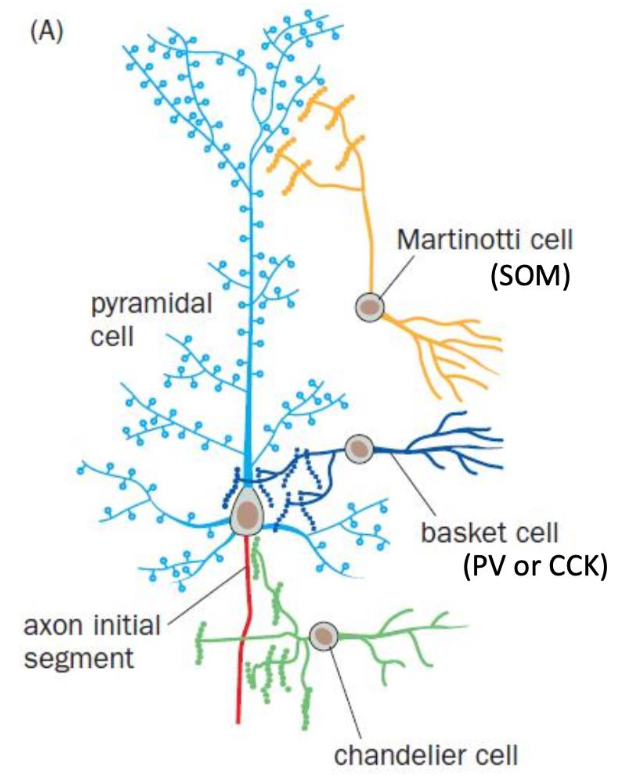
GABAergic neurons
Catecholamines
Neurotransmitter class, all share catechol structure
dopamine, norepinephrine, and epinephrine
How are catecholamines inactivated
They are reuptaken into the presynaptic neuron by transporters, NOT degraded
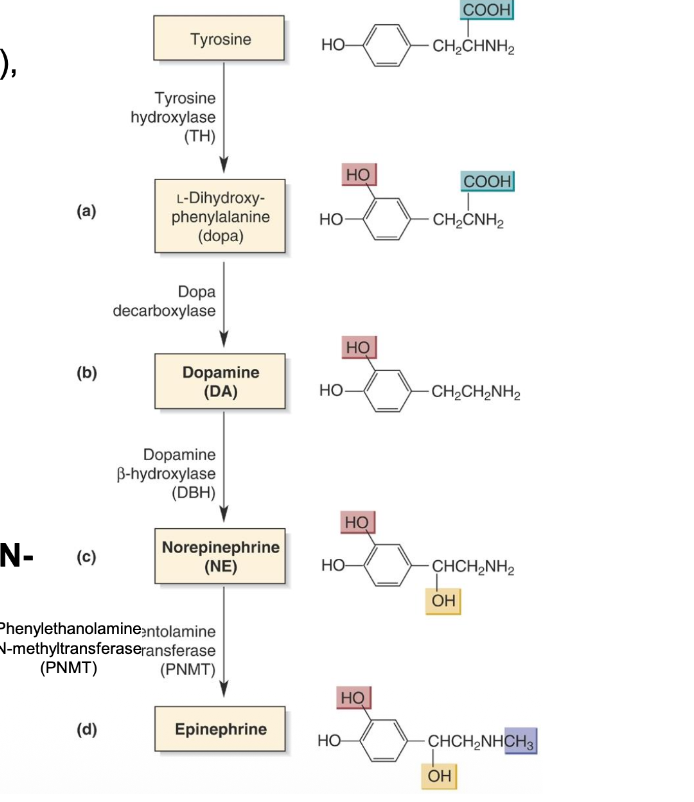
Tyrosine hydroxlase
performs first step in creation of all catecholamines: conversion of tyrosine to dopa
Synthesis of catecholamines
Dopamine neurons location in the brain
Substantia nigra and ventral tegmental area
Locus Coeruleus
Nucleus in the pons where noradrenergic neurons are located
Relatively few neurons, but they project WIDELY across the CNS
Epinephrine neurons location in the brain
Used as a neurotransmitter by a cluster of neurons in the medulla
Project to hypothalamus, thalamus, and spinal cord
Tryptophan
Used to make 5-HTP, which is then used to make 5-HT (serotonin)
Raphe nuclei
Location of serotonin neurons
Distributed along midline of the brain stem
Project diffusely across CNS
Tuberomammillary nucleus of the hypothalamus
Cluster of histamine neurons
What category of receptor are histamine receptors
They are GPCRs/metabotropic receptors
Structure of metabotropic receptors
Seven transmembrane domains
Single subunit
Intracellular segment and 3-4 loop binds to GTP binding protein
Extracellular loops 2-3 and 6-7 bind to neurotransmitter
Integration of neurotransmitter signal