Glaciers Stuff 3
 Studied by 0 people
 Call Kai
 Learn
Learn Practice Test
 Spaced Repetition
 Match
Match Flashcards
 Knowt Play
1/38

Earn XP
Description and Tags
ERS 441 Exam 3
Name | Mastery | Learn | Test | Matching | Spaced |
|---|
No study sessions yet.
39 Terms
What is a flute?
A line of sediment 1-2m high, less than 1km long, made of poorly sorted subglacial sediments (“small ice” features)
How do flutes form?
Usually behind boulders/obstacles, when water saturated till gets squeezed into cavities; Hypothesis 1: cavity may freeze becoming part of obstacle, which expands and elongates the flute. Hypothesis 2: debris freezes onto the glacier and gets pulled away, leaving room for more debris, elongated the flute
What are drumlins?
Asymmetrical sedimentary features that rarely occur alone. “big ice” features (ice sheets)
What are megaflutes?
Really elongated drumlins (km long, 100s of meters high), associated with ice sheets
What are rogen moraines?
sinuous ridges that have a ripple form, never occur alone, lowland areas under an ice sheet form them
What is the Boulton model for drumlin formation?
Differential erosion of sediments of different strengths (this model also views rogen moraines, drumlins, and megaflutes on a continuous scale)
What are the two hypothesis for rogen moraines, both by John Shaw?
subglacial floods create ripples on bed
subglacial floods create ripples on ice bottom which act as a mould for the moraines
What are murtoos and how are they formed?
Triangular shaped features associated with rogen moraines and eskers (triangle points down glacier); forms when floods disrupt the structure of rogen moraines and eskers
What are eskers?
Sinuous, steep sided ridges made of sand and gravel, can be kms long, formed in subglacial tunnels (r-channels). Eskers can be braided
What is the difference between closed tunnel and open channel eskers?
Closed tunnel eskers are steeper and can go up and down topography due to increased pressure, open channel cannot go up hill
Describe the katahdin esker system.
Longest esker system in the world, several extremely long eskers (~100km), start near katahdin and go east, end before the coast
What are moraines?
Ridges of sediments formed by glacier, marking the ice margin (except for medial moraines). Lateral: sides, End: terminus, Medial: middle (when 2 tributaries come togeteher OR down-glacier of a nunatak). When moraines are new, they are sharp
What are the moraine forming mechanisms?
push (bulldozer), dump (common in polar, when stuff melts out of the end of glacier), ice cored, and glaciotectonic (faulting or squeezing caused by stress differences)
What are kame terraces?
Terraces (flat features) formed on valley walls from meltwater sediment in streams along previous ice margin
What are kames?
Pieces/piles of debris that are on the bottom of a valley from melting out of an ice sheet
What do polar landforms and sediments look like?
Smaller, more subtle, little to no striations or molding, debris=parent material, angular, course grained, no rock flour, no water-formed features (outwash plains, kame terraces, eskers, etc.), deposits of many ages seen through each other (thin deposits), lots of wind-blown material. ice cored moraines common in polar regions
What is a kettle?
A hollow or pond created from a buried ice block melting
What is cavernous weathering?
when wind blown sediment begins to carve out hollows in rocks
What are the types of meltwater plumes?
Overflow (surface of water), interflow (mid-water level), underflow (bed of lake/ocean) - all depend on density and salinity
What are rythmites?
cyclical sedimentation of any sort - if it’s annual its called varves (course grained summer, fine grained winter)
how do lake-ice conveyors work?
Calving pushes lake ice away from glacier, the moat melts, cycle continues as icebergs get locked into lake ice (can rain out debris)
What is a keel/furrow mark?
A mark on a lip of some sort (fjord), created from icebergs scraping/re-grounding
What are tabular bergs?
icebergs from large ice sheets - large and flat bergs
What are some features of an ice contact delta?
ice contact slope, kettles, topsets (on top), and foresets (on the downward slope)
From top to bottom, what are the layers of glacial advance and retreat?
Advance: till, sand, clay. Retreat: clay, sand, till
Describe the presumpscot formation
blue/gray marine clay, filled with shells, extremely poorly drained, not a strong material to build on
Relative dating vs. absolute dating
relative: floating ages in a sequence (superposition, cross cutting relationships, association with fossils, weathering progressions, varves), absolute: real numbers (radiocarbon dating)
What is radiocarbon dating?
Measuring the amount of radiocarbon in a sample to date it. Need to know how much at start (assumption), how much now (measured), rate of decay (known), and that the system is closed (no disruption, growth of bacteria, recrystalization, water, human contamination)
How is c14 created?
From cosmic rays hitting nitrogen.
What is wrong with the assumption that the c14 ratio in the atmosphere has stayed the same throughout time?
there have been changes in c14 over time due to solar cycles, burning fossil fuels (dillution), nuclear testing - this is why radiocarbon dating cuts off after 1950. Callibration curves used to combat the fact that radiocarbon yrs are older than normal yrs
What are peri-glacial landforms?
created from areas of permafrost (need freeze-thaw cycle to be formed)
Describe stone circles/stone nets
created from continuous permafrost, usually sorted (course on the outside), form by frost heave (since rocks always move perpendicular to freezing front). circles of rocks
What is thermokarst?
When underground streams collapse, creating sinkhole type features
What are stone stripes?
Stone circles on a slope - elongated from the slope
What is a pingo?
Hills made of sediment covered ice from when water under pressure freezes, making a mound. Palsa is when it is made of peat
What is stone runs/rock glaciers
glacier made of rocks, rocks move, lobe shaped feature
What is the glacial history of Maine?
As the laurentide retreated, ice caps were left and flowed in both directions. There isn’t a gerat understanding of the history of ice in Maine before the Laurentide
Produce a paragraph about the glacial history of Maine from the LGM.
there were ice caps after deglaciation due to reatreat from St.Lawrence seaway from North, ice was gone completely from maine about 13,000 yrs ago, there used to be alpine glaciers in maine but geologists don’t know when.
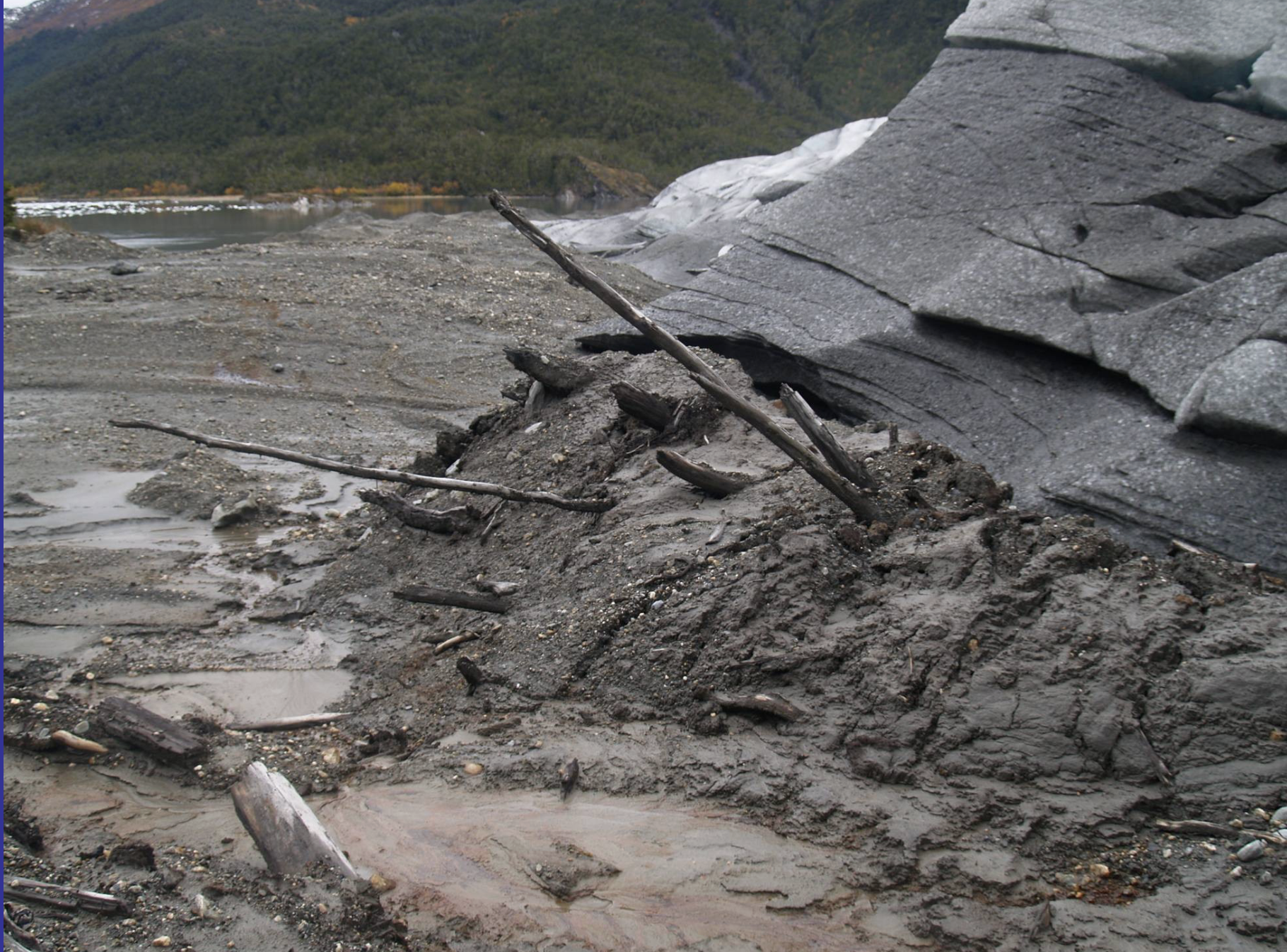
glaciotectonic example