Module 3: Topic 7: periodicity
 Call Kai
 Learn
Learn Practice Test
 Spaced Repetition
 Match
Match Flashcards
 Knowt Play
1/36

Earn XP
Description and Tags
Name | Mastery | Learn | Test | Matching | Spaced | Call with Kai | Chat |
|---|
No analytics yet
Send a link to your students to track their progress
37 Terms
What is ionisation?
The minimum amount of energy required remove 1 mole of atoms in the gaseous state.
How did mendeleev order the elements?
Atomic mass
How did Mendeleev group atoms?
Similar chemical properties
What else did Mendeleev do?
Left gaps where elements didn’t fit
Predicted properties of undiscovered elements
Why is ionisation endothermic process?
Because it requires energy and has a positive value
What is shielding?
The more electron shells between the positive nucleus and negative electron that is being removed, the less energy is required. There is weaker electrostatic attraction
What is nuclear charge?
The more protons in the nucleus, the bigger the attraction between the nucleus and outer electrons. This means more energy required to remove the electron
What is atomic size?
The bigger the atom the further away the outer electrons are from the nucleus.
The attractive force between the nucleus and outer electrons reduces so its easier to remove electrons
What is the trend of ionisation energy in a group?
Ionisation energy decreases as you go down a group
Why does ionisation energy decrease as you go down a group because of atomic radius?
The atomic radius increases as we go down,
Outer electrons are further away from the nucleus
Electrostatic attraction is weaker
Less energy required to remove the electron
Why does ionisation energy decrease as you go down a group because of shielding?
Shielding increases as you go down a group
More shells between nucleus and outer shell
Electrostatic force is weaker
Less energy required to remove electron
What is the trend in ionisation energy as you go across a period?
Ionisation energy increases as we go across a period
Why does ionisation energy increase as you go across a period?
As you go across a period, proton number increases in the nucleus which increases nuclear energy = more energy required to remove electron
Shielding is similar but distance from nucleus marginally decreases = more electrostatic attraction = more energy required to remove electron
Where are the 2 dips in ionisation energy for period 3 elements?
At aluminium and sulfur
Why is there a decrease in ionisation energy for aluminium in the period 3 elements graph?
The outer most electron in aluminium sits in a higher energy sub shell slightly further from the nucleus than the outer electrons in magnesium = less energy required to remove it
3p subshell further away from the nucleus
Also experiences slightly more shielding from 3s electrons
Why is there a decrease in sulphur for ionisation energy in period 3?
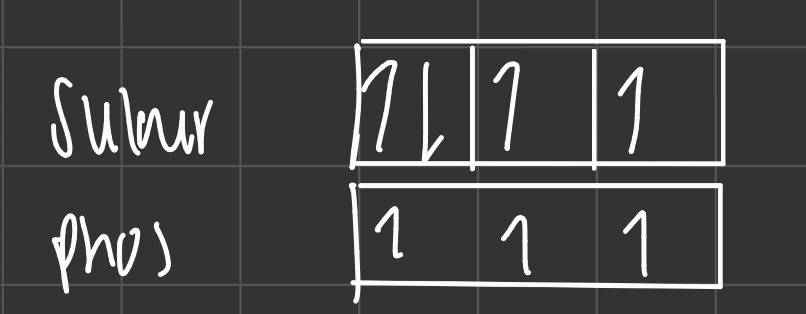
In sulphur 2 electrons occupy the same 3p orbital. Repulsion between the paired electrons makes an electron easier to remove, so less energy is required.
What is successive ionisation?
The removal of more than 1 electron from the same atom
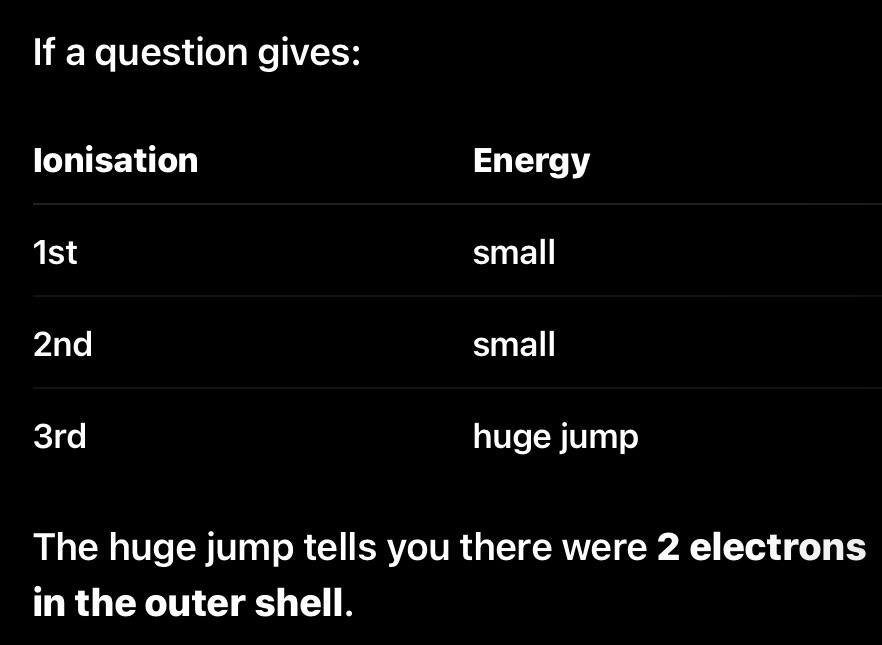
If a question gives: why is the element in group 2?
Because the first 2 electrons were easily lost, but losing a third electron requires a large amount of energy so it must be in an inner shell and closer to the nucleus
Whats the trend in ionisation as more electrons are removed?
Theres a general increase in energy as removing an electron from an increasingly more positive ion
There are jumps in energy in the graph when moving from one sub-shell to another as removing electrons closer to the nucleus requires more energy
What are examples of giant covalent structures?
Graphite and diamond and graphene
What is graphite made of?
Carbon
Talk about graphite
Each carbon is bonded 3 times and the 4th electron is delocalised and mobile so it can conduct electricity
Strong covalent bonds = high melting point
Layers slide easily as there are weak intermolecular forces between the layers
Layers are far apart in comparison to covalent bonds length so low density
Graphite is insoluble - covalent bonds are too strong to break
What is diamond made of?
Carbon
Talk about diamond
Each carbon bonded 4 times in a tetrahedral shape
The tightly packed, rigid arrangement allows heat to conduct well
Very high melting point due to many strong covalent bonds
Doesn’t conduct electricity bc no delocalised mobile electrons
Insoluble - covalent bonds too strong to break
Talk about graphene
Its 1 layer of graphite
Its 1 atom thick and made of hexagonal carbon rings - since only one cell thick its lightweight and transparent
Delocalised, free moving electons makes it good conductor of electricity
What are the uses of graphene?
Aicraft shells, high speed computers - bc of graphenes high electron moblitlity they can move fast when voltage is applied
Smart phone screens
How does metallic bonding work?
Positive metal ions are formed as metals donate electrons to form a sea of delocalised electrons
There is an electrostatic attraction between the positive metal ions and the negative delocalised electrons
The more electrons an atom can donate to the delocalised system the higher the melting point, e.g mg has a higher melting point than sodium bc magnesium can donate 2 electrons (group 2) but na can only donate 1 (group1)
Metals are insoluble bc the metallic bonding is too strong to break
What is the trend in metallic bonding across period 3 eleemnst?
General increase in melting points as metal ions have an increasing positive charge = increasing no. Delocalised electrons + smaller ionic radius. So stronger metallic bonding. So higher charge density + stronger electrostatic attraction.
What is the structure of silicon?
Giant covalent structure (macromolecular)
Period 3
Why does silicon have the highest melting point in period 3?
Many strong covalent bonds in the giant covalent lattice.
Large amount of energy needed to overcome these strong covalent bonds
Why do phosphorus (P4) and sulphur (s8) have lower melting points?
Due to their simple molecular structure. They have weaker induced dipole-dipole (london forces) between molecules that don’t require much energy to overcome
Why does sulphur have a higher melting point than phospohorous in period 3?
Because it has a larger simple molecular structure (8 sulphur atoms) so larger induced dipole-dipole forces
Why does chlorine have a lower melting point than phosphorus and sulfur in period 3?
It has a smaller simple molecular structure (2 cl atoms make up a molecule) and so has smaller induced dipole dipole forces. (London forces)
Why does argon have the lowest boiling point in period 3?
Because it only exists as individual atoms. It has smaller induces dipole-dipole forces and a lower melting point.
Why does nitrogen have a larger first ionisation energy than oxygen?
Because N atoms have less repulsion between p orbitals than o atoms.
Bc oxygen has 2 electrons (up and down arrows) in the same box, so electrons-electron reulsion is experienced, so less energy to remove one of these paired electrons from oxygen.
Explain why the first ionisation energy of magnesium is lower than the first ionisation energy of aluminium, even though aluminium has a greater nuclear charge.
Electron configuration of mg: 1s2 2s2 2p6 3s2
Electron configuration of Al: 1s2 2s2 2p6 3s2 3p6
Aluminiums outer electron is in a 3p orbital, whereas magnesiums outer shell electron is in a 3s orbital.
The 3p orbital is in a higher energy and is slightly further away from the nucleus so the electron experiences less attraction to the nucleus and is easier to remove.
Explain why sulfur has a lower first ionisation energy than phosphorus? (3 marks)
Ik s is after p so has a higher nuclear charge so you would think it has a higher nuclear charge = higher ionisation energy. But think abt where the subshells sit
Sulphur has the electron configuration of 3p4 so one of the 3p orbitals contains a pair of electrons. The repulsion between these paired electrons makes an electron easier to remove bc less energy is required.
Phosphorous has a half filled 3p3 sub shell with no paired electrons so less electron-electron repulsion.