Psych U4 AOS2
 Call Kai
 Learn
Learn Practice Test
 Spaced Repetition
 Match
Match Flashcards
 Knowt Play
1/18

Earn XP
Description and Tags
mental wellbeing + Specific phobia
Name | Mastery | Learn | Test | Matching | Spaced | Call with Kai | Chat |
|---|
No analytics yet
Send a link to your students to track their progress
19 Terms
Mental wellbeing
ones state of mind that encompasses their level of FUNCTIONING, RESILLIENCE, and SOCIAL and EMOTIONAL WELL-BEING to contribute effectively to society.
over a continuum
Ressilience
The ability to cope with and manage change and uncertainty (to bounce back from adversity)
High resillience
coping flexibility
remain optimistic
strategies that have context-specific effectiveness
Low resillience
unhealthy coping strategies (eg. alcohol)
poor coping flexibility
Social wellbeing
Related to ones ability to have satisfying relationships and interactions with others.
High SW
feel self confident alone or with others
develop and maintain relationship with family and friends
respect and understand others
Low SW
difficulty resolving conflict within relationships/struggle to maintain relationships
isolated and/or lacking supported
Functioning
How well one can independently perform or operate in an environment
high functioning
fulfill personal responsibilities and appropiate hygeine practices
good cognitive skills
low functioning
poor cognitive skills
unable to get out of bed to …
unable to interact with people
mental disorder
a condition that affects mood, thinking and behaviour, that is typically long lasting.
SEWB
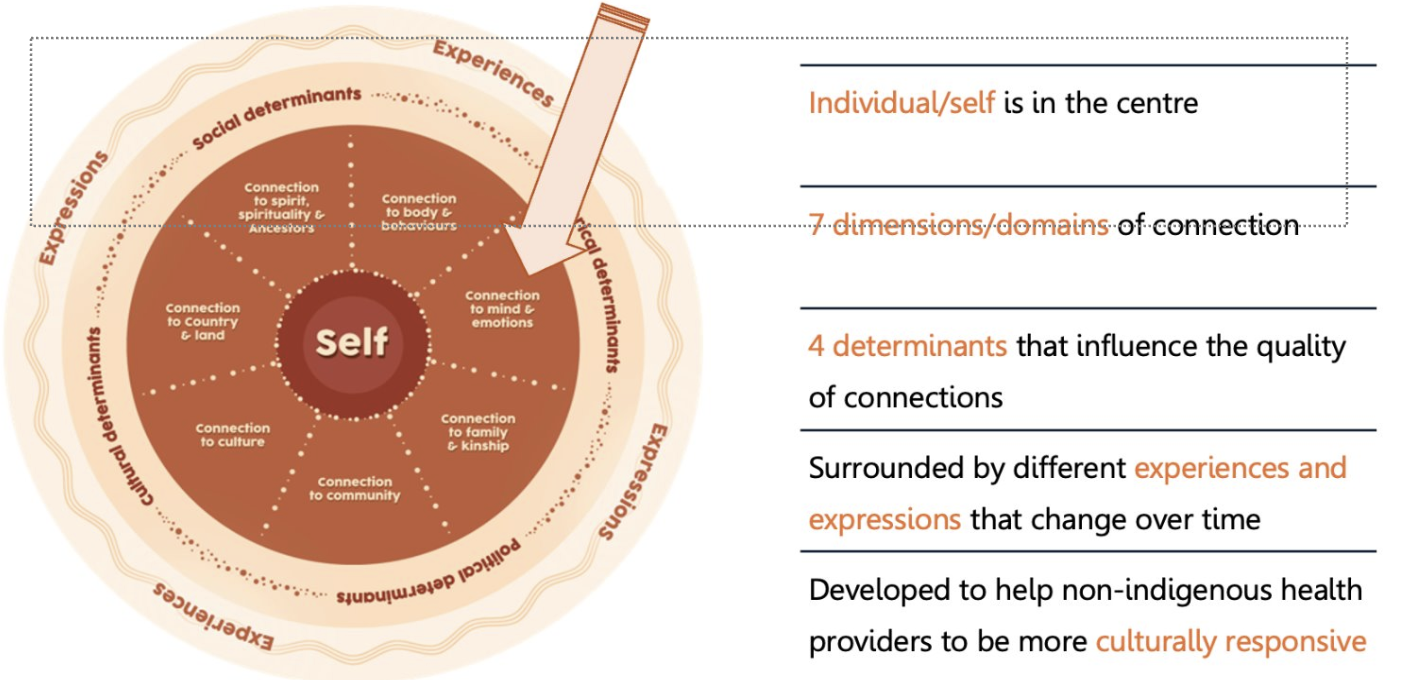
a multidimensional and holstic framework for wellbeing that encapsulates all elements of being (body, mind, emotions, family, kinship, community, culture, country, spirituality and ancestors) for Aboriginal and Torres Strait Islander peoples.
Strengths and Limitations of SEWB
Strengths:
holistic approach
wellbeing incorperates mental, physical, emotional, spiritual & cultural dimensions of wellbeing
emphasises cultural importance (traditions, practices, language)
acknowledges family and community importance in terms of wellbeing
promotes self-determination
Limitations
Due to the diversity of ATSI peoples (different nations. languages, cultural practices), there will be no consistent practice within the framework that suits all groups
access to culturally sensitive frameworks may be limited
Professionals may not be adequately trained, therefore unable to correctly implement the framework
Connection to body
Physical health – feeling strong and healthy and able to physically participate as fully as possible in life.
Examples of risk factors:
Chronic and communicable diseases
Poor diet.
Smoking
Example examples of protective factors:
Access to good healthy food
Exercise
Access to culturally safe, culturally competent and effective health services and professionals
Connection to mind and emotions
Mental health – ability to manage thoughts and feelings
Example examples of risk factors:
Development/cognitive impairment and disability
Racism
Mental illness
Unemployment
Trauma (including childhood trauma)
Examples of protective factors
Education
Agency: assertiveness, confidence and control over life
Strong identity
Connection to family and kinship
Example of risk factors:
Absence of family members.
Family violence
Child neglect and abuse
Children in out of home care
Example of protective factors:
Loving, stable accepting and supportive family
Adequate income
Culturally appropriate family-focused programs and service services
Connection to community
A connection to community provides opportunities for individuals and families to connect with each other, support each other and work together
Example of risk factors:
Family feud/comunnity lateral violence
Lack of local service services/isolation
Disengagement from communities
Lack of opportunities for employment in community settings
Example of protective factors:
Support networks
Community controlled services
Self governance
Connection to culture
Provide provides a sense of continuity with the past and helps underpin a strong identity
Example of risk factors:
Elders passing on without four opportunities to transmit culture
Services that are not culturally safe/sensitive
Language languages under threat
Examples of protective factors:
Contemporary expressions of culture
Attend attending national and local cultural event events
Cultural institutions/education
Cultural involvement and participation
Connection to country
Connection to country helps underpin identity and a sense of belonging
Example examples of risk factors:
Restrictions on access to country
Examples of protective factors:
Time spent on country
Connection to spirituality and ancestors
Provide a sense of purpose and meaning
Example examples of risk factors:
No connection to the spiritual dimension of life
Example examples of protective factors:
Opportunities to attend cultural events and ceremonies
Contemporary expressions of spirituality
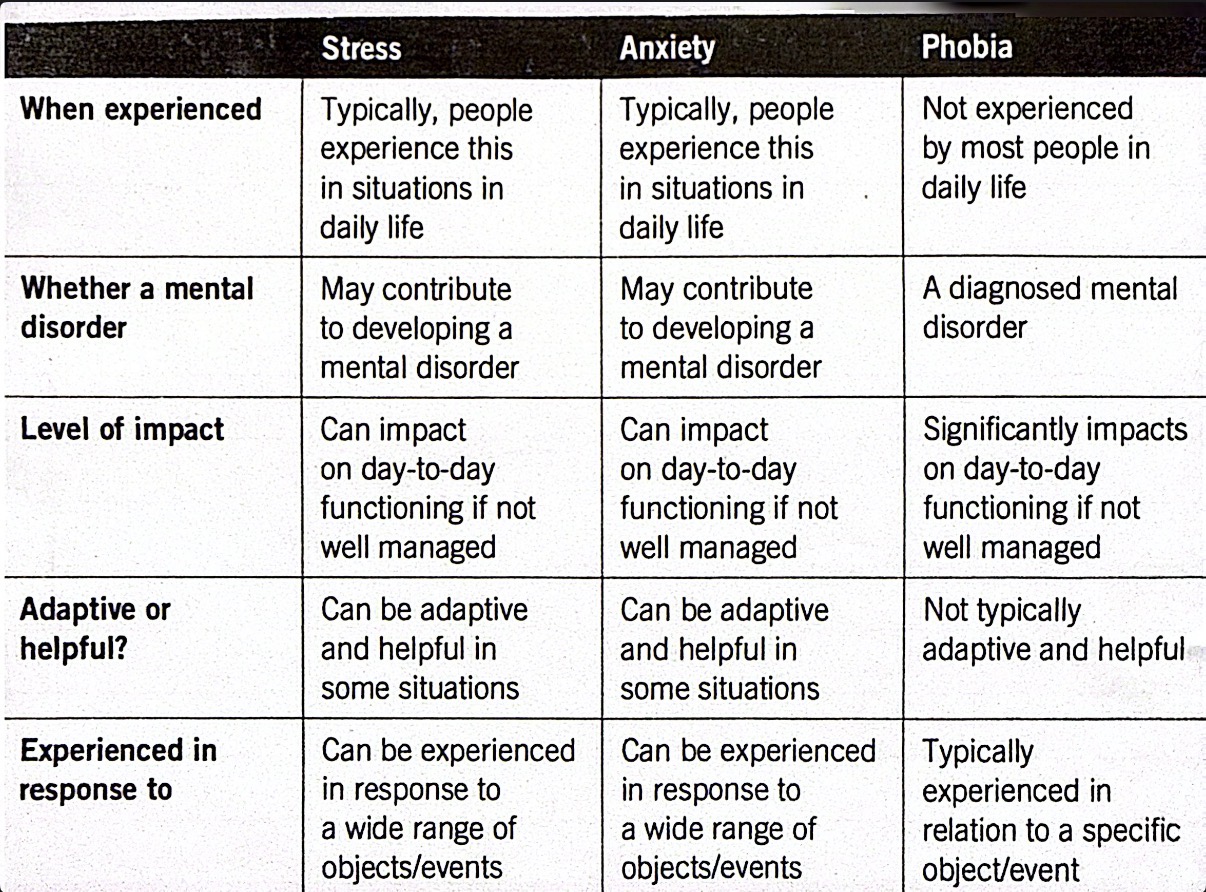
Anxiety
A state of psychological arousal a kin with feelings of unease, apprehension, or worry that something unpleasant is about to happen
Phobia
A persistent, intense, irrational fear of a specific object or event
Stress VS anxiety VS phobia