Parasitology
 Call Kai
 Learn
Learn Practice Test
 Spaced Repetition
 Match
Match Flashcards
 Knowt Play
1/60

There's no tags or description
Looks like no tags are added yet.
Name | Mastery | Learn | Test | Matching | Spaced | Call with Kai |
|---|
No analytics yet
Send a link to your students to track their progress
61 Terms
Parasites of Importance
Sheep
Cattle
Deer
Sheep:
Teladorsagia circumcincta
Haemonchus contortus
Nematodirus spp.
Trichostrongylus colubriformis
± Long-tails (Bunostomum and Chabertia)
Muellerius capillaris
Toxoplasma gondii
Cestodes: Taenia ovis
Fasciola hepatica
Lice: Bovicola ovis
Chorioptes bovis
Flystrike
Cattle:
Ostertagia ostertagi
Dictyocaulus viviparis
Cooperia oncophora
Trichostrongylus axei
Fasciola hepatica
Trichomonas foetus
Coccidia
Cryptosporidium
Neospora caninum
Theileria orientalis strain IKEDA (see “Systemic Diseases”)
Haemaphysalis longicornis
Lice: Bovicola bovis and Linognathus vituli
Deer:
Trichostrongylus askivali
Trichostrongylus axei
Dictyocaulus eckerti
Oesophagostomum sikae
Ostertagia-like
Haemaphysalis longicornis
4 Types of Helminths
Phylum
Common name
Distinctive features
Examples
Nematode = Roundworm
Examples: Strongylida
Trichostrongyloidea = Ostertagia, Teladorsagia, Haemonchus, Trichostrongylus, Cooperia, Nematodirus
Metastrongyloidea = Dictyocaulus viviparus
Cestode = Tapeworm
Features: Indirect lifecycles
Adult lives in DH small intestine
Eggs infect IH
Examples: Taenia ovis
Trematode = Fluke
Features: Indirect lifecycles with sexual and asexual phases → Increase biopotential
Examples: Fasciola hepatica and Calicophoron calicophorum
Acanthocephalans = Thorny-headed worms
Describe the general lifecycle of Strongylida (type of Nematode)
Pre-patent period = Time from ingestion of [L3] larvae to eggs being shed in faeces
PPP = ~21d for most nematodes
Lifecycle: SIX stages
Parasitic Phase
DH ingests [L3] and exsheaths into L3 within GIT
L3 enters mucosal glands to moult to L4 → Adult
Sexual reproduction to produce eggs
Free-Living Phase
Female nematode produces eggs (or larvae) which are deposited on pasture within faeces
Eggs hatch L1 which feeds on bacteria in faeces
→ Moult to L2 then [L3]
~2 - 3w for development into [L3] in-field (5 - 7d in lab)
[L3] cannot feed → Moves away from food scour and onto pasture of infect DH
Describe optimal conditions for nematode development
Development in faeces (3)
Survival of [L3] (3)
Faeces (Egg → L2):
Oxygen
Warm faeces (optimum 25 - 27˚C)
No development when <10˚C → Exponential increase in rate of development BUT fewer larvae develop to [L3] due to mortality
>40 - 50˚C = Lethal
Moist conditions = Required for feeding, movement and to avoid desiccation
L1 and L2 more susceptible to desiccation than eggs and [L3]
Larval desiccation and death does NOT occur in NZ due to lack of severe enough droughts
Survival of [L3]:
Moisture
Insufficient droughts in NZ to spell pasture
Temperature (optimum 10˚C)
<10˚C → Quiescent
Haemonchus: Winter too cold → Cannot overwinter on pasture (survives year-to-year in animals)
Relies on stored metabolites (higher temperature = More active BUT faster use of metabolites)
![<p><u>Faeces (Egg → L2):</u></p><ol><li><p><strong>Oxygen</strong></p></li><li><p><strong>Warm faeces </strong>(optimum 25 - 27˚C)</p><ul><li><p>No development when <10˚C → Exponential increase in rate of development BUT fewer larvae develop to [L3] due to mortality</p></li><li><p>>40 - 50˚C = Lethal</p></li></ul></li><li><p><strong>Moist conditions</strong> = Required for feeding, movement and to avoid desiccation</p><ul><li><p>L1 and L2 more susceptible to desiccation than eggs and [L3]</p></li><li><p>Larval desiccation and death does NOT occur in NZ due to lack of severe enough droughts</p></li></ul></li></ol><p></p><p><u>Survival of [L3]:</u></p><ol><li><p><strong>Moisture</strong></p><ul><li><p>Insufficient droughts in NZ to spell pasture</p></li></ul></li><li><p><strong>Temperature</strong> (optimum 10˚C)</p><ul><li><p><10˚C → Quiescent</p></li><li><p><em>Haemonchus</em>: Winter too cold → Cannot overwinter on pasture (survives year-to-year in animals)</p></li></ul></li><li><p><strong>Relies on stored metabolites</strong> (higher temperature = More active BUT faster use of metabolites)</p></li></ol><p></p>](https://assets.knowt.com/user-attachments/97e0577a-b284-46ca-a657-de673dc5d89d.png)
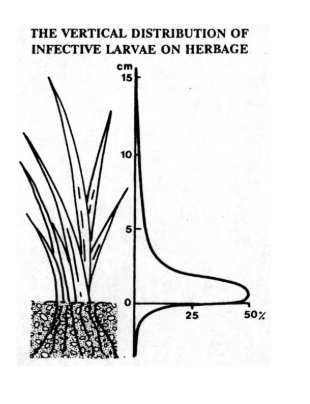
Describe distribution of larvae on pasture
95% of parasite population within pasture (5% within animals)
Close to bottom 2 - 3cm of sward (eggs + L1 - L3)
Longer pasture dilutes larval load
Avoid over-grazing
Alternative Forages for Parasite Prevention
3 Advantages
2 Disadvantages
+ve:
Process of establishing crops → Kills larvae and reduces contamination
eg. Ploughing/turning over soil and spraying out paddock to let grass die-off before planting crops
→ Newly sown crops have minimal larval contamination prior to 1st grazing
Growth habitat of some crops is NOT supportive of high larval numbers
eg. Kale = Tall with long stem (animal does not graze base of sward)
eg. Spread out plants with soil in between
Some alternative forages contain higher levels of condensed tannins → Reduce larval establishment in host
-ve:
Margins of grass along fence lines and around trees/troughs/rocks → Becomes highly contaminated with larvae
Lambs will preferentially overgraze grass with parasites before eating new crops
Multi-graze crops become very contaminated if farmers do not drench young stock still
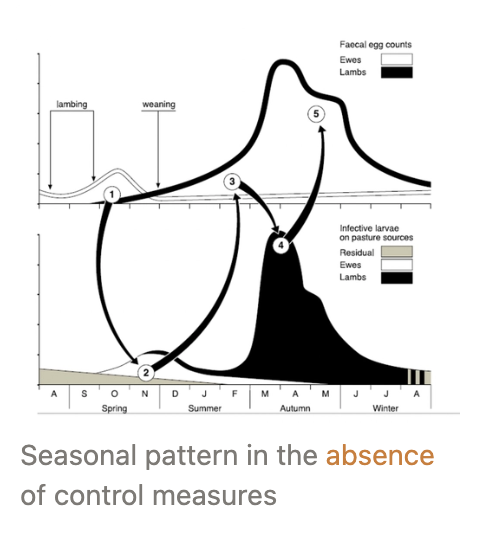
Describe the seasonal pattern of parasites on a sheep farm
Larval contamination and FEC
Dominant parasites by season
Larval Contamination and FEC:
Spring rise of larvae on pasture from TWO sources:
Periparturient rise (PPR) of ewes = Reduce immune response around late gestation → Increased FEC
NOT in cattle
Overwintered larvae
Larvae from spring rise are ingested by lambs
Eggs deposited by lambs = source of ‘autumn peak’ infective larvae
These larvae ingested = disease in autumn/winter + some overwinter (source of 1.)
A number of eggs deposited in autumn fail to develop (temp.
No PPR in cattle
Seasonality:
Late spring/early summer = Nematodirus and Teladorsagia
Summer/early autumn = Haemonchus, Teladorsagia, Trichostrongylus
Autumn/early winter = Trichostrongylus
When does immunity against parasites begin to develop in calves and lambs
Begin consuming larvae when eating pasture (2w for lambs)
Immune response begins to develop at 6 - 12m → Full adult immunity at 18m
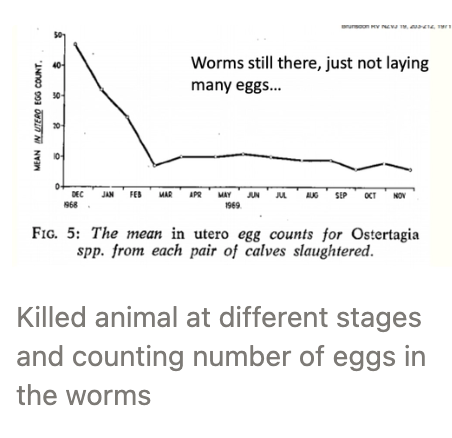
Cattle: Immune response reduces female worm fecundity (esp. Ostertagia) → Poor relationship between parasite burden and FEC in calves ≥6m
Cattle faeces is more liquid → Dilution effect
Adult cattle do NOT contribute to pasture contamination (no PPR)
Parasitism in Beef Cattle
Why are they less of a problem in extensively managed beef calves (vs. dairy)? (5)
Main risk period
When to begin drenching
Better nutrition to weaning (milk NOT pasture)
Being suckled, calves eat less grass → ingest fewer larvae and put out fewer eggs to contaminate pasture
Less heavily stocked
Often share grazing with sheep
Stay with dams until 6 months = Net removers of larvae on pasture
Risk: Late weaning (May) → Heavily infected pastures as calves are NOT drenched until weaning
Drench: Begin ~6m (may not need to be q28d or at all for low-risk farms)
Clinical effects of nematode parasites
Clinical Parasitism:
Inappetence #1
Weight loss (PLGE)
Diarrhoea (inflammatory response)
± Anaemia and sudden death (Haemonchus)
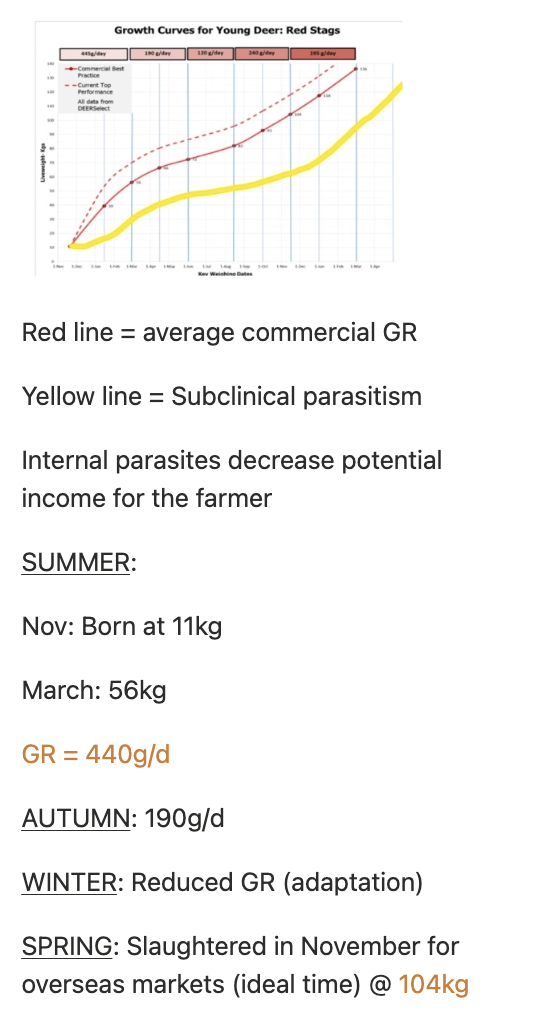
Subclinical Parasitism: Reduced GR and wool growth
Young animals take longer to reach target LWT → Lower schedule prices and increased maintenance costs and less likely to reach minimum weight for mating
Higher GR → Reach target slaughter weight earlier when schedule prices are better
Describe the general principles of parasite control on-farm (7)
“FARMED”
ONE: FEEDING
Good nutrition enhances an animal’s ability to deal with worms (effective immune response)
Growing out young stock → Less time “worm factories” are on farm
Trade off with reduced slaughter weight
Avoid unnecessary retention of young stock (difficult in lamb/calf finishing farms or pedigree farms)
TWO: AVOID = Avoid exposing susceptible animals to high pasture contamination
Provide safe feed
Crops/alternative forages/new grass (difficult on steep hill country farms)
± Resting/spelling pasture? NOT practical (≥3m required)
Silage/hay → Removes larval contamination from paddock AND kills parasites within conserved forage
Cross-grazing to remove larvae
Sheep with cattle/deer = Dead-end host
Uncommon as farmers reserve SAME areas for specific stock classes (eg. lamb paddocks)
Avoid goats and alpaca with sheep
Older (immune and well-fed) animals of same species = Net removers of larvae from pasture
CAN contribute to larval contamination if immunocompromised
Maintain higher post-grazing residuals >1400 - 1500kgDM/ha
Do NOT force young animals to graze larvae
ZERO grazing systems eg. cut and carry in goat farms
Select for genetic parasite resistance/tolerance
Moderate heritability (0.23 - 0.35)
Resistance (FEC), CARLA and resilience (high worm burden with little effect)
Quarantine protocols to avoid introducing resistant worms
THREE: REFUGIA = Deliberately retaining a gene pool of susceptibility by allowing some parasites to reproduce without exposing them to anthelmintic
Only from worms that are ingested by sheep, mate and produce eggs that contribute to subsequent generations
To keep the prevalence of the resistance worms low (susceptible worms breed with resistant worms to reduce AR)
Outcome: AR is constant or not worse
FOUR: MONITORING
Evaluate post-drench GR and clinical signs
Drench check
FECRT
FIVE: EFFECTIVE DRENCH
Regular drench checks and monitoring
Avoid long-acting anthelmintics → Increase rate of AR
Drench programmes differ between cattle farms (more individualised)
High drench use = Run-off or finishing block
Moderate drench use
Low drench use
3 Methods of Monitoring for Parasitism
Method
Advantages
Disadvantages
Evaluate Post-Drench GR and Clinical Signs
+ve: No cost
-ve: Highly inaccurate (drench efficacy can be as low as 65 - 80% before farmer sees problem)
Drench Check
Method: Assess x10 FEC 7 - 10 after drenching (should be ZERO)
FEC ≠ 0 → Ar parasites or poor drenching practice
+ve:
Cheap ($60 - 100)
Very easy → Good farmer compliance
Rapid results
Excellent starting point for conversation with farmer about anthelmintic efficacy (may lead to FECRT)
-ve:
Must assume animals had worms pre-drench
No quantitative assessment (yes/no)
Only tests ONE anthelmintic product
Assumes farmer drenches accurately
FECRT
Method: January = Good mix of nematode genera
Measure FEC pre-drench (≥500epg required)
Individual FEC and pooled sample for larval culture
Test EACH drench on separate group of 12 - 15 lambs
Measure FEC post-drench 7 - 14d later
Calculate % reduction = Overall drench efficacy
[(pre-treatment average) - (post-treatment average)]/(pre-treatment average) x 100
BOTH Strongyles and Nematodirus
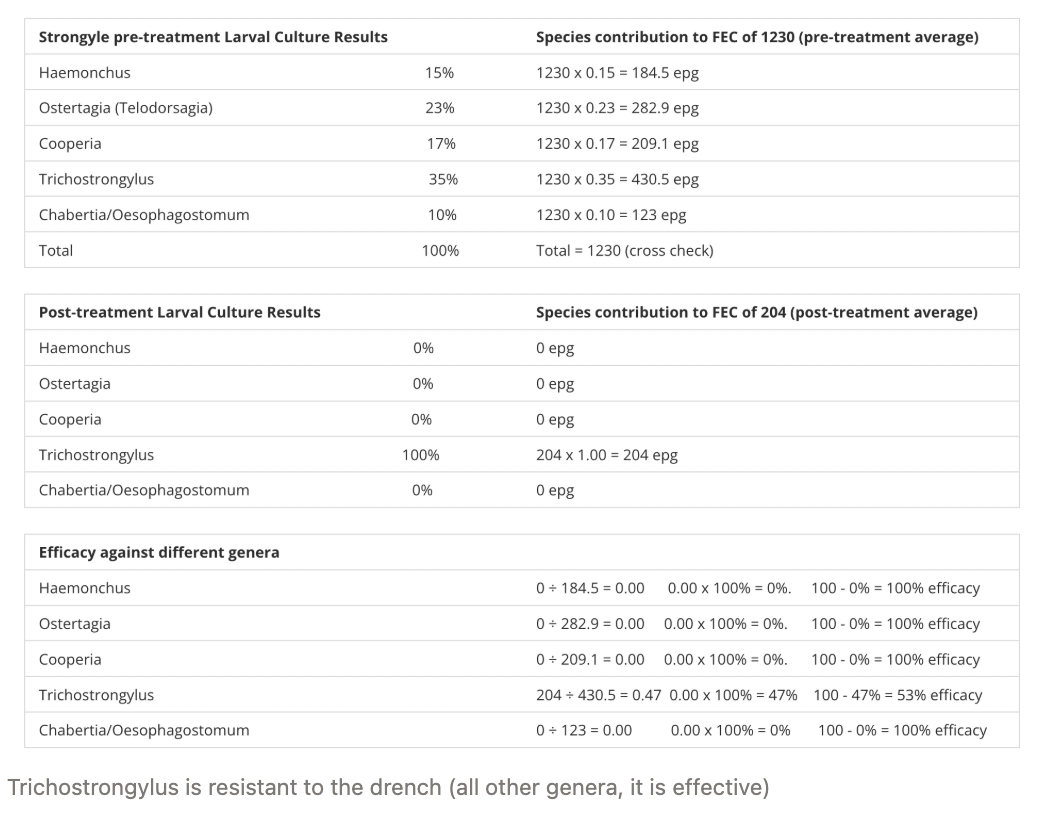
Larval culture to determine which genera are resistant to the drench
Multiply % by average number of eggs to extrapolate number of eggs in faecal samples that were produced by each genera
+ve:
Most accurate
Evaluate efficacy of multiple anthelmintics
Big investment → Farmer pays attention to results
Good motivation to follow-up with thorough parasite control plan
-ve:
Expensive ($1500 - 4500)
Single point in time → Not reflective of exactly what is happening on-farm
Time-consuming (monitor FECs until high enough → 2 visits required)
12d to obtain results from larval cultures
Calculate the efficacy and individual genera efficacy of the drench “Matrix”
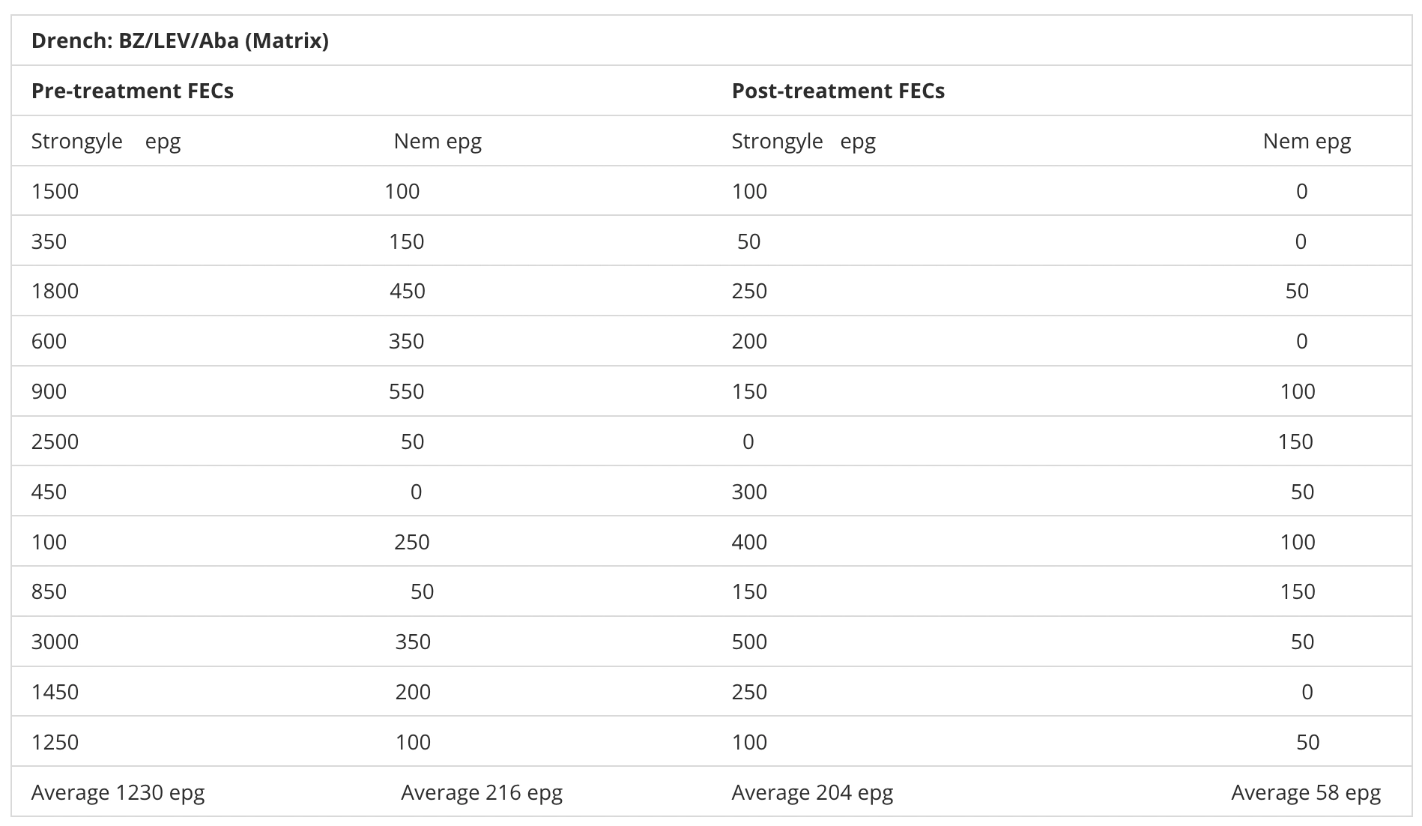
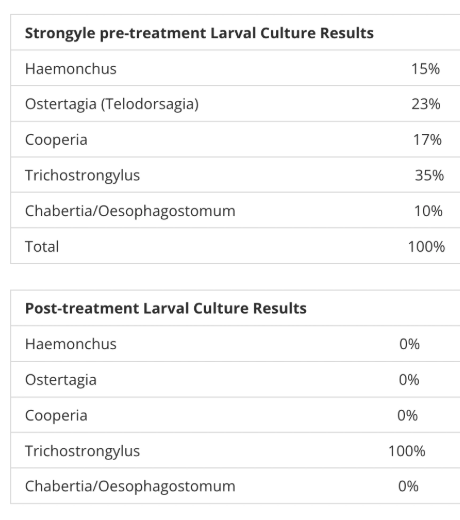
Drench Efficacy:
[(pre-treatment average) - (post-treatment average)]/(pre-treatment count) x 100
Strongyles: (1230 - 205)/1230 x 100 = 83%
Nematodirus: (216 - 58)/216 x 100 = 73%
Reduction at the Genera Level:
Multiply % by average number of eggs to extrapolate number of eggs in faecal samples that were produced by each genera
Label the following eggs
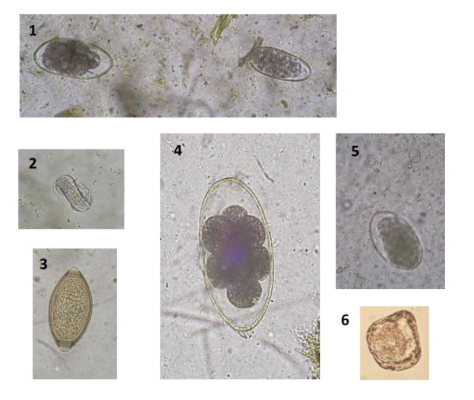
Strongylid egg = Thin-shelled, non-operculate, ovoidal egg with 8 - 64 morula
Strongyloides spp. egg (Rhabditida)
Trichuris spp. egg
Nematodirus spp. egg = 2x size of normal strongylid egg
Strongylid egg + coccidial oocyst (top right)
Moniezia expansa (tapeworm) egg
List 11 ways to reduce/delay AR development (sources of refugia)
28-day drenching interval (PPP = 21 days, leaves 7 days for new susceptible eggs to develop)
Leave some lambs undrenched (healthiest lambs)
Graze undrenched ewes after (and before) lambs
Eggs from ewe faeces will be from non-drenched larvae (later consumed by lambs)
Run some un-drenched ewes with lambs (eg. low BCS ewes)
Ewes put non-drenched eggs into the pasture to be consumed by lambs AND gain BCS in the process
Avoid anthelmintic treatment of adult stock
Avoid underdosing
Avoid use of long-acting drenches (eg. moxidectin)
Continues to kill ALL larvae for awhile, allowing AR larvae to persist
Conc. of drug decreases overtime and eventually drops below MIC = sublethal dose allowing parasites to persist
Purchase lambs from farms with proven excellent drench efficacy
Do NOT give quarantine drench, then graze in areas where home-bred lambs have been → Introduce susceptible worms and refugia
Combination drenches
Avoid single active drenches
Avoid drenching and moving onto clean pasture with no larval contamination
Clean pasture: Crops, newly sown grass, silage or hay paddock post-harvesting, grazing different species for a long time (no sheep larvae)
Only AR larvae would be present on the paddock
Avoid repeatedly grazing young animals on same area
Lamb finishing system is NOT sustainable (ONLY young lambs grazing and increasing parasite burden)
eg. Pedigree farms with ram lambs (retention of young rams and repeated drenching until sales to maintain weights)
eg. Finishing cattle (eg. intensive bull beef), heifer rearing for dairy and ram breeders
Possible Conflict: Farmer focus = Parasite control NOT selecting for AR
How to select which young stock to leave undrenched as a source of refugia in cattle
Leave some heifers undrenched depending on age class (caution when <7 months of age) and mark to ensure they are treated next time
Sufficient immunity to leave some undrenched → 6 - 7 months of age
No drench selection criteria:
BCS
FEC (impractical)
LWT gain
≥12 - 14 months → Good immunity and do NOT require drenching
Small number given high efficacy of drench
Lower efficacy of drench: More must be left untreated as more resistant larvae will be present on pasture
9 Anthelmintic Options
MoA
Examples
Spectrum of action
Pharmacokinetics
BENZIMIDAZOLES (BZ)
MoA: Bind helminth β-tubulin protein, preventing their incorporation into microtubules → Interfere with cell nutrition/division → Starvation and ovicidal
Examples: Albendazole, oxfendazole, fenbendazole
Spectrum:
Nematodes
Giardia
± Tapeworms (albendazole/fenbendazole)
± Fluke (albendazole)
Pharmacokinetics: Water-insoluble → Slow absorption in rumen over several days
LEVAMISOLE (LEV)
MoA: Bind nicotinic ACh receptors → Paralysis
Narrow safety margin
Spectrum: Nematodes ± immune stimulant (added to 5in1)
Pharmacokinetics: Water-soluble → Fast elimination
MACROCYCLIC LACTOMES (ML)
MoA: Acts on glutamate-gated Cl- channels at NMJ → Paralysis
Examples:
Avermectins: Ivermectin, abamectin, doramectin, eprinomectin, selamectin
Milbemycins: Moxidectin, milbemycin
Spectrum:
Nematodes
Arthropods (lice and mites)
Pharmacokinetics: Fat-soluble → Slow absorption (eg. MOX depot injection)
Heavily used in cattle in NZ, $$$, but easy pour-on
TETRAHYDROPYRIMIDINES
MoA: As for LEV
Higher safety margin
Examples: Morantel (pyrantel and oxantel SA)
Spectrum: Nematodes ± Cestodes?
Pharmacokinetics: Soluble and well-absorbed
MONEPANTEL
MoA: As for LEV
Example: Zolvix Plus = MON + ABA (2009)
Spectrum: Nematodes (good for AR)
Licensed for sheep AND cattle
DERQUANTEL
MoA: Nicotinic ACh antagonist (cannot use with LEV or MON)
Example: Startect = DER + ABA (2010)
Spectrum: Nematodes (good for AR), nasal bot and mites
Only licensed for sheep
PRAZIQUANTEL
Spectrum: Tapeworms #1
Highly effective against Echinococcus granulosus
BZ and pyr/mor have some activity
Standard dose NOT effective against ALL tapeworms
TRICLABENDAZOLE
MoA: Unique structure = Chloride halogenated BZ
Spectrum: Flukes (immature and adult) #1
Albendazole has some activity (also closantel) BUT only later stages
OTHER
Closantel = Fluke and Haemonchus
OP = Triple combination against Haemonchus (AUS) and ectoparasites
Best route of anthelmintic administration
ORAL combinations #1
Best pharmacokinetics + highest efficacy
Cheapest
Can be trained
Pour-on: Assume reliable absorption through skin and bloodstream in high enough conc. to kill parasites (most absorbed by licking off other herd mates)
NOT an option for sheep (fleece)
Influenced by coat length and rain
If oral not feasible: Injection next best (better chance of absorption)
If farmer insists pour-on: Ensure it is combination
Describe AR in:
Sheep
Cattle
Goats
Alpaca
Anthelmintic resistance = Failure to remove ≥95% of worms
Sheep: ~1/3 of farms with triple-resistance
Esp. Teladorsagia and Trichostrongylus
No AR in Haemonchus in NZ (vs. AUS)
Cattle: Very rarely discussed
Triple-resistant Ostertagia reported
ALL farms have ML-resistant Cooperia (well-marketed and easy to use pour-on)
BZ resistance widespread
LEV still effective
Goats: Resistance a HUGE issue (improper dosing and rapid metabolism of drug)
Triple combination resistance very common (MON and DER resistance also reported)
Alpaca: Similar resistance pattern as sheep
8 Considerations for drench selection
Efficacy against different parasites of interest
Potential impact on selection for anthelmintic resistance
Persistent activity
Frequency of administration
Route of administration
Which animals are receiving the drench (and what are we trying to achieve by giving it)
Withholding period (WHP)
Price
Describe the anthelmintic protocol for sheep
Preventative Drenching Programme (Lambs): Limit number of [L3] larvae on pasture (avoid autumn peak) → Reduce clinical and subclinical parasitism in summer and autumn
Start: Based on climate when eggs will likely develop to [L3]
North Island = Early December at weaning
Lambs begin to ingest larvae at 2w of age
Stop: Depends on climate, grazing management of efficiency of parasite control over summer/autumn
Colder areas stop drenching earlier than warmer areas
Mid- to late autumn
Drench at 28d interval for 1st 4 - 5 drenches → Spread out drenching until stopping in April - July
Programme: ≥5 drenches q28d
28 days = Allows 21 days for PPP and additional 7 days for newly established worms to shed eggs for refugia
21 days = Suppressive drench (BUT selects quickly for resistance as worms surviving are resistant)
≥28 days → Excessive larval contamination
May have issue if conditions are optimal (PPP 18 days) allowing 10 days of susceptible larvae to be produced
Do NOT give anthelmintics to MA sheep (can consider at key times such as pre-tup and pre-lamb)
![<p><strong>Preventative Drenching Programme (Lambs):</strong> Limit number of [L3] larvae on pasture (avoid autumn peak) → Reduce clinical and subclinical parasitism in summer and autumn</p><ul><li><p><u>Start:</u> Based on climate when eggs will likely develop to [L3]</p><ul><li><p>North Island = Early December at <mark data-color="yellow" style="background-color: yellow; color: inherit;">weaning</mark></p></li><li><p>Lambs begin to ingest larvae at 2w of age</p></li></ul></li><li><p><u>Stop:</u> Depends on climate, grazing management of efficiency of parasite control over summer/autumn</p><ul><li><p>Colder areas stop drenching earlier than warmer areas</p></li><li><p>Mid- to late autumn</p></li><li><p>Drench at 28d interval for 1st 4 - 5 drenches → Spread out drenching until stopping in April - July</p></li></ul></li><li><p><u>Programme:</u> ≥5 drenches q28d</p><ul><li><p><strong>28 days</strong> = Allows 21 days for PPP and additional 7 days for newly established worms to shed eggs for refugia</p><ul><li><p>21 days = Suppressive drench (BUT selects quickly for resistance as worms surviving are resistant)</p></li><li><p>≥28 days → Excessive larval contamination</p></li></ul></li><li><p>May have issue if conditions are optimal (PPP 18 days) allowing 10 days of susceptible larvae to be produced</p></li></ul></li><li><p>Do NOT give anthelmintics to MA sheep (can consider at key times such as pre-tup and pre-lamb)</p></li></ul><p></p>](https://assets.knowt.com/user-attachments/3293ee95-3648-48ae-9f25-faa9a1ff2ac8.png)
Describe 4 features of the quarantine protocol for parasite control
Keep new stock off pasture for 72 - 96hr
Takes time for nematode eggs to pass through the GIT and shed in faeces
Provide with supplementary food (hence not typically done as sheep are fussy eaters)
Quarantine drench
Sheep: 4 drug combo = Zolvix plus (MON/ABA) or Startect (DER/ABA) + BZ + levamisole
1/3 of farms have triple-resistance
Cattle: Zolvix plus OR Startect
Limited data on AR in cattle as FECRT rarely performed
FEC lower after 7 - 9 months due to immunity (poor correlation with worm burden)
Should be performed in YOUNG stock
Triple resistant Ostertagia and Cooperia have been reported
Drench check ~10d later = 10 - 15 animals tested to ensure drench was effective (FEC should be ZERO)
Place on pastures known to be contaminated with susceptible larvae to dilute resistance ones remaining
4 Features of parasitism in goats
Lower tolerance to parasites (evolved as browsers in small herds over an extensive area) → Young goats AND adults need drenching
Do NOT develop the same level of immunity as sheep
Agents shared with sheep (Teladorsagia, Trichostrongylus and Haemonchus)
No cross-over with cattle
No USEFUL anthelmintics are on-label for goats AND they require higher dose rates than sheep
Highly susceptibility to toxicity
5 Methods of parasite control in goats
Allow goats to graze NORMALLY (i.e. do not force to graze grass like sheep)
≤60% of diet is browsing (weeds, trees, thistle) → Cut and carry
High pasture residuals (1500 - 2500kgDM/ha)
Cross-graze with cattle (NEVER adult goats as net CONTRIBUTORS of pasture contamination)
Consider ZERO-grazing (eg. many dairy goat farms)
Eliminate need for off-label drenches (eg. dairy goats with standard WHP)
Cull goats which require lots of drenching
Anthelmintics = CHALLENGING for goats
Drug: Licensed for goats (oxfendazole, ivermectin and triclabendazole) → NOT useful
Almost always off-label → 91d meat WHP
Triple combination resistance very common (MON and DER resistance also reported)
Dose: 1.5 - 2x higher dose rate than sheep (rapid metabolism)
Higher susceptibility to toxicity (oesophageal groove retained → Drug bypasses rumen)
Ensure accurate weighing (eg. bathroom scales) to avoid toxicity (eg. levamisole toxic at 3x sheep dose rate)
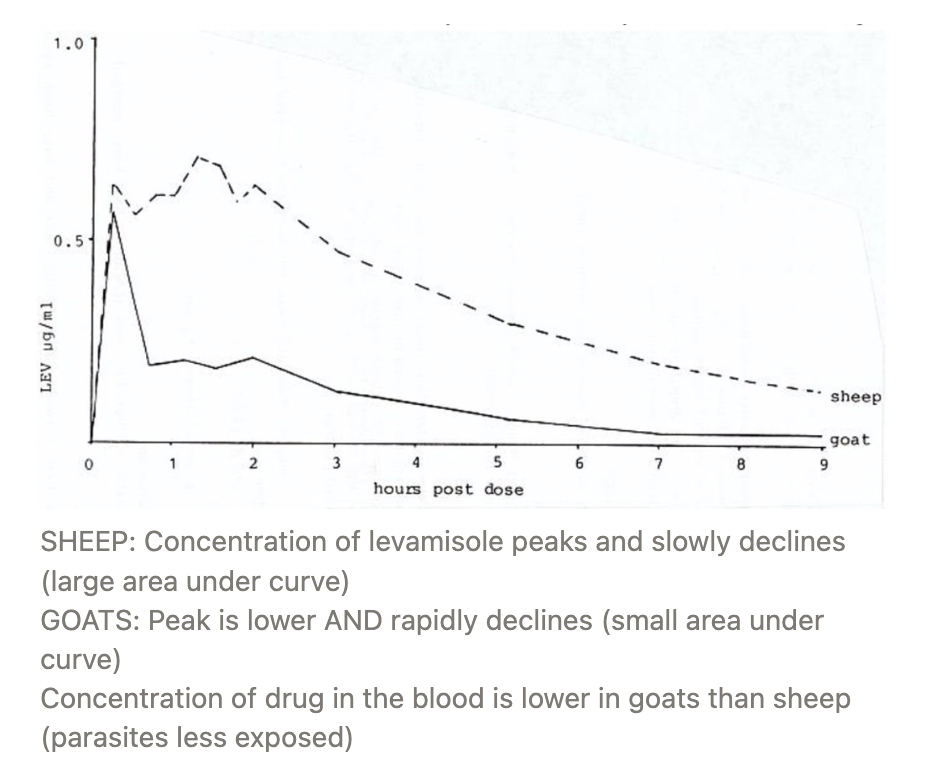
4 Features of parasitism in alpaca
Little known about alpaca parasites but share with sheep AND cattle
Haemonchus → Clinical disease (esp. young alpaca after weaning)
Drench young alpaca ± adult alpaca based on FEC
No licensed alpaca anthelmintic → ALL off-label
Recommend 1.5x sheep dose rates due to rapid metabolism
Teladorsagia circumcincta
Localisation
6 Pathological effects
Localisation: Abomasum of sheep
Pathology: Also Ostertagia in cattle
Larvae enter gastric glands and surrounding mucosa responds with nodular hyperplasia
Parietal/chief cells replaced by goblet cells → Neutral pH and more mucus
Inflammation and oedema
Morocco leather appearance of mucosa
Villous atrophy of small intestine
PLE
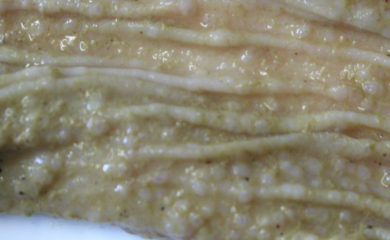
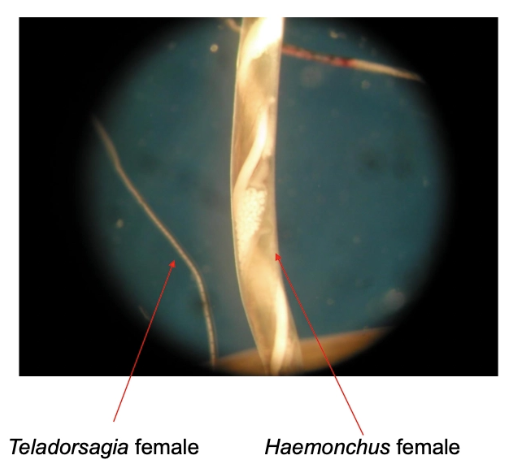
Haemonchus contortus (Barber’s pole)
Localisation
Seasonality
Pathogenesis
3 Clinical Signs
Treatment
Prevention
Localisation: Abomasum of sheep, goats, alpaca ± cattle
Seasonality: Summer - autumn
Pathogenesis: Blood-sucking → Severe anaemia
Overwinters as eL4 in sheep (eggs killed in winter environment)
Prolific egg-layer (10,000 eggs/female/d)
Clinical Signs: No diarrhoea
Anaemia (FAMACHA colour chart → Drenching?)
Bottlejaw (PLE)
± Sudden death
Treatment: Anthelmintic (no AR in NZ) eg. ML
Prevention: Barbax? = Somatic Ag from gut of worms collected from donor sheep
When worms feed on vaccinated animals, Ab binds to gut lining of worms to prevent Hb digestion
Short-lived immunity with regular boosters required
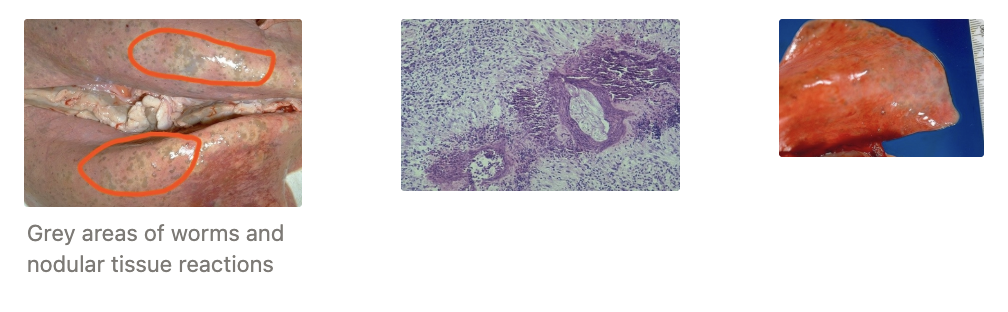
Importance of Muellerius capillaris
Non-pathogenic lungworm of sheep with indirect lifecycle (IH = mollusc)
Pathogenic in goats
PM: Worms deeper in lung tissue and surrounded by nodule of tissue reaction → Grey lesions on the dorsal surface of the lungs
Taenia ovis (Cysticercus ovis)
Importance
4 Management recommendations
Importance: Aesthetic defects in sheep meat (no public health risk) → Downgrading of carcass
No clinical signs in DH or IH
Recommendations:
Appropriate dog feeding (adequately frozen at -10˚C for 10d) → No longer covered by legislation
Praziquantel q1m for dogs
Prevent dogs scavenging carcasses containing cysts
Dog control: Farm dogs, visiting dogs and town dogs should not be allowed on property unless treated with praziquantel
Do NOT recommend farmer treat sheep for metacestodes (results in calcified lesions that do not disappear) OR prevent dogs from defaecating in paddocks
Fasciola hepatica
PPP
Signalment
Seasonality
Lifecycle
IH
4 Requirements
Pathogenesis
Clinical signs
3 Methods of diagnosis
3 Methods of prevention
PPP: ≥8w
Signalment: Sheep, cattle and goats
Adult infection just as common as young animals
Cattle more resistant than sheep and goats
Northland #1
Seasonality: Metacercariae build in Jan (>10˚C) and drop to zero by July
Higher risk in East coast = DRY with green grass in swampy areas only
Lifecycle:
Adult liver fluke located in the bile ducts of the DH lays eggs
Eggs shed in DH faeces and enter water
Eggs develop in water and hatch to release the miracidium (L1)
Miracidium penetrates the snail integument and a mother sporocyst (L2) develops
5 - 12 daughter rediae (L3) develop within the mother sporocyst (asexual reproduction) and burst out to travel to the hepato-pancreas (digestive gland) of the snail
Further asexual reproduction leads to cercariae (L4) production within the daughter rediae (up to 40) and are released in water via a birth pore in the rediae
Occasionally, 2nd generation of rediae
Mother sporocyst > daughter rediae > cercariae = huge proliferation by asexual reproduction in the snail
Cercaria released in water swim to the edge of the water and onto vegetation
Tail is shed and a cyst wall is secreted to become encysted on vegetation as metacercariae (200µm)
Metacercariae ingested by ANY DH on herbage and excyst
Young fluke are released from cysts within the DH small intestine and develop into adults
Immature fluke burrows out of the small intestine and crosses the peritoneal cavity
Penetrate liver capsule (at 1 - 2mm long)
Within the parenchyma for 5 - 6 weeks
Immature flukes are very destructive to liver tissue: Burrow around feeding in the liver parenchyma
Can observe immature liver fluke tracts under the liver capsule during sheep/cattle necropsy (mid - late Summer)
Clostridia: Causes black disease induced by F. hepatica which creates an anaerobic environment in the liver for the C. novyi to develop
Enter bile ducts (1cm long) and take 3 - 4 week to mature
IH: Lymnaea spp. = Freshwater snail
Lymnaea tomentosa (indigenous to NZ) and Lymnaea columella (more widespread and introduced)
Requirements:
Egg development (and larvae in snail) requires ≥10˚C (optimum 25˚C)
Development of miracidium within egg also requires O2 (more that what is in faeces) and water
Development in snail affected by snail nutrition (better fed, less infected = more rediae from each miracidium)
Water/marshy areas that are permanently wet (prevent egg desiccation, facilitate miracidium/cercaria swimming, penetration of aquatic snail and metacercaria must be kept moist to survive on vegetation)
Clinical Signs:
Sheep
Acute: Sudden death
MANY immature fluke migrating through liver parenchyma for first 5 - 6w → Liver failure
Late summer/early autumn
Subacute: Death 8 - 12w ± Jaundice
Liver damage and blockage of biliary system
Late summer/early autumn
Chronic: Anaemia, bottlejaw, weight loss, increased GGT
Adult fluke feed from bile duct lining and blood
Late autumn and winter
Black Disease: Clostridium novyi Type B = Infectious necrotic hepatitis → Acute death from toxaemia
Cattle = Chronic disease as for sheep (+ calcified bile ducts which persist when fluke no longer present)
Black disease and acute disease very rare
Diagnosis: GGT (DDx: FE)
Faecal sediment → ID eggs
Blood/milk ELISA Ab pooled from 10 animals
Becomes negative 3m after treatment
Faecal Ag (overseas)
Prevention:
Triclabendazole #1 = Drench or pour-on for ALL stages of liver fluke in ruminants
1 - 3x over late summer - early winter
Most farmers treat ONCE in winter and rely on there being no overwintering to metacercariae or infected snails
Treatment with nematocidals (eg. albendazole) as some effect but not for immature fluke
Potential for eradication as entire fluke population within animals over winter (August)
Drainage (permanent solution but impractical)
Fencing to prevent sheep grazing marshy areas? Impractical except for small areas
Molluscicides not an option for NZ due to environmental impact
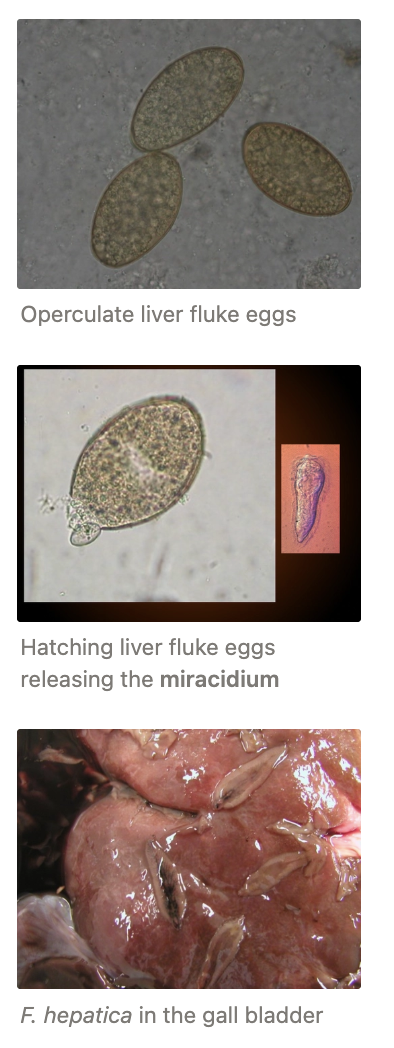
Ostertagia ostertagi
Localisation
2 Types of disease
Signalment and seasonality
Pathogenesis
Diagnosis
Clinical signs
Localisation: Abomasum of cattle
Most pathogenic worm of cattle
Type I Ostertagiosis:
Signalment: Calves in mid - late winter
Pathogenesis: High larval intake/high worm burden
Diagnosis: FEC
Type II Ostertagiosis:
Signalment: Yearling or 2yr cattle in spring
Pathogenesis:
Cattle graze highly contaminated pasture in autumn
Accumulation of inhibited eL4 in gland crypts of the abomasum heading into winter (worsening climate) = Hypobiosis → No clinical signs
Larvae resume development in early spring → En mass emergence
Clinically affected cattle due to damage to abomasal mucosa
Diagnosis: Plasma pepsinogen assay (cannot diagnose with FEC as L4 cause disease NOT adults)
Clinical Signs: Diarrhoea, dehydration, bottlejaw, inappetence, weight loss and death
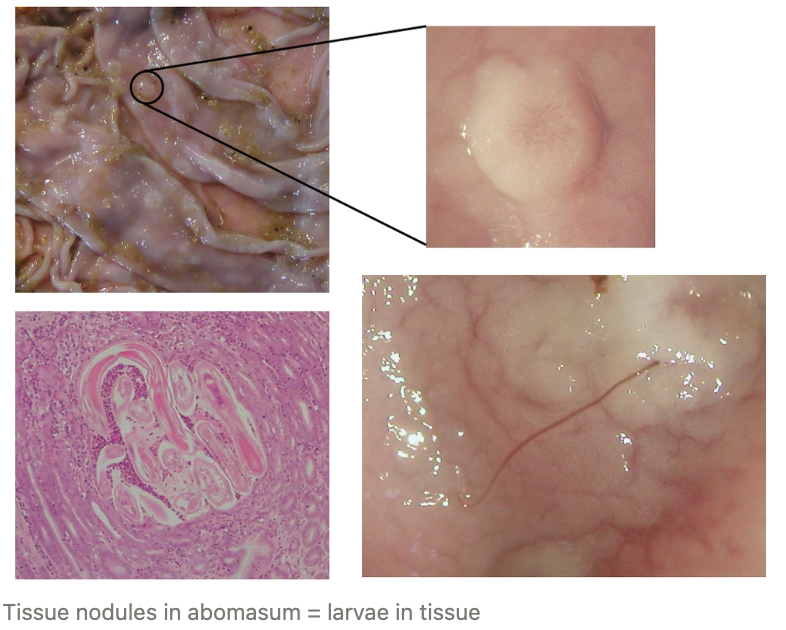
Cooperia oncophora
Importance
Signalment
Localisation
Resistance
Importance: Less pathogenic than Ostertagia (does not kill, but causes decreased GR)
Signalment: Immunity develops quickly (solid by 12 months)
Location: Small intestine
AR: Very frequent resistant to ML anthelmintics
Poor-on drenches very common: just single ML
Most commonly-used anthelmintics in cattle
Nematodirus
Localisation
Lifecycle features
Localisation: SI of ruminants
Lifecycle: Develop into [L3] within egg
Slow development rate and survive at low temperatures
Requires chilling before hatching
Pathogenesis: Bigger issue in cold climates in spring (eg. Southland) as overwinters in high numbers (eggs resistant to cold)
![<p><u>Localisation:</u> SI of ruminants</p><p><u>Lifecycle:</u> Develop into [L3] within egg</p><ul><li><p>Slow development rate and survive at low temperatures</p></li><li><p>Requires chilling before hatching</p></li></ul><p><u>Pathogenesis:</u> Bigger issue in cold climates in spring (eg. Southland) as overwinters in high numbers (eggs resistant to cold)</p>](https://assets.knowt.com/user-attachments/2e201b7a-17fe-48b7-a9ea-e0be26c16117.png)
Lungworm
2 Examples
Lifecycle
PPP
2 Methods of diagnosis
Examples:
Dictyocaulus viviparus (cattle)
Dictyocaulus eckerti (deer)
Lifecycle:
Adults mate in bronchioles and trachea
Females produce embryonated eggs which hatch L1 within the lungs → Pharynx → Swallowed
L1 exits faeces → L2 → [[L3]]
4 days
[[L3]] NOT very mobile and hence lots in one place on pasture
[[L3]] = infective stage and ingested by cattle/deer
[L3] exsheaths and burrows through SI to undergo lymphatic-pulmonary migration (lymphatics → thoracic duct → heart → lungs)
PPP: 4w
Diagnosis: History and clinical signs →
PM exam = Trachea full of worms with thickened mucus and exudate
Powerful way to show farmer evidence → Prompt treatment
Baermann’s faecal larval count = Count L1 in faeces
Method:
Wrap faeces in double gauze swab and place into glass funnel with water
Leave overnight to allow larvae to migrate out of faeces and drop into red tube
Release clamp to allow larvae to fall into container
Count larvae under dissecting microscope
2g faeces with 50 larvae = 25 larvae/g
-ve: Counts may not represent parasite burden
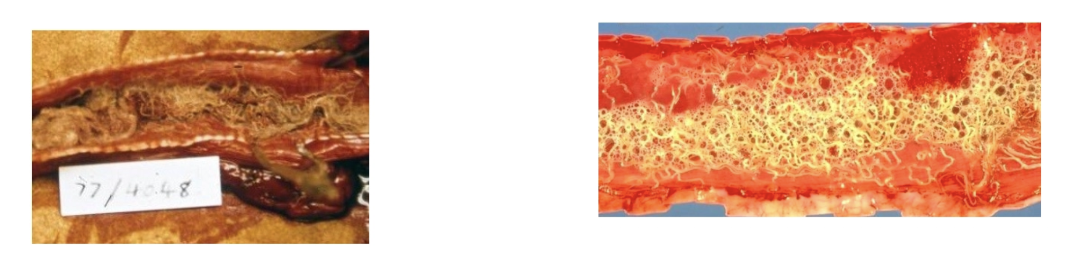
![<p><u>Examples:</u></p><ol><li><p><em>Dictyocaulus viviparus </em>(cattle)</p></li><li><p><em>Dictyocaulus eckerti</em> (deer)</p></li></ol><p><u>Lifecycle:</u></p><ol><li><p>Adults mate in bronchioles and trachea</p></li><li><p>Females produce embryonated eggs which hatch L1 within the lungs → Pharynx → Swallowed</p></li><li><p>L1 exits faeces → L2 → [[L3]]</p><ul><li><p>4 days</p></li><li><p>[[L3]] NOT very mobile and hence lots in one place on pasture</p></li></ul></li><li><p>[[L3]] = infective stage and ingested by cattle/deer</p></li><li><p>[L3] exsheaths and burrows through SI to undergo lymphatic-pulmonary migration (lymphatics → thoracic duct → heart → lungs)</p></li></ol><p><u>PPP:</u> 4w</p><p><u>Diagnosis:</u> History and clinical signs →</p><ol><li><p>PM exam = Trachea full of worms with thickened mucus and exudate</p><ul><li><p>Powerful way to show farmer evidence → Prompt treatment</p></li></ul></li><li><p>Baermann’s faecal larval count = Count L1 in faeces</p><ul><li><p><u>Method:</u></p><ol><li><p>Wrap faeces in double gauze swab and place into glass funnel with water</p></li><li><p>Leave overnight to allow larvae to migrate out of faeces and drop into red tube</p></li><li><p>Release clamp to allow larvae to fall into container</p></li><li><p>Count larvae under dissecting microscope</p></li></ol></li><li><p>2g faeces with 50 larvae = 25 larvae/g</p></li><li><p><u>-ve:</u> Counts may not represent parasite burden</p></li></ul></li></ol><img src="https://assets.knowt.com/user-attachments/b331b0b8-d718-4970-89ce-11a109278d4d.png" data-width="75%" data-align="center"><p></p>](https://assets.knowt.com/user-attachments/d7f783bd-73a6-47cd-ba27-2ffb66d1461d.png)
Dictyocaulus viviparus
Signalment
Seasonality
4 Clinical signs
Treatment
Prevention
Signalment: Calves <10m (esp. dairy calves)
Less common due to widespread use of anthelmintics to treat GI parasites
Infection common, disease uncommon due to strong immune response to migrating parasites
Seasonality: Late summer and autumn
Sporadic outbreaks of disease due to unique epidemiological factors that allows naive animals to be suddenly exposed to huge numbers of infective [[L3]]
Clinical Signs: 3w post-infection of [L3] → Verminous pneumonia
Coughing, tachypnoea and dyspnoea (“Husk”)
Weight loss
Death
± 2˚ bronchopneumonia
Treatment: ALL common drugs (no AR)
LA ML injectables #1
Prevention: NONE! Farmer does not think about D. viviparus as killed with more important GI nematodes
Huskvac vaccine = Irradiated L3 PO x2 doses 4w apart before being turned onto pasture in UK
![<p><u>Signalment:</u> Calves <10m (esp. dairy calves)</p><ul><li><p>Less common due to widespread use of anthelmintics to treat GI parasites</p></li><li><p>Infection common, disease uncommon due to strong immune response to migrating parasites</p></li></ul><p><u>Seasonality:</u> Late summer and autumn</p><ul><li><p>Sporadic outbreaks of disease due to unique epidemiological factors that allows naive animals to be suddenly exposed to huge numbers of infective [[L3]]</p></li></ul><p><u>Clinical Signs:</u> 3w post-infection of [L3] → Verminous pneumonia</p><ol><li><p>Coughing, tachypnoea and dyspnoea (“Husk”)</p></li><li><p>Weight loss</p></li><li><p>Death</p></li><li><p>± 2˚ bronchopneumonia</p></li></ol><p><u>Treatment:</u> ALL common drugs (no AR)</p><ul><li><p>LA ML injectables #1</p></li></ul><p><u>Prevention:</u> NONE! Farmer does not think about <em>D. viviparus</em> as killed with more important GI nematodes</p><ul><li><p>Huskvac vaccine = Irradiated L3 PO x2 doses 4w apart before being turned onto pasture in UK</p></li></ul><p></p>](https://assets.knowt.com/user-attachments/b5ea43f3-943f-4dd9-8cfa-80fe6a7eb865.png)
Dictyocaulus eckerti
Signalment
Seasonality
3 Clinical signs
Treatment (+ risk)
3 Methods of prevention
Signalment: Weaners <1yr (adults immune)
Higher risk in intensive, single-species grazing (sheep or cattle) with no alternative crops/forages
No drench or larval flotation history
Seasonality: Autumn and early winter = Warm and wet conditions to facilitate [L3] survival on pasture
Clinical Signs: ≤20% mortality rate with sudden death
Scruffy weaners with reduced GR
± Soft cough with stress/exercise/yarding (mask clinical signs vs. cattle)
± Slight increased moist lung sounds on auscultation
Treatment: Some products licensed for deer
ML = Highly effective but persistent activity
Lev = NOT good for deer lungworm
BZ = Shorter drench interval
Cervidae = Triple combination in deer
Risk: High burden → Death after treatment (dead worms block trachea)
WARN farmer of this risk
Prevention:
Preventative drench program x5 q28d
Start: PRIOR to weaning in Feb/March to reduce early autumn pasture contamination
Cross-grazing with sheep, cattle OR older deer
Alternative forages
Oesophagostomum sikae
Signalment
Localisation
Pathogenesis
Signalment: Young deer in autumn
Location: Large intestine
Pathogenesis: Simultaneous emergence as for Type II ostertagiosis → Reduce GR in autumn
4 Types of protozoan (+ examples)
Amoebae
Ciliates = Rumen commensals
Flagellates
Trichomonas foetus
Giardia spp.
Apicomplexan = Highly evolved obligate parasites
Coccidia (Eimeria and Isospora spp.)
Cryptosporidium spp.
Toxoplasma gondii (see “Sheep”)
Neospora caninum
Theileria orientalis strain IKEDA (see “Systemic Diseases”)
Trichomonas foetus
Agent
Prevalence
Source of infection
Transmission
Clinical sign
3 Methods of diagnosis
Agent: Trichomonas foetus = Flagellate protozoan with 3 forward-facing flagella and 1 posterior
Reproduce via binary fission
Prevalence: Uncommon in NZ, but historical outbreak on East Coast
Source: Bull genital tract (no disease but infected for life) → Cull
Transmission: Naive cow infected by bull during coitus (esp. heifer)
T. foetus multiplies in vagina causing vaginitis
Travels through cervix to uterus and destroys the placenta
Clinical Sign: Abortion 6 - 8w after natural mating → Late return to service
Diagnosis:
Flush prepuce with saline or growth media for PCR (also foetus and vaginal discharge)
Ab detected in vaginal.cervical mucus
Treatment: Cows spontaneously clear infection
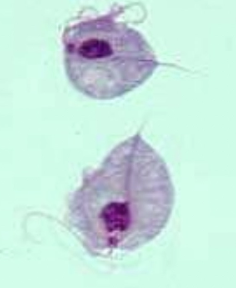
Coccidiosis
Agents/clinical signs
Cattle
Sheep
Goat
Pig
Signalment
5 Risk factors
Lifecycle
2 Methods of diagnosis
3 Treatments
Agent/Clinical Signs:
Cattle = Eimeria bovis/zurnii
Often complicated by BVD
Large bowel diarrhoea (± mucosal strips in faeces and fresh blood), tenesmus
11 other non-pathogenic Coccidia spp.
Sheep = E. ovinoidalis
Often concurrent with other enteric infection
Rare clinical disease in NZ as lambs exposed to low level of infection → Immunity without disease
Goat = 1 - 2 highly pathogenic
Often complex with nematodes and Yersinia
Pig = Cystoisospora suis
Pasty diarrhoea (no haemorrhage)
NOT fatal, but reduced GR
Signalment: Young animals
Calves <6m
Lambs <2 - 4m
Goats young AND old
Piglets 1 - 2w
Risk:
High density of young animals
Warm and moist conditions (eg. leaking water trough with defaecation and pugging)
Underfeeding
Poor hygiene in calf pens
Normal conditions with good management: Young animals exposed to few oocysts and develop effective immunity within 1 - 2 weeks with NO clinical signs
Coccidiostats in milk replacer → No immunity → Post-weaning coccidiosis
Lifecycle:
Oocyst passed in faeces (unsporulated)
NOT infective when first shed
Contains a sporont = single-cell zygote state
Environmental resistance with thick wall
Sporulation (SPOROGONY) = Sporont develops into sporocysts which contain sporozoites → Infective oocyst
Cystoisospora = 2 sporocysts each with 4 sporozoites
Eimeria = 4 sporocysts each with 2 sporozoites
Ingestion of sporulated oocyst and liberation of sporozoites which penetrate intestinal epithelial cells
1st PHASE OF SCHIZOGONY = Asexual reproduction and host cell ruptures to produce numerous schizozoites
2nd PHASE OF SCHIZOGONY = Asexual reproduction
GAMETOGONY = Sexual phase. 2nd gen schizozoites invade cells and differentiate into:
ONE macrogametocytes (female)
Many motile microgametocytes (male) which leave the host cell to seek the macrogamete
FERTILISATION = Oocyst formation which contains a zygote
Unsporulated oocyst released from host
Diagnosis:
Very high oocyst count in faeces (cattle > 100,000/g)
PM and mucosal scraping to ID schizonts, gametocytes and oocysts in large numbers
Treatment:
Supportive care (fluids and electrolytes)
Remove animals from contaminated environment
Coccidiostat/coccidiocide
Polyether ionophores (eg. Lasalocid or monensin) = Milk replacer/calf meal
Amprolium = Avian drinking water or oral drench
Sulphonamides ± pyrimidine for synergism
Fluoroquinolones
Toltrazuril (Baycox) = ONLY curative option (coccidiocide)
Cryptosporidium parvum
Signalment
Seasonality
Lifecycle
Oocyst structure
Clinical signs
3 Methods of diagnosis
Treatment
Signalment: Calves <10d AND humans
Seasonality: Spring peak in humans associated with calving (summer peak associated with C. hominis)
Lifecycle:
Calf ingests oocyst which liberates sporozoites
Sporozoites invade microvillus brush border of GIT to carry out:
2 cycles of schizogony
Gametogony
Sporulation while oocyst still in microvillus
Oocyst becomes immediately infective to another/SAME host
Oocyst: 4 free-floating sporozoites with acid-fast cell wall
Immediately infective (infective dose only requires 1 - 10 oocysts due to autoinfection)
Highly resistant in environment (accumulate in calf shed)
Clinical Signs: Atrophy and fusion of intestinal villi → Neonatal diarrhoea
Diagnosis:
Ziehl-Neelsen stain on faecal float to ID oocysts
Faecal PCR
PM histopathology ASAP (brush border deteriorates rapidly)
Treatment: Supportive care ONLY and remove animal from infected environment
Anti-cryptosporidials??? eg. Beta-cyclodextrin, paramomycin (aminoglycoside) or halofuginone (Halocur)
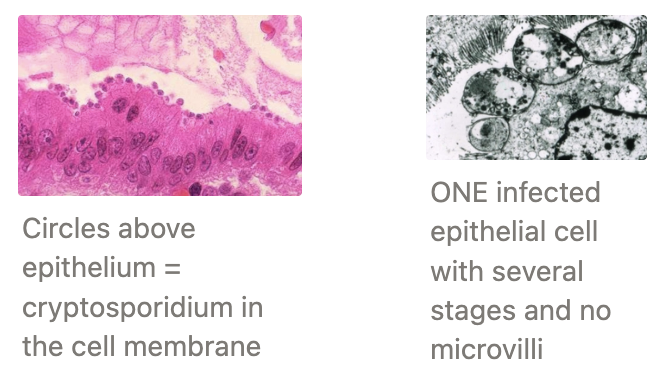
Neospora caninum
Lifecycle
2 Methods of transmission in cattle
3 Clinical outcomes in cattle
Diagnosis
Prevention
Lifecycle: DH = Dog (HL paralysis in puppies) and IH = Cattle
Dog (DH) passes unsporulated oocysts in faeces
Oocysts sporulate to produce sporozoites
Sporozoites liberated when cow (IH) ingests pasture contaminated with dog faeces
Sporozoites infect GI cells →
Tachyzoites invade ALL tissues (esp. CNS and myocardium)
Bradyzoites
Tachyzoites invade the placenta and foetus → Placentitis and inflammation
Abortion
Dog infected by ingestion bovine placenta containing bradyzoite cysts
Transmission:
Horizontal transmission = Ingestion of oocysts from dog faeces (epidemic neosporosis)
Vertical transmission = Congenital infection via immunosuppression late gestation → Bradyzoite reactivation (endemic neosporosis = maintain infection in herd without dog)
Cattle: Abortion
No clinical signs in cow and no gross lesions
Early gestation infection (<5m) = Abortion
Late gestation infection = Calf born clinically normal, but infected
Infected cows repeatedly give birth to congenitally infected calves (70 - 80% of pregnancies)
Congenitally infected heifers have higher chance of abortion during 1st pregnancy
Diagnosis:
Serology IFAT/ELISA Ab (titres decline after 2 - 3m, but cows with recent abortion have high titres)
Histopathology of placenta, foetal brain and myocardium
PCR on fresh foetal stomach
Prevention: None? No vaccination available
Haemaphysalis longicornis
6 Effects on deer/cattle
Structure
Location on host
Cattle
Sheep
Deer
Dogs/cats
Distribution in NZ
Lifecycle
Habitat of ticks
Diagnosis
3 Methods of prevention
Deer/Cattle:
Mortality of newborn fawns (adult ticks at highest numbers in summer = same time fawns hide in pasture)
Death by exsanguination/anaemia
Hide damage (~10% wet blue hides with tick damage → 1/4 downgraded)
Velvet antler damage by adults (late November)
Reduced growth and production
Papulonodular lesions, variable pruritus and pain
Transmission of Theileriosis
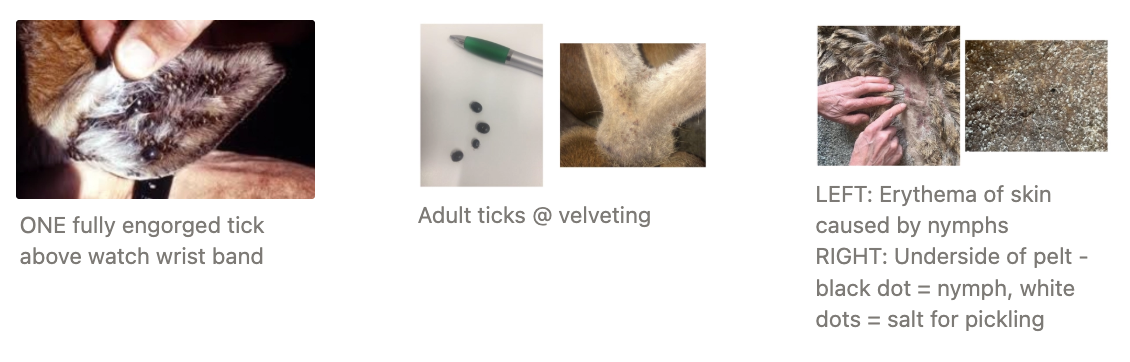
Structure: 3 lifestages = Larvae, nymph, adult (only nymph and adult transmit Theileria)
Larvae = 6 legs
Nymph = 8 legs
Adult = 8 legs
Location: Areas with thin coat and skin close to ground
Cattle = Ventrum, udder and head
Sheep = Non-fleeced areas of axilla, groin, face ad ears
Deer = Ears and antlers
Dogs/Cats = Ears, interdigital areas and under jaw
Distribution: Northern parts of North Island (unfed nymph best adapted to overwinter and require mild conditions to survive)
Annual mean temp > 12˚C
July max > 12˚C and July min > 2˚C
< 50 ground frosts/yr
Lifecycle: Three-host tick = Each stage of lifecycle (larvae, nymph and adult) feeds on separate host animal
Nymph climb onto host and engorge on blood (August - October)
Nymph drops to ground when full and moults to adult stage
Adult climbs onto another host and engorges on blood (November - January)
Adult drops to ground to lay eggs in sheltered and moist spot
ONLY females in NZ → Reproduce via parthogenesis
Larvae emerge from egg and climb onto host (February - March)
Larvae engorge on blood for ~5d
Larvae drop to ground and moult to nymph stage which overwinters unfed
Habitat: Dense grass, scrub, rushes, long grass = same habitat as fawn hiding places
Diagnosis: Easy to see adult ticks on PE
Assess pastures with towel or “indicator animal” eg. sheep or light-coloured dog grazed through pasture
Control:
Pasture management = Reduce “tag” and dead matter which nymph live in over winter
Chemical
Pour-on bayticol (1% flumethrin) = 21d protection with repeat treatment q3w during 3 waves of ticks
Begin before calving
Ear tags impregnated with synthetic pyrethroids (some transfer from hinds to fawn)
Reduce paddock burden with sheep as “cleaners”
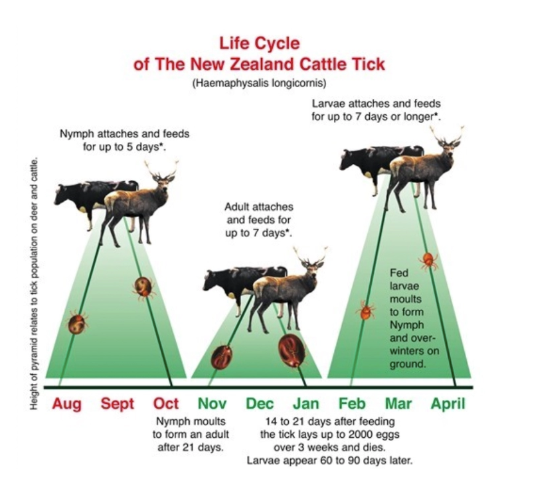
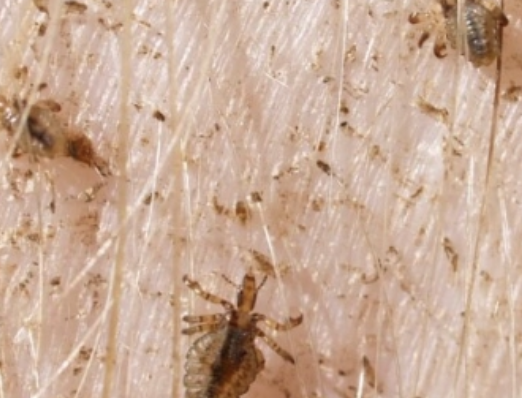
Lice
2 Types (+ genera examples)
Lifecycle
Seasonality
Transmission
Aim of treatment
Types:
Biting louse = Head wider than thorax with ventral mouthparts
Bovicola spp.
Trichodectes canis
Felicola subrostratus
Sucking louse = Head narrower than thorax with anteriorly projecting mouthparts
Haematopinus spp.
Linognathus spp.
Solenopotes spp.
Lifecycle: Can complete entire lifecycle on ONE host
Males and females mate
Nits = Operculate eggs cemented to hair shaft (easily seen with naked eye)
1st nymph stage hatches after 1 - 3w
TWO more nymphal stages via gradual metamorphosis
Seasonality: Winter peak (thick coat with more stable environment and temperature)
Transmission: Direct contact
Treatment: Kill ALL lifestages ASAP during treatment (may require 2nd treatment if 1st treatment cannot penetrate eggs)
Sheep Lice
3 Agents
Prevalence
Location
Type of louse
3 Effects
Diagnosis
Treatment
Species:
Species | Prevalence | Location | Type |
|---|---|---|---|
Bovicola ovis | Very common (#1 species) | Body louse | Biting louse |
Linognathus pedalis | Uncommon | Feet and legs | Sucking louse |
Linognathus ovillus | Rare | Head | Sucking louse |
Effects:
Pruritus (movement of lice over skin)
Damage to fine wool breeds (eg. Merino)
Broken fibres, change in colour (increased yolk/lanolin)
Cockle = Small hard nodules on partly processed pelt (recurrent type I hypersensitivity to B. ovis)
Diagnosis: Assess if sheep have lice by looking for stringy pulls of wool hanging from the animal or off fencing where they have been scratching
Treatment:
Shearing along can remove up to 80% of lice
Eradication possible with modern insecticides (low biotic potential and ONLY found on host)
Treat BEFORE winter (difficult to coordinate with shearing) to prevent peak

Cattle Lice (Pediculosis)
2 Agents
Signalment
Seasonality
Type of louse
Location
4 Effects
Treatment
Species:
Species | Signalment | Seasonality | Type |
|---|---|---|---|
Bovicola bovis | Beef cattle | August - September | Biting louse |
Linognathus vituli | Dairy cattle | June - July | Sucking louse |
Effects: Anaemia uncommon and seldom clinically apparent
No significant effects of growth rates
Welfare and aesthetic problem (pruritus, alopecia, poor hair coat)
Hide damage
Bulls kept in paddocks with electric fencing → Forced to rub on each other → Fighting
Location: Above withers
Treatment: No economic benefit
Autumn (before numbers build in winter) q14 - 21d to kill newly hatched lice which were not killed within egg on 1st treatment
ML common due to GI nematode control
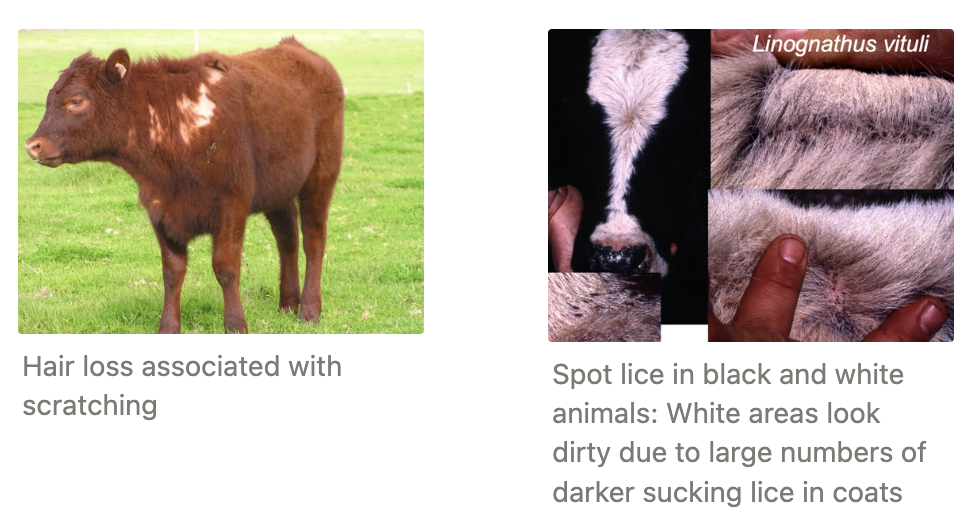
Pig Lice
Agent
Effects
Treatment
Species: Haematopinus suis = Sucking louse
Largest domestic louse species
Pig hairs are coarse and far apart
Effects: Irritation and anaemia proportional to numbers present
Symptom of poor husbandry in backyard piggeries and lifestyle blocks
Treatment: Repeat treatment q10 - 14d (very hard to get drug to persist on sparsely haired pig skin)
Mites
Lifecycle
Main mite of livestock
Host
Prevalence
Location
Clinical effects
Diagnosis
Treatment
Lifecycle: Entire lifecycle on animal with gradual metamorphosis
Egg → Larvae (6 legs) → Nymph 1 - 3 (8 legs) → Adult (8 legs)
Agent: Chorioptes bovis → Chorioptic mange
Host: Horse, cattle, sheep, goat
Prevalence: 72%
Location: Legs, tail, scrotum, udder
Clinical Effects: Reduced fertility in rams (>1/3 of scrotum affected) with hypersensitivity reaction
Rare disease of cattle (housed ONLY in winter) → Pruritus, crusting and alopecia
Few mites required to cause disease due to allergic reaction
Diagnosis: Scratch affected area with gloved hand and assess if ram nibbles with mouth
Treatment: Injectable ML (oral ineffective)
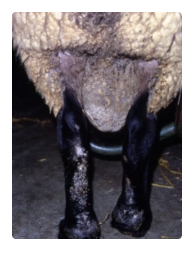
Flystrike
Prevalence
Seasonality
Importance (3)
Prevalence: Common even with preventative methods (~1 - 2%/yr)
Some farms ≤10%
Seasonality: Warm and wet conditions
North Island = Oct - May (Dec - Mar #1)
South Island = Nov - Apr
Importance:
Production cost
Welfare cost = Code of Welfare for Sheep and Cattle section 15
All reasonable steps must be taken to prevent, or identify and manage the risk of flystrike in sheep
Sheep cannot control flies due to wool → Rely on humans to protect them
Affected sheep must receive appropriate treatment at the earliest opportunity
Increased pressure from international markets and NZ public to reduce/rationalise use of ectoparasiticides BUT less tolerance for cases of flystrike
TWO types of Strike Flies (+ examples and appearances)
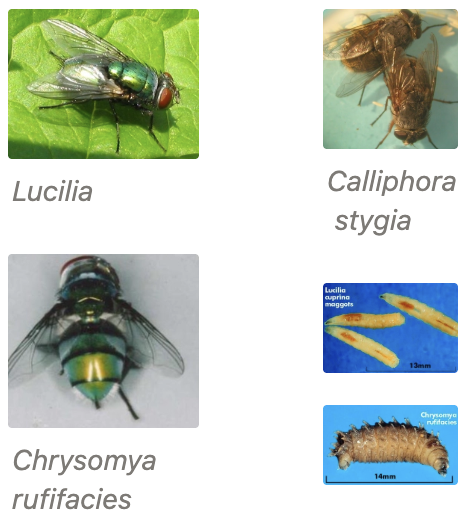
Agents: Family = Calliphoridae (Blowflies)
PRIMARY Strike Flies (1y) = Initiate strike through intact skin (OR act as 2y)
Lucilia sericata = Greenbottles
Lucilia cuprina = Australian blowfly
Can adapt to live almost exclusively on sheep (cannot compete with other flies for carrion)
Calliphora stygia = Black body with fine brown hairs
SECONDARY Strike Flies (2y) = Require pre-existing wound
Chrysomya rufifacies = Hairy maggot fly
Greenbottle with black bands
ONLY in North Island
Other Calliphora spp. = Bluebottles
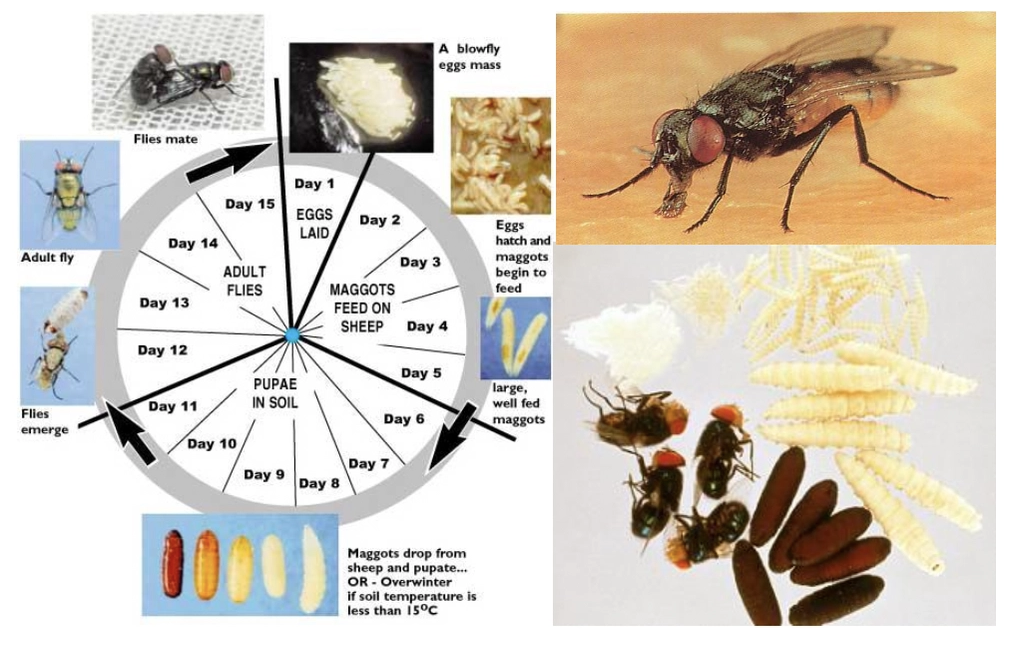
Lifecycle of Calliphoridae (Blowflies) → Flystrike
Generation interval: 7 - 10d in optimal conditions
Adult blowfly feeds on organic material and reproduce via sexual reproduction
Female lays eggs in shaded/moist areas
eg. Carrion, live animals, decaying vegetation
Eggs and larvae prone to desiccation
Eggs hatch in 1d and L1 larvae begin to feed on surrounding nutrition
→ L2 which penetrates skin allowing wound to expand rapidly
→ L3 fall to ground to pupate within the soil
Complete metamorphosis in puparium (3 - 4w)
OR overwintering as pre-puparium = Diapause
Adult emerge from puparium and feed on protein source
Sexually mature in 2d
Flystrike
Pathogenesis
5 Areas commonly affected
6 Risk factors
Pathogenesis: Wool provides perfect microclimate for fly eggs and maggots
Risk factors = Dags, wounds and footrot → Olfactory trigger to attract flies
Maggots bite sheep causing inflammatory response resulting in leakage of fluid (electrolytes and protein) which attracts more flies
Fluid runs down sheep and causes lesions to spread
Areas:
Crutch/breech #1 (reliably contaminated with faeces ± urine in ewes) ~80% of flystrike
Dorsum
Fleece rot = Pseudomonas aeruginosa
Release proteolytic enzymes → Dermatitis → Localised serum ooze → Olfactory cue and nutrient source for L1 larvae)
Dermatophilus congolensis in rain/humid conditions → Dermatitis → Serous exudate and scab formation → Nutrient source for L1 (even when skin has healed)
Feet (footrot)
Pizzle (rams)
Head (fighting rams)
Risks:
Dags
Footrot
Wounds (eg. head-butting or shearing wounds)
Fleece length >4w → Moist and protected
Fleece conditions causing extra smell (eg. bacterial/fungal disease)
Genetic predisposition
Clinical signs of flystrike in sheep
8 Clinical signs
3 Clinical signs after treatment
Clinical Signs: Death due to dehydration or toxaemia
Brown staining of wool → Deranged and falling out
Irritation = Stamping feet, looking at self and quickly running forwards a few steps then stopping, nibbling at affected area
Maggots visible on close inspection of the area
Depression and shade-seeking
Reduced BCS (not eating)
Dehydration due to fluid, electrolyte and protein loss
± Recumbency
Distinct flystrike smell
AFTER Treatment:
Sunburn of affected area (scarring)
Medium-term production loss (eg. severe effect on lamb GR)
Affected ewes non-pregnant that breeding season
8 Flystrike treatments
Remove affected wool (NOT at skin level as sunburn is a common sequelae)
Remove maggots by manual removal
Application of ectoparasiticides licensed to kill maggots (OPs)
Rehydration with access to high quality feed and water
Access to shade
NSAIDs for anti-inflammatory and analgesia
± Antibiotics due to 2˚ bacterial infection → Bacteraemia (fever and depression)
Euthanasia if depressed or extensive lesions
List 3 ways to control for flystrike
Monitoring = Knowledge of risk periods via local knowledge, monitoring climatic conditions and fly activity through fly traps
Non-chemical control methods
Chemical control
Even with careful use of non-chemical control methods, it is very difficult to control flystrike in most areas of NZ without use of ectoparasiticides
Key is strategic and effective use
→ Apply dip chemical ~4 weeks after shearing = Sufficient fleece to bind the chemical and retain it for longer BUT fleece still short enough that flystrike should not occur before the chemical is applied
8 Examples of non-chemical control method for flystrike
Ensure lamb tails are docked to correct length = Long enough to cover the vulva of ewe lambs and equivalent length in ram lambs
+ve: Reduce build up of faecal matter (dags) = Important risk factor for flystrike as smell attracts flies and the daggy area itself is humid and moist → Perfect maggot conditions
Docked too short →
Exposure of the perineum to sunlight and sunburn
Nerve damage and neuroma
Docked too long → Defeats the purpose of docking
Crutching and dagging to remove soiled wool
Shearing at strategic times = Early summer
Ensures 4 weeks of flystrike protection during high-risk period AND application of chemical at optimum time to an optimum fleece length
May NOT be feasible or desirable time depending on farm
Also issues with shearer availability during this busy period
Control footrot and rapidly treat other wounds
ID areas of farm with high challenge (warm, sheltered areas eg. bush margins, gullies and avoid grazing those areas during periods of high risk)
Areas of lower risk = Exposed and windy paddocks
Limit fly populations by disposing of dead carcasses ± use of large fly traps
Shedding sheep (eg. Wilshire, “easy care”) or hair sheep breeds → Reduce requirement for shearing and less prone to flystrike
Genetic selection for low dag score (linked to resistance and resilience to internal parasites)
2 Types of ectoparasiticide MoA
Target arthropod nervous system → Uncoordinated movement/paralysis and eventual death
Interfere with growth/moulting → Eggs cannot hatch and larvae cannot moult or pupate
Interferes with growth hormones OR
Interferes with chitin synthesis
6 Ectoparasiticides
Advantages
Disadvantages
Drug | Advantages | Disadvantages |
Organophosphate (OP) |
|
|
Insect growth regulators (IGR)
|
|
|
Ivermectin |
| Only available in combination formulation |
Synthetic pyrethroid (SP) | Cheap |
|
Spinosyn |
| Very short period of protection against fly (mainly use for lice control) |
Neonicitinoid | Included in some combinations to provide treatment of existing flystrike |
|
5 Methods of Ectoparasiticide Application
Advantages
Disadvantages
Method | Advantages | Disadvantages |
Plunge dip (rare in NZ) | Full saturation of whole sheep |
|
Shower dip (infrequent in NZ) |
|
|
Automated jetting races (#1 in NZ) |
|
|
Hand jet |
|
|
Low volume pour-on/spray-on (Common (esp. lambs) around breech/crutch at docking) |
|
|
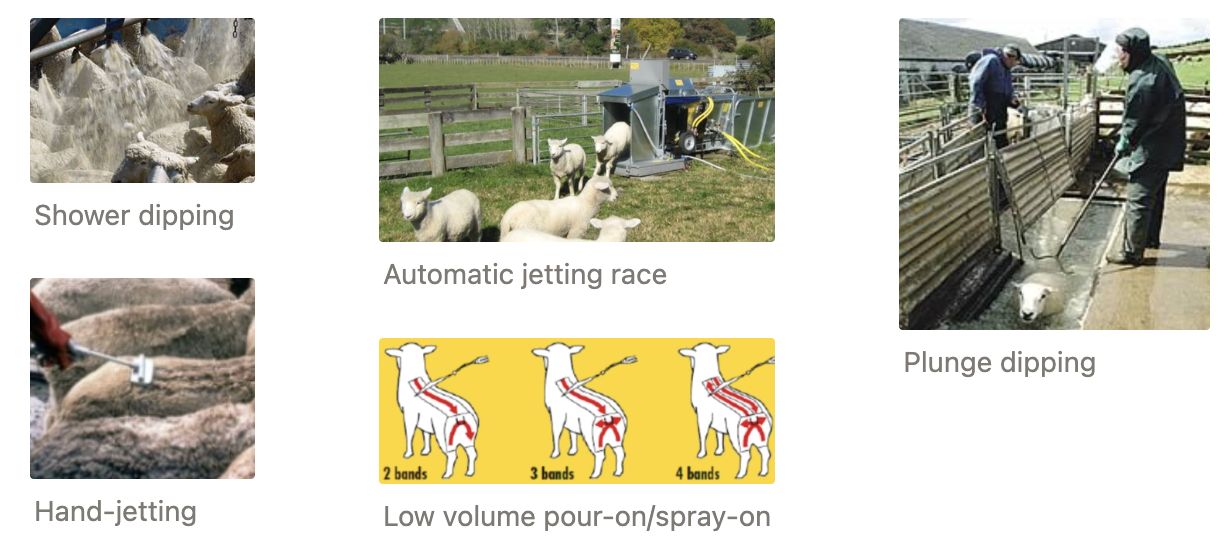
9 Factors which influence protection periods of ectoparasiticdes
Label claim for protection periods are NOT always accurate as influenced by many factors
Application method
Correct mixing/concentration and appropriate dosage applied for size of sheep and wool length
Correct applicator with label-recommended application pattern
Stock class
Wool type and length
Stock cleanliness
Wet fleece at time of application
Rainfall after treatment
Resistance to the chemical → Reduced protection periods
EXAMPLE: Hamilton early February with 1500 ewes and 1300 lambs (plus cattle)
12 ewes and 50 lambs with active flystrike and several of each age group dead
Sheep were dipped with products purchased from the vet clinic
Lambs received spray around crutch after docking in late-October with Clik Extra Spray on (dicyclanil = IGR))
Protection for 14 - 26 weeks
Applied at dose rate as per label instruction and lambs were dagged and weaned in mid-December but yet to be shorn
Ewes shorn in late December and dipped a week later in early January with Zenith (diflubenzuron = IGR) with Electrodip (automatic jetting race)
Protection for ≤12 weeks
Questions:
Good aspects of flystrike prevention
Bad aspects of flystrike prevention
Reasons for flystrike
Describe an appropriate flystrike control programme
Good Aspects:
Lambs dagged in mid-December → Reduce risk of dags accumulating which is a risk for flystrike
Lambs sprayed around crutch at docking (open wound)
Ewes shorn in risk period
Appropriate dip method for ewes
Bad Aspects:
Lambs not yet shorn in February and did not receive a dip → Longer fleece and high flystrike risk
Dagged shortly after drug application to crutch → Removal of product
Interval between shearing and treatment of ewes with ectoparasiticides is too short (ideal ~4 weeks) to ensure there is sufficient fleece growth for drug to adhere to the wool for longer duration of action
Lack of monitoring (ideally q3d)
Reasons for Flystrike:
Waning drug protection during highest risk period of flystrike
Drug resistance (esp. Zenith)
Protection UP TO…
Extremely high risk farm: Early February in Hamilton = Warm and humid
Lack of monitoring
Lack of lamb flystrike prevention
Appropriate Flystrike Control Programme:
Spray lamb crutch at docking with shorter-acting drench (will dagging in a few months time)
Pre-wean crutch or dag for ewes
Weaning → Dagging (consider drafting out and dagging dirty sheep only)
Ewe shearing during risk period and dip 4 - 6 weeks later
Dip ± shear lambs early January (after weaning to prevent stress)
Rotation of chemicals to avoid resistance developing?
Monitor q3d