Basics of metabolism + balancing act SDL
 Call Kai
 Learn
Learn Practice Test
 Spaced Repetition
 Match
Match Flashcards
 Knowt Play
1/74

There's no tags or description
Looks like no tags are added yet.
Name | Mastery | Learn | Test | Matching | Spaced | Call with Kai | Chat |
|---|
No analytics yet
Send a link to your students to track their progress
75 Terms
Define metabolism
the overall process through which living organisms acquire and use free energy to carry out various functions
what are the 2 categories of metabolic processes
catabolic
anabolic
what are metabolic pathways
a series of connected enzymatic reactions that produce specific products
what catalyses metabolic pathways?
enzymes
what helps reduce the formation of useless/toxic by-products of metabolic reactions?
high specificity of enzymes, ensuring efficiency of reactions
what are 6 categories of enzyme reactions?
oxidation-reduction
transfer of chemical groups
hydrolysis
removal of chemical groups
linking two groups together
isomerisation
how are enzymes regulated in metabolic pathways?
by monitoring the effects that the changes in enzyme activity has on the whole metabolic pathway.
what are the 2 levels of control of metabolism?
intrinsic
extrinsic
what is involved in intrinsic regulation of metabolic pathways
feed forward and feedback mechanisms - self regulation in response to change in levels of substrate or products
what is involved in extrinsic control of metabolism
a cell in a multicellular organism changing its metabolism in response to signals from other cells
define catabolism
the breakdown of large organic molecules into smaller molecules, releasing energy contained in the chemical bonds
what is energy
the capacity for doing work
how do we measure energy in terms of metabolism
the capacity to produce heat
what are the 3 steps in aerobic respiration
glycolysis
kreb’s cycle
oxidative phosphorylation
what is the function of the kreb’s cycle?
release of stored energy throguh oxidation of acetyl-CoA into ATP, NADH, FADH2 and CO2
what is the function of oxidative phosphorylation
ATP is produced due to transfer of electrons from NADH and FADH2 to O2 via electron carriers, generating a proton gradient, which then provides the energy for ATP synthase.
how many steps are there in the kreb’s cycle?
8
how many enzymes are involved in the krebs cycle?
8
what does each cycle of the krebs cycle regenerate?
oxaloacetate and 2 Co2 molecules
what is substrate level phosphorylation
when energy is released from substrates which directly transfers a PO43- molecule to ADP, generating ATP
what is the difference between oxidative and substrate-level phosphorylation
substrate levels involves the direct transfer of a phosphate to ADP from a substrate
oxidative involves the generation of a proton gradient and the action of ATP synthase
what are the 3 VFAs produced by ruminants?
acetate
propionate
butyrate
what happens to most of butyrate once absorbed?
converted into ketone bodies or CO2
where is acetate principally used in ruminants (with some species differences)?
peripheral tissues - fat and muscle especially
what happens to propionate once absorbed by ruminants?
largely converted into glucose - 50-60% of the animals glucose.
what are the steps of propionate conversion into glucose?
propionyl CoA → methylmalonyl CoA → succinyl CoA → kreb’s cycle
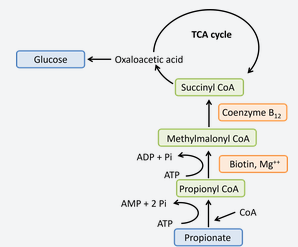
what vitamins are essential for propionate conversion into succinyl-CoA?
biotin (vitamin H)
vitamin B12
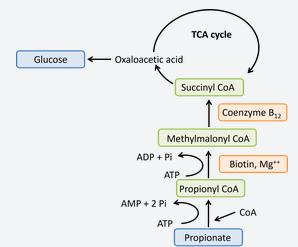
how can propionate be used directly for glucose generation?
it interrupts krebs cycle at the point of pyruvate.
with the correct enzymes and substrates present, pyruvate leaves mitochondria for cytosol and is converted back to glucose for export
propionate can be converted to succinyl CoA to enter the krebs cycle, what else can it be converted into?
directly into glucose
oxaloacetate
what is the BER/BMR?
basal energy requirement, or basal metabolic rate
what does the BER/BMR represent?
the amount of energy needed to maintain life
how do we express BER/BMR?
kcal/day for smallies
MJ in large animals
what do RMR or RER stand for?
resting metabolic rate
resting energy requirement
why do we use RMR/RER more in vet medicine than BER/BMR?
it represents the energy needed for the animal when ‘rested’ but also includes body size, age, sex, species and other life-stage factors.
it’s proportional to metabolically active tissue and lean body mass
what calculation do we use for RMR/RER for animals weighing 2-30kg?
(30 x body weight in kg) + 70
what calculation do we use for RMR/RER for animals weighing <2 and >30kg?
70 x (bodyweight in kg)0.75
what is the relationship between size and energy requirement based on?
interaction between animal’s weight and surface area as energy is lost constantly thorugh skin
why do the RMR/RER need to be adjusted for birds/reptiles?
because they have higher metabolic rates and are linked to the environment (ectotherms)
what additional factor do we need to use for the calculation of RMR/RER for birds and reptiles?
K factor
what is MER?
maintenance energy requriement
how do we calculat MER?
RER + energy needed for exercise, digestion + food absorption
it’s the same equation as RER
how can we adapt our RER/MER for sick/injured animals?
we can use illness factors to predict the requirements in these conditions
but avoid over feeding and use more conservative energy estimates
what do we call the RER when it’s adjusted for individual parameters?
daily energy requirement - DER
daily energy expenditure - DEE
what do we mulitply our RER by for a) dogs b)cats that are: critical care/hospitalised
by 1
what do we mulitply our RER by for a) dogs b)cats that are: weight/loss or obese
dogs - 1 x
cats - 0.8-1.0 times
what do we mulitply our RER by for a) dogs b)cats that are: overweight prone/inactive
dogs - 1.2-1.4 x RER
cats - 1.0 x RER
what do we mulitply our RER by for a) dogs b)cats that are: neutered adults
dogs - 1.6 x RER
cats - 1.2 x RER
what do we mulitply our RER by for a) dogs b)cats that are: intact adult
dogs - 1.8 x RER
cats - 1.4 X
what do we mulitply our RER by for a) dogs b)cats that are: gestating
dogs - 1.6 - 2.0 X (dogs remain stable until third trimester when E req increases)
cats - 2-3 x (cats need increases steadily though gestation)
what do we mulitply our RER by for a) dogs b)cats that are: lactating
dog - 2-6 x RER
cat - 2-6 x RER
what do we mulitply our RER by for a) dogs b)cats that are: juvenile growing <4 mo
dog - 2-3 X
cat - 2-3 X
what do we mulitply our RER by for a) dogs b)cats that are: juvenile growth >80% adult weight
dog - 1.8-2.0 X
cat - 2.5 X
how many MJ is 500 kcal?
2MJ
what is metabolic homeostasis
the balance between need and availability of ATP
how is intertissue integration thtat’s required for metabolic homeostasis achieved?
concentration of nutrients or metabolites in blood affects the rate they’re used
hormones carry messages to individual tissue about physiological state and nutrient supply/demand
CNS uses neural signals to control tissue metabolism - directly/via hormones
what type of hormone is insulin?
anabolic
what type of hormone in glucagon?
catabolic
what protein does insulin promote the production of in the liver?
albumin
when do the lowest levels of glucagon occur?
after a high carbohyrate meal
what hormones and neurotransmitters are insulin counterregulatory hormones
adrenaline
noradrenaline
cortisol
how is the release of cortisol, adrenaline and noradrenaline mediated?
neuronal signals
what metabolic condition triggers the release of cortisol, adrenaline and noradrenaline?
hypoglycaemia
how does the release of insulin counterregulatory hormones occur?
ACTH is released from the pituitary and stimulates release of cortisol from adrenal cortex
detection of low blood glucose by hypothalamic regulatory centre stimulates the release of adrenaline from the adrenal medulla and noradrenaline from nerve endings
how does stress impact the pancreas?
adrenaline promotes glucagon release
how does stress impact hepatocytes?
directly promotes the binding of glucagon to liver cells
via different mechanisms to promote glycogenolysis and gluconeogenesis inside hepatocytes
how does stress impact muscles
adrenaline binds to receptors resulting in glycogenolysis
how does stress impact adipose cells
adrenaline acts and stimulates hormone-sensitive lipase → fatty acid mobilisation
what is reciprocal regulation?
when the same molecule has opposing affects on catabolic and anabolic pathways
different enzymes have opposite responses to the same metabolic signal
what does reciprocal regulation prevent?
unnecessary breakdown or storage where anabolic and catabolic pathways occur in the same cellular location
what are the 2 enzymes that govern glycogen?
glycogen synthase
glycogen phosphorylase
how is reciprocal regulation relevant in termss of glycogen storage?
adrenaline and glucagon promote glycogen phosphorylase and inhibit glycogen synthase
insuin promotes glycogen synthase but inhibits glycogen phosphorylase
what are the 3 metabolic pathways affected by insulin?
glycogenesis
lipogenesis after high carb meal
amino acid uptake and protein snythesis
what 2 metabolic pathways are affected by glucagon
gluconeogenesis
fatty acid release from adipose tissue
what 2 metabolic pathways are affected by adrenaline
glycogenolysis from muscle and liver
lipolysis
what 3 metabolic pathways does cortisol affect in this context
amino acid mobilisation from muscle protein
gluconeogenesis
fatty acid release from adipose tissue