Leases
 Call Kai
 Learn
Learn Practice Test
 Spaced Repetition
 Match
Match Flashcards
 Knowt Play
1/32

There's no tags or description
Looks like no tags are added yet.
Name | Mastery | Learn | Test | Matching | Spaced | Call with Kai | Chat |
|---|
No analytics yet
Send a link to your students to track their progress
33 Terms
Mulholland v Waimarie Industries Ltd.
Waimarie Industries sought relief from court to stop cancellation of lease. Hadn’t paid rent nor the backlog of rent. Issue: Can relief be sought for failure to pay rent? | Court declined relief. If breach solely failure to pay rent - presumptive right to relief on payment 'restored … all that the landlord is entitled to' But generally no relief is clear T is hopelessly insolvent. Not to be 'foisted' on L. General rule failure to pay rent does not mean it can be cancelled if you pay it back. |
Strong v Hurunui Hotel
Landlord seeking to cancel lease, because the Tenant had breached a number of covenants.
| Considers what the court should take into account when exercising discretion on relief. Strong at [38] citing Studio X ltd v Mobil Oil NZ Ltd;
This breach was;
BUT;
AND;
Granted conditional relief - do so in 50 days (landlord could take security money and cancel the lease) |
Sibrad Company v Kanters and Edwards
Sibrad , tenant operate land nearby Rootorangi farm Leased rural land from Kanters (landlord) for 1 year with RoR. Sibrad forgets to give timely notice of renewal. Kanters wants out and refuses to renew. Sibrad seeks forced renewal ( ss 261-264 PLA). Kanters oppose alleging breaches. 4 essential breaches argued against granting relief;
| Breaches were so serious that Kanters probably could have cancelled the lease based on then and not have to wait to refuse to renew. Breakdown in communication (Sibrad side with abusive language within children’s hearing)
Sibrad;
But;
= NO relief |
What is a lease?
Can be registered under Torrens system Landlord has an interest in the reversion (original set of rights reverting back to them at the end of the lease.) Tenant gets right to possess land for an indefinite period Lease = binding to 3rd parties (proprietary rights) Licenses = personal contractual rights subject to privity of contract = not binding to 3rd parties |
Definitional core of a lease
Note: usually a rent but not essential |
GENERAL FORMAL REQUIREMENTS
S 24: form; contracts for disposition of land not enforceable unless in writing;
Contract is in writing or its terms are recorded in writing; and
Contract or written record is signed by the party against whom the contract is sought to be enforced.
NOTE; Does not include a short-term lease
S 26; Doctrine of part performance is not affected.
Historical types of leases
Legal Lease:
Historically 2 steps for legal lease (Agreement + conveyancing Deed), conferring best title (good against the world - nemo dat)
Equitable Lease:
Contract for lease = treated as though it was the lease itself.
Parties with a contract for a lease had an ‘equitable lease’ = vulnerable to bona fide purchasers for value without notice.
When equity will treat an agreement as an equitable lease; Rule in Walsh v Lonsdale:
Must be enforceable (agreement, intention to create legal relations, consideration and certainty) AND either’
a) Written and signed; or (now in s 24 PLA)
b) Oral contract that has been partly performed [usually tenant entering and paying rent]. (now s 26 PLA)
Types of leases now
PLA AND LTA (Torrens System)
Best interest = registered ‘indefeasible’ title (indefeasible = bind the world at large)
Key distinction is between registered and off register interests
All off register interests are treated as equitable.
Equitable/off register interests can be defeated by someone else going on the register
Walsh v Lonsdale requirements as modified by ss 24 and 26 PLA still creates an equitable lease (quite common and may underpin a caveat.)
PLA rules apply to both registered and equitable leases.
Short-term leases
exception to formal requirements
S 207; defines a short-term lease;
An unregistered lease
Term commences not later than 20 working days after the date of the contract to lease; and
Is a lease for a term of 1 year or less; or
Periodic tenancy for periods of 1 year or less;
S 208: can be made orally or in writing
S 209; effect; lessee who occupies land under short term lease has legal interest [historic sense] in the land (subject to the Land Transfer Act)
ways to show lease exists
registered lease
unregistered lease (written + signed or oral + part performance)
Short term leases (oral or written subject to short term lease requirements)
Landlords default obligation (Covenants)
S 218 PLA 2007; default covenants implied into leases unless the lease says otherwise; Quiet enjoyment - central obligation owed by the landlord to the tenant (Often an express covenant) (clause 9 of Part 2, schedule 3)
|
Tenants default obligations
PLA 2007; s 216; schedule 3; 4(1) Lessee will pay the rent payable under the lease when it falls due. 5(1) Lessee will not without the consent of the lessor alter any building that comprises or is part of the leased premises. 6(1) Lessee will not do or permit to be done (2) any act or thing that causes… any nuisance, damage or disturbance 13(1) Keep and yield up premises in existing condition |
Who can be bound by the covenants - PLA Changes of landlord/tenant
For assignments of the reversion to LX; New landlord X receives the benefit of all covenants under the lease. LX also subject to all obligations that former Landlord had to T. For assignment of the lease to TX: Tenant X becomes current landlord’s tenant (LX owes TX same obligations L1 owed T1) The original tenant, and any new tenant, carry on being bound by all obligations for the duration of the lease. Even though they have passed on their interest. (Transferor or assignor remains liable s 241 PLA) Why do the new PLA rules say nothing about liability of subtenants under the L1-T1 lease?
|
CL what happens if tenant or landlord changes (replaced by PLA requirements this is just to have an idea)
Contract-centric view: parties to the contract under it's terms. L1 + T1 due to privity of contract not L1 & T2.
So, T1 continues to owe obligations to L1 despite assignment to T2 unless contracted out.
So no contract between T2 + L1
Property-centric view; Those in a property relationship. So, L1 & T2, due to privity of estate.
LX and TX need to have the estate that original L1 or T1 had.
Consequence; T X and LX owe some of the original obligations. Estate only absorbs obligations that 'touch and concern' the estate (rent etc) -> not personal contract stuff eg opening a competing business.
Note: pre-2008 leases will be dealt with above (in real life)
Cancellation (s 12 PLA) as a remedy - when may landlord cancel a lease?
Tenant fails to pay rent (subject to 15 day grace period)
Tenant failing to observe or perform any other covenant (subject to 15 day grace period) (express or implied in the lease)
Cancellation procedure; to avoid landlord abuse of power. (code)
S 244 to 264 = code which;
limits what parties can be agreed to concerning cancellation (s 243(3) - can’t contact out of the code.
Put in place procedural requirements which limits landlord powers - Landlord wishing to cancel for breach must serve a formal notice on tenant saying so + specifying breach, giving time to remedy etc.
Empowers courts to provide relief against cancellation or proposed cancellation, or the refusal to extend or renew a lease (where there is a right of renewal)
S 253: who can apply for relief?
S 253(1): where the landlord has cancelled or proposes to cancel a lease the tenant may apply to a court for relief against (proposed) cancellation.
Or s 253(3) may be sought in a proceeding brought by the Landlord to cancel the lease.
Powers of court on application for relief: s 256
Court has wide discretion, may grant on any condition it thinks fit.
Can be relieved even it it’s an irremediable breach (serious) or an essential term has been breached.
Principles to grant relief come out of case law and equity (1 what they aim to do, 2 types of breaches)
Attempt to weigh up how proportionate cancellation is to the breach.
Breach by failure to pay rent:
For non-rent breaches:
Principal for cancellation consideration for Breach by failure to pay rent:
If breach is solely failure to pay rent - presumptive right to relief on payment of rent as 'restored… all that the landlord is entitled to’ (Mulholland v Waimarie Industries Ltd.)
But; no relief if clear tenant is insolvent [even if they have managed to scrape rent payment] (Mulholland v Waimairie Industries Ltd.)
Courts to consider for non-rent breaches (cancellation)
Studio X ltd v Mobil Oil NZ Ltd as cited in Strong v Hurunui Hotel; Courts to consider when exercising discretion.
Was breach advertent or deliberately committed
Was breach entirely beyond the tenants control
Can breach be remedied by the tenant
Is the tenant willing and able to fulfil their obligations in the future?
Conduct of the landlord (did it contribute to the breach) - does the Landlord have clean hands?
Financial position of the tenant (sometimes 3rd parties - contracting purchasers of interest)
Whether a breach has occasioned lasting damage to the landlord
Is cancellation really a proportionate outcome to the breach (major vs minor)
If there is minor break down in communication (due to breach) e.g. mildly pissed off, or a little short with tenant its treated neutrally (it’s bound to happen) (Strong v Hurunui Hotel)
Major break down in communication e.g. hostile and aggressive behavior may play a factor into cancelling lease or not renewing it (Courts will consider this) (Sibrad Company v Kanters)
Serious permanent damage to the land increases likelihood of no relief (Sibrad Company v Kanters)
Street v Mountford: Principles (objective)
When deciding if a lease exists ask: What did they actually achieve? Objectively did they have a lease.
Doesn't matter what they call the agreement or what they intended their statement to be just what it is in law.
Fatac Ltd v Commissioner fo Inland Revenue
Difference b/t a lease and a license:
Tenancy (lease) is an interest in land conferring the right to possess it for a limited period. A licence is a mere permission to be on the land, with or without additional permission to perform specified acts there.
Tenant has a right to exclusive possession (must be a minimum finite terms [fixed or periodic]) - can exclude others from the property
Lease - estate in land, licence = no estate
Lease has statutory and court relief. Licence doesn’t.
Smallwood v Sheppards [1895]
Hire a piece of waste land (for the purpose of erecting swings and roundabouts) fore the next 3 bank holidays. 45 pounds all up.
Leases can be fixed but don’t have to be a continual period (one day after another).
Still a 3 day fixed lease.
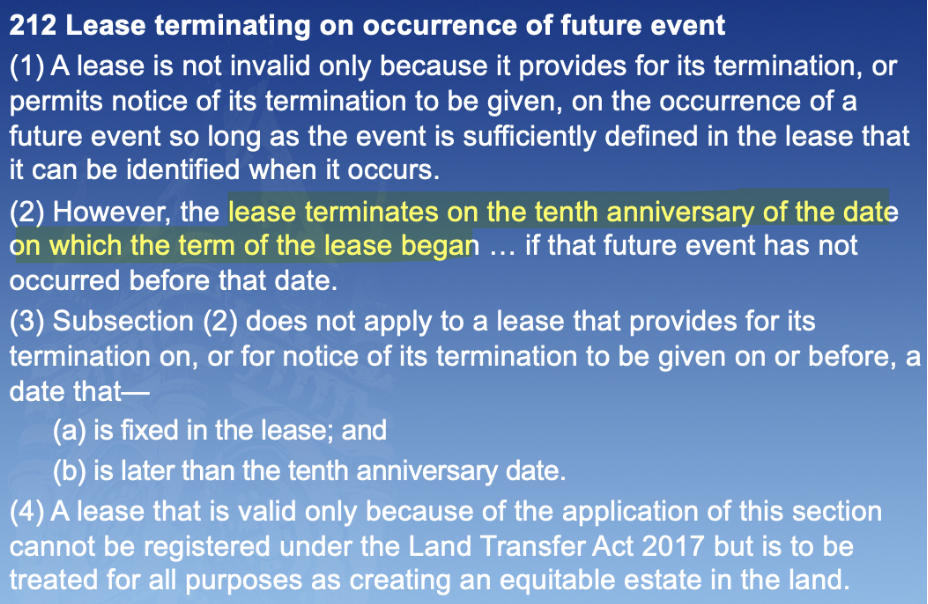
s 212 Lease terminating on occurrence of future event
New Zealand Fish & Game Council v Attorney-General
Facts | Law |
|
|
Critical factors:
Logical form (grant with subtractions vs a series of permissions)
the most intrusive rights reserved (ability to let 3rd party on land) by granter can be exercised only with grantees consent
restrictions on grantee are not inconsistent with having possession (even though extensive)
The extent of the obligations put on the grantee (so many its surprising that it would only be a licence)
Crowns purpose in making the grants
The Wik Peoples v Queensland
Pastoral leases under equivalent provision were not leases (licenses) did not expressly confer right of exclusive possession
= no exclusive possession was granted (because of limits placed on tenant)
Whether or not the lease extinguished Aboriginal/native title - political context which doesnt apply to the same extent in NZ.
HC of Australia were divided decision only made by a bare majority.
Different nature of the farming enterprise in AU vs NZ
Sealink Travel Group NZ ltd v Waiheke Shipping Ltd.
Facts:
Dispute on who has the entitlement to use the mooring poles to store the ferries.
Sealink has issued proceeding against WSL in trespass
WSL says that Sealink doesn’t have the standing to sue in trespass or have exclusive possesion/control over the site and water space.
Issue: are SL’s rights as a licensee sufficient to support an arguable claim in trespass
Whether or not an owner intended to give exclusive possession to a licensee is to be determined objectively by the terms of the contract (Street v Mountford)
Analysis;
ARTA has reserved itself all underlying rights of control of the facility
Sealink’s rights to use facility is limited to certain defined periods and is not absolute
The payment secures a qualified right of access to and use of certain areas for limited periods and purposes but not exclusive possession and control of the facility.
Concludes:
Document does not give sealink control over the premises
a licensee will have standing to sue in trespass only if it has ‘lawful possession’ which is:
The licensee has the requisite degree of custody and exclusive physical control of the land (factual possession); and
The parties intend that the licensee shall exercise custody and control for its owen benefit.
Outcome:
ARTA had the ultimate control of the facility
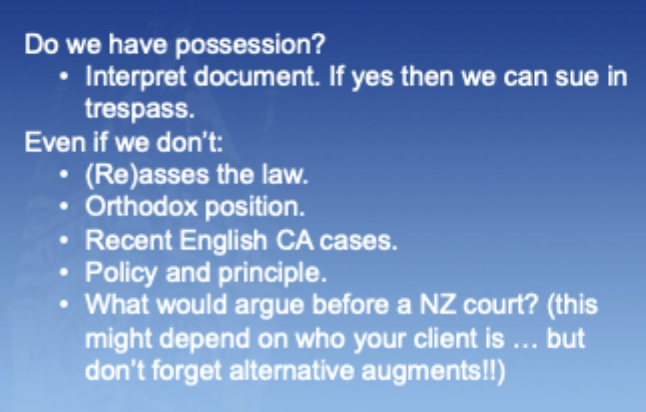
Method for Lease/Licence/Trespass
Georgeski v Owners Corporation
facts:
The plaintiff owns a residence in Sydney bordering a tidal river, the foreshore of which belongs to the Crown. Plaintiff and her predecessors in title had had a Crown licence to erect and enjoy a jetty and slipway out into the river and to make and enjoy a concrete pathway to it. The defendants, neighbours, had been exercising their right as members of the public to walk along the foreshore at low tide and in doing that had been going on to the pathway, jetty and slipway. The plaintiff now sues them for trespass.
Plaintiff was never in possession (not allowed to construct barriers or anything.)
Agreement required the P to allow access to the public land= no rights over land that mean she is able to restrain others = no trespass.
Manchester Airport v Dutton
facts:
Piece of land owned by the English National Trust near Manchester airport
Airport had to fell and trim trees on the land to ensure a safe approach to a second runway
The National Trust granted to the airport a licence to undertake the work
Before the work started a group of protesters had entered the wood in order to try and prevent the felling from happening by occupying the trees
Laws LJ/Majority said: A licensee should be able to sue anyone who has a right lesser than theirs (not the owners) if they had possession.
Minority (Chadwick LJ) took an approach consistent with the traditional approach to trespass
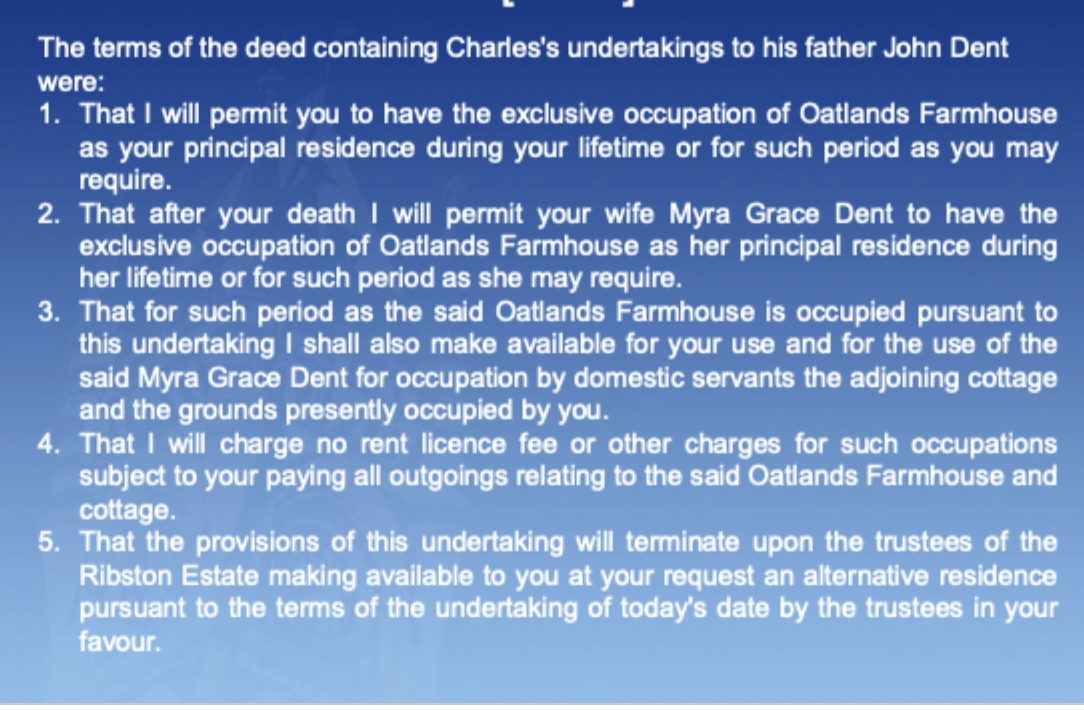
Dent v Dent
What sort of interest does this create?
Is this a property right (lease)? Or a licence?
Judge decided it created an irrevocable licence.
Father would have no possession and can't sue in trespass
Why shouldn’t the father have this ability -then extend to step-mother so maybe there is some merit in what Manchester said.
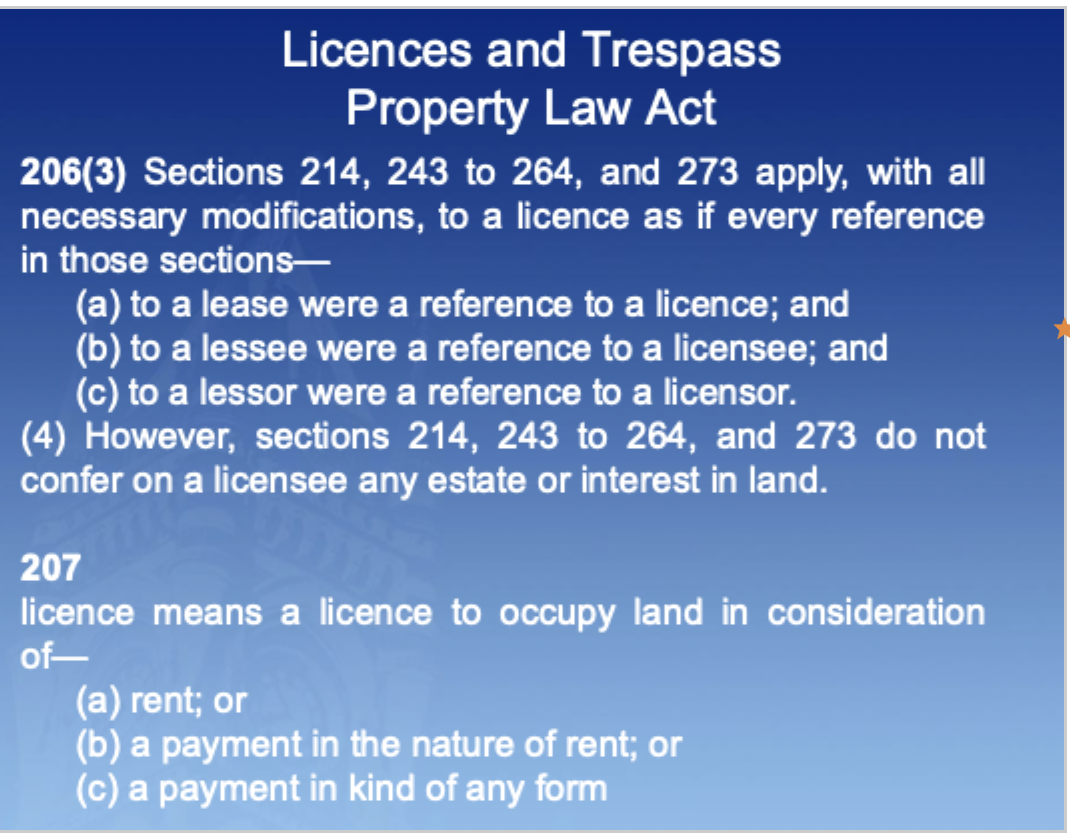
s 206(3), PLA
Apply to licences with consideration (money payment)
Would have to follow the same procedures as if it was a lease for cancellation
Gradual conflation
At exam- even if you aren't sure they would apply regardless