Case 5: Carmen Shellinger - Hand Pain/Numbness
 Call Kai
 Learn
Learn Practice Test
 Spaced Repetition
 Match
Match Flashcards
 Knowt Play
1/20

There's no tags or description
Looks like no tags are added yet.
Name | Mastery | Learn | Test | Matching | Spaced | Call with Kai | Chat |
|---|
No analytics yet
Send a link to your students to track their progress
21 Terms
Peripheral Nerves: Layers
Endoneurium
Perineurium
Epineurium
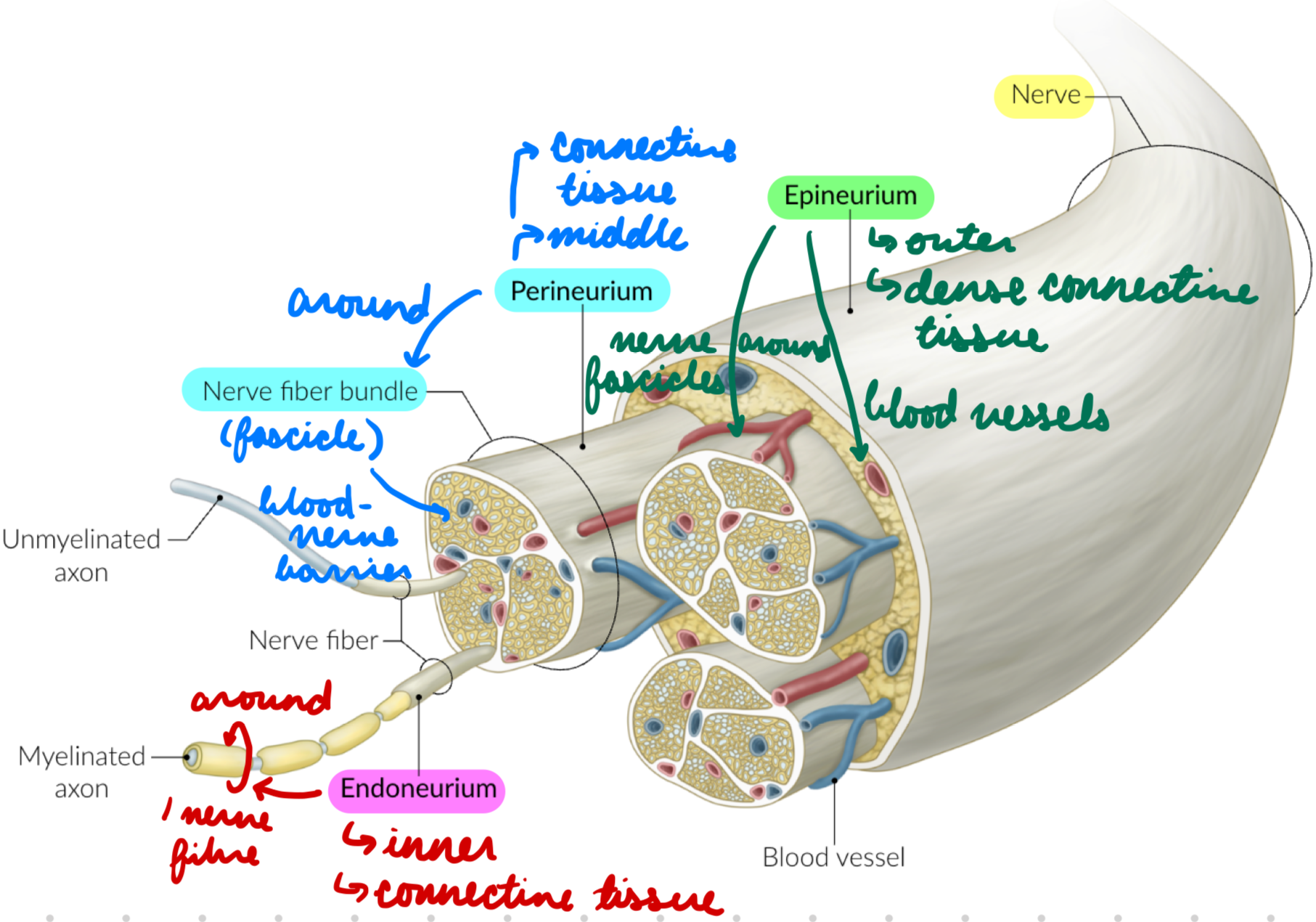
Peripheral Nerves: Endoneurium
Inner layer
Thin
Connective tissue around 1 nerve fibre
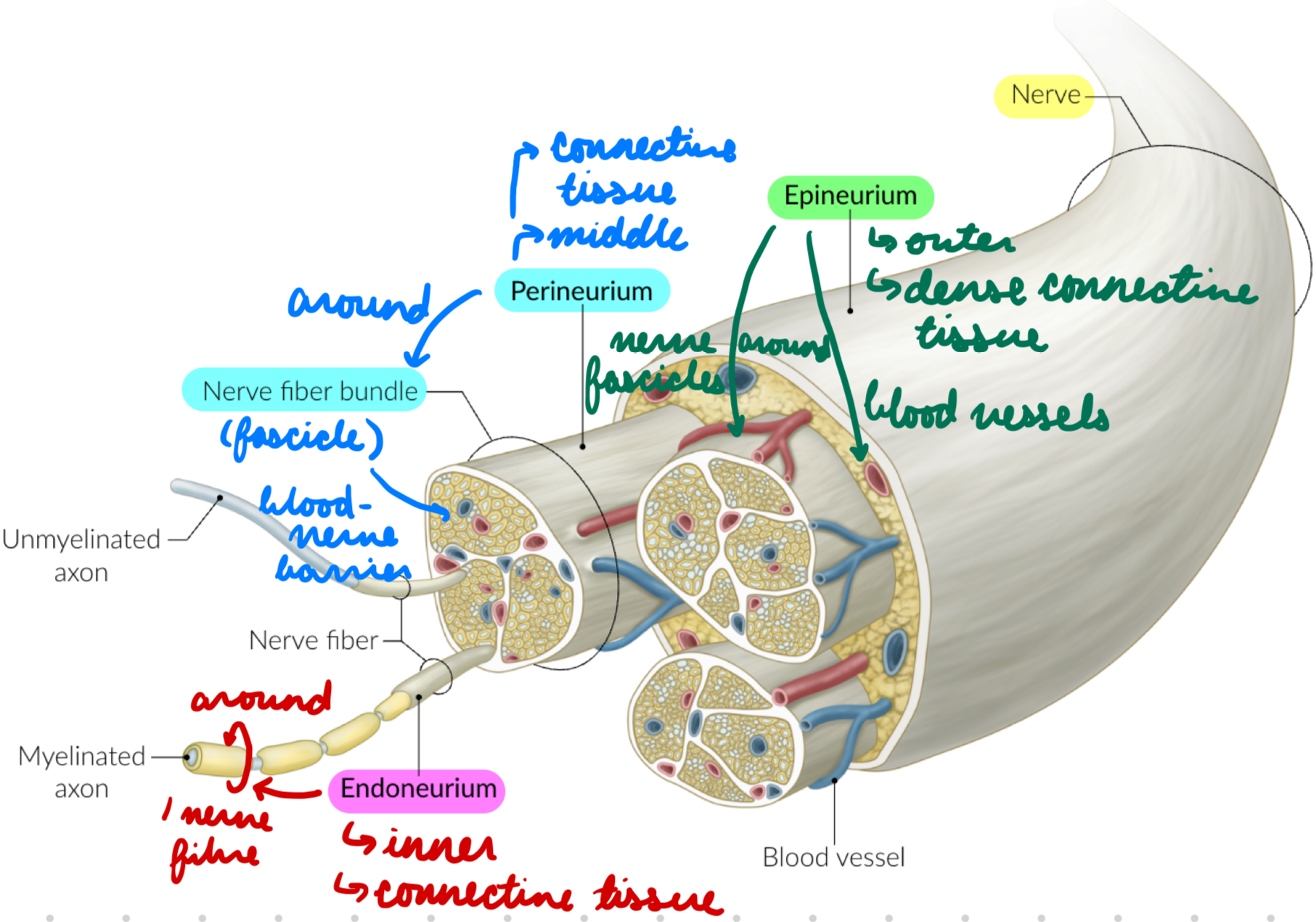
Peripheral Nerves: Perineurium
Middle layer
Connective tissue around nerve fascicles (bundle of fibres)
Contain blood-nerve barrier
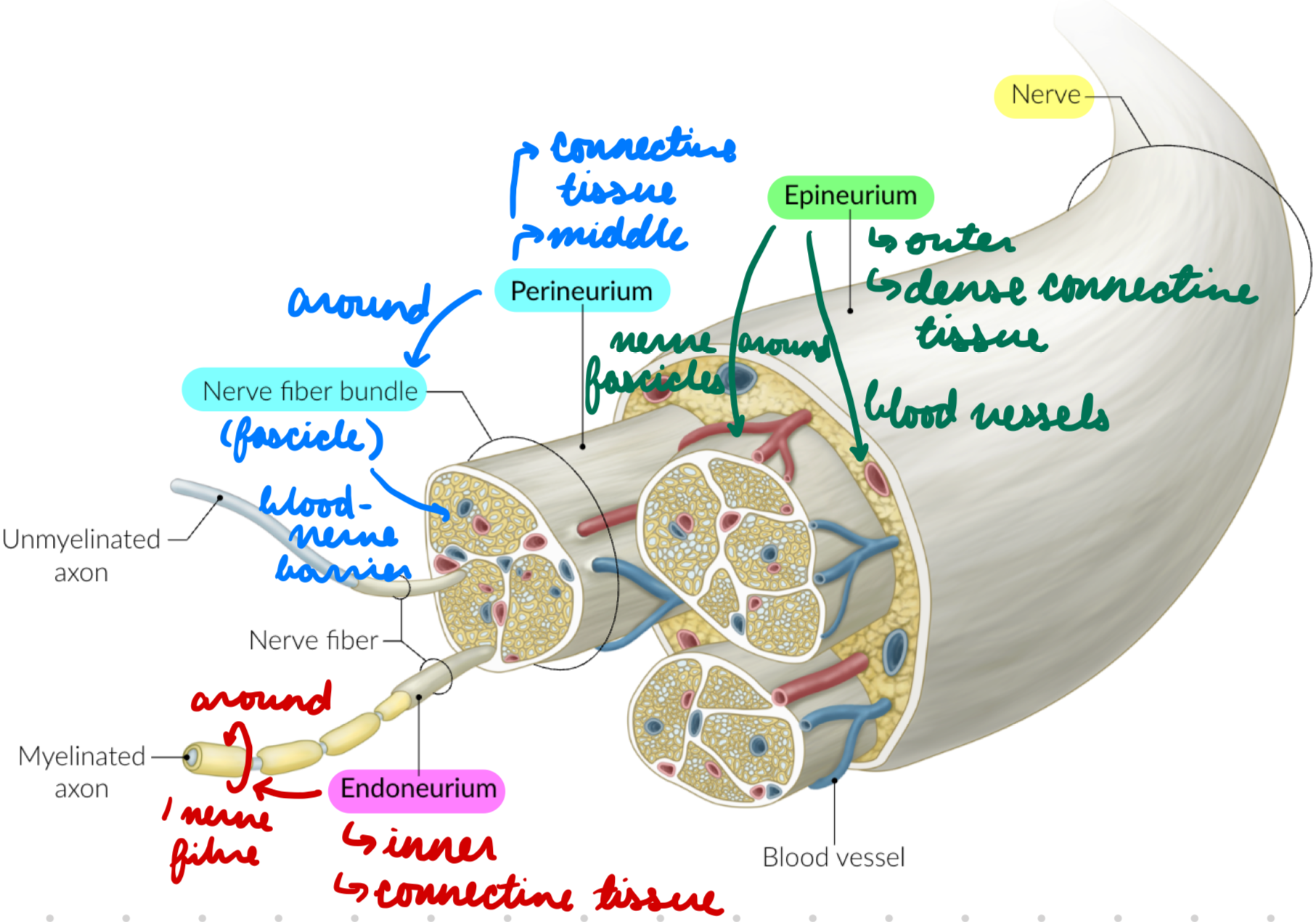
Peripheral Nerves: Epineurium
Outer layer
Dense connective tissue around nerve
Contain:
Nerve fascicles
Blood vessels
Peripheral Nerves: Parts
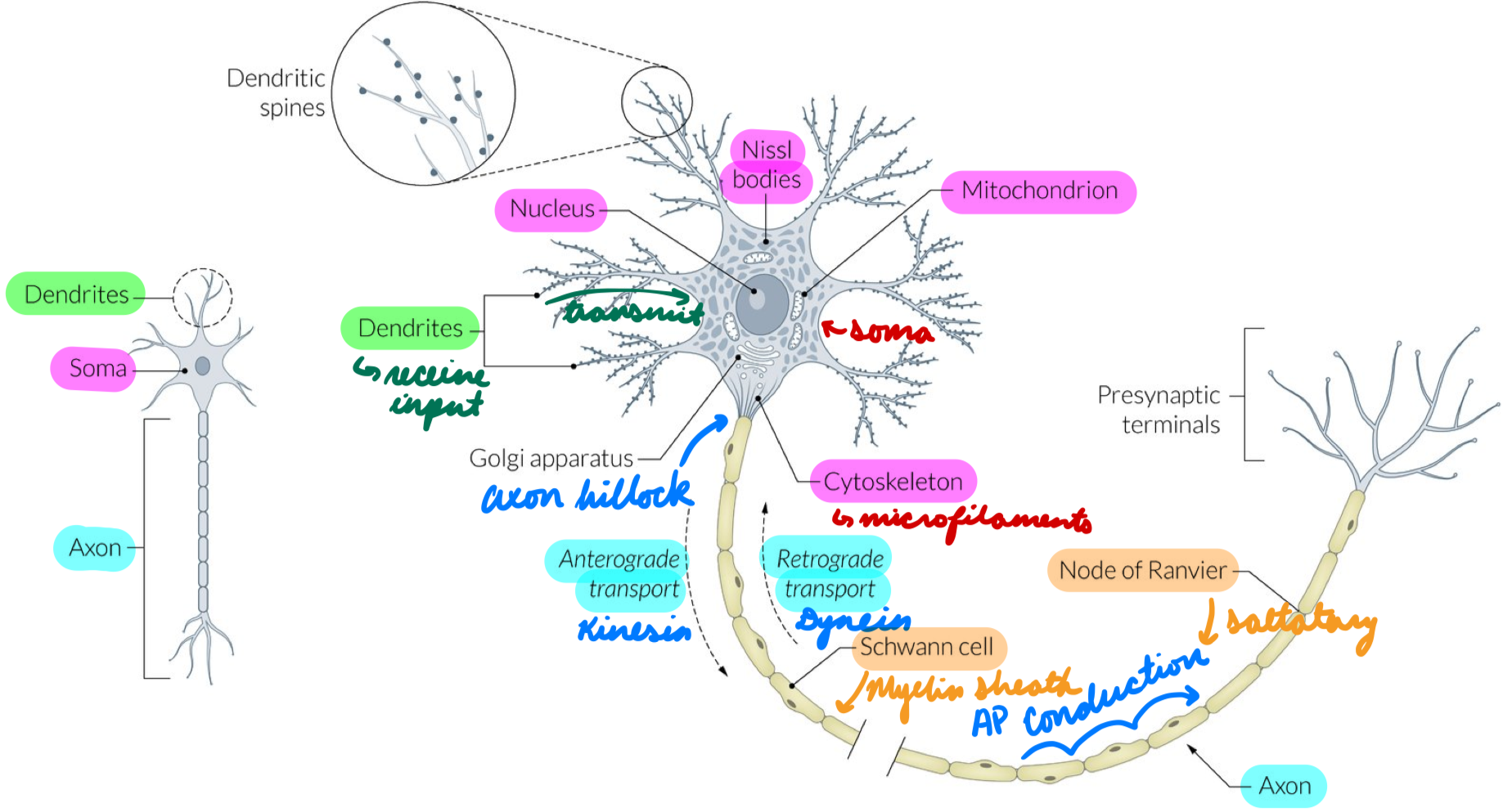
Soma
Axon
Dendrites
Myelin sheath
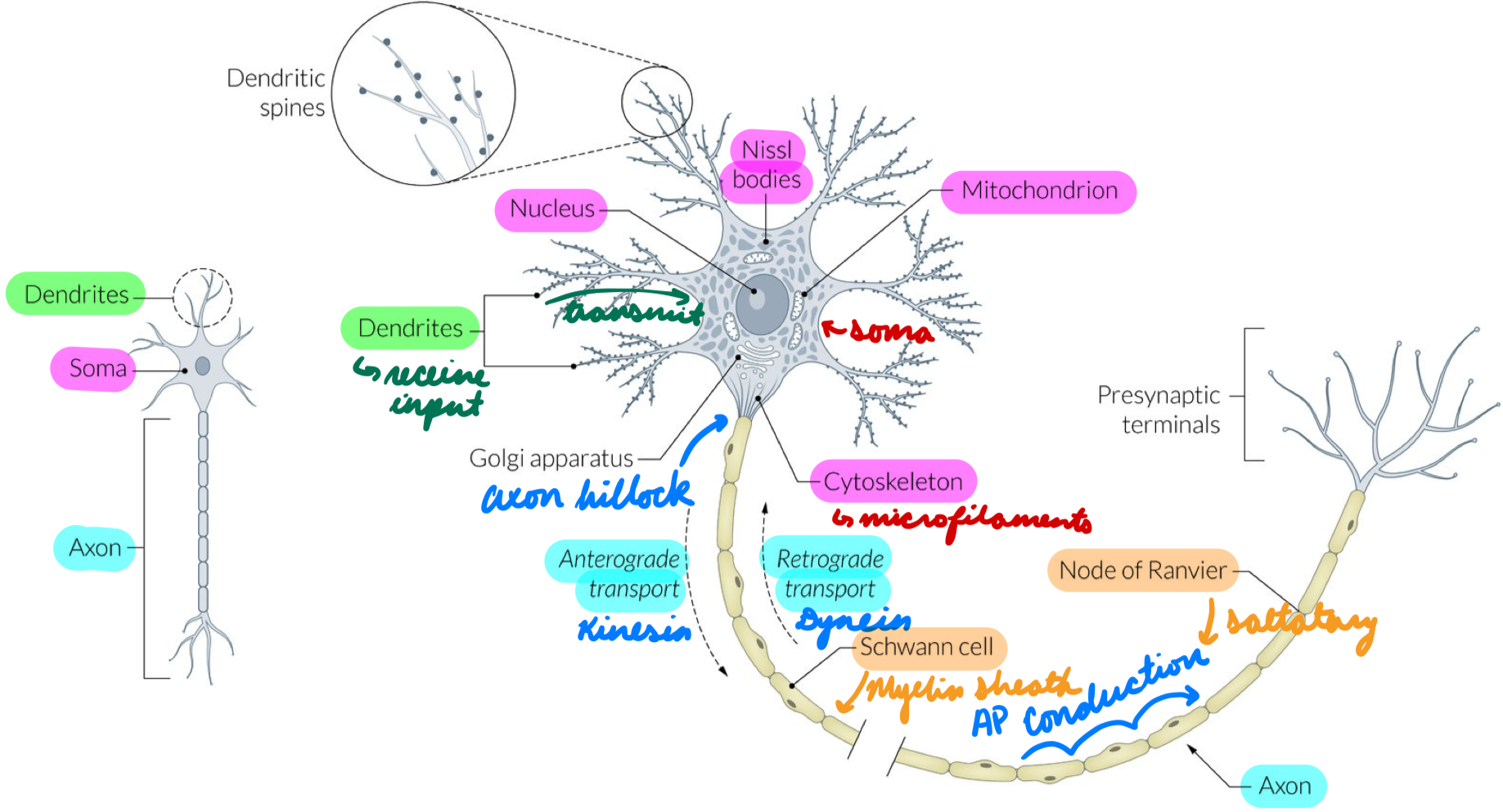
Peripheral Nerves: Soma
Cell body
Contain:
Nucleus + organelles
Nissl Substance: Produced by rough ER proteins
Cytoskeleton: Microfilaments
Peripheral Nerves: Axon
Projection from soma
Conduct AP
From axon hillock (connection to soma) → Synapse
Contain:
Cytoskeleton: Microtubules
Transport cargo (organelles, proteins)
Kinesine: Anterograde transport (- → +)
Dynein: Retrograde transport (+ → -)
Neurofilaments: Structural support
Peripheral Nerves: Dendrites
Branching projections from soma
Receive input from other neurons
Transmit to cell body
Contain:
Spines: Increase synapses to other neurons
Nissl substance
Cytoskeleton: Microfilaments
Peripheral Nerves: Myelin Sheath
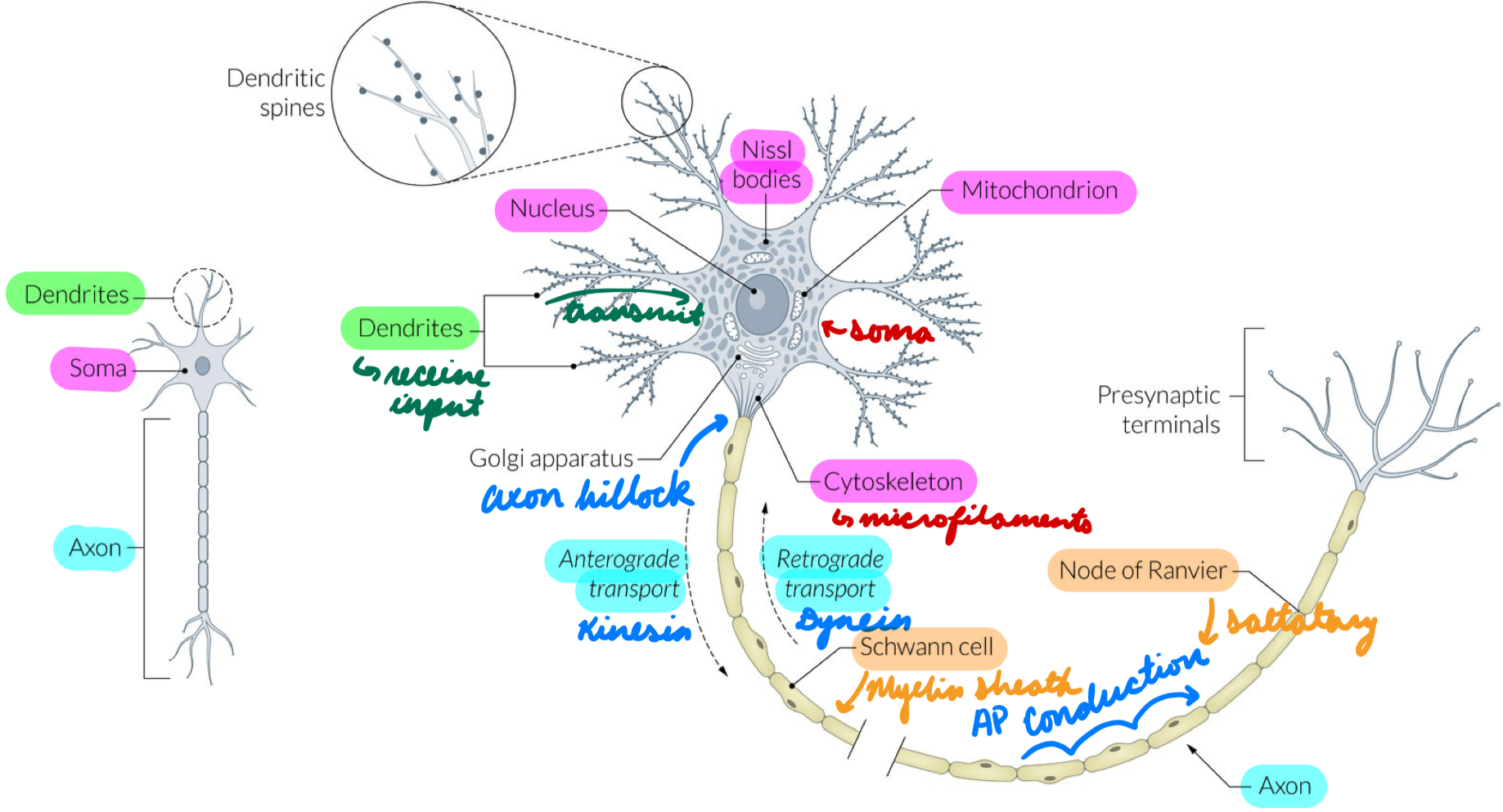
Lipid-rich insulating layer around axons
Increase signal conduction velocity
Produced by Schwann cells
1 cell/internodal segment in 1 axon
Phagocytose debris after injury + promote injury repair (guide nerve regeneration)
Nodes of Ranvier: Signal conduction
Myelin Sheath: Nodes of Ranvier
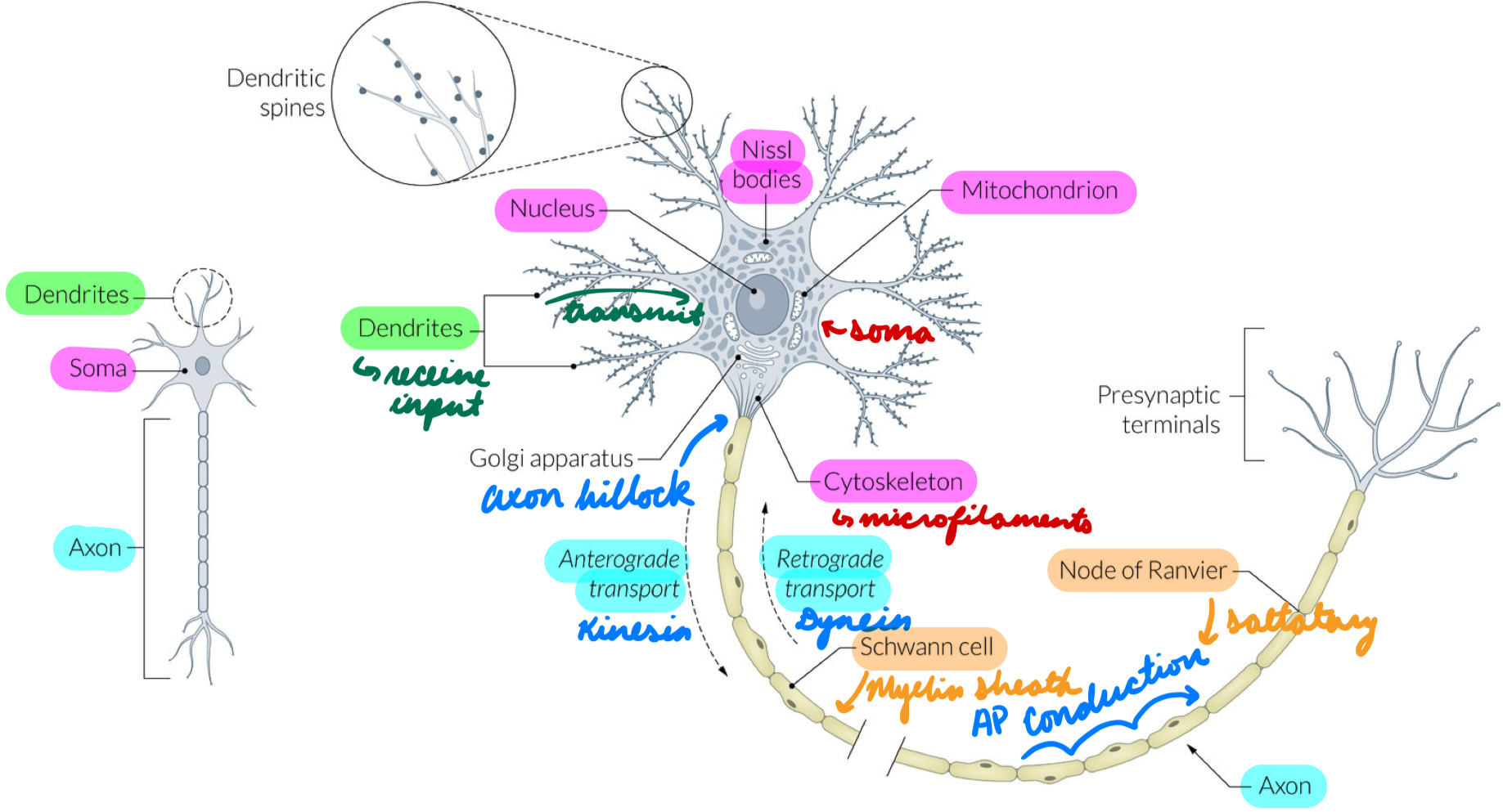
Unmyelinated regions between myelinated segments
Increased Na+ channels = Saltatory conduction
Gaps in myelin = Signal jump between gaps = Increase AP velocity
Approach to Hand Pain + Numbness: DDX
Nerve entrapment
Ulnar:
Cubital tunnel syndrome: At elbow
Guyon canal syndrome: At wrist
Median:
Carpal tunnel syndrome
Radial:
Elbow: Radial tunnel syndrome
Deep: Forearm
Superficial: Forearm + wrist
Ulnar Nerve Entrapment: Clinical Presentation
Ulnar claw: Clawed digits 4 + 5
Tinel sign: Tapping humerus medial epicondyle = Paresthesias in digits 4 + 5
Cubital Tunnel + Guyon Canal Syndrome:
Motor: Muscle atrophy + weakness
Decreased dexterity + grip strength
Difficulty lifting
Sensory: Paresthesias + sensory loss of…
Medial hand
Digit 5
Ulnar side of ring finger
Median Nerve Entrapment: Clinical Presentation
Bottle sign: Cannot hold cylindrical object
Tinel’s sign: Tapping over carpal tunnel = Paresthesias in thumb + digits 2,3,4
Phalens’s sign: Flex wrists (press back of hands together) = Paresthesias in thumb + digits 2,3,4
Carpal Tunnel Syndrome:
Motor:
Impaired digits 1,2,3 flexion
Thenar muscle atrophy
Sensory: Paresthesias + sensory loss of…
Thumb
Digits 2 + 3
Radial side of ring finger
Radial Nerve Entrapment: Clinical Presentation
Radial Tunnel Syndrome:
Motor: Weakness during extension + supination
Sensory: Pain + tenderness from…
Extension
Repeated pronation/supination
Deep:
Motor: Finger extensor paralysis
Sensory: None
Superficial:
Motor: None
Sensory: Paresthesias + loss of sensation of radial hand dorsum
Nerve Entrapment: Investigations
Sensation exam
Nerve conduction study
EMG
Nerve Entrapment Investigations: Sensation Exam
Follow dermatomes
Tactile
Sharp/pain: Spinothalamic
Dull: Dorsal
Light touch: Dorsal
Pallesthesia (vibration): Dorsal
Proprioception: Dorsal + spinocerebellar
Temperature: Spinothalamic
Nerve Entrapment: Treatment
Conservative therapy
Surgery
Nerve Entrapment Treatment: Conservative Therapy
Physical therapy + exercise
Analgesics
NSAIDs
Glucocorticoid injections
Immobilization
Night brace
Nerve Entrapment Treatment: Surgery
Decompression
Indications:
Severe + persistent symptoms
Worsening symptoms with conservative therapy
Nerve Entrapment: Complications
Nerve trauma
Seddon Classification:
Neurapraxia: Transient function block
Local demyelination
No anatomical damage
Axonotmesis: Axon + myelin sheath disruption
Intact connective tissue layers
Neurotmesis: Complete nerve axon, myelin, and connective tissue layers disruption
Nerve Trauma: Clinical Presentation
Sensory loss
Numbness
Paresthesias
Tingling
Loss of sensation
Neuropathic pain
Motor loss
Muscle weakness + atrophy
Fasciculations
Loss of tendon reflexes
Autonomic dysfunction
Sweating abnormalities
Orthostatic hypotension
Bowel/bladder dysfunction
Dry eyes + mouth