mod 4
 Call Kai
 Learn
Learn Practice Test
 Spaced Repetition
 Match
Match Flashcards
 Knowt Play
1/113

There's no tags or description
Looks like no tags are added yet.
Name | Mastery | Learn | Test | Matching | Spaced | Call with Kai | Chat |
|---|
No analytics yet
Send a link to your students to track their progress
114 Terms
What is a chromosome?
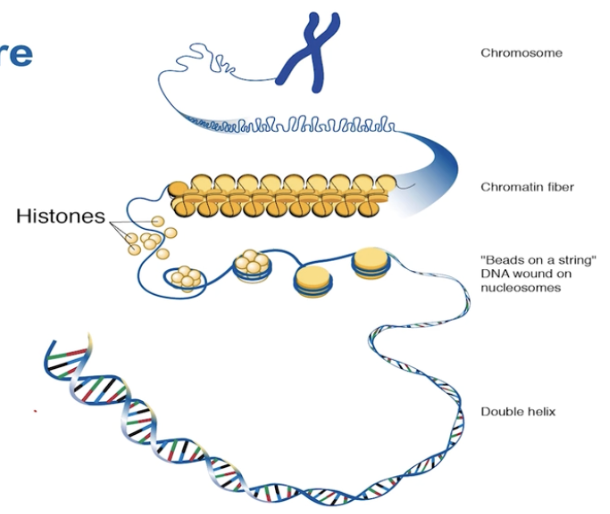
A long DNA that has been folded / packaged, containing genes
DNA wraps around proteins called histones
Those folded structures are called nucleosomes
The nucleosomes can be folded further and further, allowing DNA to becomes highly packaged
The packaging is reverable

What is a gene?
A gene is a specific segment / sequence of nucleotides within DNA
Genes act like blueprints / codes stored in DNA
What is DNA?
Packaged into chromosomes
Chromosomes contain genes
Genes are specific sequences of nucleotides

What are histones?
Histones are proteins that DNA wraps around to form nucleosomes, which help package DNA into chromosomes
What are nucleosomes?
Folded structures of DNA wrapped around histone proteins.
They can be folded further and further, allowing DNA to become highly packaged.

Is chromosome packaging permanent?
No, it is reversible
What makes up the DNA structure?
It is a double helix structure made of sugar + phosphate = sugar phosphate backbone
It has four nitrogenous bases: Adenine (A), Guanine (G), Thymine (T), Cytosine (C)

What is the difference of Purines vs Pyrimidines?
Purines have 2 carbon-nitrogen rings : Adenine (A) + Guanine (G)
“ PURe As Gold = Purines A + G ”
Pyrimidines have 1 carbon-nitrogen ring : Cytosine (C) + Thymine (T)
and Uracil (U) in RNA

Explain the difference of Nucleoside vs Nucleotide
Nucleoside = Base + Deoxyribose sugar
Nucleotide = Base + Deoxyribose sugar + phosphate

DNA strands are held together by ________
hydrogen bonds
A ↔ T have ____ hydrogen bonds
G ↔ C have ____ hydrogen bonds
A ↔ T have TWO hydrogen bonds
G ↔ C have THREE hydrogen bonds
What is it called when the DNA strands run in opposite directions?
Antiparallel
one runs 5’ to 3’
while the other runs 3’ to 5’
If one DNA strand is 5’ TGCA 3’ what is the complementary strand?
3’ ACGT 5’
What is DNA replication?
Making a copy of DNA
Where does DNA replication occur?
In the Nucleus
When does DNA replication occur?
During the S phase of the cell cycle
What happens during DNA replication?
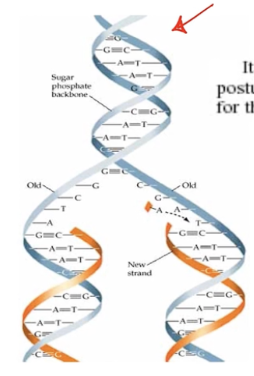
The hydrogen bonds between the DNA bases are seperated
The two original strands separate
Each original strand acts as a template
A complementary strand is made
The result is two DNA molecules identical to the original
What is Transcription?
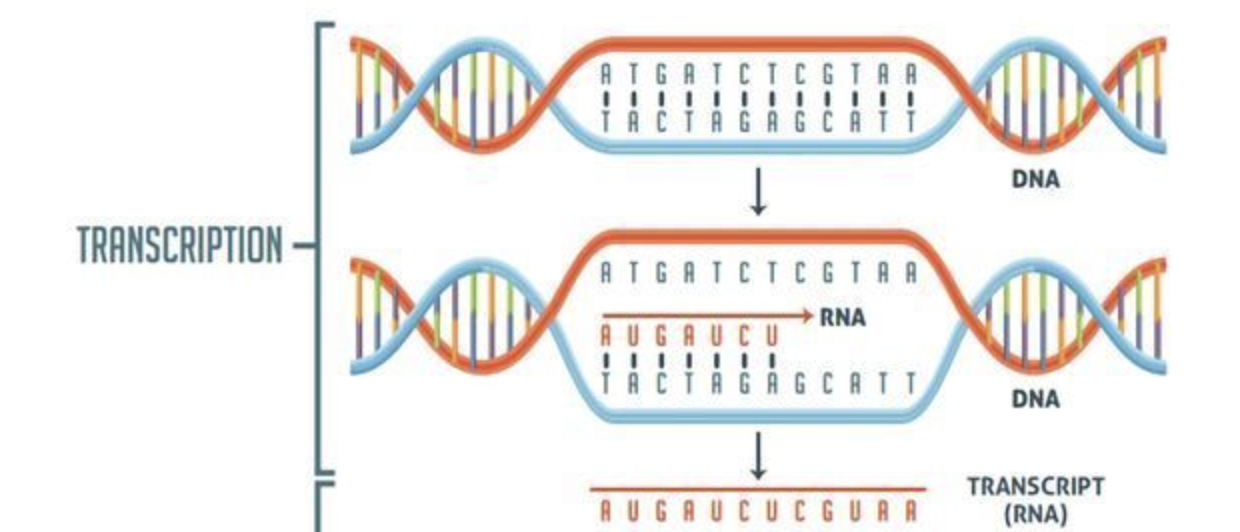
When you are going to produce an RNA copy of one of the strands
RNA is produced from the ______ strand
RNA is produced from the antisense strand
Explain the Sense strand & the Antisense strand
The sense strand of DNA is the coding strand that has the same base sequence as the resulting messenger RNA (mRNA),
while the antisense strand is the template strand used by the cell to build that mRNA.

Explain the association of mRNA and Ribosomes
The ribosome reads the mRNA sequence and uses that information to specify amino acids to make a protein
All genes code for ____
All genes code for RNA
What is a genome?
A genome is the sum total of the genetic material / chromosomes

What is this showing?
It is a graph of all the different segments of each of these chromosomes that are being transcribed throughout the genome
the green regions are where the genes are actively being transcribed, making RNAs
the red regions are the genes that are essentially silent
Humans have ___ chromosome pairs
23
Somatic cells have ___ total chromosomes
46
____ chromosomes come from mother
23
____ chromosomes come from father
23
What is the longest chromosome?
Chromosome 1
What is the shortest chromsosome?
Chromosome 22
What is chromosome 23?
The chromosome that contains the sex determining genes
It can be either X or Y
What is the order of the phases of the cell cycle?
G1 phase → S phasve → G2 phase → M / mitosis phase

What happens in G1?
The growth phase
The cell grows, produces mRNA, produces proteins needed for DNA synthesis, duplicates cellular components in preparation for division
It is checking for “Should this cell actually continue dividing?”
What happens in the S phase?
DNA replication
What happens in G2?
It is another growth phase
The cell continues growing, produces proteins, produces organelles needed for mitosis, reorganizes contents, and checks that DNA replication went correctly
That happens in M phase?
Where mitosis occurs ; Division of genetic material
has 5 subphases
and where cytokinesis occurs ; Division of cytoplasm
What are the subphases of mitosis?
Prophase → Prometaphase → Metaphase → Anaphase → Telophase
“Please Pee on the MAT”
What happens during Prophase?
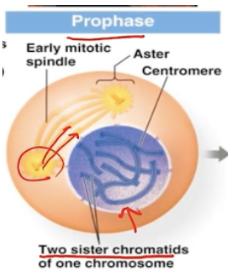
Chromatin condenses
Centrosomes move
Mitotic spindle forms
Nucleolus dissolves
Chromosomes become visible / condensed
Sister chromatids are joined at the centromere
What happens during Prometaphase?
The nuclear envelope breaks down
Spindle microtubules form / expand
Kinetochore microtubules attach to chromosomes
Centrosomes / centrioles move toward opposite poles

What happens during Metaphase?
Chromosomes line up alone the middle of the cell = this is the Metaphase Plate
Centrosomes are at opposite poles
Chromosomes are completely condensed
Kinetochores are attached to spindle microtubules

What happens during Anaphase?
Sister chromatids separate
ana = apart
They move toward opposite poles
The cell elongates
Microtubules shorten / depolymerize and pull chromosomes toward the poles

What happens during Telophase?
Two nuclei
telo = two
Nuclei & Nucleoli reform
Chromosomes decondense
Spindle microtubules dissolve
Mitosis phase finishes
Cytokinesis occurs

What happens during Cytokinesis?
The cytoplasm divides
in animal cells: a cleavage furrow forms
A contractile ring of actin microfilaments contracts with the help of myosin
The cell is pinched into 2 daughter cells
The daughter cells are genetically identical to the parent cell

Homologous chromosomes
Maternal + paternal versions of the same chromsosome
Sister chromatids
Duplicated copies of the same chromsome
Mitosis separates …
Sister chromatids
Meiosis 1 separates …
Homologous chromosomes
Meiosis 2 separates …
Sister chromatids (into four cells)
Why do cells need checkpoints during the cell cycle?
To make sure the cell is ready & to prevent damaged / improper cells from continuing
Where are the three major checkpoints?
G1, G2, M
Explain the G1 Checkpoint
The most important checkpoint!
Because once the cell passes G1, it has committed to division
What are growth factors?
Protein messengers that are released by neighboring cells that stimulate nearby cells to divide
If the cells conditions are not good at the checkpoint, what can happen?
The cell can leave the cell cycle and enter:
G0 = non dividing / resting state
some cells can stay in G0 permanently
What is Density Dependent Inhibition?
A cell regulation mechanism so that normal cells don’t just keep growing on top of eachother
when cells become crowded they stop dividing
What happens with cancer cells for density dependent inhibition?
Cancer cells ignore these “stop” signals and continue dividing
What happens during Anchorage Dependence?
Where cells need to be anchored to a surface in order to proliferate
Examples include attachment to a surface or extracellular matrix
Cancer cells may not respond to this control and can grow unattached
Explain the G2 Checkpoint
It evaluates newly duplicated DNA
Asks “Was the DNA copied completely and correctly?”
If an error is detected: the cell cycle can stop, or
if damage is too severe to repair: apoptosis / cell death
Explain the M Checkpoint
It makes sure the spindle microtubules are properly attached to kinetochores
It checks chromosome alignment
If a chromosome isn’t properly aligned / attached: the cell pauses
once everything is properly attached: cellular progression continues
Then separase can be activated to separate sister chromatids
What are Cyclins?
Proteins whose concentrations change throughout the cell cycle
These consist of:
G1 cyclin
G1 / S cyclin
S cyclin
M cyclin
What are CDKs?
Cyclin dependent kinases
Their concentrations remain relatively constant, but they require cyclins to become active
Cyclin binds CDK:
Cyclin + CDK → activated CDK
kinases phosphorylate target proteins, driving the cell cycle forward
What is M-Cyclin?
It forces the cell to evaluate what’s going on in prometaphase
it is crucial for the progression of mitosis during the cell cycle
It increases during G2 and binds CDK to form MPF
What is MPF?
Maturation promoting factor
It helps push the cell into M phase
It decreases as anaphase approaches → during anaphase: cyclins are degraded → MPF activity decreases
The CDK remains and can be reused
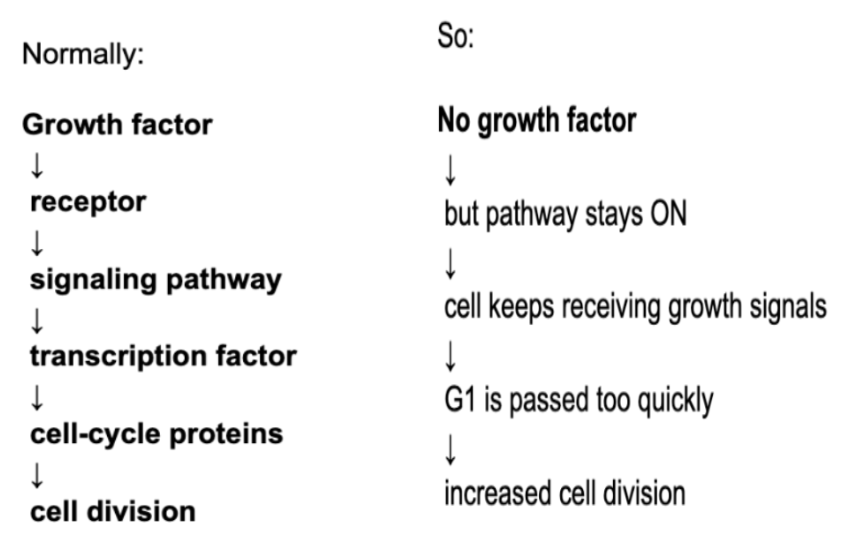
Explain Ras mutation with cancer
It is a gain of function mutation the can cause the pathway to remain active even without a growth factor, leading to increased cell division
What is p53?
A tumor suppressor
It helps prevent damaged DNA from proceeding through the cell cycle
If DNA is damaged:
p53 → cell leaves / stops cell cycle → DNA repair can occur
If p53 is mutated:
Damaged DNA may remain in the cycle, mutation can be passed along, increased cell division can occur
When does cancer develop?
When normal controls over cell growth / division are lost
A single cell can: avoid cell cycle control, escape destruction, begin dividing excessively
This can produce a tumor
Compare Benign vs Malignant tumors
Benign tumors: Does not spread to other areas & can usually be surgically removed
Malignant tumors: Grows without restraint & invades / spreads to nearby tissues
What is Metastasis?
The spread of cancer cells from one location to another in the body
Cancer cells can leave the original tumor and enter the bloodstream or lymphatic system to form another tumor in other organs
Meta = Move
How can cancer cells escape normal controls?
Ignore external “stop” signals
Continue growing without growth factors
Produce their own growth factors
Lose responsiveness to cell surface signals
Develop abnormal internal signaling
Develop mechanisms allowing immortal growth
Accumulate genetic changes / mutations
Some have impaired DNA repair
What is Chemotherapy?
It targets actively and rapidly dividing cells
It interferes with stages of the cell cycle to kill or slow down cancer cells
Why does Chemotherapy cause side effects?
Because some healthy cells also divide rapidly
Such as: Hair follicles, intestinal tract, esophagus, bone marrow / immune related cells
So, it can cause hair loss, digestive problems, and immune supression
What is Radiation therapy?
It uses high doses of radiation to kill or damage cancer cells by disrupting their ability to divide and grow
Radiation → DNA damage → cancer cells unable to repair → cell death
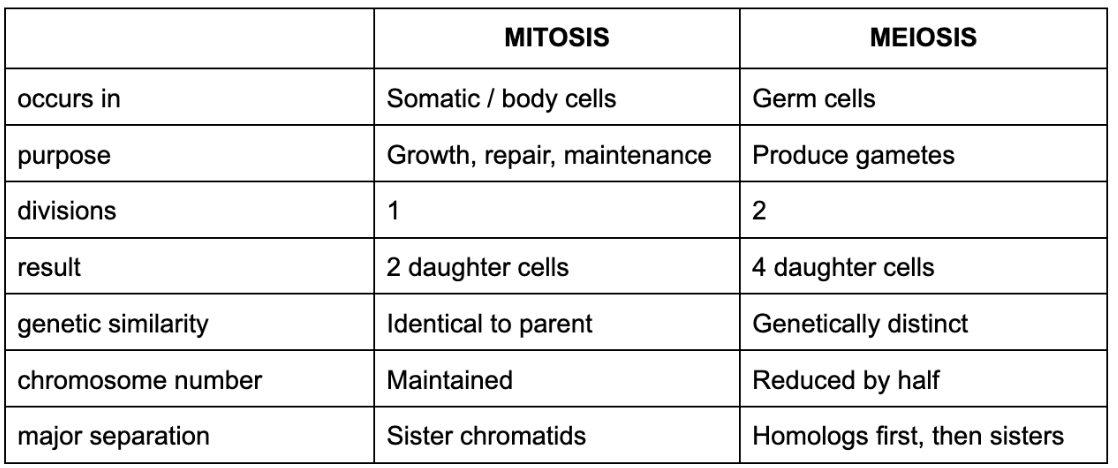
Explain the differences between Mitosis vs Meiosis
Explain the difference between Diploid vs Haploid
Diploid = 2n (two sets of chromosomes)
Human somatic cells: 2n = 46
one set from mom + one set from dad
Haploid = n (one set of chromosomes)
Human gametes: n = 23
What are homologous chromosomes?
They are similar but not necessarily genetically identical
contain the same genes
are the same size
look similar after chemical staining
one came from mother & one came from father
Explain Autosomes vs Sex chromosomes
Autosomes are chromosomes that do not determine the sex of an individual, while
Sex chromosomes are involved in determining the sexual characteristics and reproductive functions
In humans, there are 22 pairs of autosomes and 1 pair of sex chromosomes (XX for females and XY for males).
What is a Karyotype?
An ordered display of homologous chromosomes
Used to examine an individual's chromosomal composition and identify chromosomal abnormalities
What process separates homologous chromosomes?
Meiosis 1
What process separates sister chromatids?
Meiosis 2
What is Prophase 1?
The first stage of Meiosis 1 where chromosomes have already replicated so each chromosome has 2 sister chromatids
Homologous chromosomes pair together
This is where crossing over occurs
What happens during crossing over?
Non sister chromatids exchange DNA
between homologous chromosomes
genetic information from both parents - increasing genetic diversity
What is a Synaptonemal complex?
A protein complex that helps bring homologous chromosomes together gene by gene during prophase 1 of meiosis
This allows crossing over and Synapsis = the close association of homologous chromosomes through this process
What is Chiasmata?
Visible crossing over points
What are Cohesins?
Proteins that hold sister chromatids together
Why is crossing over important?
It creates genetic variation
allows the resulting chromosomes to not be identical to the original parent chromosomes
What happens in Metaphase 1?
Homologous pairs line up
What happens in Anaphase 1?
Homologous chromosomes separate
Sister chromatids stay together
What happens in Telophase 1 + Cytokinesis?
Two haploid daughter cells form, but chromosomes are still duplicated
How does Meiosis 2 start?
With the two cells produced by Meiosis 1
What happens during Prophase 2?
Spindle forms again
What happens during Metaphase 2?
Chromosomes line up in center
What happens in Anaphase 2?
Sister chromatids separate
What happens in Telophase 2 + Cytokinesis?
Nuclei reforms and cells divide
What is the final result of Meiosis 2?
4 genetically distinct haploid cells
What is Independent assortment?
During Meiosis 1, maternal and paternal homologous chromosomes are randomly shuffled into daughter cells to create different combinations of chromosomes
crossing over + independent assortment = genetic variation
What is Trisomy 21?
During Meiosis 2, sister chromatids of chromosome 21 fail to separate properly = nondisjunction
The resulting gamete can contain an extra chromosome 21
So after fertilization, there are 3 copies of chromosome 21 instead of 2, resulting in 47 total chromosomes
What did Gregor Mendel study?
Pea plants and their inheritance patterns
He used true-breeding plants
What is a true-breeding organism?
One that consistently produces offspring with the same characteristic when self-pollinated
What were the three generations from the pea plant crossing?
P generation = parents
F1 = First generation offspring
F2 = Offspring produced from the F1 cross
Example: purple x white
F1: all purple
F2: purple + white
the white trait wasn’t actually gone, it was masked
What are alleles?
Different versions of the same gene
Example:
P= purple , p= white
Each gene has two alleles: one from each parent