3.3 Second Law of Thermodynamics and Entropy

0.0(0)
studied byStudied by 0 people
0.0(0)
full-widthCall with Kai
learnLearn
examPractice Test
spaced repetitionSpaced Repetition
heart puzzleMatch
flashcardsFlashcards
GameKnowt Play
Card Sorting

1/10

encourage image

There's no tags or description

Looks like no tags are added yet.

Study Analytics
Name
Mastery
Learn
Test
Matching
Spaced
Call with Kai

No study sessions yet.

11 Terms

1
New cards

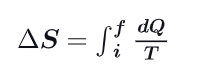
What is Entropy S ?

  • J/K

  • a measure of disorder or randomness in a system and thus the uncertainty or unpredictability pf data.

  • quantifies the number of ways microscopic components can be arranged.

  • Higher entropy means more disorder.

<ul><li><p><span style="color: oklch(0.872 0.01 258.338)">J/K</span></p></li><li><p><span style="color: oklch(0.872 0.01 258.338)">a measure of disorder or randomness in a system and thus the uncertainty or unpredictability pf data.</span></p></li><li><p><span style="color: oklch(0.872 0.01 258.338)">quantifies the number of ways microscopic components can be arranged. </span></p></li><li><p><span style="color: oklch(0.872 0.01 258.338)">Higher entropy means more disorder.</span></p></li></ul><p></p>
2
New cards

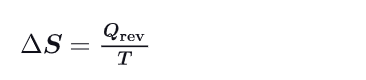
What becomes the entropy equation if the process is isothermal ?
knowt flashcard image
3
New cards

What is the second law of thermodynamics ?

if a process is applied : Consider a certain amount of gas enclosed in a cylinder–piston chamber and an external compressive force is applied on the piston to decrease the chamber’s volume

In a closed system, the entropy of the system increases for irreversible processes

It remains constant for reversible processes and never decreases

<p><strong>if a process is applied : Consi</strong><span>der </span><strong>a</strong><span> </span><strong>certa</strong><span>in </span><strong>amou</strong><span>nt </span><strong>o</strong><span>f </span><strong>g</strong><span>as </span><strong>enclo</strong><span>sed </span><strong>i</strong><span>n </span><strong>a</strong><span> </span><strong>cylin</strong><span>der–</span><strong>pist</strong><span>on </span><strong>chamb</strong><span>er </span><strong>a</strong><span>nd </span><strong>a</strong><span>n </span><strong>exter</strong><span>nal </span><strong>compres</strong><span>sive </span><strong>for</strong>ce is <strong>appli</strong>ed <strong>o</strong>n <strong>t</strong>he <strong>pist</strong>on <strong>t</strong>o <strong>decre</strong>ase <strong>t</strong>he <strong>chamb</strong>er’<strong>s</strong> <strong>volu</strong>me</p><p><strong>I</strong>n <strong>a</strong> <strong>clos</strong>ed <strong>syst</strong>em, <strong>t</strong>he <strong>entro</strong>py <strong>o</strong>f <strong>t</strong>he <strong>syst</strong>em <strong>increa</strong>ses <strong>f</strong>or <strong>irrevers</strong>ible <strong>proces</strong>ses </p><p><strong>It remai</strong>ns <strong>const</strong>ant <strong>f</strong>or <strong>reversi</strong>ble <strong>proces</strong>ses and <strong>nev</strong>er <strong>decrea</strong>ses</p>
4
New cards

What is the cycle of carnot ?

A Carnot engine is a perfect imaginary heat engine.
It:

  • takes in heat from something hot,

  • uses that heat to move or push (it “does work”),

  • then throws away some leftover heat to something cold.

<p>A <strong>Carnot engine</strong> is a perfect imaginary heat engine.<br>It:</p><ul><li><p><strong>takes in heat</strong> from something hot,</p></li><li><p><strong>uses that heat to move or push</strong> (it “does work”),</p></li><li><p>then <strong>throws away some leftover heat</strong> to something cold.</p></li></ul><p></p>
5
New cards

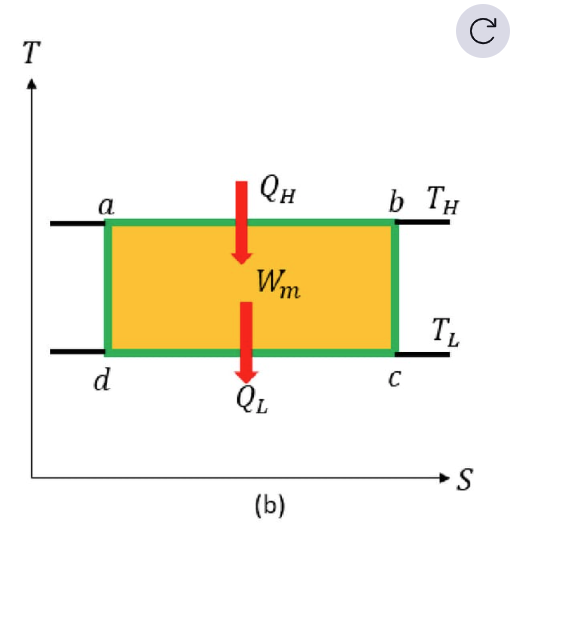
Describe the 4 stages of a carnot cycle (and draw the T-S diagram)

  • ab – Isothermal Expansion
    Heat Q_H​ enters from the hot reservoir at constant temperature T_H
    The gas expands and does work.

  • bc – Adiabatic Expansion

    No heat exchange.
    The gas keeps expanding, so it cools down (from T_H​ to T_L​).

  • cd – Isothermal Compression
    Heat Q_L​ is released to the cold reservoir at constant temperature T_L.
    The gas is compressed.

  • da – Adiabatic Compression
    No heat exchange
    The gas is compressed, so it heats up (from T_L back to T_H​).

Area within loop cycle = net useful work generated by the system
<ul><li><p><strong>ab – Isothermal Expansion</strong><br>Heat Q_H​ enters from the hot reservoir at constant temperature T_H<br>The gas expands and does work.</p></li><li><p><strong>bc – Adiabatic Expansion</strong></p><p>No heat exchange.<br>The gas keeps expanding, so it cools down (from T_H​ to T_L​).</p></li><li><p><strong>cd – Isothermal Compression</strong><br>Heat Q_L​ is released to the cold reservoir at constant temperature T_L.<br>The gas is compressed.</p></li><li><p><strong>da – Adiabatic Compression</strong><br>No heat exchange<br>The gas is compressed, so it heats up (from T_L back to T_H​).</p></li></ul><p>Area within loop cycle = net useful work generated by the system</p>
6
New cards

What is the relationship between heat and useful work in a carnot cycle ?

knowt flashcard image
7
New cards

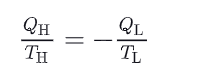
what is the relationship between Q-H, T_H & Q_L & T_L ? write the demonstration
knowt flashcard image
8
New cards

What is the fomula for the efficiency of a carnot cycle using Work and Heat exchanged ? Write the demonstration
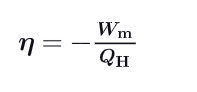
knowt flashcard image
9
New cards

What is the formula for the efficiency of a carnot cycle using temperatures ?
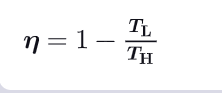
knowt flashcard image
10
New cards

Is the efficiency formula an idealization ? What Would be missing ?

Yes, it depends of the fluid used or the internal structure and design of the engine

11
New cards