Chapter 1: Introduction to Pharmacology
 Call Kai
 Learn
Learn Practice Test
 Spaced Repetition
 Match
Match Flashcards
 Knowt Play
1/107

There's no tags or description
Looks like no tags are added yet.
Name | Mastery | Learn | Test | Matching | Spaced | Call with Kai | Chat |
|---|
No analytics yet
Send a link to your students to track their progress
108 Terms
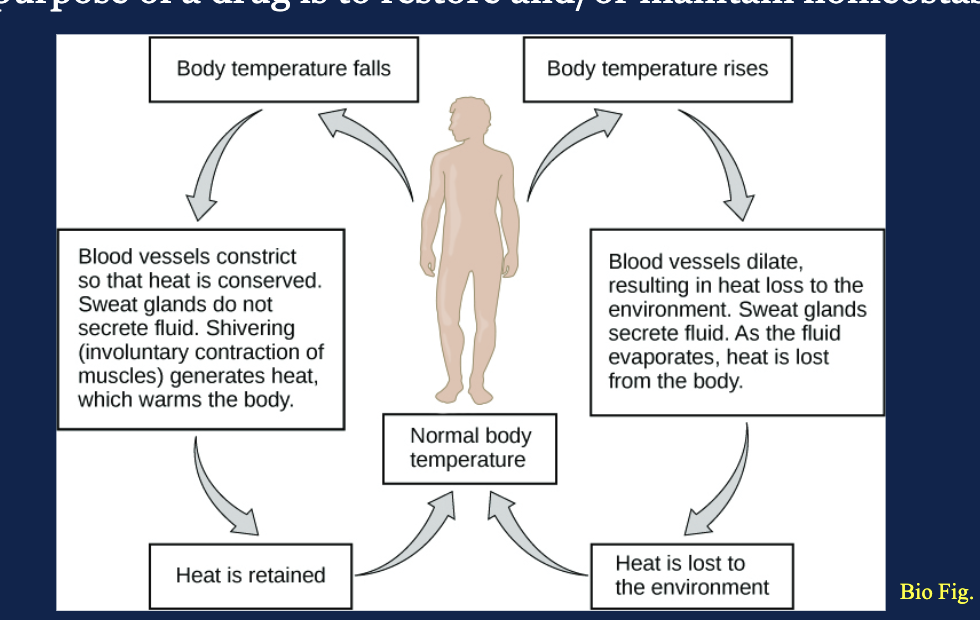
What is homeostasis?
The maintenance of stable, normal conditions inside the body
(Homeostasis=keeping the body balanced)
What can happen when the body cannot maintain homeostasis?
Disease can occur
What is the desired purpose of a drug?
To restore and/or maintain homeostasis
What does it mean for a drug to maintain homeostasis?
It helps keep the body’s internal conditions stable
What happens when body temperature falls?
The body tries to conserve and generate heat to return toward normal temperature
What happens to blood vessels when body temperature falls?
They constrict to conserve heat
What does constrict mean?
To become narrower
Why does the body shiver when it gets cold?
Muscle contractions from shivering generate heat
What happens when body temperature rises?
The body tries to lose heat to return toward normal temperature
What happens to blood vessels when body temperature rises?
They dilate, which helps the body lose heat
What does dilate mean?
To become wider
How does sweating help restore normal body temperature?
Sweat evaporates, causing heat to be lost from the body
Memorize this chart
What is pharmacology?
The study of effects of drugs on the body
What does pharmacology study about drugs?
What effects drugs have on the body
What simple question can help you remember pharmacology?
“What does the drug do to the body”
What are the two main types of drugs listed on the slide?
Small organic molecules
Biologics
What are small organic molecule drugs?
Relatively small chemical compounds used as drugs
What type of drug makes up the vast majority of drugs currently on the market?
Small organic molecules
What are biologics?
Drugs made from biological molecules
What two types of biologics are listed on the slide?
Peptides/proteins
Oligonucleotides
What are examples of peptide or protein biologics?
Hormones and antibodies
What are examples of oligonucleotide biologics?
RNA and siRNA
What is an oligonucleotide?
A short sequence of nucleotides (a short sequence made from the building blocks or DNA or RNA)
What is the clinical pipeline?
All drugs currently under development or in clinical trials
About what percentage of drugs in the clinical pipeline are biologics?
About 55%
What is the difference between drugs on the market and drugs in the clinical pipeline?
Drugs on the market are already available, while drugs in the clinical pipeline are still under development or in clinical trials
How do drugs currently on the market compare to drugs in the clinical pipeline?
Drugs on the market are already available, while drugs in the clinical pipeline are still under development or in clinical trials
How do drugs on the market compare with drugs in the clinical pipeline?
The vast majority of drugs currently on the market are small organic molecules, while about 55% of drugs in the clinical pipeline are biologics
What are the four major targets of small organic molecule drugs?
Receptors
Ion channels
Transport proteins
Enzymes
What are receptors?
Proteins that bind and respond to endogenous (inside) chemical signals
What does endogenous mean?
Produced naturally within the body
What are the two types/locations of receptors listed on the slide?
Membrane-bound receptors
Intracellular receptors
What are two examples of membrane bound receptors?
G-protein coupled receptors
Receptor tyrosine kinases
What does intracellular mean?
Inside the cell
What type of receptor is a steroid hormone receptor?
An intracellular receptor
What are ion channels?
Proteins that allow ions to move across cell membranes
What are transport proteins?
Proteins that help move substances across membranes
What are enzymes?
Proteins that help speed up chemical reactions
What do peptide hormones bind to?
Receptors
What can antibodies bind to?
Hormones
Receptors
Other structural proteins
What do oligonucleotides primarily bind to?
mRNA
Besides mRNA, what can some newer oligonucleotides bind to?
DNA, in a few newer cases
Connection card: Match each biologic with its target: peptide hormones, antibodies, and oligonucleotides
Peptide hormones → receptors
Antibodies → hormones, receptors, or structural proteins
Oligonucleotides → mRNA (and sometimes DNA)
What are the major drug-target relationships from this slide?
Small organic molecules → receptors, ion channels, transport proteins, & enzymes
Biologics → specific targets depending on the type of biologic
Why do drugs affect cellular functions?
To help correct homeostatic imbalance
How do drugs affect cellular functions to correct homeostatic imbalance?
By modifying the activity of individual proteins
What are the four ways drugs can modify protein activity?
Directly modify Activity
Modify Transcription
Modify Translation
Increase degradation
What does it mean for a drug to directly modify protein activity
The drug increases or decreases the activity of a protein
What is an agonist?
Something that increases protein/receptor activity
What can directly decrease protein activity?
Antagonists
Inhibitors
Antibodies
What is transcription?
The process of going from DNA→ mRNA
Can drugs increase or decrease transcription?
Yes. Drugs can modify transcription in either direction
What is translation?
The process of going from mRNA → Protein
Can drugs increase or decrease translation?
Yes. Drugs can modify translation ways
How can siRNA decrease protein production?
siRNA targets mRNA → decreases translation → less protein is produced
What drug is listed as an example of siRNA that decreases translation?
Inclisiran
targets PCSK9
What does degradation mean?
Breakdown or destruction of something
What does increasing protein degradation do?
It causes more of the target protein to be broken down
What two binding sites are mentioned for proteins used to increase degredation?
A binding site for the target protein and a binding site for E3 ligase
What new drug target is mentioned in connection with degradation and pancreatic cancer treatment?
Ras
How are transcription and translation different?
Transcription = DNA → mRNA
Translation= mRNA → protein
At what four points can drugs alter protein function or amount?
Existing protein activity → direct modification
DNA→mRNA → modify transcription
mRNA→protein→modify translation
Existing protein → breakdown → increase degradation
What is specificity?
The ability of a drug to bind selectively to its target(s)
Where are a drug’s targets ideally found when the drug is specific?
Only on a subset of cells or tissues
What does selectively mean?
The drug preferentially binds to certain target(s) rather than everything
What is affinity?
The strength of binding between a drug and its receptor
What does high affinity mean?
The drug has a strong chemical attraction/binding to its receptor
What is efficacy?
The ability of a drug to produce a given physiological effect
What is another way to think about efficacy?
The effectiveness of a drug
What is potency?
The dose of a drug needed to produce a given physiological effect
If one drug requires a smaller dose than another to produce the same effect. which drug is more potent?
The drug requiring the smaller dose
When is potency relavent?
When comparing two or more drugs
What is the difference between affinity and efficacy?
Affinity = strength of binding
Efficacy= ability to produce an effect
What is the difference between efficacy and potency?
Efficacy= ability to produce an effect
Potency= Dose needed to produce a given effect
Match specificity, affinity, efficacy, and potency with their main question.
Specificity → What does it target?
Affinity → How strongly does it bind?
Efficacy → How much dose is needed
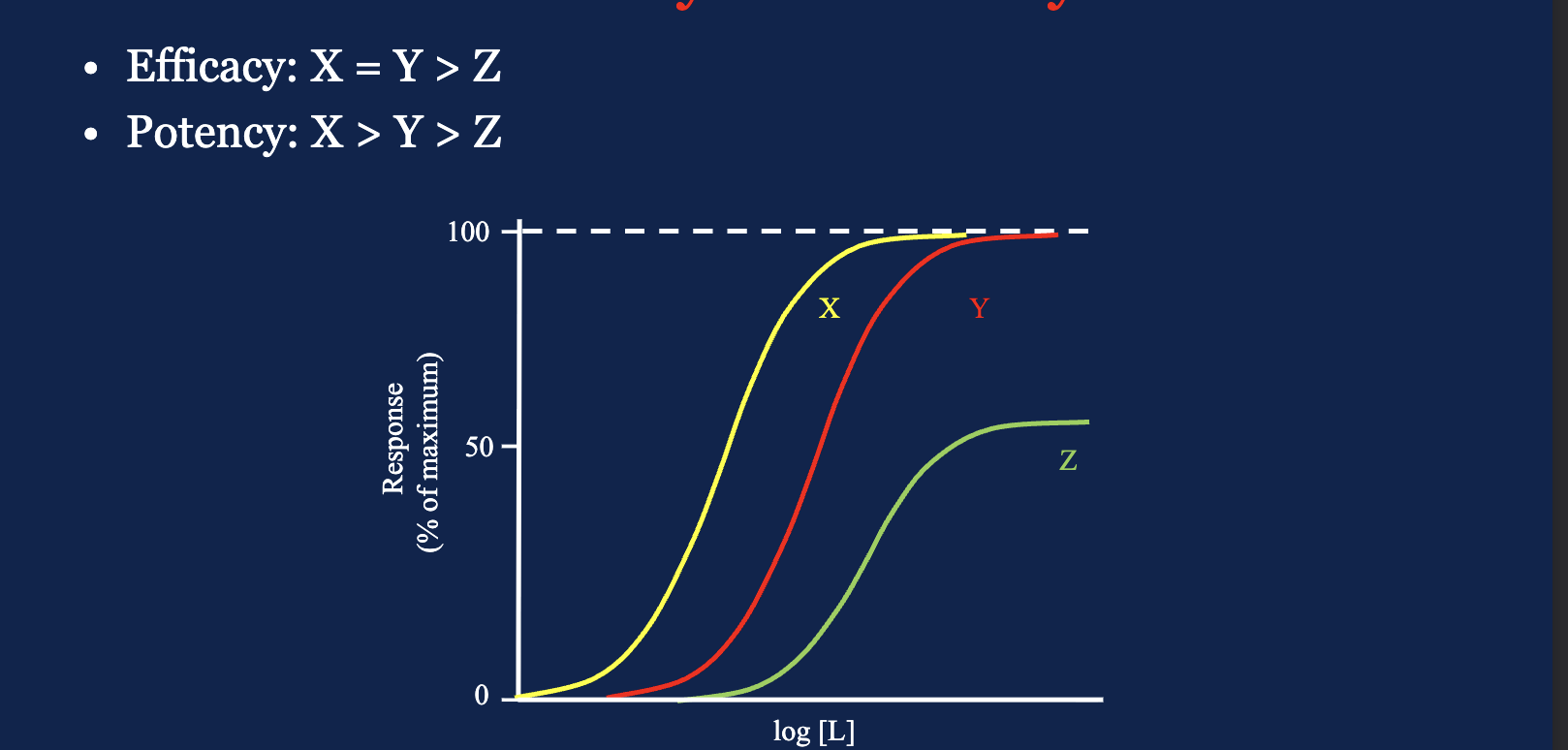
What does efficacy represent on a dose-response graph?
The maximum effect/response a drug can produce
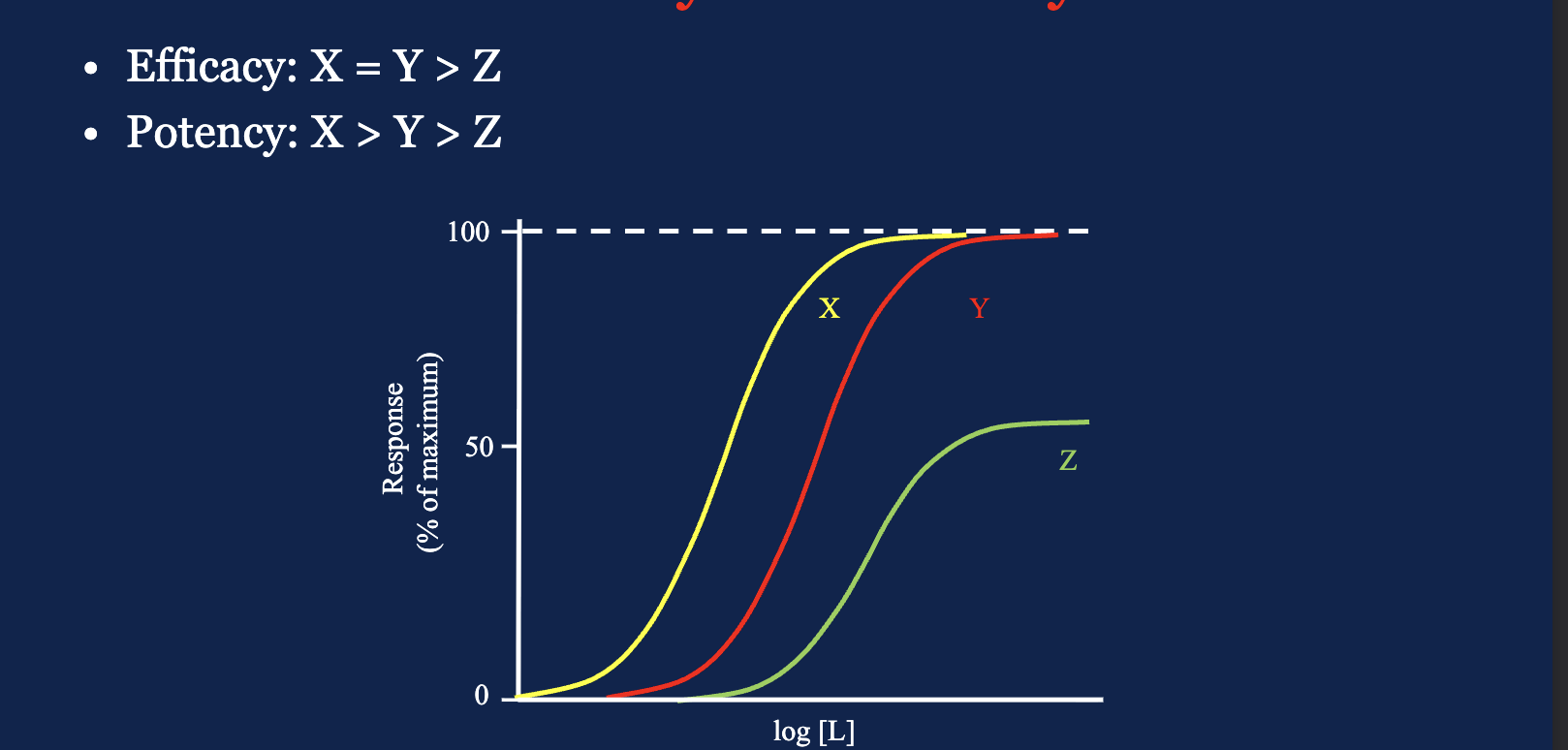
How do you compare efficacy on a dose-response graph?
Look at how high each curve reaches
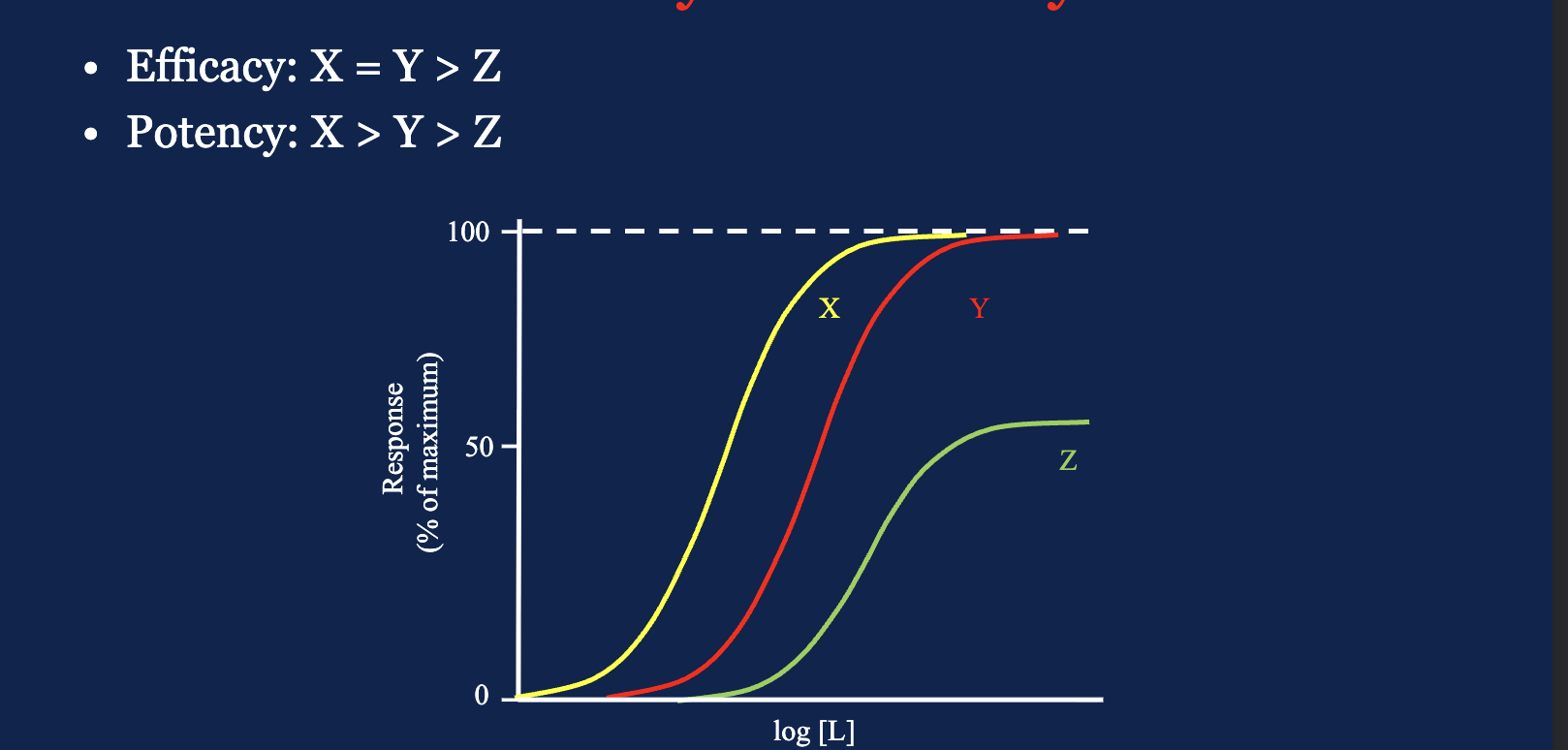
Which drugs have the greatest efficacy on this graph?
X and Y
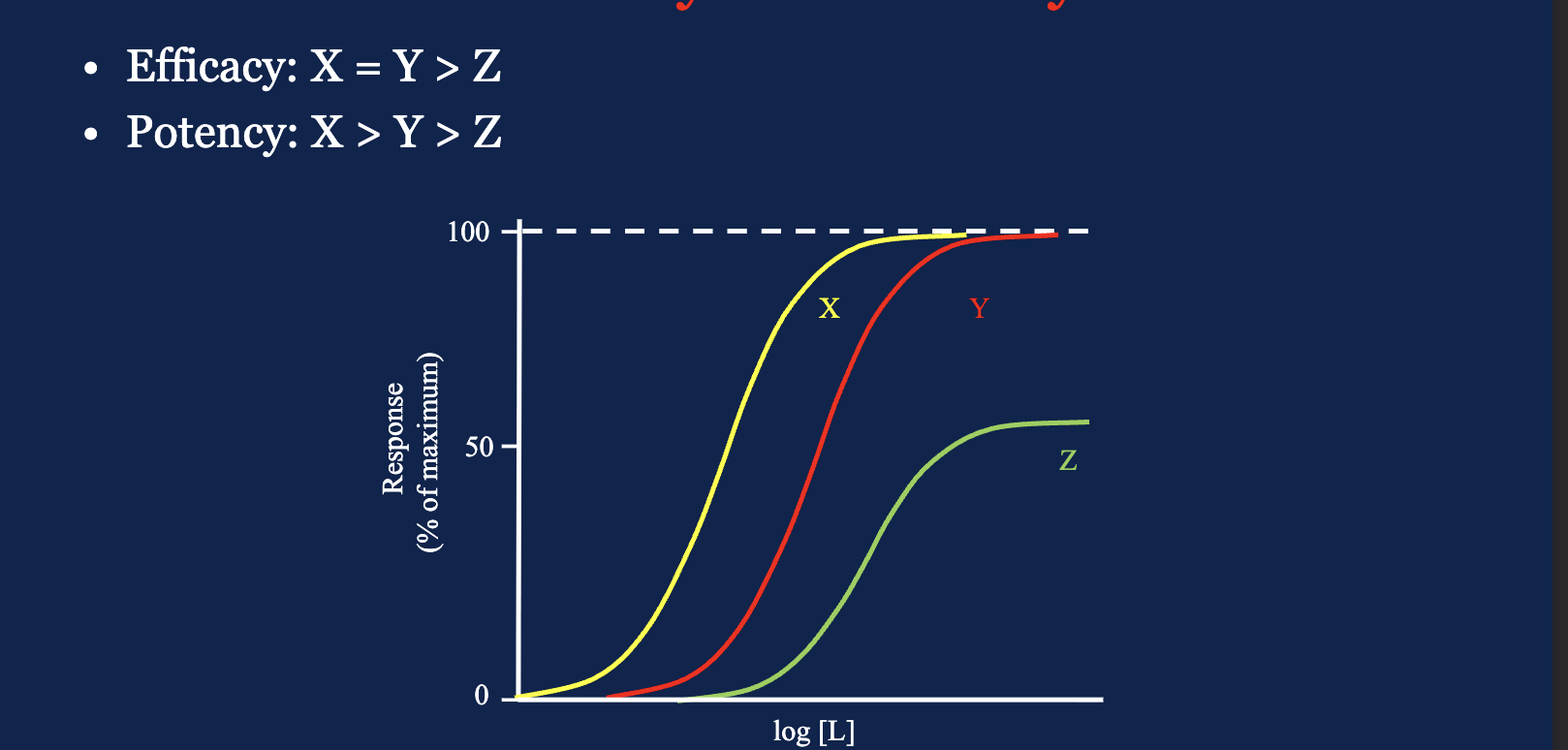
What is the efficacy ranking of X, Y, and Z
X= Y>Z
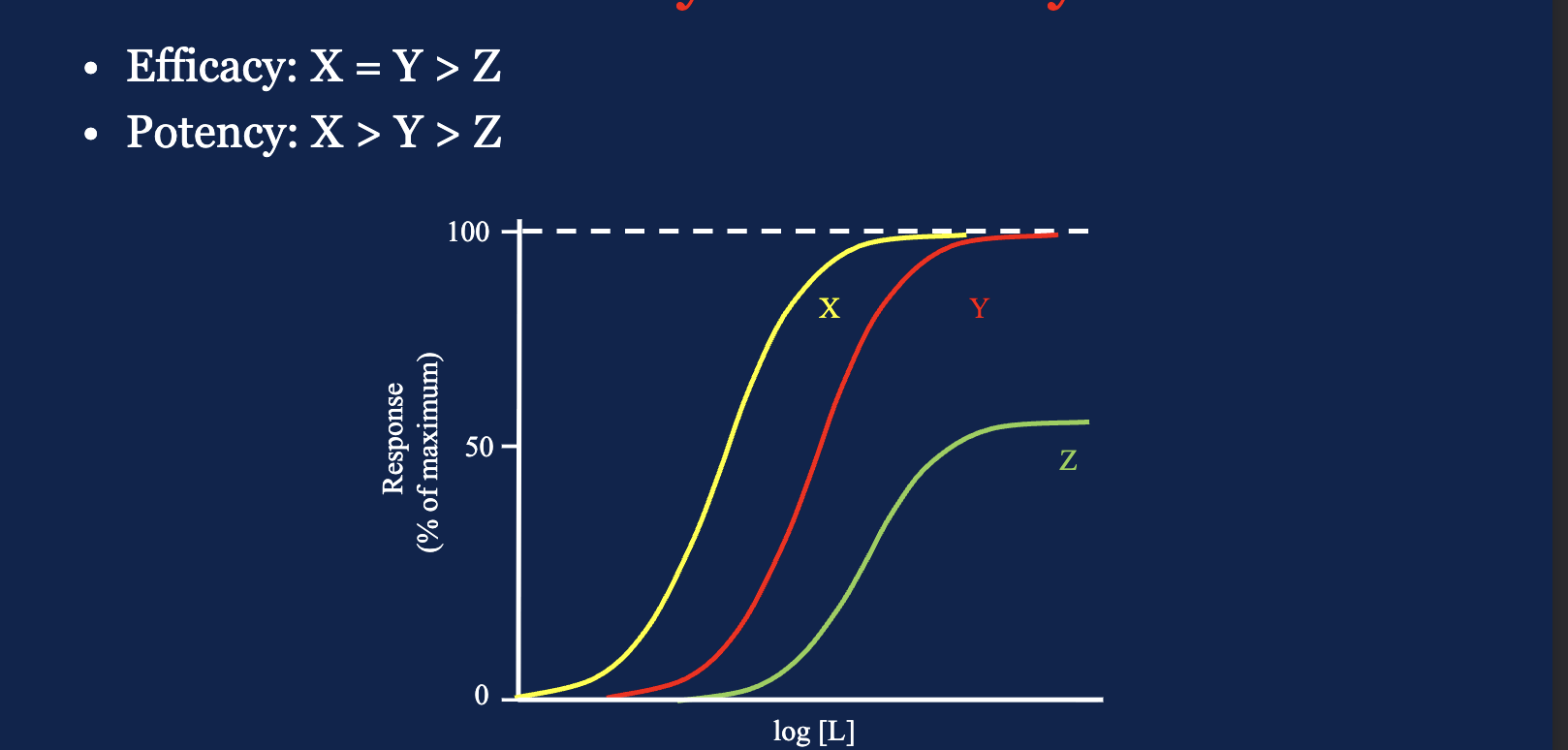
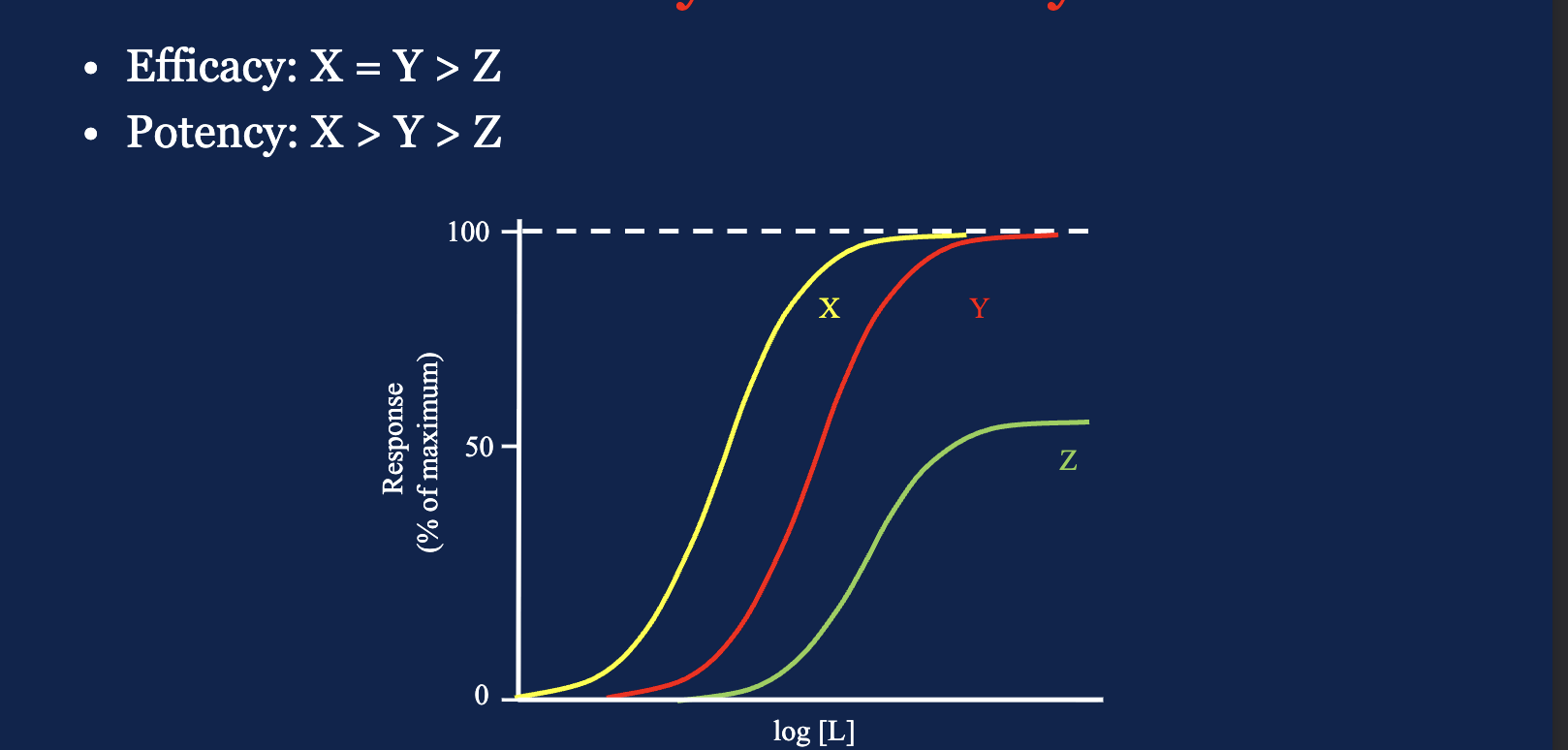
Why do X and Y have equal efficacy?
The both reach approximately the same maximum response (~100%)
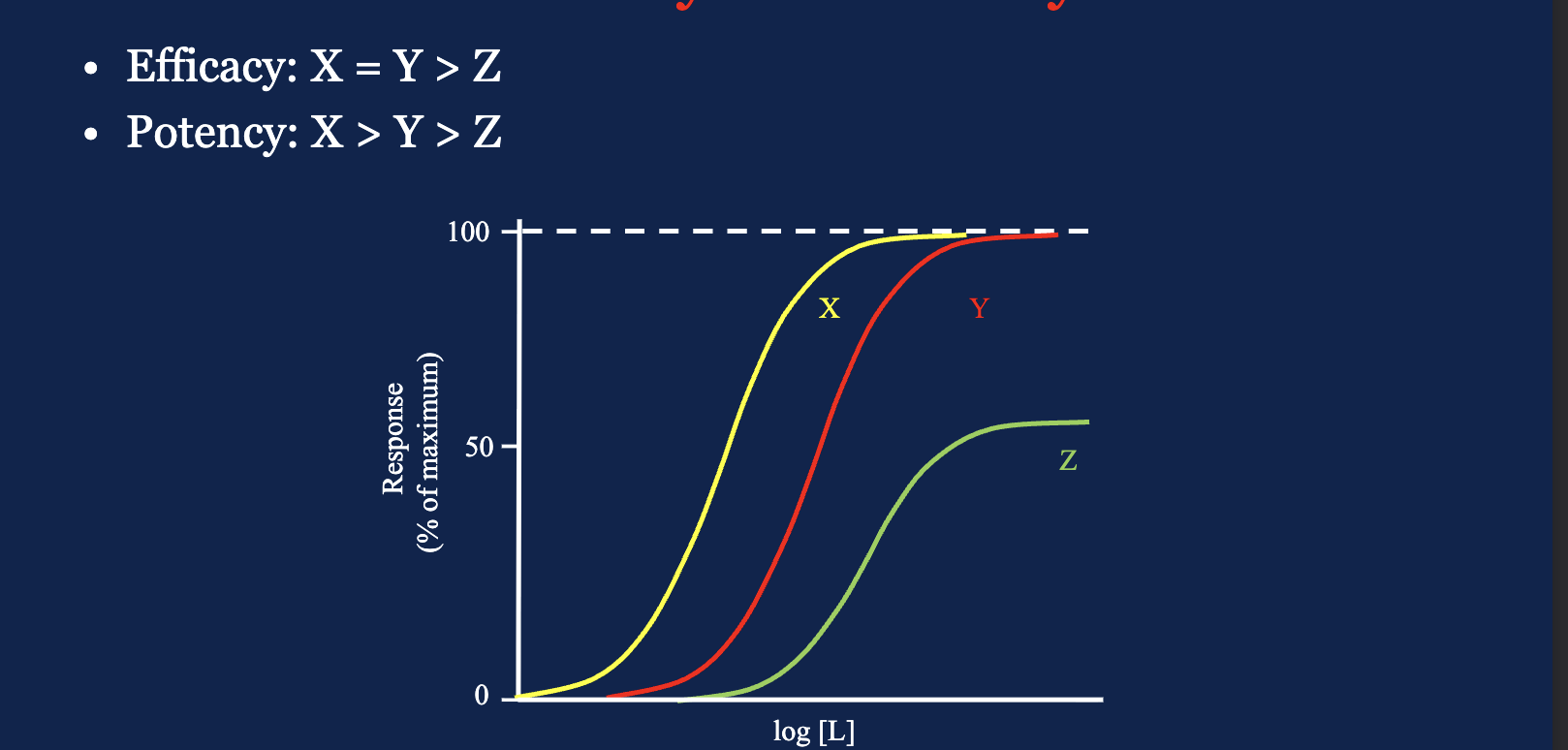
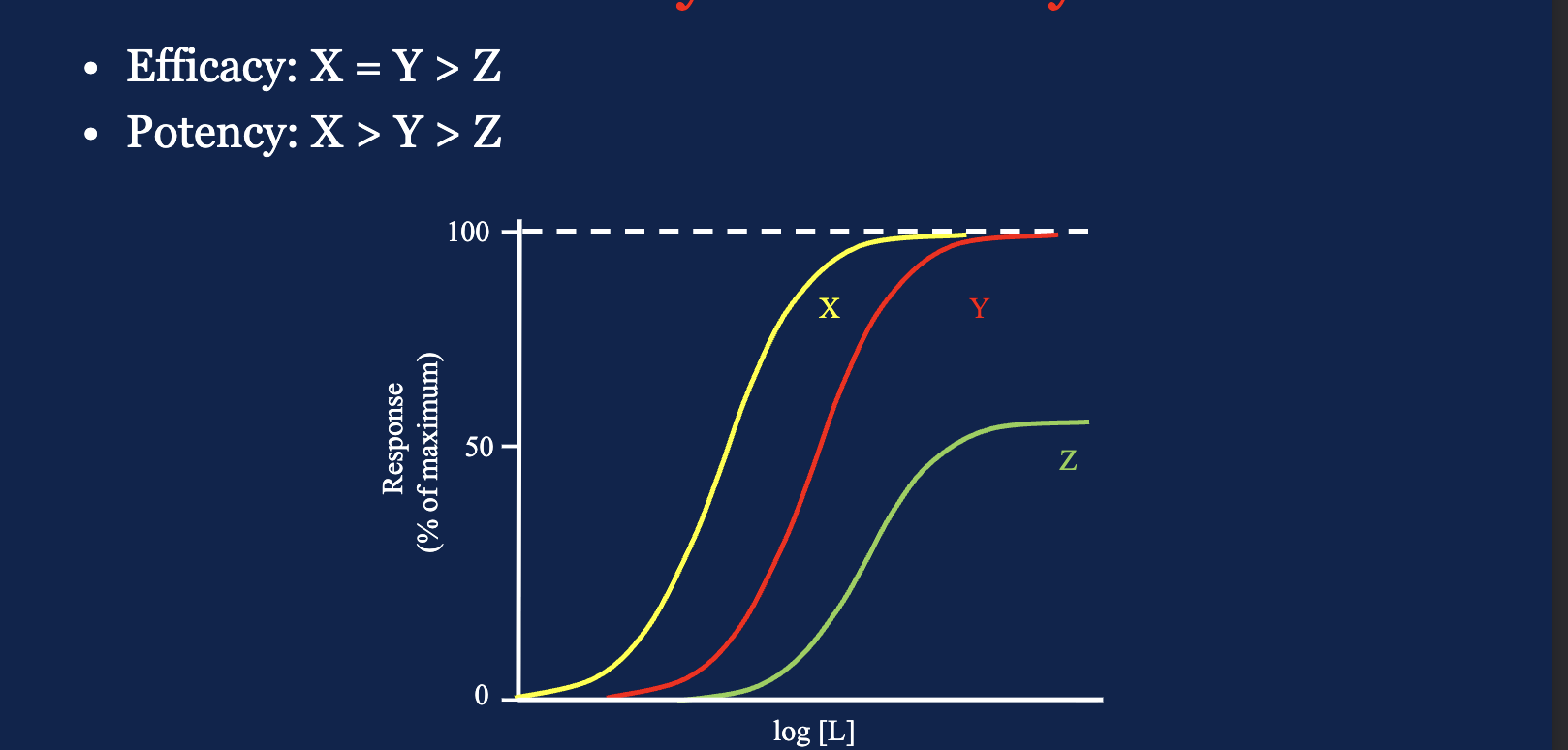
Why does Z have a lower efficacy than X and Y?
Z reaches a lower maximum response
What does potency tell you?
How much drug is needed to produce a given effect
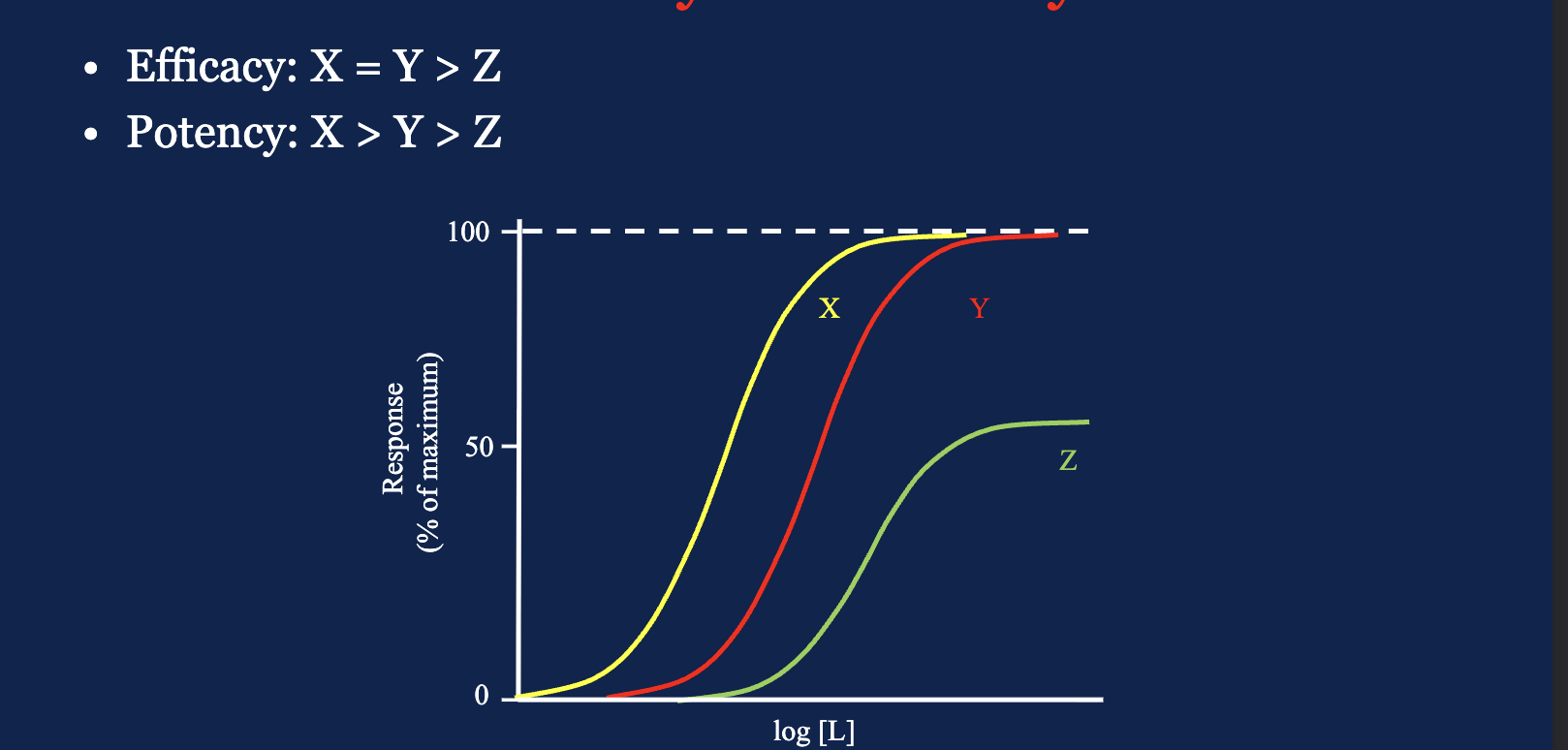
How do you compare potency on a dose-response graph?
Compare the curves left to right
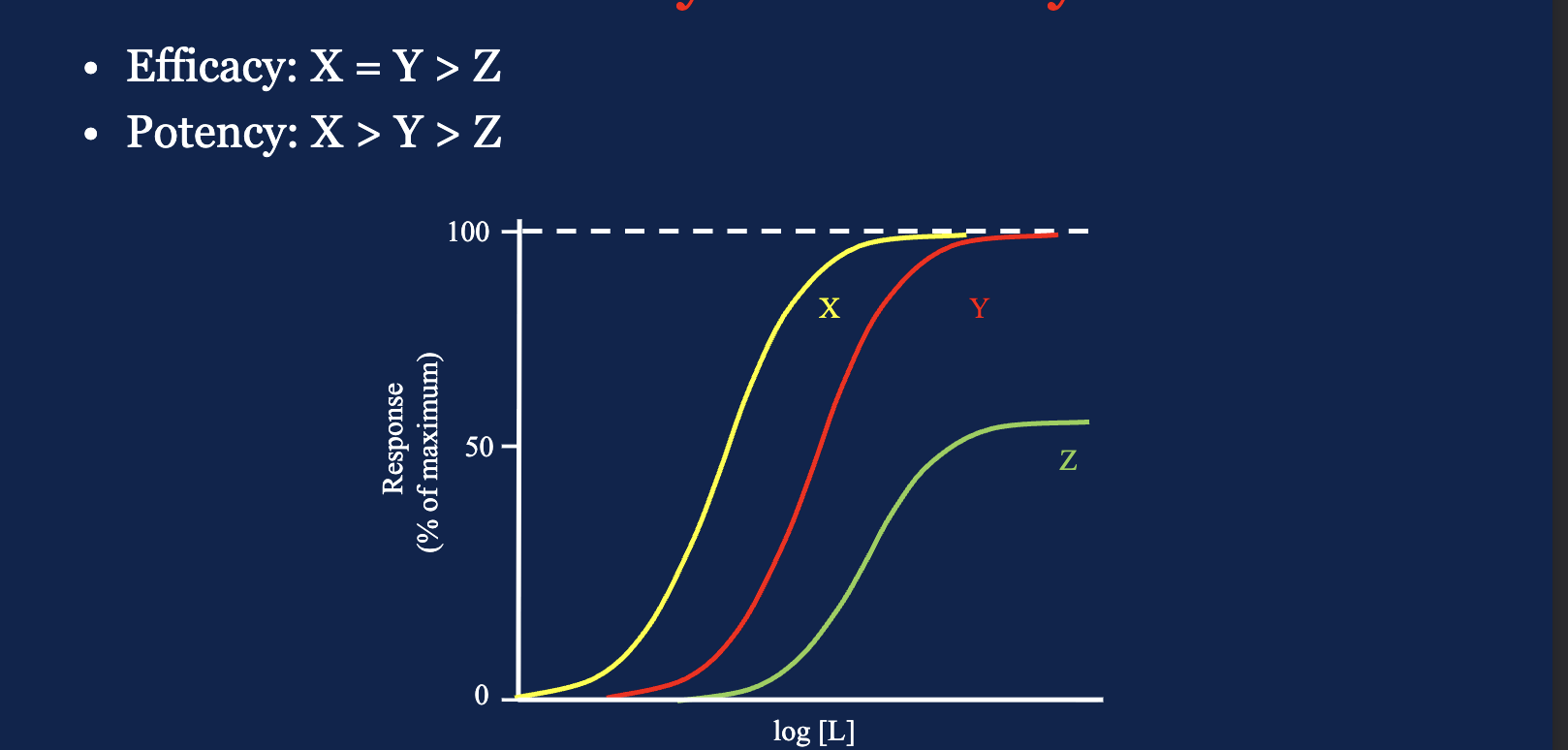
What does a curve farther to the right indicate?
Lower potency
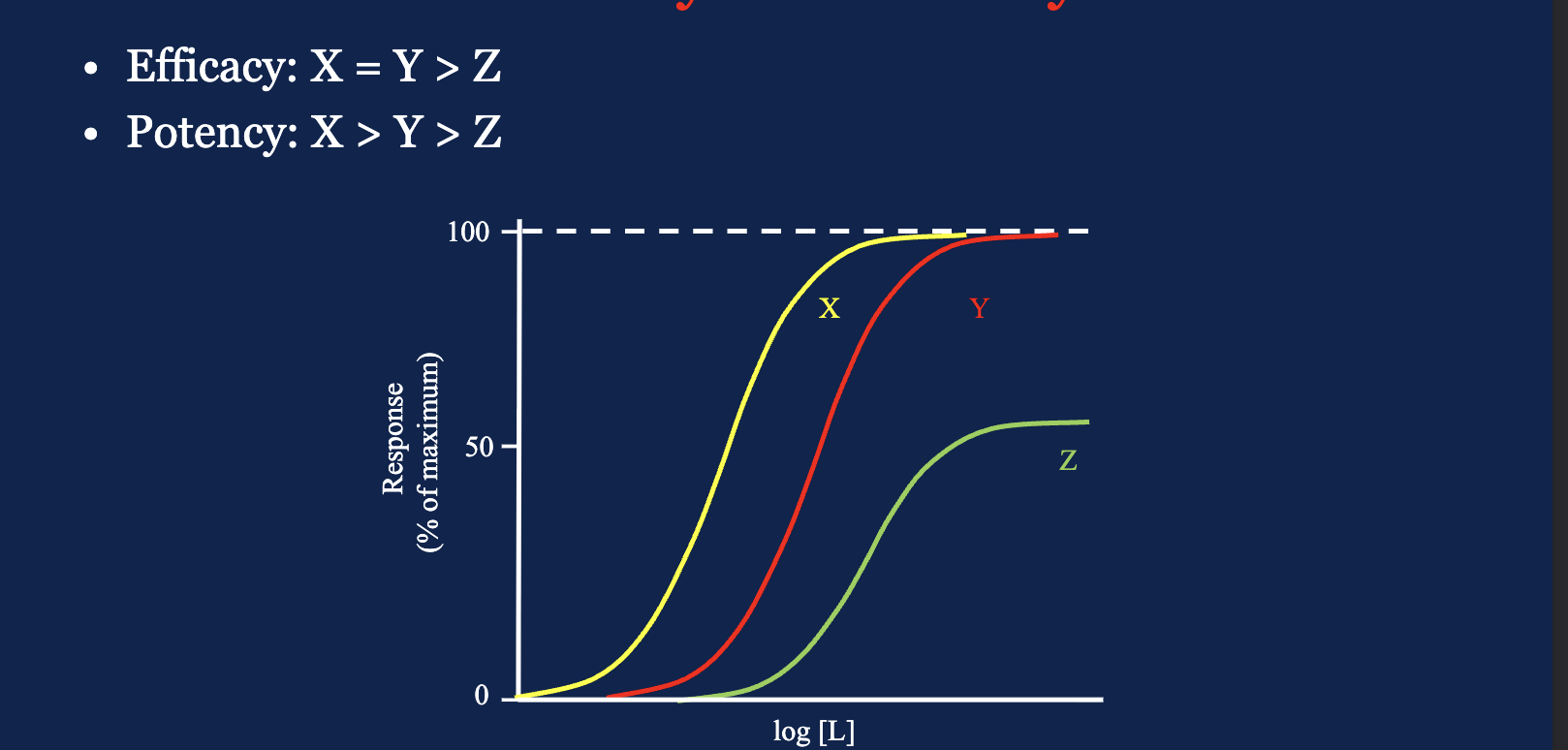
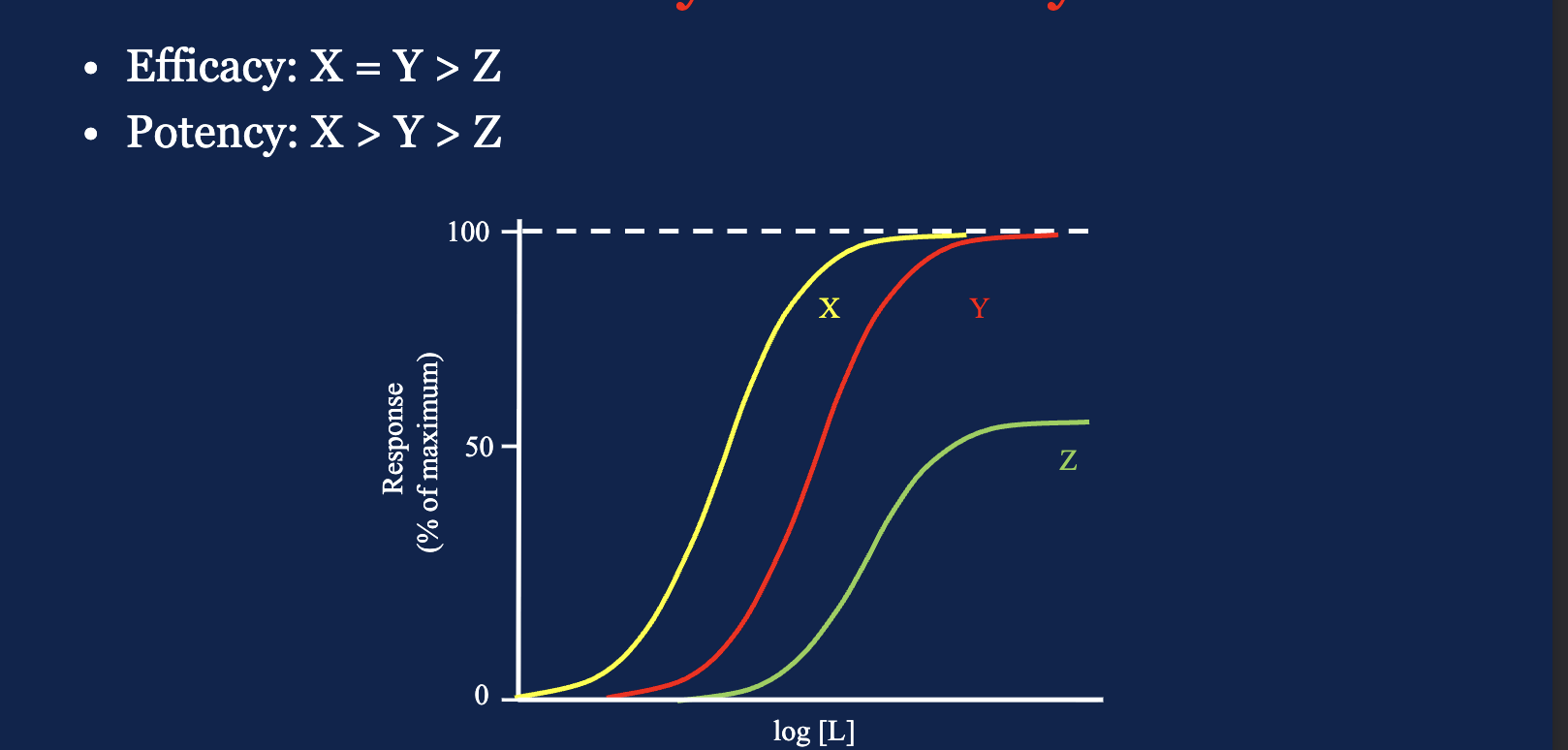
What is the potency ranking of X, Y, and Z?
X > Y > Z
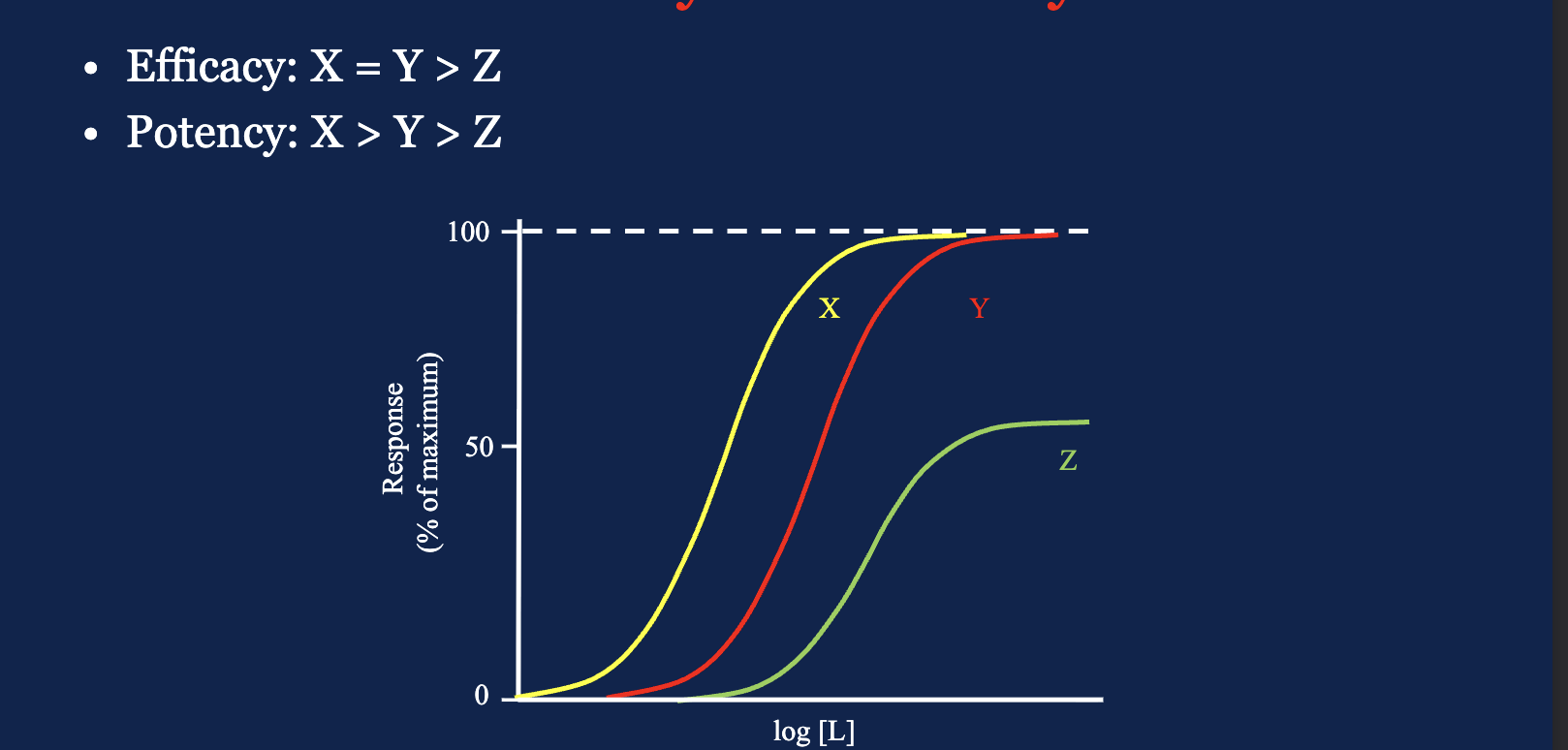
How does efficacy and potency differ when reading a graph?
Efficacy → look at height
Potency → look left vs right
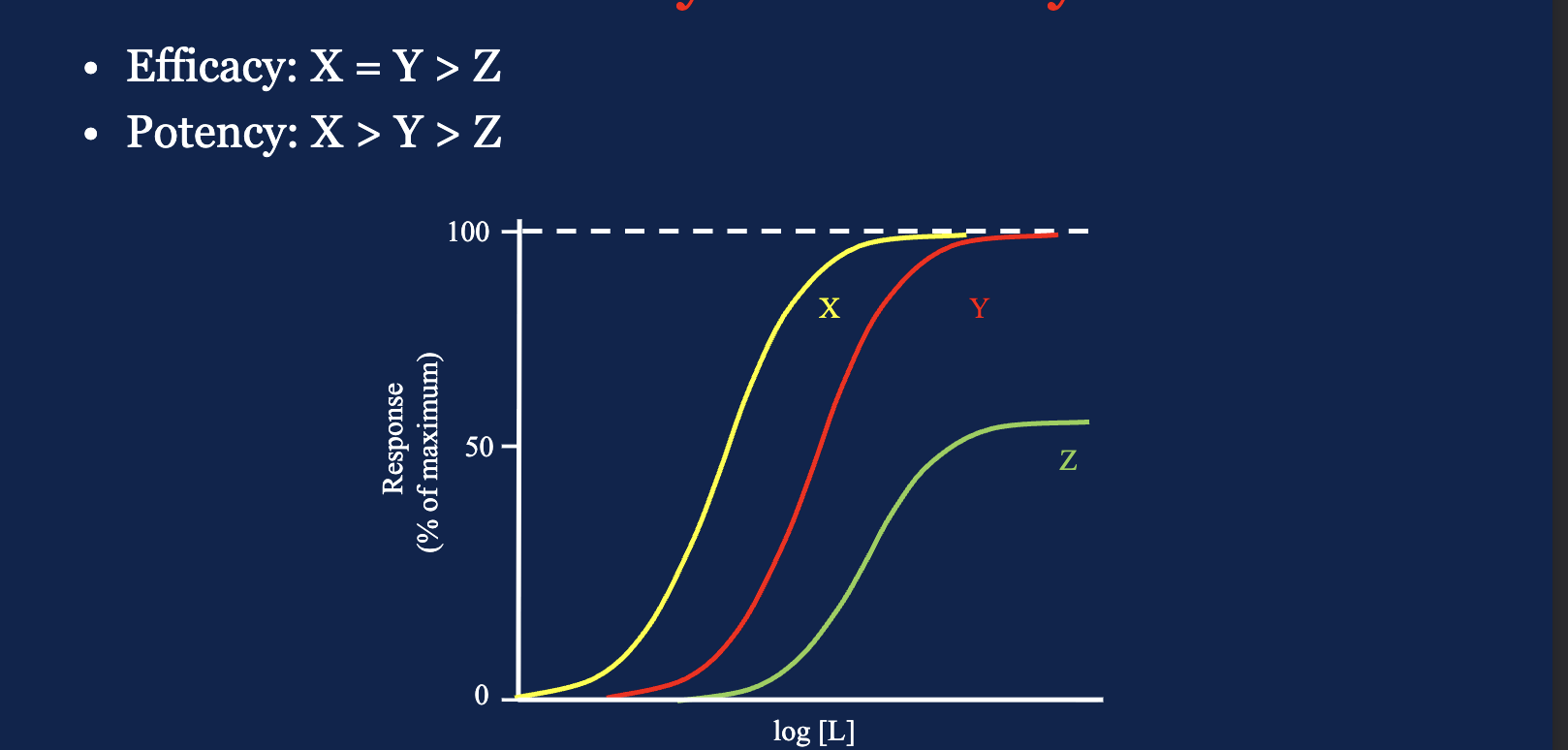
How do drugs X and Y compare in efficacy and potency?
Efficacy: X = Y
Potency: X > Y
They can produce the same maximum effect, but X requires less drug to produce a given effect
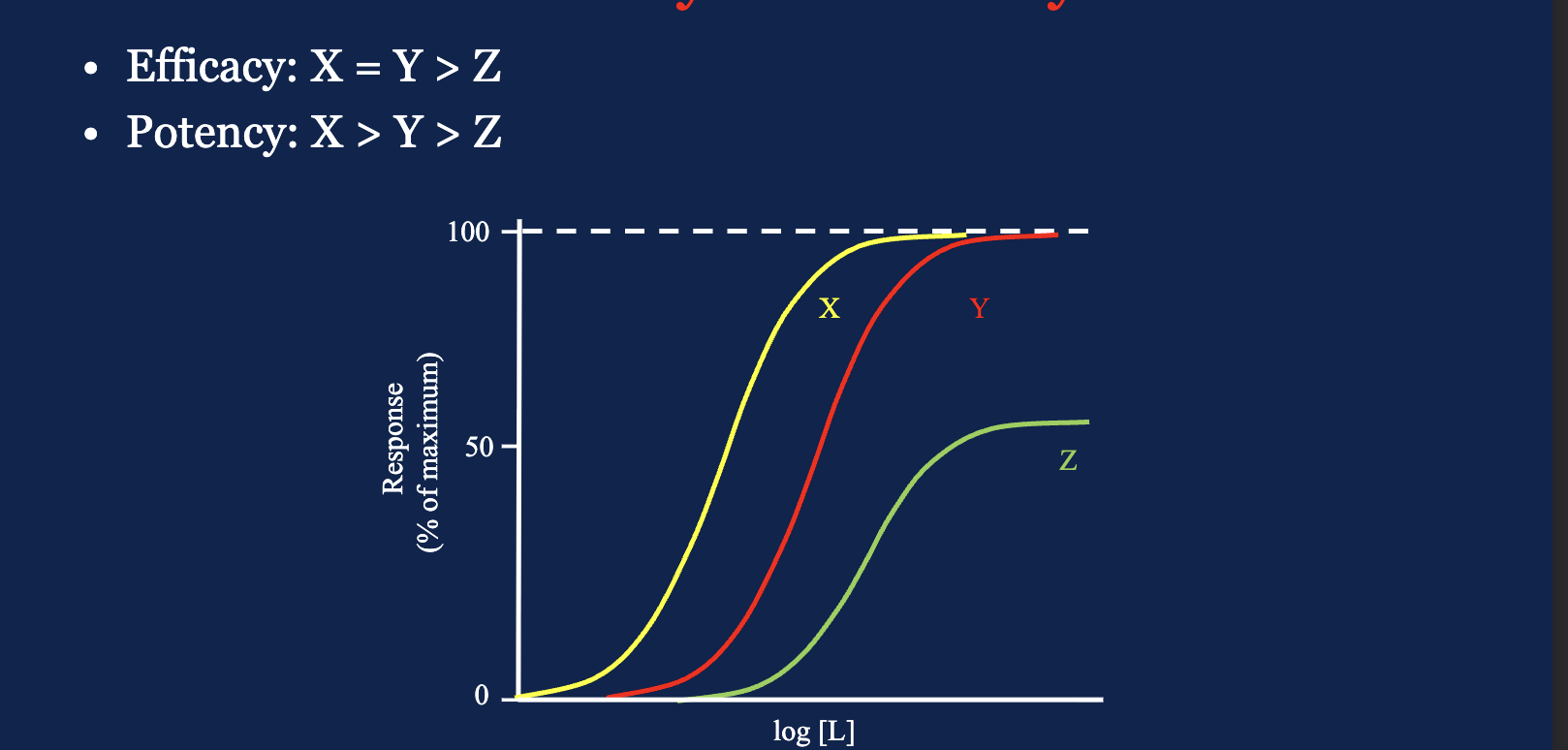
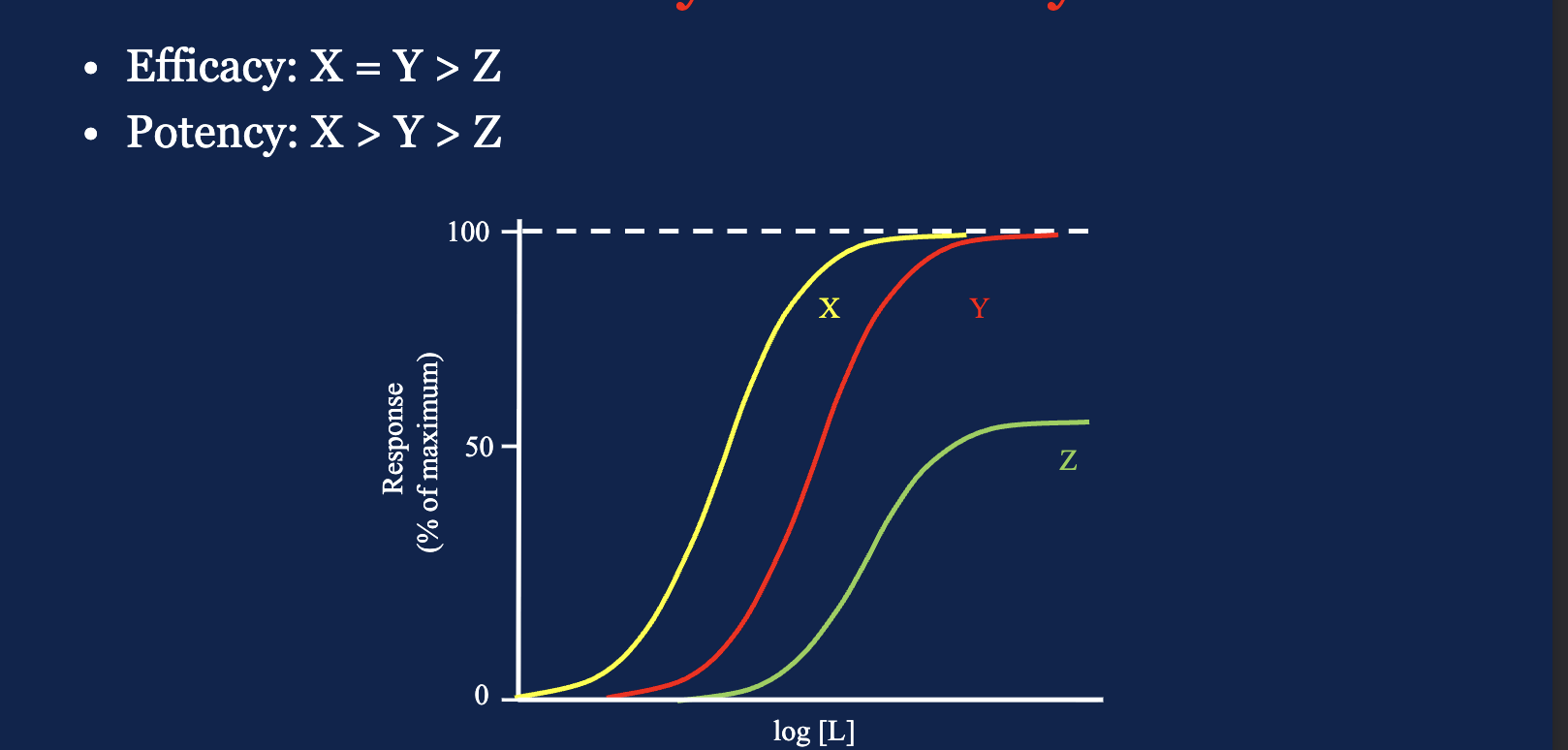
How does drug Z compare with X and Y?
Z has a lower efficacy and lower potency on the graph
Does a more potent drug automatically have greater efficacy?
No
What is generally more important to a practitioner? Efficacy or potency?
Efficacy
Why is efficacy generally more important than potency?
Because efficacy tells you the drug’s ability to produce the desired physiological effect
If choosing between two or more drugs with different efficacies, which should be used?
The more efficacious drug
When does potency become important when choosing between drugs?
When the drugs have equal efficacy
If two drugs have equal efficacy, which drug should be used according to the slide?
The more potent drug
Why would the more potent drug be chosen when efficacy is equal?
It can achieve the effect at a lower dose
What does greater potency mean about the dose needed?
A lower dose is needed to produce a given effect
What does “the poison is in the dose” mean?
A substance can become harmful/toxic depending on the dose
What is the therapeutic index?
The ratio of the amount of a drug that is harmful to the amount that is helpful
What is the formula for therapeutic index?
TI=LD50/ED50