AP Bio unit 3 (enzymes, photosynthesis, cellular respiration)
 Call Kai
 Learn
Learn Practice Test
 Spaced Repetition
 Match
Match Flashcards
 Knowt Play
1/54

There's no tags or description
Looks like no tags are added yet.
Name | Mastery | Learn | Test | Matching | Spaced | Call with Kai | Chat |
|---|
No analytics yet
Send a link to your students to track their progress
55 Terms
What is an enzyme?
an enzyme is a protein that acts as a biological catalyst mediating reactions in living things
How do enzymes mediate reactions?
Enzymes speed up reactions by lowering activation energy acting as a catalyst
What is a substrate?
Reactants that bind to the active site of the enzyme
whats an enzyme-substrate complex?
When enzymes are bound to their substrates
what makes enzymes only catalyze specific reactions?
Each enzymes active site has a specific shape that the substrate can bond to that allows the enzyme to only catalyze that reaction
Whats metabolism?
All the chemical reactions in a living thing
What factors can affect the function/efficiency of a enzyme?
-Inhibitors
-pH
-Temperature
Why might an enzyme denature?
Altering pH and Temperature too much can disrupt the proteins secondary structure by interfering with hydrogen bonds
What increases enzymatic reaction rate?
-increasing concentration of enzyme and substrates
-Increasing temperature
What are inhibitors?
Molecules that bind to an enzyme and prevent the catalysis of a reaction
Whats a competitive inhibtor?
A molecule that binds to the active site of the enzyme preventing the substrate from bonding
Whats a non-competitive inhibitor?
A molecule that bonds to the allosteric side of an enzyme changing the shape of the active site to prevent the substrate from binding to the active site
How do living things obey the first law of thermodynamics that energy is conserved?
Living things transform one form of energy to another
How do living things obey the second law of thermodynamics that every time energy is used it increases the entropy of a system?
Energy transformations are not 100% efficient because energy is lost as heat which increases the entropy of the system
What must be true about the energy input of all living organsims?
The energy input of living things must be greater that its output or they will die
What are ways living things save energy
Metabolic pathways
energy coupling
What are metabolic pathways
The product of one reaction becomes the reactant of another pathway
What is energy coupling
Reaction or process in a pathway that releases energy may be paired with one that requires energy
What is photosynthesis
series of reaction in plants that uses carbon dioxide, water and energy from light to produce oxygen and carbohydrates
Whats the chemical equation of photosynthesis?
6CO2+6H2O--> C6H12O6+6O2
What are the two types of reaction in photosynthesis?
Light Reactions and Light independent reactions (Calvin cycle)
What happens in the light dependent reactions?
Metabolic pathways that capture light energy to produce ATP (cellular energy) and NADPH (Electron carrier)
What happens in the light independent reactions (calvin cycle)?
Reactions that take CO2 molecules and link them together (carbon fixation) into carbohydrates using energy from ATP and NADPH from the light dependent reactions
What is the sight of photosynthesis?
Chloroplast
Define Photophosphorylation
The addition of a single phosphate to an ADP molecule to produce ATP using light energy
How do the light independent reactions produce ATP and NADPH
Uses an electron transport chain to cause Photophosphorylation
Whats the site of the light dependent reactions
On the thylakoid membrane
What is chlorophyll?
Pigment molecule that absorbs light energy and makes plants green
Where is the chlorophyll located?
In photosystems I and II
What is the importance of the chlorophyll molecules?
They are able to absorb the light energy-in photosystem II- which releases a high energy electron from the chlorophyll molecule to be used in the ETC

What is the purpose of H20 in photosythesis
Water is split in a process called photolysis
(H2O-->O2+2e+2H+) which produces electrons to replenish electrons to the chlorophyll molecule

Where does the electron released from photosystem II go?
The electron is passed along the proteins in the membrane through an ETC to Photosystem I

What happens as the electron moves from photosystem I to II?
Energy from the excited electron powers a proton pump that moves H+ from the Stroma into the Thylakoid causing there to be a higher concentration of H+ ions in the thylakoid (proton gradient)
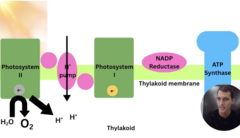
Why is the proton pump so important in photosynthesis?
Creates a proton gradient across the thylakoid membrane that will want to even out again. In order to do so it will have to diffuse through ATP synthase which is necessary for its function
What does ATP synthase do in photosynthesis?
Uses the energy from flow of protons back to the Stroma (Chemiosmosis) to phosphorylate ADP-->ATP
What is chemiosmosis?
The movement of ions (typically H+) across a selectively permeable membrane down their electrochemical gradient, generating energy to synthesize ATP
What happens to the electron that was moved to Photosystem I?
Another photon of light re-excites that electron, that gets passed to an enzyme on the membrane called NADP reductase

What does NADP reductase do?
An enzyme that catalyzes a reaction using the energy from the electron passed from photosystem I to reduce NADP+ into NADPH

what did photosynthesis first evolve in
In cyanobacteria (prokaryotic organisms). Now plants, algae, and cyanobacteria are photosynthetic
What is cellular respiration?
Process by which macromolecules (carbohydrates) are used to synthesize ATP
What are the 4 parts of the mitochondria
Outer membrane
Inter membrane space
Inner membrane
The Matrix
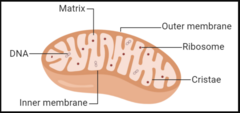
What are the steps of cellular respiration in order?
Glycolysis
The linking Step
Krebs Cycle
Electron Transport Chain
What are the inputs and net outputs of glycolysis?
Inputs-Glucose
Outputs- 2 pyruvate molecules, 2 ATP, 2 NADH
Where does glycolysis occur
In the cytoplasm outside of the mitochondria
What are the steps of anaerobic respiration
In anaerobic respiration, the only step that takes place is glycolysis
What is the linking step?
Critical transition phase between glycolysis and the Krebs cycle.
What are the inputs and outputs of the linking step?
Inputs-2 pyruvate
Outputs-2CO2, 2NADH, Acetyl CoA
What is the Krebs cycle?
Cycle of reactions following the linking step whose main purpose is to produce electron carriers (FADH2 and NADH) to be oxidized in the electron transport chain.
What are the inputs and outputs of Krebs Cycle?
Inputs: 2 Acetyl-CoA
Outputs: CO2, 2ATP, 6NADH, and 2FADH2.
What is the electron transport chain?
A series of oxidation and reduction reactions that establish an H+ proton gradient
What is oxidative phosphorylation?
metabolic pathway in aerobic organisms (cellular respiration) that produces ATP by using energy released from redox reactions in the Electron Transport Chain
Whats the first step of the ETC in cellular respiration?
NADH-->NAD+
FADH2-->FADH
Both electron carriers are oxidized, and their electrons are transferred to proteins on the inner mitochondrial membrane

What happens as the electrons from NADH and FADH2 are transferred across proteins on the inner mitochondrial membrane?
Energy is utilized by the proton pump to pump H+ ions from the mitochondrial matrix into the intermembrane space to create a proton gradient

What does ATP synthase do in cellular respiration?
Uses the flow of H+ protons from the intermembrane space back into the matrix to phosphorylate ADP->ATP

What happens to the electrons once they are passed to the final protein on the inner mitochondrial membrane?
O2 is the final electron acceptor of the electrons. It gains a negative charge attraction it to the H+ ions to form water. O2+4e+4H->2H2O