ch. 3 - cytokines + chemokines
 Call Kai
 Learn
Learn Practice Test
 Spaced Repetition
 Match
Match Flashcards
 Knowt Play
1/69

There's no tags or description
Looks like no tags are added yet.
Name | Mastery | Learn | Test | Matching | Spaced | Call with Kai | Chat |
|---|
No analytics yet
Send a link to your students to track their progress
70 Terms
cytokine signaling
inducing stimulus
PAMPs
antigen
DAMPs
cytokines
cytokine signaling
induced response
enzyme activation
transcription
metabolism
chemotaxis
cytokine signaling
effector response
proliferation
degranulation
phagocytosis
cytokine secretion
autocrine cytokine signaling
autoimmune cell expresses receptor for a self-made cytokine
paracrine cytokine signaling
immune cells secrete cytokines into environment and nearby cell expresses receptor
endocrine cytokine signaling
immune cells secrete cytokines into environment and travel long distances to receptor
pleiotropy
single cytokine produces multiple, distinct effector responses
synergy
2 (or more) cytokines produce effect together that neither produce alone
redundancy
2 (or more) cytokines produce an identical effect even in combination
antagonism
1 cytokine blocks or prevents the effector reponse produced by another
cytokine molecular signaling pathway
cytokine receptor waits w/ receptor -associated kinase
cytokine binds + receptor chains dimerize + become phosphorylated
transcription factors bind to phosphorylated chains
dissociate + turn into active transcription factors that bind to promoter
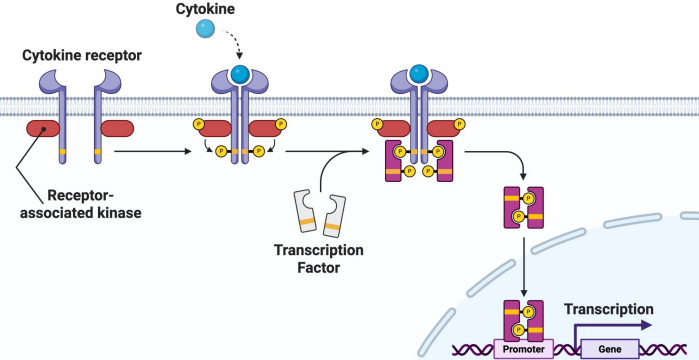
class 1 (hematopoietins, IL-2) cytokines utilize ________ signaling
JAK/STAT
class 1 cytokines effector outcomes
survivial
proliferation
differentiation

class 1 cytokine receptor subunit formation
intermediate affinity IL2R: beta + gamma subunits
TCR activation → alpha subunit binds to beta + gamma
high affinity IL2R
JAK/STAT negative feedback loop
IL6 binds to IL6R
proceeds as normal
2 products: SOCS and proinflammatory effector molecules
SOCS
self-made product that inhibits JAK/STAT signaling
interferons (class 2 cytokines) are potently _________
antiviral
type 1 interferons
cytokines: IFN-alpha, IFN-beta, others
expression: ubiquitous
type 2 interferons
cytokines: IFN-gamma
expression: T cells
type 3 interferons
cytokines: IFN-lamda
expression: barrier tisssues

IFNAR 1/2
activated by IFN-alpha and beta

IFNLR1/IL10R2
activated by IFN-lamda

IFNGR1/2
activated by IFN-gamma
forms ONLY STAT1/1 heterodimer
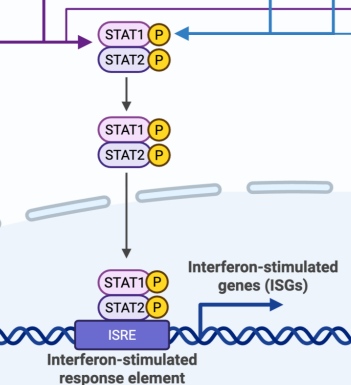
interferon stimulated response element
binds to STAT 1-2 heterodimer
comes from type 1 and type 3 interferons
functional transcription complex → interferon-stimulated genes (ISGs)

gamma interferon activation
binds to STAT 1/1 homodimer
comes from all interferons
functional transcription complex → interferon-stimulated genes (ISGs)
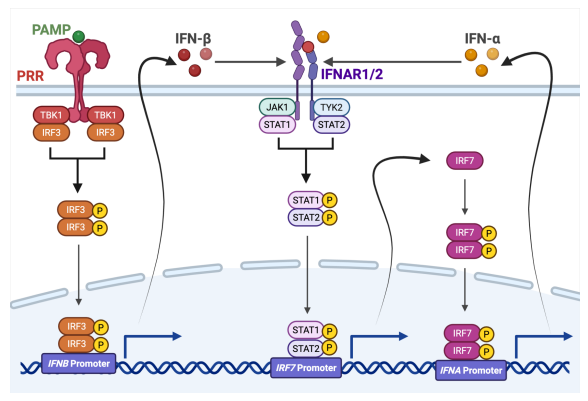
type 1 IFN positive feedback regulation steps
PAMP binds to PRR
2 TBK1s phosphorylate 1 IRF3s → IRF3 homodimer → IFNBeta promoter
IFN-beta activate → IFNAR1/2 → STAT1-2 heterodimer → IRF7 promoter
IRF7 activated → induces IFNAlpha promoter → IFN-Alpha active
reactivates IFNAR1/2!
types of ISG effector molecules
IFITM proteins
OAS/RNAse L
Protein Kinase R (PKR)
Mx proteins
IFITM proteins
bloackade of viral entry/ endocytosis
OAS/RNAse L
RNA degradation/ editing
Protein Kinase R (PKR)
inhibition of translation
Mx proteins
inhibition of viral assembly
chemokines
cytokines that coordinate cellular movement
chemotaxis
chemical induced cellular movement
attracted to source of chemokines
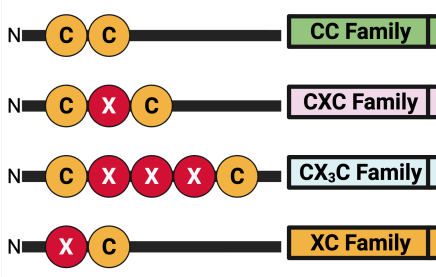
4 subfamilies of chemokines
CC
CXC
CX3C
XC
how are the ligands and receptors of the families named?
add L and R to the end of the names
chemokines exhibit _________ receptor binding
promiscuous
many ligands bind to receptors
CXCR1 ligands
L6 and L8
CXCR2 ligands
L1-3, L5-8
CXCR3 ligands
L9-11
CXCR4
only L12 — NON-promiscuous!
chemokine pleiotropic functions (GCPR)
AKT supresses apoptosis
cytoskeletal reorganization
gene expression
CXCR7/ ACKR3
NOT GCPR! atypical chemokine
R7 binds to L12 → endocytosis of receptor-ligand complex
complex binds to lysosome → L12 degraded
R7 goes back to cell surface w/o L12
naive B cell chemokines
(B cells) CXCR5 → CXCL13 (made by follicular dendritic cells)
naive T cell chemokines
(T cells) CCR7 → CCL 19/21 (made by reticular fibroblasts)
what if B and T cells meet their Ag?
their receptors are downgraded and they leave through efferent pathways
locations of PRRs
extracellular (PM), cytosolic and endosomal
extracellular PRRs
TLR + CLR
cytosolic PRRs
cGAS, NLR and RLR
endosomal PRRs
TLR
gram positive bacteria TLRs (extracellular)
diacyl lipopeptides → TLR2 + TLR6
fungi TLRs (extracellular)
triacyl lipopeptides → TLR2 + TLR1
flagellated bacteria TLRs (extracellular)
flagellin → TLR5 homodimers
gram negative bacteria (extracellular)
LPS → TLR4 homodimers
TLR adaptor molecules
MyD88 and TRIF
what do the TLR adaptor molecules turn on?
NF-kB (inflammatory) and IRFs (type 1 IFNs)
NF-kB activation
TLR + IKK active
IKK phosphorylates IkB (inhibitor) → IkB degraded
NF-kB can bind to kB site → immune response
IRF activation
TLR + TBK1 active
TBK1 phosphorylates IRF3
IRF3 homodimer → induction interferon expression
CLRs detect ________ PAMPs and induce _______
carbohydrate, phagocytosis
CLR induced phagocytosis
yeast/fungus detected by dectin-1
Syk activates NF-kB
simultaneously, phagosomes take up yeast/ fungus
2 major RLRs
RIG-I and MDA-5
RIG-I activation
RIG-1 binds to ssRNA
MDA-5 activation
MDA-5 binds to dsRNA
RLR combined immune response
MAVS activates TBK1
TBK1 phosphorylates IRF3 → IRF3 homodimer
induces type 1 IFNs
cGAS/STING detect _______ DNA and induce ____
cytosolic, IFNs
cGAS immune response
cGAS detects cytosolic DNA
cGAMP activates STING (endoplasmic ret)
STING activates TBK1 → IRF3 phosphorylation → IRF3 homodimer
type IFNs1
nod-like receptors (NLRs) sense cytosolic insults + form _________
inflammasomes
NLRP3 activation
sterile insults: pore formation, ion flux, crystal and ROS
NLRC4 activation
bacterial flagellin
AIM2 activation
cytosolic dsDNA
NLR inflammasome functions
process IK-1 cytokines = inflammation
procces GSDM-D = pyroptosis