Newton's 0
 Call Kai
 Learn
Learn Practice Test
 Spaced Repetition
 Match
Match Flashcards
 Knowt Play
1/78

There's no tags or description
Looks like no tags are added yet.
Name | Mastery | Learn | Test | Matching | Spaced | Call with Kai | Chat |
|---|
No analytics yet
Send a link to your students to track their progress
79 Terms
The terminal velocity of an object in free fall occurs when
the force on the object is 0
frictional force cancels the gravitational force
this is the maximum speed the object attains
Newton’s 3 laws of motion describe
how an object responds to interactions with other objects that exert forces on it
If the net force on the object is 0, it will have
0 acceleration
A nonzero force produces acceleration in proportion to
the mass of the object
The weight of an object is
the gravitational force exerted on it by Earth
If object A exerts a force on object B, then B
exerts an equal and opposite force on A
We don’t tilt our coordinate system, if the acceleration is
horizontal
For many problems, each of the forces that had to be resolved shows up twice — once with sine and once with a cosine factor. A set of force equations without matched sine and cosine factors is likely
incorrect
Make sure you don’t neglect any
equations
for centripetal acceleration problems, the maximum speed corresponds to
the maximum frictional force
When do you use the procedure for motion with resistive forces?
Situations where the force on an object (thus its acceleration) depends on its velocity
Ex. air resistance, fluid resistance
Applying 2nd law gives you a differential equation to solve by integrating.
Motion with resistive forces, Step 1
Draw a free-body diagram
Motion with resistive forces, Step 2
Choose a coordinate system, one axis parallel to the net force if possible
Motion with resistive forces, step 3
Resolve all forces in the free-body diagram into components along the axes of coordinate system, apply Newton’s 2nd law
Motion with resistive forces, step 4
express all variables in your equations in terms of velocity and time to obtain a 1st order differential equation.
acc. = 1st derivative of velocity - dv/dt
Since force depends on velocity, you must solve using calculus
Motion with resistive forces, step 5
Solve the differential equation by separating the variables and integrating
Definite integrals are slightly easier to work with (v0, vf, t0, tf)
Motion with resistive forces, step 6
Use the final condition (behavior as time approaches infinity) to check your work.
You should be able to do this w/o calculus
General Approach to Solving Newton’s Law Problems, Step 1
Draw a free-body diagram for each object
Sketch that indicates all external forces exerted on the object
If we’re talking motion of several objects, draw a separate diagram for each
General Approach to Solving Newton’s Law Problems, Step 2
Choose a coordinate system for each object
Technically you could choose any (as long as it’s an inertial reference frame)
Good choice simplifies problems
What coordinate system should you choose if it’s a linear motion problem?
Choose one axis parallel to the direction of motion
Ex. one axis should be parallel to the incline
What coordinate system is appropriate for UCM?
One axis parallel to the radial coordinate, along the direction of centripetal acceleration
If there is no net force or acceleration, what coordinate system should you choose?
Choose which axes are most convenient
Try to align 1 axis parallel to the direction of possible motion
ex. one axis parallel to incline
If you’re solving a problem that contains multiple bodies with the same acceleration (e.g. connected by a rope),
make sure the accelerations of the objects are related appropriately
positive acc. of one object in its coordinate system corresponds to positive acc. of a connected object in its coordinate system
General Approach to Solving Newton’s Law Problems, Step 3
Resolve all forces in the free-body diagram into components along the axes of your coordinate system.
Add the components in each direction separately, applying Newton’s 2nd law
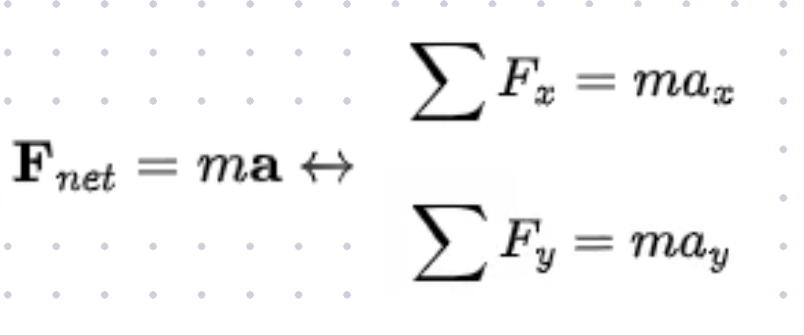
General Approach to Solving Newton’s Law Problems, Step 4
Solve the simultaneous equations from Newton’s 2nd law
Static equilibrium (object at rest) →
Fnet,x = Fnet,y = 0
(corollary of Newton’s first law)
Circular motion — solving equations
The centripetal force = net force required for circular motion
Can be provided by tension, normal force, gravity, friction, etc.
Centripetal force should never appear on a free-body diagram, but it equals the net force when solving 2nd law problems.
In any UCM problem, the net force must equal
the centripetal force, Fnet = mv²/r
net force must point toward the center of the circle
For solving equations,
you may also need to use equations that define the magnitudes of forces
ex. equations for static & kinetic friction or gravity
the accelerations of any 2 objects attached by a string of fixed length have equal magnitudes (assuming string is massless and taut)
Why is it useful to designate θ and θ’?
keeping track of angles
θ' = 90 - θ
complement of θ
if θ is one angle in a right triangle, the other must be θ’
if θ divides a right angle, the other angle must be θ’
You can easily identify one angle after you’ve solved another
quickly label all angles as either θ or θ’
sin θ = cos θ’, and sin θ’ = cos θ
How do you calculate the coefficient of static friction?
Using the following equation,
Fmaximum static friction = μsFN
Make sure you are familiar with the free-body diagram and geometry used in what types of problems that are commonly seen in the AP?
inclined plane problems
For Atwood machines, what are possible equations for the 2 masses?
Fnet,m1 = FT - m1g = m1a1
Fnet,m2 = FT - m2g = m2a2
v1 = -v2
a1 = -a2
For the pulley in the Atwood machine, what’s the upward force the pin must exert?
For the pulley not to fall down, it must exert an upward force exactly canceling the downward tension forces.
Since the pulley is rotating, not translating, the net force is still 0.
Fnet,y = Fpin - 2FT
When several objects move together and accelerate at the same rate,
we can treat them as a single object to find their common acceleration.
To calculate the net force on a mass,
most cases you can simply substitute into Newton’s 2nd law.
For contact forces,
use Newton’s 3rd law. You can try finding the force one exerts on the other via a free-body diagram and applying the 2nd law.
In an elevator,
Fnet,y = FN - mg = ma
The scale reads the normal force.
Newton’s 1st Law
Fnet = 0 → a = 0
n individual forces =
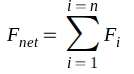
force = sum of
components, i.e., F = Fxi + Fyj
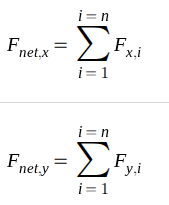
In problem solving, we add forces
component-wise, to get a set of 1D equations
that can be related to 1D equations for UAM
Breaking Fnet into components:
inertia
how much an object resists change in velocity
measured by mass
v = 0 and/or v = constant is related to
a = 0 and Fnet = 0
This is the basis of solving static equilibrium problems involving particles
What’s the difference between static equilibrium and dynamic equilibrium?
Static equilibrium = object at rest
Dynamic equilibrium = motion w/ constant velocity
Both involve 0 acceleration and 0 net force.
Newton’s laws are only valid in
inertial reference frames
reference frames that move @ constant velocity w/ respect to other inertial reference frames
Example of an inertial reference frame
Earth (ignoring spin & revolution)
Noninertial reference frames
attached to objects w/ linear acceleration (car example)
centripetal acceleration (merry go round)
linear & radial acceleration
Newton’s 2nd Law
Fnet = ma
Newton’s 2nd Law implies force is a vector parallel to
acceleration
Force is measured in
lbs / Newtons
1 N = 1 kg m/s²
Newton’s 3rd Law
If a force is exerted by one object on another, another force equal & opposite is exerted back at the other object
Newton’s 3rd Law applies to
pair of objects
mass
measure of inertia
SI unit = kg
weight
magnitude of force exerted on object by closest nearby planet
w = mg
units of force (Newton / pounds)
magnitude of gravitational force
F = w = mg
Direction of gravitational force
towards center of the earth
not necessarily perpendicular to surface
magnitude of normal force (FN)
determined by 2nd law
direction of normal force
always perpendicular to surface object is on
pointing away from surface towards object
normal force characteristics
equal & opposite, increases so net force = 0
must have magnitude mg if a = 0
magnitude of frictional force
derived from experiments, it’s a function of applied horizontal force
static friction
Ffr = Fa
whatever it takes to prevent motion
objects aren’t sliding relative to each other
maximum magnitude of static friction
μsFN
μs = coefficient of static friction, property of 2 materials
kinetic friction
when objects are sliding
magnitude = constant value = μkFN
μk = coefficient of kinetic friction
the magnitude of kinetic friction is __ than the maximum static friction force
lower
Fstatic inequality
Fstatic ≤ μsFN
Fkinetic equation
Fkinetic = μkFN
direction of frictional force
it points parallel to the plane of contact
its direction opposes the object’s motion
the normal force is perpendicular to
surfaces of contact
for friction, think
opposite of direction of motion
the minimum force for an object to move is
Fapplied = μsFN = μ mg
(given that vertical acceleration = 0, so it should just cancel out gravitational force (mg))
Once an object moves, if +x is the direction of motion, we’re only applying minimum horizontal force,
Fnet,x = Fapplied,x + Ffriction,x
Fnet,x = μsmg - μkmg
anet,x = Fnet,x / m = (μs - μk)g
tension force - magnitude
determined by 2nd law
ropes are approximated as massless so tension @ every point is the same
direction of tension force
parallel to rope / string
points towards middle of rope / string @ ends connected to objects
In Newton’s Law problems, be careful with the normal force, since
there are forces going against it you may forget to take into account.
For problems with graphs, give an example of why you should pay attention to details.
Asking questions, like “does velocity start at zero for this graph?” can quickly eliminate options.
A good idea is to familiarize yourself with ____ graphs.
position, velocity, and acceleration graphs (relative to each other)
Average force equation
Assuming mass is constant, based on F = ma, the average force = mass * average acceleration, (vf - v0)/Δt