A-Level Biology - 3.6.4 Homeostasis is the maintenance of a stable internal environment
 Call Kai
 Learn
Learn Practice Test
 Spaced Repetition
 Match
Match Flashcards
 Knowt Play
1/39

There's no tags or description
Looks like no tags are added yet.
Name | Mastery | Learn | Test | Matching | Spaced | Call with Kai | Chat |
|---|
No analytics yet
Send a link to your students to track their progress
40 Terms
What does homeostasis in mammals involve?
physiological control systems that maintain the internal environment within restricted limits
Name three factors kept stable by homeostasis
core temperature
blood pH
blood glucose concentration

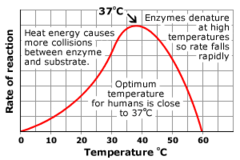
What is the importance of maintaining a stable core temperature?
if temperature is too high:
enzymes may denature (tertiary structure changes)
so active site is no longer complementary to substrate)
if temperature is too low:
lower kinetic energy
lower enzyme activity
How is temperature controlled in mammals?
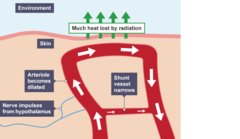
thermoreceptors detect blood and skin temperature
hypothalamus coordinates response (negative feedback)
*Temperature too high:*
-vasodilation (heat energy lost by radiation)
-sweating
-hair muscles relax
*Temperature too low:*
-vasoconstriction (less heat energy lost by radiation)
-shivering
-hairs erected
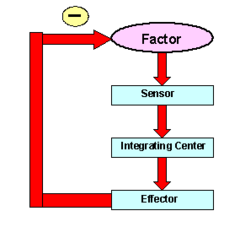
What does negative feedback do?
restores systems to their original level
a deviation of a value from the norm initiates corrective mechanisms
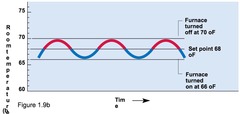
Why do organisms possess separate mechanisms involving negative feedback?
controls departures in different directions from the original state, giving a greater degree of control
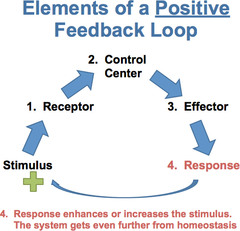
What does positive feedback do?
amplifies change
one change causes *more* of another change, which in turn causes *more* of the original change
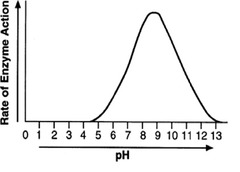
What is the importance of maintaining a stable blood pH?
when pH is too low or too high:
hydrogen/ionic bonds break, changing the tertiary structure of the enzyme
shape of active site changes, so is no longer complementary to substrate and ES complexes can no longer form
enzyme is denatured
What is the importance of maintaining a stable blood glucose concentration?
so that respiratory substrate is available
to maintain the water potential of blood
Name three ways glucose can enter the bloodstream
absorption in the gut following carbohydrate digestion
hydrolysis of glycogen stores
non-carbohydrates such as glycerol and amino acids that have been converted to glucose
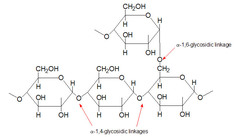
Describe the role of the liver in glycogenesis
Converts glucose → glycogen
triggered by *insulin*
removes glucose molecules from bloodstream, decreasing blood glucose concentration
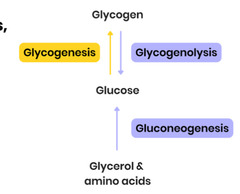
Describe the role of the liver in glycogenolysis
Converts glycogen → glucose
triggered by *glucagon*
activates enzymes within liver to break down glycogen molecules into glucose
releases glucose molecules into bloodstream, increasing blood glucose concentration
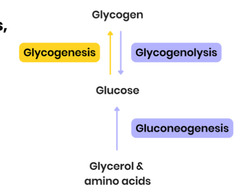
Describe the role of the liver in gluconeogenesis
Converts non-carbohydrate molecules → glucose
triggered by *glucagon*
enzymes in the liver convert amino acids / glycerol to glucose
glucose molecules released into bloodstream, increasing blood concentration
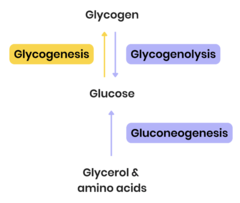
Where is insulin secreted from?
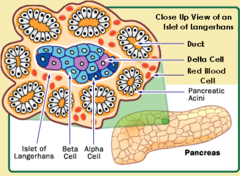
from endocrine tissue in pancreas called islets of Langerhans
secreted from β cells
How does insulin work to reduce blood glucose concentration?
attaches to receptors on the surfaces of target cells (liver and muscle cells)
causes the inclusion of more glucose transporter channel proteins into surface membranes of target cells
increases rate of facilitated diffusion of glucose into cells
activates enzymes involved in the conversion of glucose to glycogen in the liver
Where is glucagon secreted from?
from endocrine tissue in pancreas called islets of Langerhans
secreted from α cells
How does glucagon work to increase blood glucose concentration?
attaches to receptors on the surfaces of target cells
activates enzymes involved in the conversion of glycogen to glucose
activates enzymes involved in the conversion of glycerol and amino acids into glucose
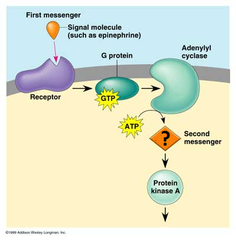
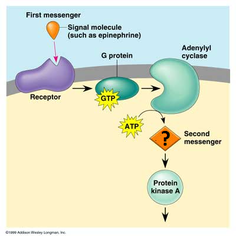
Describe the second messenger model of glucagon action
1) glucagon (first messenger) binds to receptors on surface of liver cells
2) causes the enzyme *adenylate cyclase* to change shape and become activated
3) active adenylate cyclase catalyses conversion of ATP to second messenger, *cyclic AMP (cAMP)*
4) cAMP binds to *protein kinase* enzymes, activating them
5) active protein kinase enzymes catalyse the breakdown of glycogen to glucose
How does adrenaline work to increase blood glucose concentration?
attaches to receptors on the surfaces of target cells
activates enzymes involved in the conversion of glycogen to glucose
Describe the second messenger model of adrenaline action
1) adrenaline (first messenger) binds to receptors on surface of liver cells
2) causes the enzyme *adenylate cyclase* to change shape and become activated
3) active adenylate cyclase catalyses conversion of ATP to second messenger, *cyclic AMP (cAMP)*
4) cAMP binds to *protein kinase* enzymes, activating them
5) active protein kinase enzymes catalyse the breakdown of glycogen to glucose
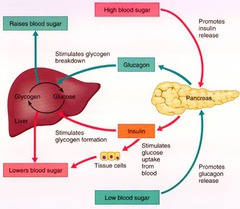
Describe the negative feedback loop when blood glucose concentration is too low
islet cells in pancreas detects low glucose concentration
α cell secretes glucagon
more glucagon stimulates hydrolysis of glycogen (glycogenolysis)
less insulin decreases uptake and use of glucose by liver and muscle cells
blood glucose concentration increases
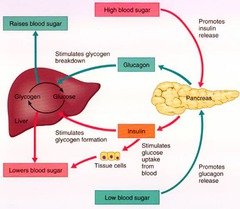
Describe the negative feedback loop when blood glucose concentration is too high
islet cells in pancreas detects high glucose concentration
β cells start producing insulin
more insulin causes glycogenesis
more insulin increases uptake and use of glucose by liver cell and muscle cells
blood glucose concentration decreases
What is the cause of type I diabetes?
autoimmune response to β cells in pancreas - they are damaged
so less/no insulin produced
leading to dangerously high blood glucose concentrations
How can type I diabetes be controlled?
diabetes appropriate diet (lower in sugar) and exercise
blood glucose monitoring and insulin injections
What is the cause of type II diabetes?
diet high in sugar leads to constantly high insulin levels in the blood
insulin still produced by pancreas but cells of the body become resistant to it
leading to dangerously high blood glucose concentrations
How can type II diabetes be controlled?
maintain low carbohydrate diet with regular exercise
reduces need for insulin
What is osmoregulation?
control of water potential in the blood
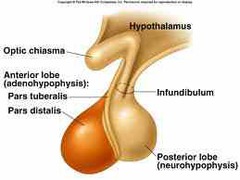
What is the role of the hypothalamus, posterior pituitary and antidiuretic hormone (ADH) in osmoregulation?
osmoreceptors (sensory neurones) found in the *hypothalamus* monitor the water potential of the blood
if they detect a *decrease* in blood water potential, nerve impulses are sent to the *posterior pituitary gland*
nerve impulses stimulate posterior pituitary gland to release *ADH*
*ADH* causes kidneys to reabsorb more water, reducing water loss in urine
How does the release of ADH affect urine produced by the kidneys?
Permeability of membrane / cells to water is increased
More water absorbed from distal tubule and collecting duct
Smaller volume of urine
Urine becomes more concentrated
What is the role of ADH in the production of concentrated urine?
1) When water potential of the blood too low
2) Detected by receptors in the hypothalamus
3) Pituitary releases more ADH
4) ADH increases the permeability of the membrane of the DCT and collecting duct by the recruitment of aquaporins
5) More water is reabsorbed, leaving the nephron and moving into the blood
6) By osmosis down the water potential gradient
What is the role of ADH in the production of dilute urine?
1) When water potential of the blood too high
2) Detected by receptors in the hypothalamus
3) Pituitary releases less ADH
4) permeability of the membrane of the DCT and collecting duct deceased
5) less water is reabsorbed from DCT and collecting duct
6) By osmosis down the water potential gradient
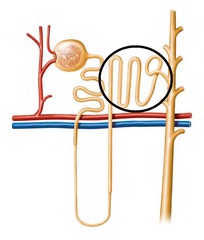
What is the structure of a nephron?
*Bowman's capsule* contains *glomerulus*
*proximal convoluted tubule* in the cortex leads into
*loop of Henle* in the medulla, which leads into
*distal convoluted tubule* in the cortex which leads into
*collecting duct* in the medulla
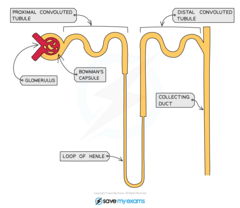
What is a nephron?
tiny tube that is the functional unit of the kidney
responsible for the formation of urine
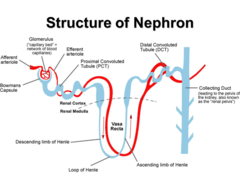
What are the four main roles of the nephron?
ultrafiltration (formation of glomerular filtrate)
reabsorption of glucose and water by the proximal convoluted tubule
maintaining a gradient of sodium ions in the medulla by the loop of Henle
reabsorption of water by the distal convoluted tubule and collecting ducts
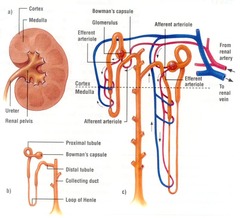
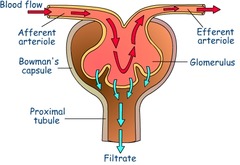
What is the role of the nephron in ultrafiltration?
1) High blood (hydrostatic) pressure
2) causes small substances to pass out (eg water, glucose, ions, urea, amino acids)
3) through small pores in the endothelium of capillaries in the glomerulus (proteins stay behind as they are too large to pass through)
4) and through capillary basement membrane
into the Bowman's capsule to form glomerular filtrate
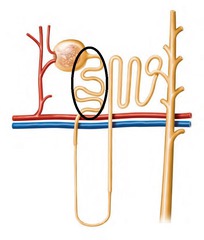
How are glucose and water reabsorbed by the *proximal convoluted tubule*?
sodium-potassium pumps in the basal membrane transport Na⁺ out of epithelial cells, lowering concentration of Na⁺ inside cells
Na⁺ diffuse down their concentration gradient into epithelial cell through co-transporter proteins that also transports glucose from the filtrate
glucose diffuses down concentration gradient into the blood through transport proteins
movement of glucose *increases* water potential of the *filtrate* and *decreases* water potential of *blood*
creating a steep water potential gradient causing water to move into the blood by osmosis
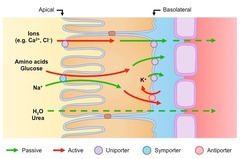
What substances are selectively reabsorbed by the proximal convoluted tubule?
*all* glucose
*some* amino acids, vitamins, and inorganic ions
How is the lining of the proximal convoluted tubule adapted for reabsorption?
made of a single layer of epithelial cells with:
- microvilli increase surface area
- many co-transporter proteins
- many mitochondria
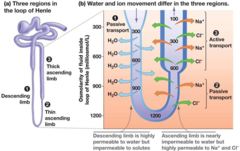
What is the role of the loop of Henle in the absorption of water from the filtrate?
*Loop of Henle acts as a counter-current multiplier*
1) In the ascending limb, sodium ions actively transported out
2) Ascending limb impermeable to water
3) In descending limb, some sodium ions diffuse in
4) Water moves out of the descending limb
5) Low water potential / high concentration of ions in the medulla
6) The longer the loop, the lower the water
potential in medulla
7) high concentration at the base of the loop causes some ions to diffuse out near base increasing concentration outside loop
7) Water leaves collecting duct / DCT by osmosis
How is water reabsorbed from the *distal convoluted tubule* and *collecting ducts*?
collecting duct and DCT permeable to water
water moves out by osmosis down water potential gradient