Bio Final
0.0(0)
Studied by 6 people Call Kai
 Learn
Learn Practice Test
 Spaced Repetition
 Match
Match Flashcards
 Knowt Play
Card Sorting
1/70

Earn XP
Description and Tags
Last updated 9:44 PM on 12/11/22
Name | Mastery | Learn | Test | Matching | Spaced | Call with Kai | Chat |
|---|
No analytics yet
Send a link to your students to track their progress
71 Terms
1
New cards
Learning Objective, lecture 13:
•Recognize chromosomes as the physical units of inheritance.
•Explain how genes determine traits.
•Differentiate between mitosis and meiosis as two forms of cell division. Recall the key sequence of events for each.
•Relate the alignment of homologous chromosomes in meiosis to the generation of genetic variation in gametes.
•Explain how genes determine traits.
•Differentiate between mitosis and meiosis as two forms of cell division. Recall the key sequence of events for each.
•Relate the alignment of homologous chromosomes in meiosis to the generation of genetic variation in gametes.
2
New cards
How are an organism's traits determined? 13
"Units of heredity" - physically transmitted as nucleic acid sequences (DNA, RNA)
3
New cards
Types of Cell Division 13
binary fission (prokaryotic cells),
• 1 parent cell →divides into 2 daughter cells with identical genetic information
• For growth (= reproduction in single-celled organisms)
mitosis (eukaryotic cells),
• 1 parent cell →divides into 2 daughter cells with identical genetic information
• For growth (and maintenance), sometimes reproduction in single-celled organisms
meiosis (eukaryotic cells)
• 1 parent cell →eventually divides into 4 daughter cells, each with ½ genetic information of parent
• For reproduction (eventually)
• 1 parent cell →divides into 2 daughter cells with identical genetic information
• For growth (= reproduction in single-celled organisms)
mitosis (eukaryotic cells),
• 1 parent cell →divides into 2 daughter cells with identical genetic information
• For growth (and maintenance), sometimes reproduction in single-celled organisms
meiosis (eukaryotic cells)
• 1 parent cell →eventually divides into 4 daughter cells, each with ½ genetic information of parent
• For reproduction (eventually)
4
New cards
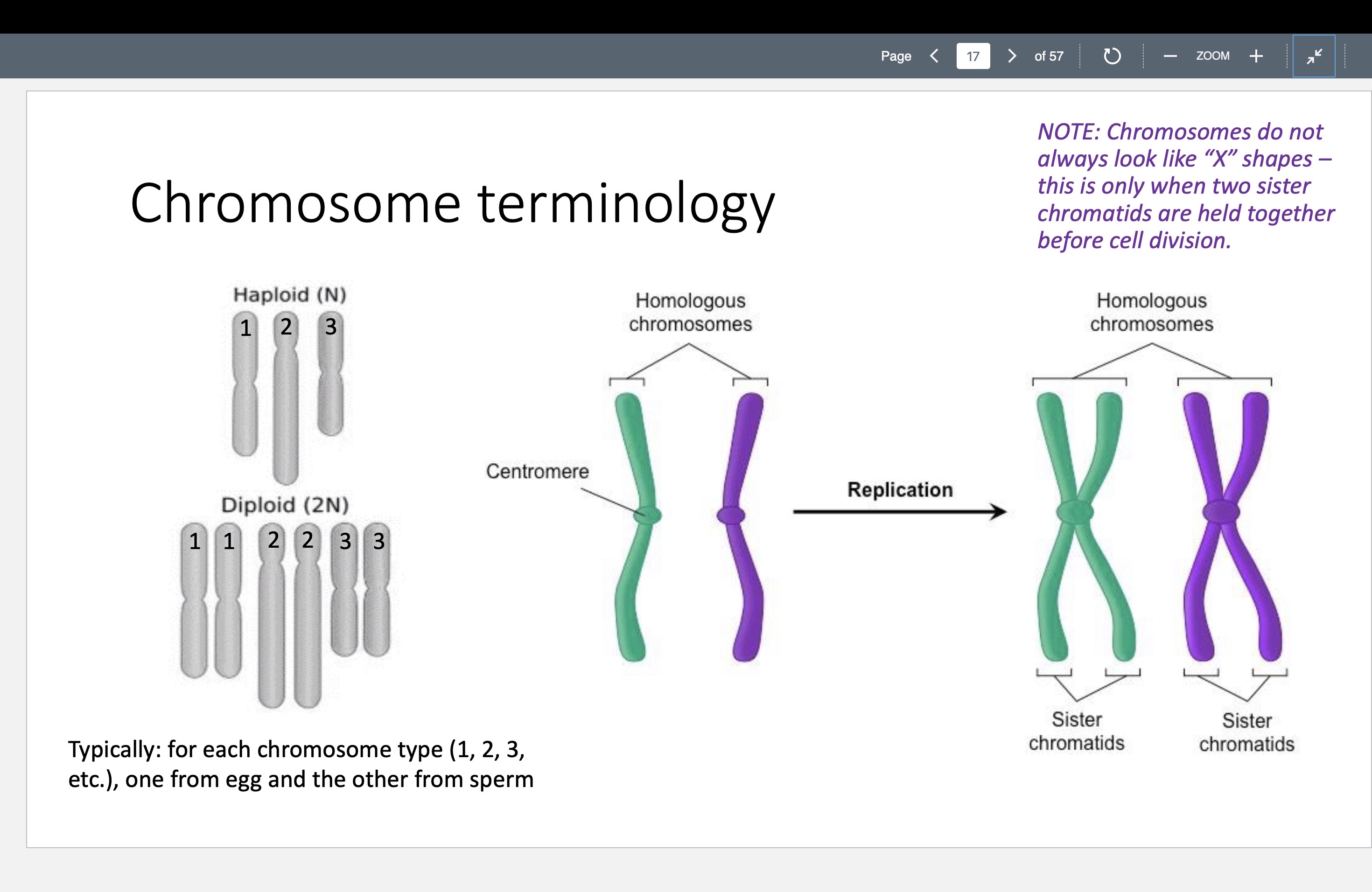
Chromosome Terminology 13 (insert image from leg 13)
5
New cards
Set up Punnett squares of monohybrid crosses and describe the expected ratios of offspring in the F1 and F2 generations. (14)
A monohybrid cross is a genetic mix between two individuals who have homozygous genotypes (GG X gg)
expected ratio of F1 generation: all heterozygous dominant
expected ratio of F2 generation (if F1 allowed to self-pollinate):
1:2:1
expected ratio of F1 generation: all heterozygous dominant
expected ratio of F2 generation (if F1 allowed to self-pollinate):
1:2:1
6
New cards
Mitosis 13
Means "division of the nucleus" -this is why only eukaryotes undergo mitosis
Objective: to partition genetic material in a precise way to ensure that each new cell gets one (and only one) full set of genetic information
• In a diploid cell (2n), this means dividing 4n correctly into 2 cells with 2n each
Objective: to partition genetic material in a precise way to ensure that each new cell gets one (and only one) full set of genetic information
• In a diploid cell (2n), this means dividing 4n correctly into 2 cells with 2n each
7
New cards
Phases of Mitosis : List them 13
interphase, prophase, metaphase, anaphase, telophase
8
New cards
Phases of Mitosis: (before) 13
•Before mitosis begins, the cell is in interphase
- Includes gap phases & S-phase
- In this state, DNA dispersed throughout nucleus
•In preparation for mitosis, chromatin must condense
- Includes gap phases & S-phase
- In this state, DNA dispersed throughout nucleus
•In preparation for mitosis, chromatin must condense
9
New cards
Phases of Mitosis: 13
(Interphase)
• Chromosomes have been copied
• Sister chromatids connected at centromere
(Prophase)
• Chromosomes condense
• Nucleus may dissociate
• Microtubules attach to centromeres
(metaphase)
• Chromosomes align at the metaphase plate
(anaphase)
• Microtubules pull sister chromatids apart
(Telophase)
• Chromosomes start to decondense
• Nucleus may reform
(Cytokinesis)
• Cells separate
• Chromosomes have been copied
• Sister chromatids connected at centromere
(Prophase)
• Chromosomes condense
• Nucleus may dissociate
• Microtubules attach to centromeres
(metaphase)
• Chromosomes align at the metaphase plate
(anaphase)
• Microtubules pull sister chromatids apart
(Telophase)
• Chromosomes start to decondense
• Nucleus may reform
(Cytokinesis)
• Cells separate
10
New cards
Result of Mitosis 13
2 identical daughter cells
11
New cards
Meiosis 13
•Objective: to ensure that each cell gets a complete set of chromosomes -one from each homologous pair
• Parent cell is diploid (2n), daughter cells are haploid (n) →this means dividing 4n correctly into 4 cells with n each
•Two rounds of division:
• Meiosis I
• Meiosis II
•Pre-meiosis, starting in G2:
• DNA replicated in S-phase prior to G2
• Parent cell is diploid (2n), daughter cells are haploid (n) →this means dividing 4n correctly into 4 cells with n each
•Two rounds of division:
• Meiosis I
• Meiosis II
•Pre-meiosis, starting in G2:
• DNA replicated in S-phase prior to G2
12
New cards
Humans have 23 pairs of chromosomes. How many different (unique) combinations of chromosomes can you get in haploid cells? 13
2^23 = 8.6 millions
13
New cards
meiosis I
(prophase I / metaphase I / anaphase I / telophase I / cytokinesis I) 13
(prophase I / metaphase I / anaphase I / telophase I / cytokinesis I) 13
(Prophase)
• Homologous pairs find each other
• (Each one is two sister chromatids held together at centromere →2 blue sister chromatids, 2 red sister chromatids per homologous pair)
(Metaphase I)
• Homologous pairs line up at metaphase plate
(Anaphase I)
• Homologous chromosomes separate
(Telophase I)
• Each to-be daughter cell now has one of each chromosome (chr. 1, 2, 3, etc.)
• (each chromosome still consists of 2 sister chromatids)
(cytokinesis I)
• Daughter cells separate
• Homologous pairs find each other
• (Each one is two sister chromatids held together at centromere →2 blue sister chromatids, 2 red sister chromatids per homologous pair)
(Metaphase I)
• Homologous pairs line up at metaphase plate
(Anaphase I)
• Homologous chromosomes separate
(Telophase I)
• Each to-be daughter cell now has one of each chromosome (chr. 1, 2, 3, etc.)
• (each chromosome still consists of 2 sister chromatids)
(cytokinesis I)
• Daughter cells separate
14
New cards
meiosis II 13
the second phase of meiosis consisting of chromatids separating, along with the two diploid cells splitting in two
15
New cards
Result of Meiosis 13
•1 parent cell →4 daughter cells (2 rounds of division)
•Half the genetic material of the parent cell (one full set of chromosomes -haploid, n)
•Half the genetic material of the parent cell (one full set of chromosomes -haploid, n)
16
New cards
Genetic Recombination 13
The regrouping of genes in an offspring that results in a genetic makeup that is different from that of the parents.
17
New cards
mitosis vs meiosis differences 13
• Homologous chromosomes don't need to line up in mitosis, but they do in meiosis (meiosis I)
• Crossing over occurs in meiosis (meiosis I), but not in mitosis
• Crossing over occurs in meiosis (meiosis I), but not in mitosis
18
New cards
Karyotype 13
the full set of chromosomes in a cell
diploid human cell with 22 pairs of homologous chromosomes + 1 pair of sex chromosomes (1 X, 1 Y). In total 23 for human
diploid human cell with 22 pairs of homologous chromosomes + 1 pair of sex chromosomes (1 X, 1 Y). In total 23 for human
19
New cards
Homologous pairs 13
one from egg, one from sperm
20
New cards
Genes and alleles 13
•Gene -a stretch of DNA that encodes an RNA or protein product (once transcribed and translated)
•Alleles -variant forms of genes
• One gene can have many different variant forms -each of these variant forms is an allele of that gene
•Alleles -variant forms of genes
• One gene can have many different variant forms -each of these variant forms is an allele of that gene
21
New cards
Genes in blood type, reference look at lec 13
Genes in blood type, reference look at lec 13
22
New cards
Cell Cycle 13
insert the image from leg
23
New cards
Describe Mendel's work on inheritance of traits, including his experimental set-up and the conclusions of particulate inheritance. (14)
24
New cards
Relate gametes (& meiosis) to the law of segregation. (14)
Law of segregation:
The two alleles for each trait segregate during gamete formation, and then unite at random (one from each parent) at fertilization. NOT DONE YET^^^
The two alleles for each trait segregate during gamete formation, and then unite at random (one from each parent) at fertilization. NOT DONE YET^^^
25
New cards
What are genes? (14)
units of heredity (stretches of DNA that encode a specific RNA or protein product)
26
New cards
What are alleles? (14)
variant forms of a gene
27
New cards
What is a genotype? (14)
set of alleles at a gene
28
New cards
What is a phenotype? (14)
observable trait (relate to genotype)
29
New cards
What does heterozygous mean? (14)
different alleles for a gene (each homologous chromosome carries a different allele at the gene)
30
New cards
Autosomes vs sex chromosomes- what are they? (14)
Autosomes - Any chromosome that isn't a sex chromosome, 22 are autosomes.
Sex Chromosomes - 23rd pair is the sex chromosome and it differs between male and female - Female is XX and male is XY
Sex Chromosomes - 23rd pair is the sex chromosome and it differs between male and female - Female is XX and male is XY
31
New cards
What is true breeding? (14)
true breeding is a kind of breeding wherein the parents would produce offspring that would carry the same phenotype. This means that the parents are homozygous for every trait.
32
New cards
What is a self-cross? (14)
Crossing two individuals with the same genotype
33
New cards
What is a test cross? (14)
cross with known homozygous recessive individual
34
New cards
What is a monohybrid cross? (14)
Monohybrid:
individual that is hybrid for one trait (heterozygous for trait)
Monohybrid cross: cross between two individuals monohybrid at the same trait (e.g. all F1 self-pollinations and F1 x F1 crosses from lecture 14 part 1)
individual that is hybrid for one trait (heterozygous for trait)
Monohybrid cross: cross between two individuals monohybrid at the same trait (e.g. all F1 self-pollinations and F1 x F1 crosses from lecture 14 part 1)
35
New cards
What is a dihybrid cross? (14)
Dihybrid: individual that is hybrid for two traits (heterozygous for both)
Dihybrid cross: cross between two individuals that are dihybrid at the same two traits
Dihybrid cross: cross between two individuals that are dihybrid at the same two traits
36
New cards
What is a reciprocal cross? (14)
perform first cross where female = trait form 1, male = trait form 2, then a second cross where female = trait form 2, male = trait form 1 (if trait is sex-linked, results should differ between crosses)
37
New cards
What is a carrier? (14)
individual who carries an allele that is not seen (means allele must be recessive because it is there but "hidden")
38
New cards
What does homozygous mean? (14)
two of the same allele for a gene (both homologous chromosomes carry the same allele)
39
New cards
What is the process of Meiosis? (13)
Meiosis I
Prophase I - Spindles form, Chromosomes condense and line up with homologous pairs, crossing over occurs here
Metaphase I - chromosomes line up at equator with homologous pairs
Anaphase I - Chromosomes are pulled away from their pair
Telophase I - two new nuclei are formed
Cytokinesis - splits the cell into two slightly different cells
Meiosis II
Prophase II - Spindles form, chromosomes are already condensed with a sister chromatid
Metaphase II - Chromosomes line up
Anaphase II - Chromatids are pulled away from each other
Telophase II - New nuclei developing
Cytokinesis - splits the cell into 4 unique daughter cells
Prophase I - Spindles form, Chromosomes condense and line up with homologous pairs, crossing over occurs here
Metaphase I - chromosomes line up at equator with homologous pairs
Anaphase I - Chromosomes are pulled away from their pair
Telophase I - two new nuclei are formed
Cytokinesis - splits the cell into two slightly different cells
Meiosis II
Prophase II - Spindles form, chromosomes are already condensed with a sister chromatid
Metaphase II - Chromosomes line up
Anaphase II - Chromatids are pulled away from each other
Telophase II - New nuclei developing
Cytokinesis - splits the cell into 4 unique daughter cells
40
New cards
What is one way to determine possible combinations of a multihybrid cross. (14)
Use probability
Product rule:
probability of two independent events occurring together is the product of their individual probabilities
P(1 and 2) = P(1) x P(2)
Product rule:
probability of two independent events occurring together is the product of their individual probabilities
P(1 and 2) = P(1) x P(2)
41
New cards
What is the law of independent assortment? (14)
During gamete formation, different pairs of alleles segregate independently of each other.
42
New cards
What is the process of Mitosis? (13)
\- Prophase - Spindles form, chromosomes condense and appear as two sister chromatids joined at centromere
- Metaphase - chromosomes line up at equator of cell and spindle fibers attach to centromere
- Anaphase - chromatids are pulled apart poleward
- Telophase - two new nuclei are forming on the poles of the cell
- Cytokinesis - The cell is divided into 2 identical cells
- Metaphase - chromosomes line up at equator of cell and spindle fibers attach to centromere
- Anaphase - chromatids are pulled apart poleward
- Telophase - two new nuclei are forming on the poles of the cell
- Cytokinesis - The cell is divided into 2 identical cells
43
New cards
Describe the four patterns of Mendelian inheritance: autosomal dominant, autosomal recessive, sex-linked (X-linked) dominant, and sex-lined (X-linked) recessive. (14)
autosomal dominant: non-sex chromosomes have one or two dominant alleles (Bb/BB)
autosomal recessive: non-sex chromosomes only have recessive alleles (bb)
sex-linked dominant: sex chromosome has one or two dominant alleles
X^B X^B
X^B X^b
X^B Y
sex-linked recessive: sex chromosome has only recessive alleles
X^b X^b
X^b Y
autosomal recessive: non-sex chromosomes only have recessive alleles (bb)
sex-linked dominant: sex chromosome has one or two dominant alleles
X^B X^B
X^B X^b
X^B Y
sex-linked recessive: sex chromosome has only recessive alleles
X^b X^b
X^b Y
44
New cards
Explain the physical basis of linkage between traits and how this shows up in offspring phenotypes. (14)
45
New cards
Set up Punnett squares of dihybrid crosses and describe the expected ratios of offspring in the F1 and F2 generations. (14)
46
New cards
Explain the physical basis of linkage between traits and how this shows up in offspring phenotypes. (14)
47
New cards
Describe how we can estimate the frequency of alleles in a population. (16)
48
New cards
Explain the Hardy-Weinberg principle and how it relates to changes in allele frequency in a population. (16)
49
New cards
Allelic relationships: Three types 15
•Dominance
•Incomplete dominance
•Codominance
•Incomplete dominance
•Codominance
50
New cards
Incomplete dominance 15
•Phenotype of heterozygote is an intermediate between parental phenotypes
E.g. Andalusian chicken →heterozygote neither black nor white, but blue
E.g. Andalusian chicken →heterozygote neither black nor white, but blue
51
New cards
Allele frequencies change due to... (16)
•Genetic Drift -nonselective & random, based on sampling error
•Gene Flow -nonselective & random, based on migration
•Natural Selection -selective, based on various selective pressures
•Gene Flow -nonselective & random, based on migration
•Natural Selection -selective, based on various selective pressures
52
New cards
Recap vocabulary: Crosses
Monohybrid cross
Dihybrid cross. 15
Monohybrid cross
Dihybrid cross. 15
• Monohybrid cross -looks at one trait that differs between parents being crossed (alleles of one gene)
• Dihybrid cross -looks at two traits that differ between parents being crossed (alleles of two genes)
• Dihybrid cross -looks at two traits that differ between parents being crossed (alleles of two genes)
53
New cards
What is genetic drift? (16)
A change in allele frequency from generation to generation due to chance
• E.g.: Just by chance, the population (stick figure example) mated in a way that didn't exactly produce the same allele frequencies in the next generation
• E.g.: Just by chance, the population (stick figure example) mated in a way that didn't exactly produce the same allele frequencies in the next generation
54
New cards
Human Inheritance:Pedigrees
Learning Objective 15
Learning Objective 15
•Use pedigrees to identify the mode of inheritance of a trait.
55
New cards
What types of genetic drift are there? (16)
Founder effect:
Immigrants establish new population; new population is likely to have different allele frequencies than source population by chance
decreases genetic variety
Bottleneck effect:
High mortality strikes due to event, leftover population is likely to have different allele frequencies than original population by chance,
decreases genetic variety
Immigrants establish new population; new population is likely to have different allele frequencies than source population by chance
decreases genetic variety
Bottleneck effect:
High mortality strikes due to event, leftover population is likely to have different allele frequencies than original population by chance,
decreases genetic variety
56
New cards
What is the Hardy-Weinberg principle? (16)
57
New cards
What are the assumptions of Hardy-Weinberg principle? (16)
Random mating
•No natural selection
The gene in question does not affect fitness under present conditions and is not under selection
•No genetic drift
No changes to frequency of alleles by randomness
•No gene flow
No individuals entering/leaving the population
•No mutation
Alleles are not changing
•No natural selection
The gene in question does not affect fitness under present conditions and is not under selection
•No genetic drift
No changes to frequency of alleles by randomness
•No gene flow
No individuals entering/leaving the population
•No mutation
Alleles are not changing
58
New cards
Reading Pedigrees 15
• Pedigrees represent families (here, genetically linked individuals)
• Symbols represent people, and the lines between them represent how they are linked
• Generations are marked with Roman numerals
• Individuals within generations are marked with numbers
• Traits of interest or diseases are shown by filling in the symbol for an individual →indicates "affected" individual
• Symbols represent people, and the lines between them represent how they are linked
• Generations are marked with Roman numerals
• Individuals within generations are marked with numbers
• Traits of interest or diseases are shown by filling in the symbol for an individual →indicates "affected" individual
59
New cards
Patterns of inheritance 15
•Autosomal dominant
•Autosomal recessive
•X-linked dominant
•X-linked recessive
•Autosomal recessive
•X-linked dominant
•X-linked recessive
60
New cards
Inherited diseases 15
• Disease-causing mutations arise in cells
• Chemicals that cause mutations →mutagens (if cancer-causing, then "carcinogens")
• Irradiation
• Errors in DNA replication and repair
• Only mutations carried in germline cells can be passed down
• Somatic cells: all diploid cells in the body
• Germline cells: egg- and sperm- forming cells, haploid-
• Congenital: born with, but not inherited from parents (e.g. mutation that doesn't exist in parents, that arose in embryo or during development of offspring)
• Chemicals that cause mutations →mutagens (if cancer-causing, then "carcinogens")
• Irradiation
• Errors in DNA replication and repair
• Only mutations carried in germline cells can be passed down
• Somatic cells: all diploid cells in the body
• Germline cells: egg- and sperm- forming cells, haploid-
• Congenital: born with, but not inherited from parents (e.g. mutation that doesn't exist in parents, that arose in embryo or during development of offspring)
61
New cards
Patterns of Inheritance: X-linked inheritance vs Y-linked 15
(X-linked)
• If recessive: affected mothers will always have affected sons; usually more males affected than females; never passed from father to son
• If dominant: affected fathers will always have affected daughters but not affected sons
(Y-linked)
• Cannot affect females; affected fathers always have affected sons
• If recessive: affected mothers will always have affected sons; usually more males affected than females; never passed from father to son
• If dominant: affected fathers will always have affected daughters but not affected sons
(Y-linked)
• Cannot affect females; affected fathers always have affected sons
62
New cards
Patterns of Inheritance: Vertical vs Horizontal pattern 15
(Vertical)
• affected individual always has an affected parent
• usually dominant trait
(Horizontal)
• unaffected parents may have affected child
• usually recessive trait
• affected individual always has an affected parent
• usually dominant trait
(Horizontal)
• unaffected parents may have affected child
• usually recessive trait
63
New cards
Pedigrees 15
•A format of family tree used to record relationships between individuals in a family →also record phenotypes
• Traits of interest, diseases
• Traits of interest, diseases
64
New cards
What is gene flow?
65
New cards
Recap vocabulary: Extensions to Mendelian genetics
Linkage, Incomplete dominance, Codominance, Gene interactions, Quantitative traits, Pleiotropy. 15
Linkage, Incomplete dominance, Codominance, Gene interactions, Quantitative traits, Pleiotropy. 15
• Extensions to Mendelian genetics
• Linkage -traits travel together, do not display independent assortment
• Incomplete dominance -intermediate phenotype between the two alleles' phenotypes
• Codominance -both alleles' phenotypes simultaneously expressed (not intermediate)
• Gene interactions -multiple genes influence one trait
• Quantitative traits -multiple genes contribute to a trait to create a continuum of phenotypes
• Pleiotropy -one gene affects multiple traits
• Linkage -traits travel together, do not display independent assortment
• Incomplete dominance -intermediate phenotype between the two alleles' phenotypes
• Codominance -both alleles' phenotypes simultaneously expressed (not intermediate)
• Gene interactions -multiple genes influence one trait
• Quantitative traits -multiple genes contribute to a trait to create a continuum of phenotypes
• Pleiotropy -one gene affects multiple traits
66
New cards
What are the four types of natural selection? (16)
1\. Directional Selection:
favors one extreme of a certain phenotype, causing the average phenotype to change in one direction
- genetic variation is reduced
2. Stabilizing Selection:
favors the intermediate of a certain phenotype, maintaining average phenotype
- genetic variation is reduced
3. Disruptive Selection:
favors the two extremes of a phenotype
- genetic variation is increased
4. Balancing Selection:
no single phenotype is favored in all populations of a species at all times
- genetic variation is maintained
favors one extreme of a certain phenotype, causing the average phenotype to change in one direction
- genetic variation is reduced
2. Stabilizing Selection:
favors the intermediate of a certain phenotype, maintaining average phenotype
- genetic variation is reduced
3. Disruptive Selection:
favors the two extremes of a phenotype
- genetic variation is increased
4. Balancing Selection:
no single phenotype is favored in all populations of a species at all times
- genetic variation is maintained
67
New cards
Mendel's study system: single-gene traits (with only two alleles per trait with a clear dominance relationship) for his crosses.
BUT
MOST traits are not so simply determined: Why? 15
BUT
MOST traits are not so simply determined: Why? 15
Gene interactions →multiple genes influence one trait
<•>E.g. dog fur colourB = pigment colour gene, determines brown (b) vs. black (B) pigment.A = gene determining ability to deposit pigment →if aa, doesn't matter whether B_ (black fur) or bb (brown fur), will have light fur
---------------------------
•Quantitative traits →multiple genes contribute to a trait, creating a continuum of phenotypes (as opposed to discrete phenotypes) for the trait
<•>Discrete traits (discontinuous variation): ABO blood type, number of teeth
<•>Quantitative traits (continuous variation): finger length, skin colour
<•> Multiple gene loci (locus = place on chromosome) contribute to phenotype
<•> The more loci, the more continuous Over 600 genes (loci) have
-------------------------------------
•Pleiotropy →one gene influences many traits
<•>E.g. sickle cell allele:
<•><•> sickle cells affect multiple organs
<•><•> sickle cell trait confers protection against malaria
<•>E.g. phenylketonuria
<•><•> phenylalanine hydroxylase defect causes build-up of phenylalanine (Phe), also lack of tyrosine (Tyr)
<•><•> Phe build-up is toxic to brain
<•><•> Tyr deficiency →low melanin
<•>E.g. dog fur colourB = pigment colour gene, determines brown (b) vs. black (B) pigment.A = gene determining ability to deposit pigment →if aa, doesn't matter whether B_ (black fur) or bb (brown fur), will have light fur
---------------------------
•Quantitative traits →multiple genes contribute to a trait, creating a continuum of phenotypes (as opposed to discrete phenotypes) for the trait
<•>Discrete traits (discontinuous variation): ABO blood type, number of teeth
<•>Quantitative traits (continuous variation): finger length, skin colour
<•> Multiple gene loci (locus = place on chromosome) contribute to phenotype
<•> The more loci, the more continuous Over 600 genes (loci) have
-------------------------------------
•Pleiotropy →one gene influences many traits
<•>E.g. sickle cell allele:
<•><•> sickle cells affect multiple organs
<•><•> sickle cell trait confers protection against malaria
<•>E.g. phenylketonuria
<•><•> phenylalanine hydroxylase defect causes build-up of phenylalanine (Phe), also lack of tyrosine (Tyr)
<•><•> Phe build-up is toxic to brain
<•><•> Tyr deficiency →low melanin
68
New cards
Relate Hardy-Weinberg equilibrium to evolution. (16)
When a Hardy-Weinberg equilibrium has been reached, evolution is not occuring
69
New cards
Recognize the consequence of different types of selection on genetic variation. (16)
70
New cards
Beyond Mendelian Inheritance: Learning Objectives 15
•Define allelic relationships beyond simple dominance -include codominance, incomplete dominance.
•Define monogenic vs. polygenic traits.
•Explain how gene interactions involve multiple genes to determine a single trait.
•Explain how quantitative traits result in a continuum of a phenotype.
•Recognize mutation as the source of new alleles of a gene.
•Define monogenic vs. polygenic traits.
•Explain how gene interactions involve multiple genes to determine a single trait.
•Explain how quantitative traits result in a continuum of a phenotype.
•Recognize mutation as the source of new alleles of a gene.
71
New cards
Extensions to Mendel's rules: 15
•Not all traits are passed down the way Mendel saw the "antagonistic pairs" passed down in pea plants!
•... Linkage -important exception to independent assortment
•... Allelic relationships -not just dominant and recessive
•... Single-gene traits -most traits are not determined by just one gene
•... Linkage -important exception to independent assortment
•... Allelic relationships -not just dominant and recessive
•... Single-gene traits -most traits are not determined by just one gene