[AMECON] Chapter 3: P1 DEMAND | Supply, Demand, and Elasticity
 Call Kai
 Learn
Learn Practice Test
 Spaced Repetition
 Match
Match Flashcards
 Knowt Play
1/40

There's no tags or description
Looks like no tags are added yet.
Name | Mastery | Learn | Test | Matching | Spaced | Call with Kai | Chat |
|---|
No analytics yet
Send a link to your students to track their progress
41 Terms
Demand
in economic terms can be defined as the ability and willingness to buy specific quantities of a good or a service at alternative prices in a given time period under ceteris paribus (all else being equal) conditions.
Demand
Important Notes
Airlines determine airfares based on passenger demand and market competition.
The primary objective of airlines is to maximize revenue for every flight.
Air transport demand is affected by macroeconomic variables and external industry factors.
During COVID-19, airline demand dropped significantly because airlines reduced capacity to about 10% of pre-pandemic levels. Demand later recovered as travel restrictions were lifted and economies improved.
Law of Demand
states that, ceteris paribus, as price increases, quantity demanded decreases; and as price decreases, quantity demanded increases. There is an inverse (negative) relationship between price and quantity demanded.
Important Notes
Consumers buy more at lower prices.
Consumers buy less at higher prices.
Different passengers respond differently to price changes depending on their preferences and characteristics.
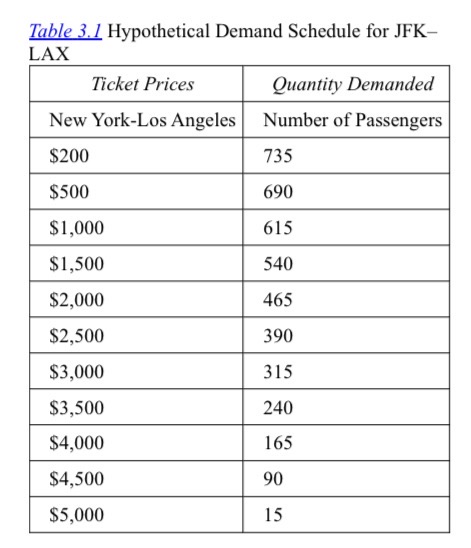
Demand Schedule
is a table showing the quantities demanded at different prices while all other factors remain constant.
Important Notes
It illustrates the relationship between ticket price and number of passengers willing to travel.
It is the basis for constructing the demand curve.
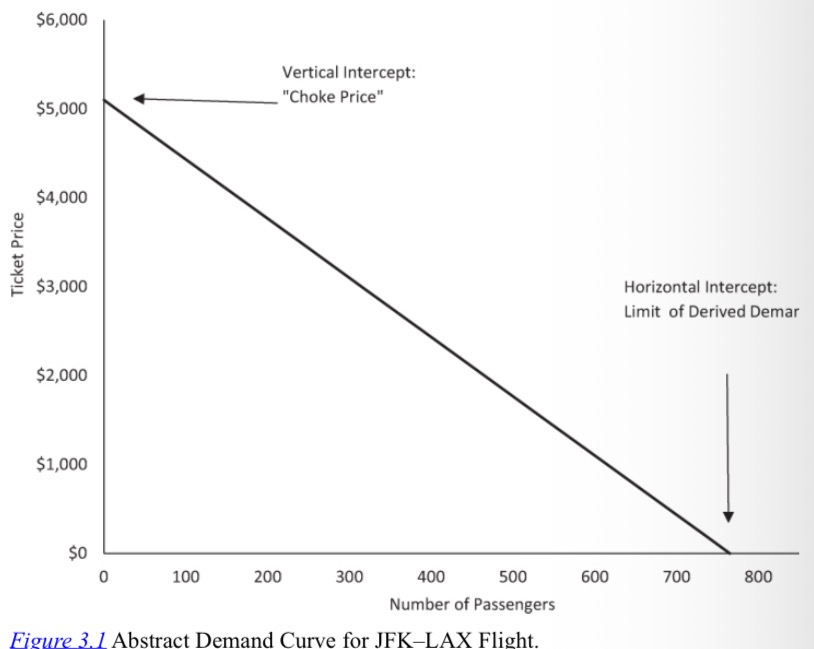
Demand Curve
can be constructed from the aforementioned demand schedules and is a graphical description of the demand schedule, illustrating the quantities of a good that customers are willing and able to buy at varying prices in a given period of time. These are always graphed with the price per unit on the vertical axis and the quantity demanded on the horizontal axis.
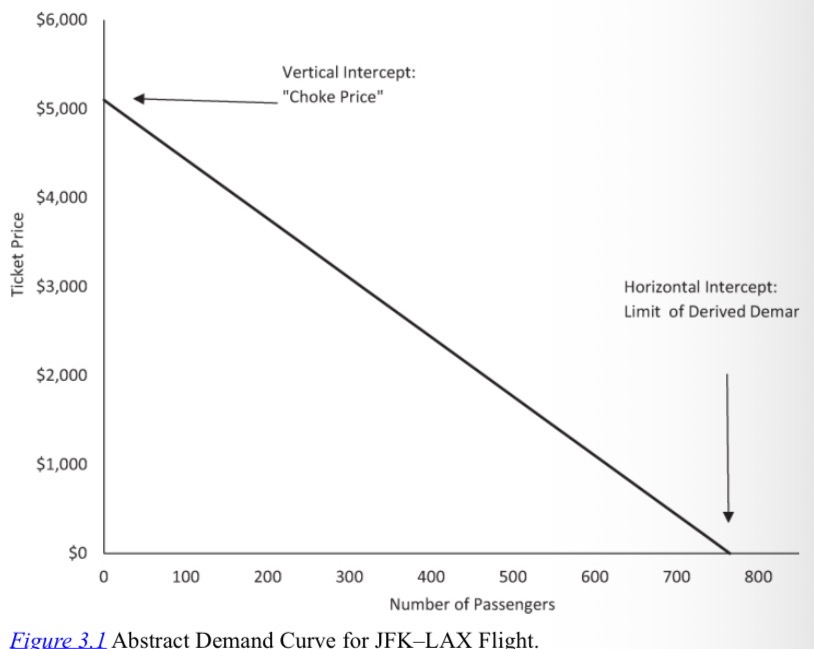
Demand Curve
is the graphical representation of the relationship between price and quantity demanded.
Important Notes
The curve has a negative slope.
A movement along the curve is caused only by a change in price.
A shift of the entire curve occurs when factors other than price change.
Direct Demand
refers to demand for goods and services meant for final consumption. The demand for goods does not depend on the demand for any other service or commodity.
Airline Example
Passengers purchase airline tickets because they want transportation from one place to another.
Derived Demand
When the demand for a particular product depends on the demand for another product or service or exists because another good or service is demanded. This is a key concept to identifying how changes in the demand for one product can have a ripple effect throughout the supply chain.
Airline Example
Demand for aircraft, pilots, airport services, and aviation fuel is derived from the public's demand for air transportation.
Advertising
Airline passengers
Commercial aircraft
Demand for pilots
Freight transportation
Jet fuel
Demand Function
represents the functional relationship (a mathematical equation) between the quantity demanded for a commodity and its determinants (independent variables). Can be constructed using information from the demand schedule or the demand curve. Numerous factors, not only price, influence demand. It expresses the relationship between quantity demanded and the factors that influence demand.
General factors include:
Ticket price
Income
Competitor's prices
Consumer preferences
Other economic variables
Implicit Demand Function
simply state a general relationship between the quantities demanded and the factors affecting demand. This do not provide the actual mathematical relationships, but rather, a more generalized statement of the factors influencing demand.
Ticket Price (P)
[Implicit Demand Functions] is one of the most fundamental determinants of demand since it is often the first factor that consumers think about when they are planning to purchase. This can change for various reasons (technology, competition, and consumer preference).
![<p><strong>[<em>Implicit Demand Functions] </em></strong>is one of the <strong>most fundamental determinants of demand</strong> since it is often the <strong><u>first factor that consumers think about when they are planning to purchase</u>.</strong> This can change for various reasons (technology, competition, and consumer preference).</p>](https://assets.knowt.com/user-attachments/be37ef8e-1397-4e6c-9da9-73ccb04b8ac5.heic)
Income (Y)
[Implicit Demand Functions] is an important determinant of demand. This influences both the willingness and ability to purchase. Consumers with higher _____ are able to purchase more goods and services; therefore, an increase in disposable _____ will lead to an increase in demand for air travel.
![<p><strong>[<em>Implicit Demand Functions] </em></strong>is an <strong>important determinant of demand</strong>. This influences both the <strong>willingness and ability to purchase</strong>. Consumers with higher _____ are able to purchase more goods and services; therefore, an increase in disposable _____ will lead to an increase in demand for air travel.</p>](https://assets.knowt.com/user-attachments/01895e1a-eee3-4c6c-bdea-d6ad2b4b2083.heic)
Inferior goods
are the types of products people typically purchase when their income is low.
Airline Example
When passengers have less disposable income, they’re more likely to use low-cost airlines. When their income rises, they may travel by full-service airlines.
Substitute Goods
Goods that can replace one another.
Examples:
Air travel and high-speed rail
Competing airlines on the same route
If the price of one substitute increases, demand for the other usually increases.
Complementary Goods
Goods used together.
Examples:
Airline tickets and hotel accommodations
Airline tickets and vacation packages
Airline tickets and car rentals
When the price of a complementary good increases, demand for airline travel may decrease.
Consumer Income
Income directly affects purchasing power.
Price of other related goods and services (POG)
[Implicit Demand Functions] The demand for a product or a service is also affected by the ______________, namely substitutes. For air travel, this includes other modes of transportation.
Price remains the primary determinant of quantity demanded.
According to the Law of Demand, higher prices reduce quantity demanded, while lower prices increase it.
![<p><strong>[<em>Implicit Demand Functions] </em></strong>The demand for a product or a service is also affected by the ______________, namely <strong>substitutes</strong>. For air travel, this includes other modes of transportation.</p><ul><li><p>Price remains the primary determinant of quantity demanded.</p></li><li><p>According to the <strong>Law of Demand</strong>, higher prices reduce quantity demanded, while lower prices increase it.</p></li></ul><p></p>](https://assets.knowt.com/user-attachments/a4e18871-2c07-44a0-bbf6-54e32f8bc3e2.heic)
Determinants of Demand
are factors other than price that influence the quantity of a good or service consumers are willing and able to purchase. When these factors change, the entire demand curve shifts instead of causing movement along the curve.
Normal Goods, Inferior Goods
Consumer Income
Income directly affects purchasing power.
___________ – Demand increases as income increases.
___________ – Demand decreases as income increases because consumers shift to better alternatives.

Consumer’s preferences and tastes (PREF)
[Implicit Demand Functions] also plays a role in demand. Airline passengers often compare and evaluate alternative modes of transportation before making any decisions, including their preference between legacy and low-cost carriers.
Airline Example
some people might find that Disney World in Japan is much more accessible and affordable than Disney World in Orlando.
Expectation (EXP)
[Implicit Demand Functions] Demand changes depending on what consumers expect in the future.
Examples:
Expected fare increases encourage early booking.
Expected economic recession may reduce travel demand.
![<p><strong>[<em>Implicit Demand Functions] </em></strong><span>Demand changes depending on what consumers expect in the future.</span></p><p class="p1"><span>Examples:</span></p><ul><li><p><span>Expected fare increases encourage early booking.</span></p></li><li><p><span>Expected economic recession may reduce travel demand.</span></p></li></ul><p></p>](https://assets.knowt.com/user-attachments/f09f93a7-a502-4662-b728-467b082f5d69.heic)
Population (POP)
[Implicit Demand Functions] A larger _____ generally creates higher demand for transportation services because there are more potential travelers.
![<p><strong>[<em>Implicit Demand Functions] </em></strong>A larger _____ generally creates higher demand for transportation services because there are more potential travelers.</p>](https://assets.knowt.com/user-attachments/4efc0e0d-8f63-4f43-bcfb-1242a2060b90.heic)
Explicit Demand Function
provide precise mathematical relationships between the quantity demanded and the variables impacting demand.
Example format:
QD = a − bP
where:
QD = Quantity Demanded
P = Price
a = Intercept
b = Slope coefficient
The coefficient of price is negative, indicating the inverse relationship between price and demand.
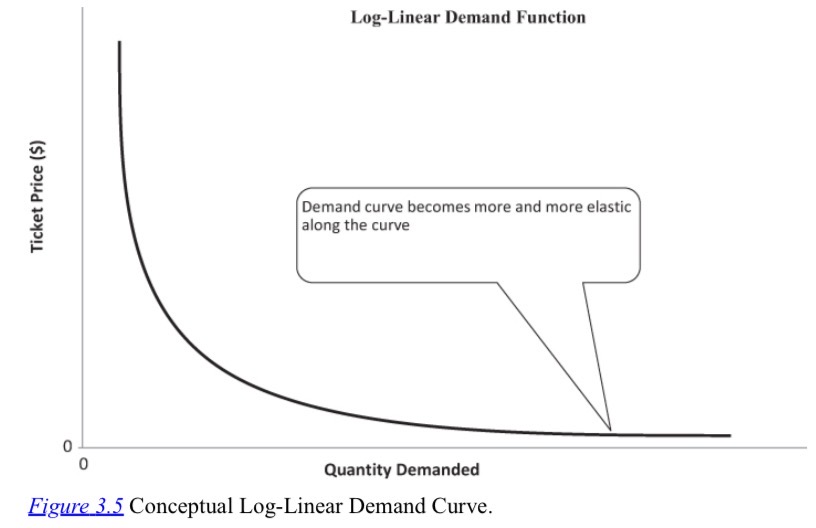
Log-Linear Demand Function
assumes demand follows a logarithmic relationship instead of a straight line.
Important Notes
The slope is not constant.
Small price reductions at high prices may have little effect on demand.
Larger demand increases may occur after prices fall below a certain level.
Inverse Demand Function (Price Function)
treats price as a function of quantity demanded.
General form:
P(Q) = a + b(Q)
where:
a = Intercept
b = Negative slope
Important Notes
Revenue managers use the inverse demand function to determine pricing strategies.
As quantity demanded increases, ticket prices generally decrease.
It helps airlines estimate the maximum price passengers are willing to pay for a given number of seats.
Determinants of Demand for Air Transportation
Aircraft type and location of airport
Airfare
Availability of other modes of transportation
Competitor’s ticket prices
Frequency of service
In-flight amenities
Passenger income
Passenger loyalty
Random factors (i.e., disease, terrorism, or natural disaster)
State of the economy
Safety
Social and demographic factors
Flight frequency
This is especially important for business travelers who are generally most time-sensitive. An airline with a large number of flights between two cities has a greater probability of meeting a traveler’s demand than does an airline with only a few flights.
Connectivity between city-pair
The availability of a non-stop flight will generally increase demand more than the availability of a flight with a connection. However, this assumption may not apply to all markets, especially ultra-long-haul markets where passengers may appreciate a stopover. Therefore, generally a non-stop flight variable is expected to have a positive relationship with demand (with some exceptions).
Customer loyalty program
Frequent flier programs have been one of the most successful marketing tools for airlines. By offering free flights and perks for loyalty, carriers have successfully obtained repeat business, particularly among business travelers.
Customer service
Airlines emphasize service in the form of aircraft seat placement (more room), in-flight entertainment, food and beverages, airport amenities, baggage handling, and friendly customer service.
On-time performance
The Bureau of Transportation Statistics (BTS) uses _______________ to rank airlines every quarter. Moreover, this demand variable is often used as a proxy for customer service and is an important determinant in public perception of an airline’s quality.
Cyclicality
[Characteristics of Demand for Air Transportation]
refers to a long-term trend of peaks and troughs of economic activity. Demand for air transportation follows the business cycle.
During economic growth, demand increases.
During recessions, demand decreases because people and businesses spend less on travel.
Cyclicality
Directional flow
Fluctuations
Perishability
Seasonality and peaking
Characteristics of Demand for Air Transportation (5)
Seasonality and Peaking
[Characteristics of Demand for Air Transportation]
Demand changes depending on the time of year.
Peak seasons include:
Summer vacations
Christmas holidays
Holy Week
Major festivals
Off-peak seasons usually experience lower passenger volumes.
Airlines adjust schedules and ticket prices according to seasonal demand.
Directional Flow
[Characteristics of Demand for Air Transportation]
Relates to the increased demand of passengers in one direction for a period of time. While cyclicality spans decades and peaking spans years, this is usually assessed on a weekly basis and is fairly short term.
Example:
A tourist destination may experience heavy inbound traffic during holidays but lighter outbound traffic.
This creates scheduling and revenue management challenges for airlines.
Perishability
[Characteristics of Demand for Air Transportation]
The main problem with cyclicality, peaking, and directional flow is that demand for air transportation is _______. The moment the plane departs the gate, any empty seat represents lost revenue.
This is why airlines:
Use revenue management.
Offer promotional fares.
Practice overbooking.
Continuously adjust ticket prices.
Demand Fluctuations
[Characteristics of Demand for Air Transportation]
Demand constantly changes because of:
Economic conditions
Fuel prices
Weather
Pandemics
Political events
Airline competition
Consumer confidence
These fluctuations make demand forecasting essential.
Market Demand
is simply the sum of the individual demand. Is the total quantity demanded by all consumers in a particular market at various prices during a given period. This obtained by adding together all individual demand curves.
Revenue Passenger Miles (RPM)
[Measuring Airline Market Demand] measures the number of paying passengers multiplied by the distance traveled (in miles). It measures actual passenger traffic.
Revenue Passenger Kilometers (RPK)
[Measuring Airline Market Demand] is similar to RPM but uses kilometers instead of miles. It is the international standard used by many airlines.
Passengers (PAX)
[Measuring Airline Market Demand] refers to the total number of passengers transported by an airline. Although useful, this alone does not measure travel distance.