Aquatic biomes
 Studied by 0 people
 Call with Kai
 Learn
Learn Practice Test
 Spaced Repetition
 Match
Match Flashcards
 Knowt Play
1/75

There's no tags or description
Looks like no tags are added yet.
Name | Mastery | Learn | Test | Matching | Spaced | Call with Kai |
|---|
No study sessions yet.
76 Terms
The gulf stream
brings warm water from caribbean & USA to europe
allows temp regulation
Coastal upwelling
Surface currents move away from the coast, it is replaced by water from greater depths
Deep water is rich in nutrients, so these upwelling areas are highly productive
costal areas bc shallow waters allow turbulance and seasonal turnover and also costal runoff(nutrients) are the highest productivity
Tides
Result from the gravitational pulls of the Sun and the Moon.
The tidal force of the moon is 2.2x the force of the sun.
Everyday Earth pass through two of the lunar tides (high tides) and two low tides at right angles to the high tides

Spring tides
higher than normal
occur when the sun and moon line-up twice a month (new moon and full
moon)
Neap tides
lower than normal
occur during the quarter phases when the gravitational forces of the sun partially cancel out those of the moon
Marine Biomes
~70% of ELS(ecological land services)
based on chemical and physical abiotic factors(depth, temperature, wave action, oxygen content and substrate)
Open Ocean
including hydrothermal vents(rich in hydrogen sulfite)
Hydrothermal vents
Rich in Hydrogen sulfite
expel hot water up to 400º C → Cold seawater enters these cracks moving towards magma
seawater stripped of oxygen, sulfate, and magnesium
from the earth’s curst it gains copper, iron, zinc, and sulfur
when water returns to ocean it is heated but it doesn’t boil due to pressure
Hydrothermal vents are located worldwide on mid oceanic ridges → support chemoautrophic bacteria which convert sulfite into sulfate
Shallow water biomes
Coral reefs, kelp forests, sea grasses
The intertidal biomes
Rocky shores, sandy beaches, mangrove forests, and salt marshes
The Open ocean
divided into different zones according to proximity to shore, depth, and ligth availability
Neritic zone
extends from intertidal zone/littoral zone to continental shelf
Pelagic zone
open ocean
from continental zone onwards
reaches depths of around 4000 m
nutrient concentrations are typically low but can increase due to upwelling
cold only warm in photic zone
photic zone
area where sunlight reaches
aphotic zone
area where no light reaches - cold
most food from dead organisms that sink down
depths where less than 1% of sunlight reaches
epipelagic zone
surface waters, 0.2 km, only in photic zone
photosynthetic phytoplankton - nearly ½ of earth’s photosynthesis
mesopelagic zone
below epipelagic zone, 0.2-1km
Bathypelagic zone
below mesopelagic zone 1-4 km
abyssal zone
4-6 km
Hadal zone
6+ km
Bioluminescence
A chemical reaction that produces light
Bioluminescence examples
Headlights, lures to attract prey, counter-illumination to hide from predators, confusing predators or prey, social signals for mates, setting off burglar alarms to attract predators of predators!
Primary Producers in the open ocean
Energy obtained from photosynthesis or chemosynthesis
Phytoplankton, Algae
Consumers in the open ocean
Herbivores (zooplankton, suspension feeders, foragers)
Predators
Detritivores/Scavengers
Thermocline
Zone where temperature decreases rapidly with depth
Zonation by temperature
Thermal profiles within open water: Polar regions
NO THERMOCLINE
Water is cold in all seasons.
Water is well-mixed and nutrients are generally abundant.
Phytoplankton grow rapidly during short period of light and warmer temperature
Thermal profiles within open water: Tropical regions
PERMANENT THERMOCLINE
Sharp division between warm upper layer and cold depth
Low nutrients limit phytoplankton productivity
Thermal profiles within open water: Temperate regions
SEASONAL THERMOCLINE
Summer:
Strong stratification, no mixing
Spring/Fall:
Decreased stratification allows for nutrients to come to the surface
Winter:
No stratification (cold throughout), well mixed
Coral reefs
clear, warm tropical waters with hard substrates
0.1% of ocean
25% of marine species
low nutrient tropics in the photic zone
bc of relationship w/ mutualistic photosynthetic flagellytes
Threatened by: acidification, climate change, harvesting
Kelp forests
clear, cool temperate waters with hard substrates
50 cm per day growth rate can reach 5 m
invertebrates, fish, birds, mammals
Threatened by: harvesting, hunting, runoff, overharvesting of kelp(for algen water sucker uper)
Sea grasses
clear water with sandy substrate in both cool and warm water
bottom of protected waves and other shallow costal waters
seagrasses have strong roots to withstand wave action and large and small herbivores
spawn sites for lots of fish
erosion control
Threatened by: boating action, pollution, runoff
Rocky Intertidal Zones
where land meets sea
sea brings nutrients carry away organic material
low competition due to waves, open space for colonization
Threatened by: harvesting of shells and animals, oil spills
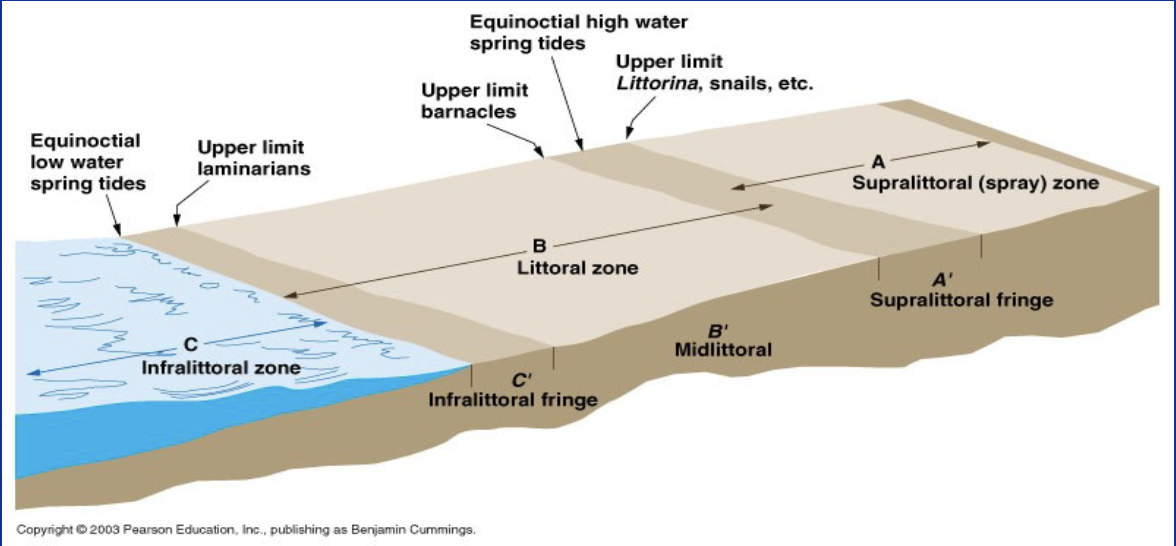
Infralittorial zone
exposed only during lowest tides
seaweed, mollusks, sea anenomes, etc.
Littoral zone
submerged during highest regular tide and exposed during lowest regular tide
seaweeds, and mollusks
Supralittoral fringe
covered only during highest tides
Supralittoral(spray) zone
Never covered
receives splashes or spray
Sandy Shores
produced by waves that wear down costal cliffs or coral reefs, or by grinding down shells → ground down to shingle and sand
sand can be deep and wave action extensive → harsh environment
deeper sand = less oxygen
Beach drains and drys out quickly
Gradient of oxygen availability → decrease w/ depth
Temperature changes quickly
lots of invertebrates live in between sand grains
tube worms, Polychaete worms, clams, bivalves, mole crabs
Threatened by: human development, general human disruption
Mangroves
Along worlds tropical coastline(25º N/S)
Develop where no wave action, sediments accumulate, mud is anoxic
mangrove roots are for oxygen exchange(aerial roots) and support them in muddy sediment
Dominant plants are mangroves and other salt-tolerant plants
Support rich fauna (both terrestrial and aquatic)
Threatened by: human development, boat action, oil spills, use of wood, pollution, susceptible to freezing
Salt Marshes
Temperate latitudes where coastlines are protected from the action of waves within estuaries, deltas, by barrier islands and dunes
Distinct zonation
Structure determined by tides and salinity
more salt tolerant are in low marsh(closer to shore)
Meandering creeks
drainage system → cary tides back
Variety of herbivores but they tend to be small
fiddler crabs, periwinkle, plant hopper
spartina, salt marsh grass → experience salt daily
Threatened by: pollution, urban development
Freshwater habitats
governed by the unique properties of water
Lentic and Lotic
water is most dense at 4º C at 0º it is least dense(frozen)
water becomes more dense w/ increasing salinity
Zonation of aquatic environments
based on distance from shore and light penetration, and distance from shore
Lentic
nonflowing (ponds, lakes)
Zonation in lakes
Zonation is by light and temperature in lakes
Layers occur during the summer:
Epilimnion - area warmed by the sun → warm, low density, low nutrient waters
photosynthetic plankton
Metalimnion - thermocline
Hypolimnion - not warmed by the sun → cold, high density, high-nutrient waters
Annual Cycle of a Temperate Lake(DRAW IT)
lakes have to be deep enough for this to happen
Tropical lakes are usually isothermal

Mixing influences nutrient availability
During spring and fall turnovers, plankton are carried downward, nutrients from decomposition are carried upward
In spring, phytoplankton have access to both nutrients and light! → spring bloom
Lakes reflect the surrounding land
Water moves through soil and enters waterways, transporting silt and nutrients
Human activities influence flow as well as the movement of materials → eutrophication
Eutrophication
nutrient enrichment(chemically)
can be natural
Oligotrophic
least productive lakes
low nutrient levels
good light penetration
high dissolved oxygen → low decomposers
deep waters
low algal growth
small mouth bass, lake trout, pike, sturgeon, whitefish
young
Oligotrophic naturally becomes eutropic over time but can be influenced by humans
Eutrophic
High nutrient
poor light penetration
low dissolved oxygen
shallow waters
high algal growth
carp, bullhead, catfish
encouraged by nutrient rich deciduous forests or farmland
Dissolved Oxygen
Enters into water via
diffusion from atmosphere
from plants and algae that are photosynthesizing
in moving water that traps air(moving over rocks etc)
Cold water can hold more DO
Decomposers take up DO → lots of decomposing material = low DO
Lotic
flowing (rivers and streams)
Definition: Flowing, linear bodies of water that traverse some distance
Velocity of current molds stream character and structure
Order of streams
First order → Where snow melt starts(head waters)
second order → 2 or first order streams merge
so on
major rivers are usually fourth order
Stream movement
pathway widens as it goes downstream
water slows as it goes downstream
temperature gets warmer as it goes downstream (less canopy over water)
greater input of solar energy as it goes downstream
less decaying matter as it goes downstream
more light & phytoplankton as it goes downstream
CPOM
course particulate organic matter
more upstream
FPOM
fine particulate organic matter
more downstream
Shredders
feed on fungi & bacteria found on CPOM
Caddisflies, stoneflies
More upstream
Grazers
feed on algal coating of stones and rubble
water penny
midstream - down stream
Collectors
feed on the bacteria on FPOM → filtering: black flies
or stream- bottom sediments → gatherers: midge larva
More downstream
Flowing water alternates between two different habitats
Riffles
Pools
exist in same river
Riffles
Turbulent
Sites of primary production
Organisms attach to rocks, etc
shells of rocks or pebbles
Pools
Less turbulent
Sites of decomposition
Velocity slows, organic material settles
Major sites of CO2 production
Estuaries
Where the river meets the ocean
Saltiness ranges from <1% to 3% → amount depends on freshwater and saltwater flow rate
Organisms mainly stationary(sessile)
Highly productive
Mixing temperatures and salinities creates a counterflow that traps nutrients
nutrients and oxygen are carried in by the tides
Provide nursery areas for oysters, crabs, and many fish
Oysters lie at right angles to tidal currents, which bring in food and carry waste away
Brackish - freshwater and saltwater
Wetlands
Range from permanently flooded to occasionally saturated
flooded anaerobic soils
Distinctive plant(intolerant of drought) and bird species
One of the most productive and species rich biomes
help w/ flood control, water filitration
Threatened by: pollution, drainage & land conversion
Inland wetlands
freshwater swamps and marshes, fens, bogs…
Costal wetlands
mangrove swamps, salt marshes (temperate)
Bogs
Very sensitive habitats, very specialized habitat
Water at the ground surface very acidic → from acidic groundwater, or precipitation, Spagium mosses(dominant species) release H
Nutrient poor
Organic materials are very well preserved
Lots of carnivorous plants(supplementing their diet)
peet - produce organic acid
Tollund Man - Denmark 400 BC
Anaerobic environment(like bogs) can result in remarkable preservation of organic material!
Mummified corpse from Denmark, found in 1950, lived in the 4th century.
New York City’s Drinking Water
Every day more than 1 billion gallons of water are brought in from upstate reservoirs
DEP performs 900 tests daily!
Mesopotamian marshes in Iraq
at end of Euphrates and Tigris(+2 more) rivers
reliant on flooding
home to the marsh arabs
No sewage treatment lead to contaminated marshes
“kidney” of the natural world
Drained by Saddam Hussein
Extensive diversion structures built by Army destroyed 90% of marshland
“Brutal Ecocide”
Lawler 2005
Extinction of an otter, bandicot rat, long-fingered bat
66 species of water birds at risk
Devastating consequences for fisheries (shrimp, fish, etc)
In the 1990’s, fisheries in Gulf reduced by 50%
Water quality: (the wetlands) “were the kidneys”
Livelihood of Marsh Arabs
Local residents breach the dikes
2003: people of marshland reflood half of the marshes
By 2005, the vegetation was expanding, but high habitat fragmentation
Species returning, but low numbers
Almost half the original area reflooded, but:
Dams, drought, increasing salt, climate change and irrigation upstream
However rhizomes stay viable for a long time
Ongoing questions in 2006
What are the problems that could result from uncontrolled reflooding?
How serious are the problems of water quality and soil toxicity?
Can native fauna and flora reestablish?
Will there be enough water for restoration?
Ongoing Issues for the marsh
Wetland habitat fragmentation (disconnected patches)
Difficulties in collecting data (remote, dangerous)
Release of toxins, salts from reflooded soils
Flooding of newly developed villages
False sense of water availability
Reflooding does not equal restoration
Shifting way of life – from marshlands to sheep, wheat and cattle?
UN FAO
Goal: to reverse land degradation in the marshland areas of southern Iraq and promote sustainable land use through application of agroecology and conservation agriculture practices
more women inclusion
Eden in Iraq Wastewater Project
Dr. Jassim al-Asad, Nature Iraq
restoring marsh areas
UNDP, Ministry of Water Resources of Iraq, and the Government of Canada goals
2023 – 2026: improving regulations on sustainable hunting and fishing and equipping environmental police and increasing the capacity of police, women groups, and non-governmental organizations (NGOs) to enforce these laws.
Enhancing the traditional knowledge of Marsh Arab women through capacity-building trainings to increase their economic opportunities, whilst improving climate change adaptation of the Marshlands