EDEXCEL A-LEVEL PURE MATHS (12): DIFFERENTIATION
 Call Kai
 Learn
Learn Practice Test
 Spaced Repetition
 Match
Match Flashcards
 Knowt Play
1/34

There's no tags or description
Looks like no tags are added yet.
Name | Mastery | Learn | Test | Matching | Spaced | Call with Kai | Chat |
|---|
No analytics yet
Send a link to your students to track their progress
35 Terms
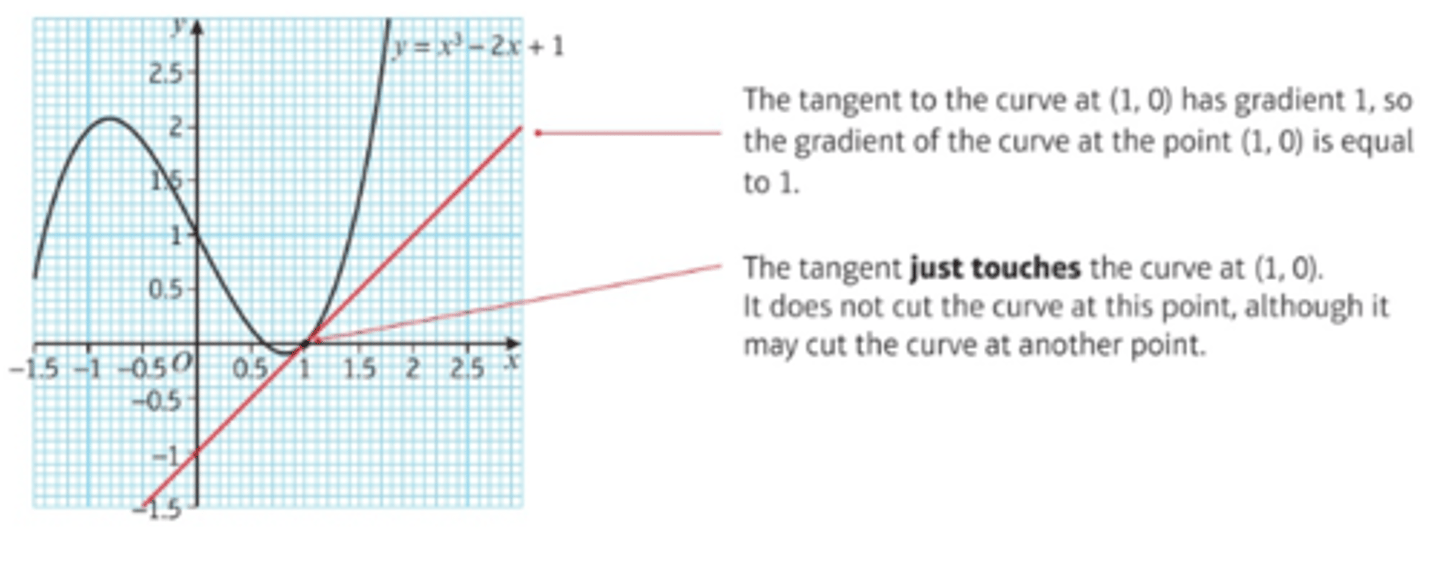
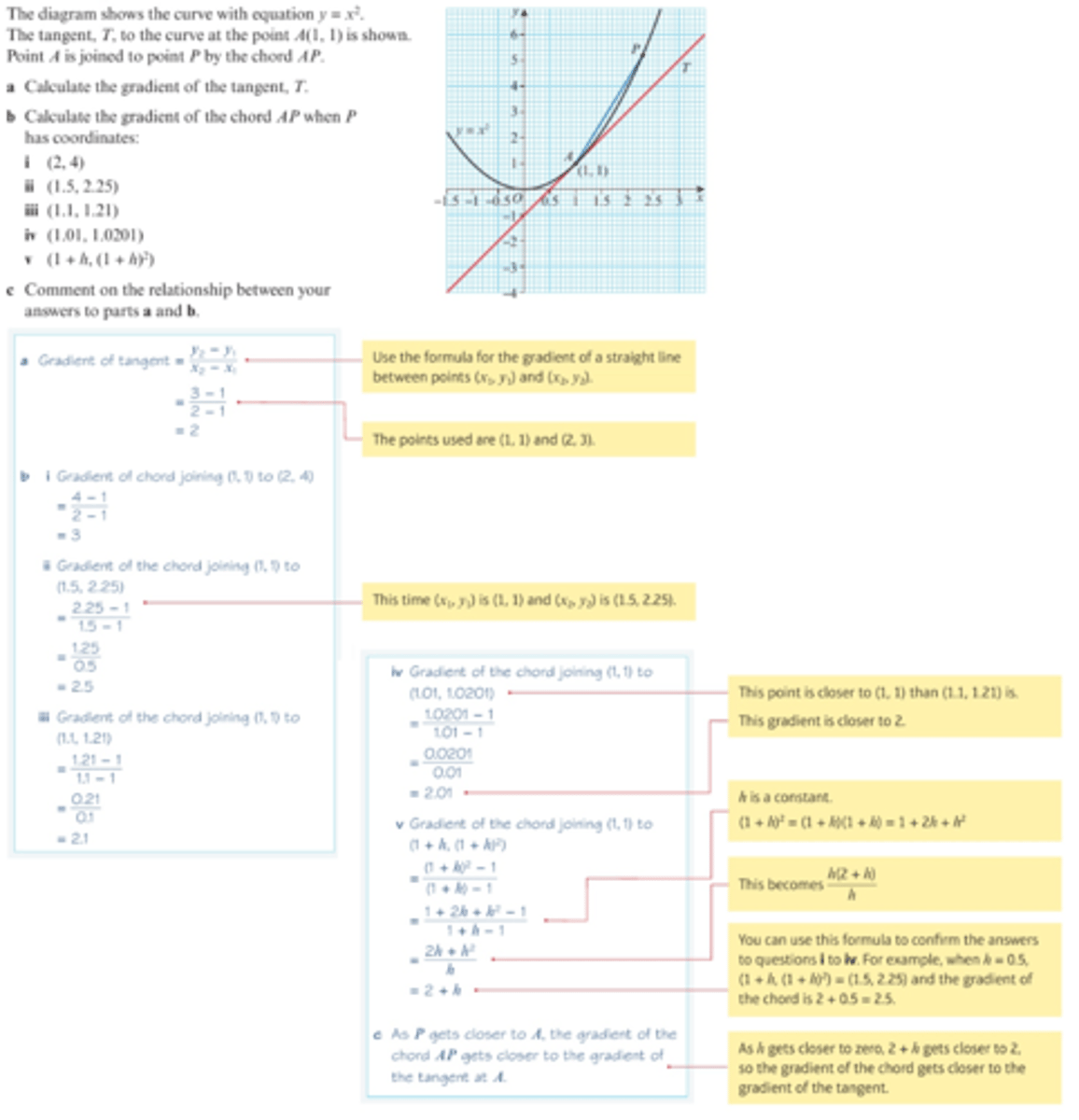
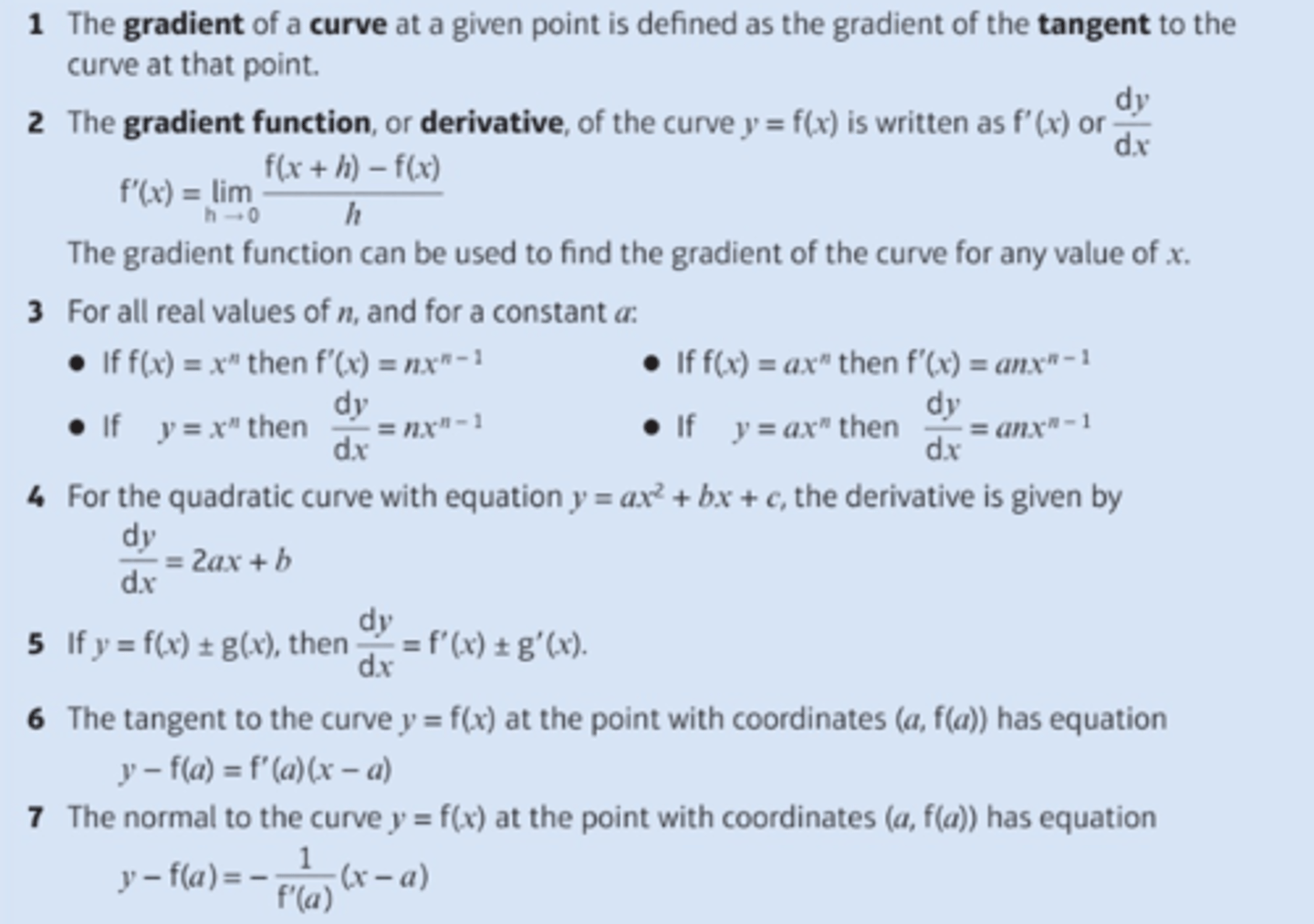
How do you find the gradient of a curve?
- The gradient of a curve is constantly changing.
- You can use a tangent to find the gradient of a curve at any point on the curve.
- The tangent to a curve a t apoint A is the straight line that just touches the curve at A.
- The gradient of a curve at a given point is defined as the gradient of the tangent to the curve at any point.
What is an example of finding the gradient of a curve?
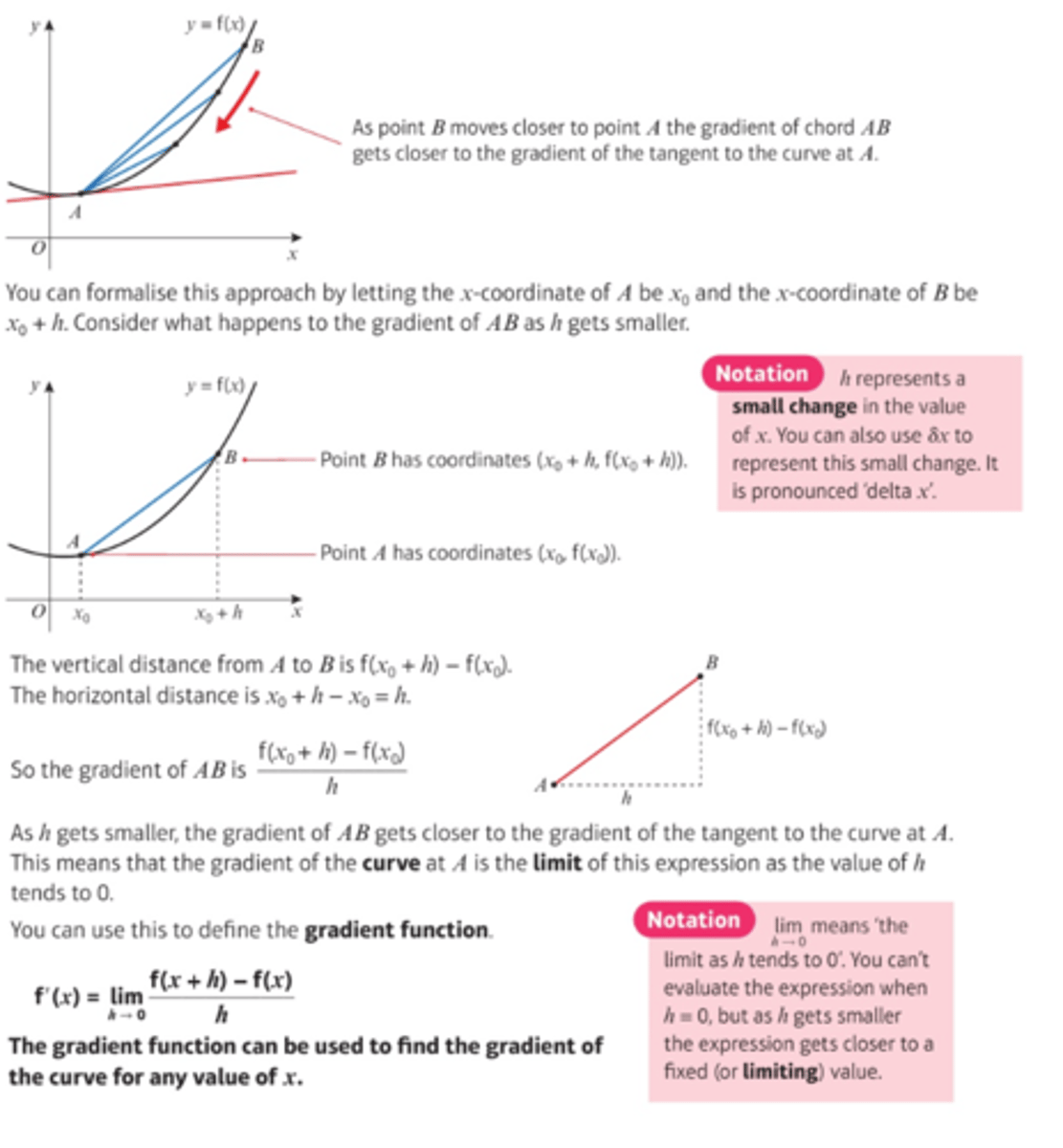
How can you find the derivative?
- You can use algebra to fid the exact gradient of a curve at a given point.
- The gradient function, or derivative of the curve y = f(x) is written as f' (x) or dy/dx.
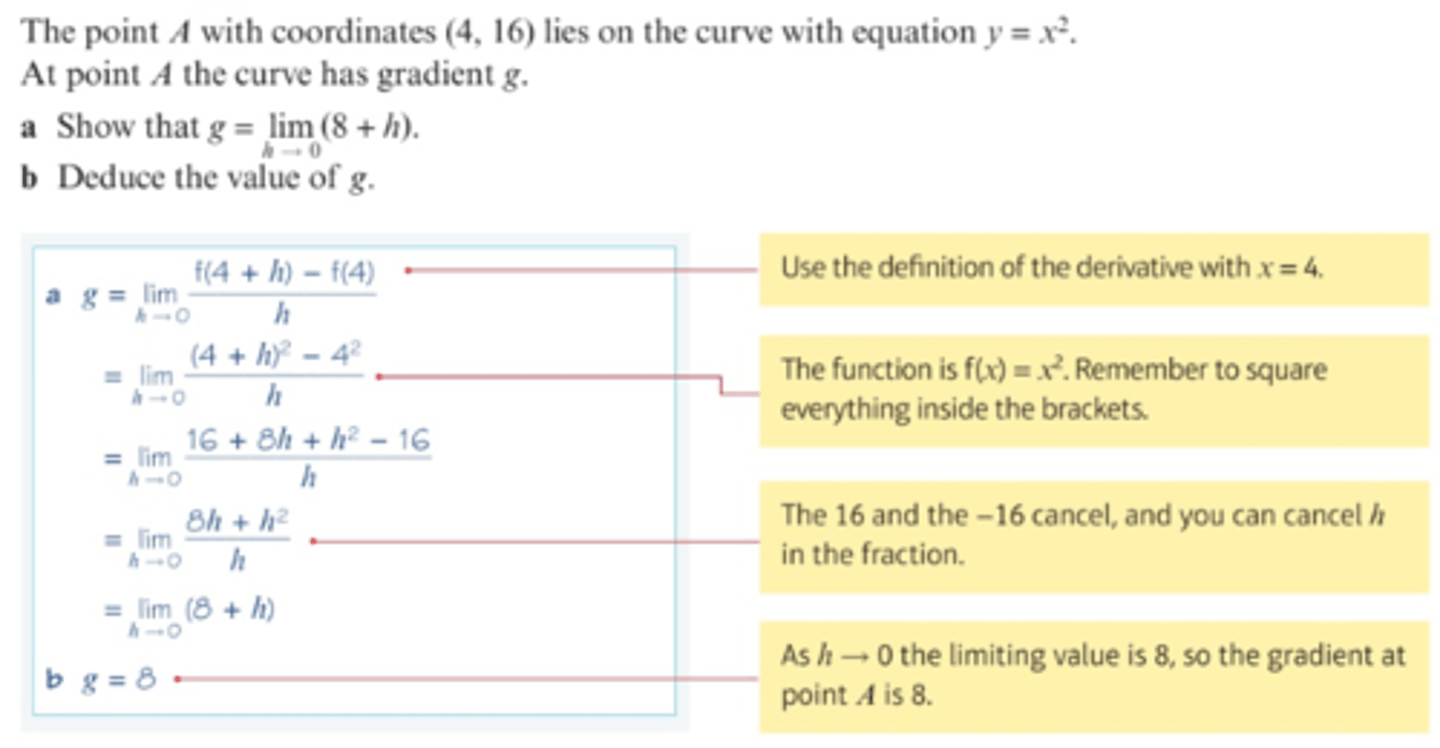
What is an example of differentitating from first principles?
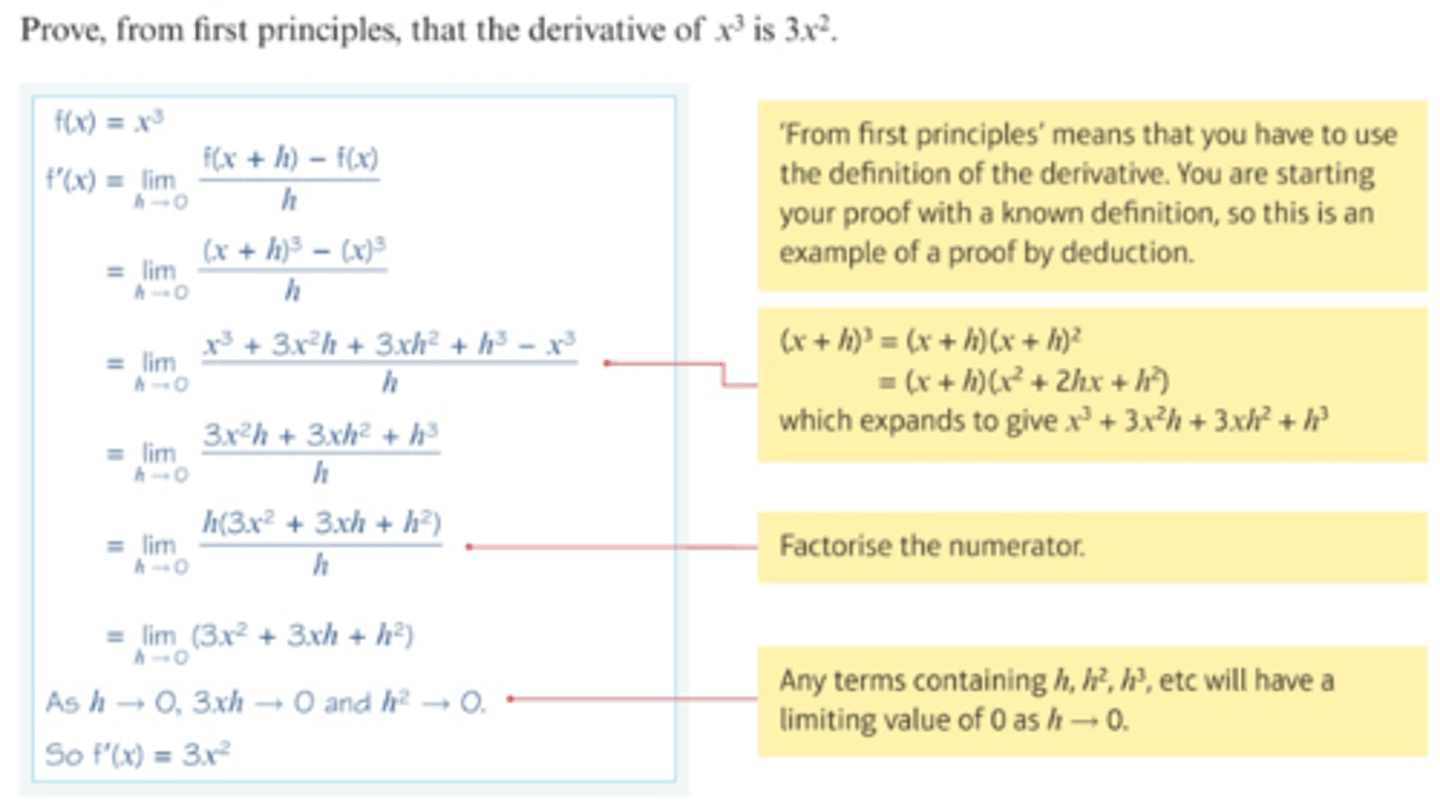
What is an example of a question involving proofs using differentitation from first principles?
What is differentiation?
- You can use the definition of the derivative to find an expression for the derivative of xⁿ, where n is any number; this is called differentiation.
- For all real values of n, and for a constant 'a':
1) If f(x) = xⁿ, then f' (x) = nxⁿ⁻¹.
2) If y = xⁿ, then dy/dx = nxⁿ⁻¹.
3) If f(x) = axⁿ, then f'(x) = anxⁿ⁻¹.
4) If y = axⁿ, then dy/dx = anxⁿ⁻¹.
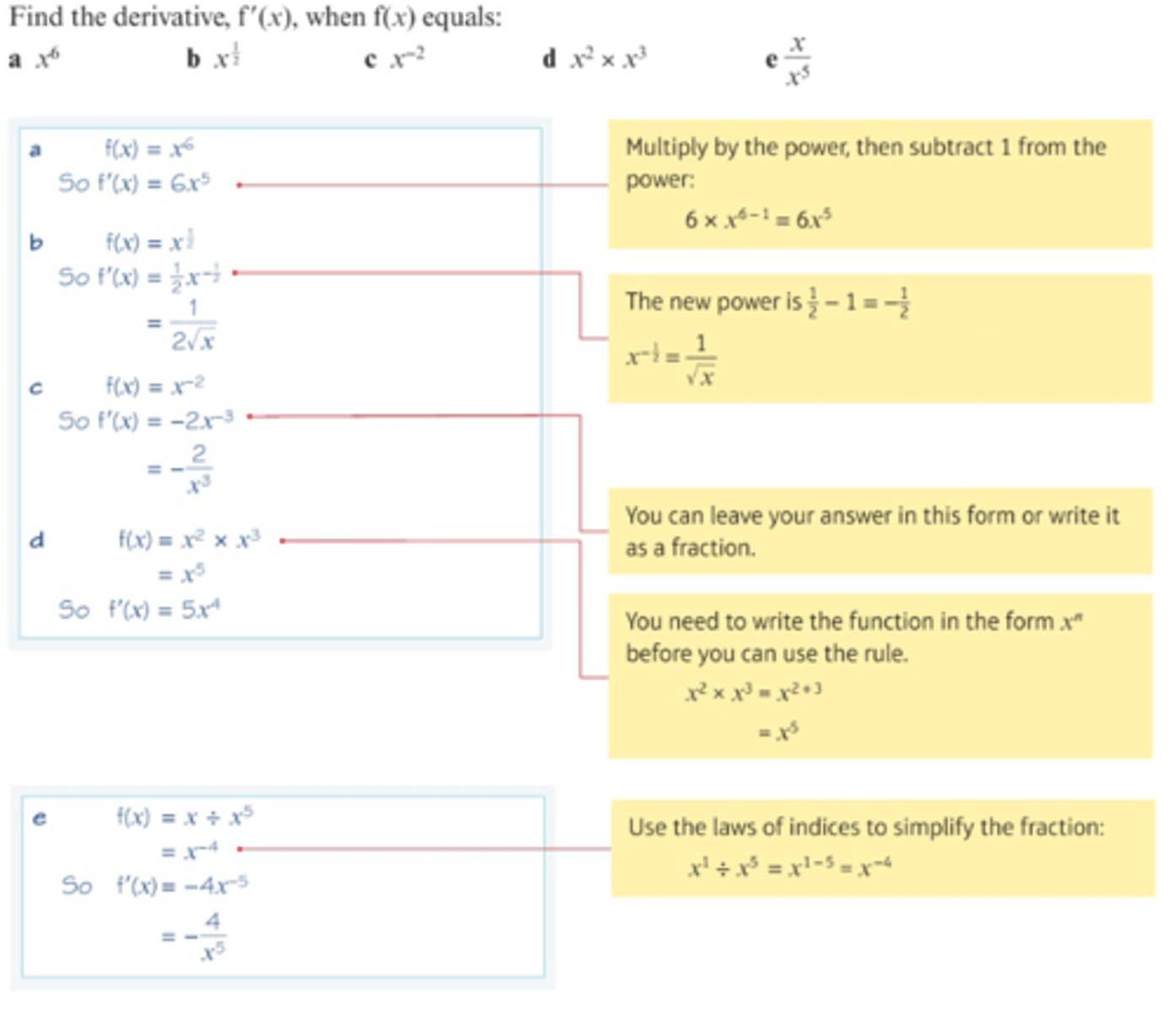
What are examples of finding f'(x) when given f(x) through differentiation?
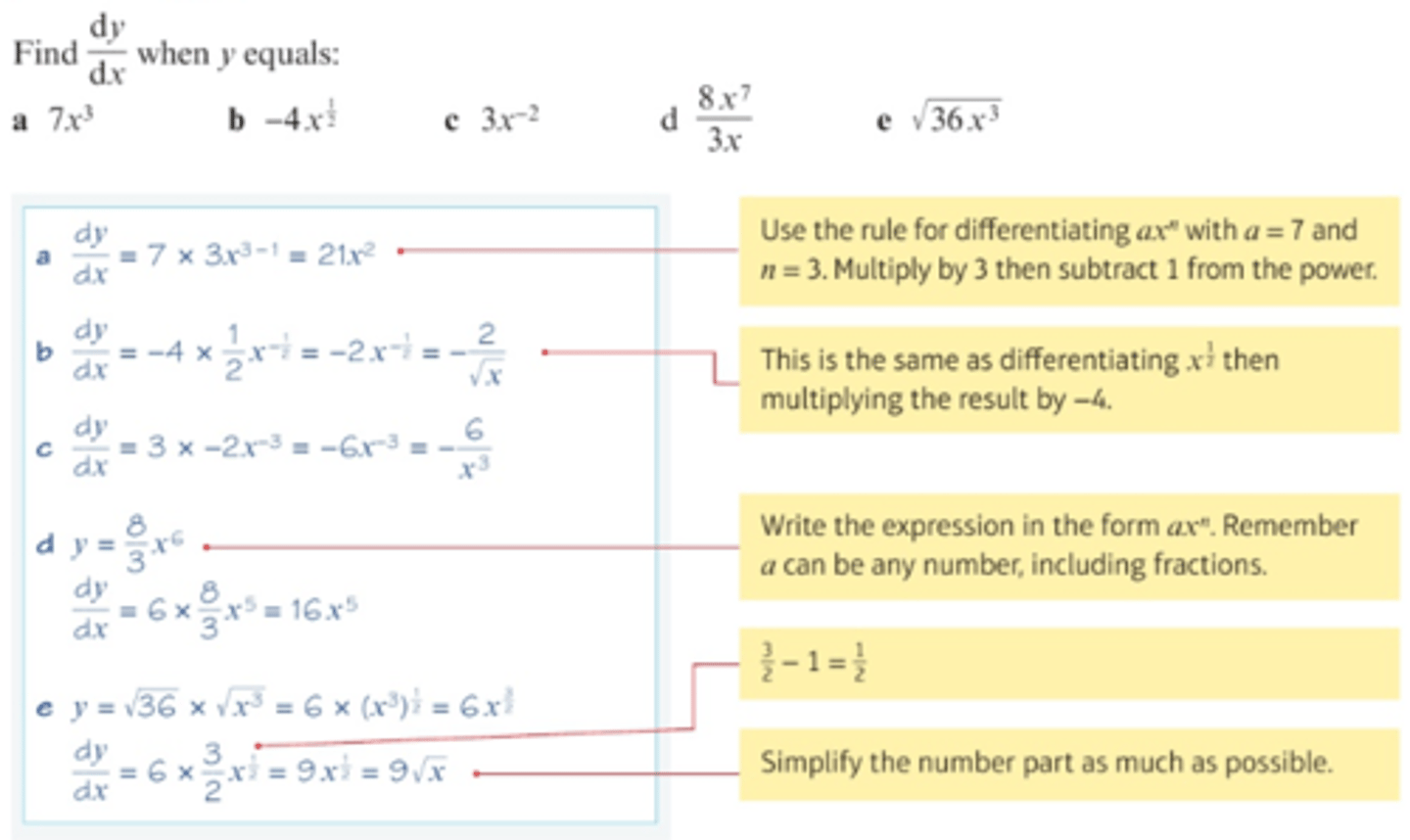
What are examples of finding dy/dx when given y through differentiation?
How can you differentitate a function with more than one term?
- By differentiating the terms one-at-a-time.
- The highest power of x in a quadratic function is x², so the highest power of x in its derivative will be x.
- For the quadratic curve equation y = ax² + bx + c, the derivative is given by dy/dx = 2ax + b.
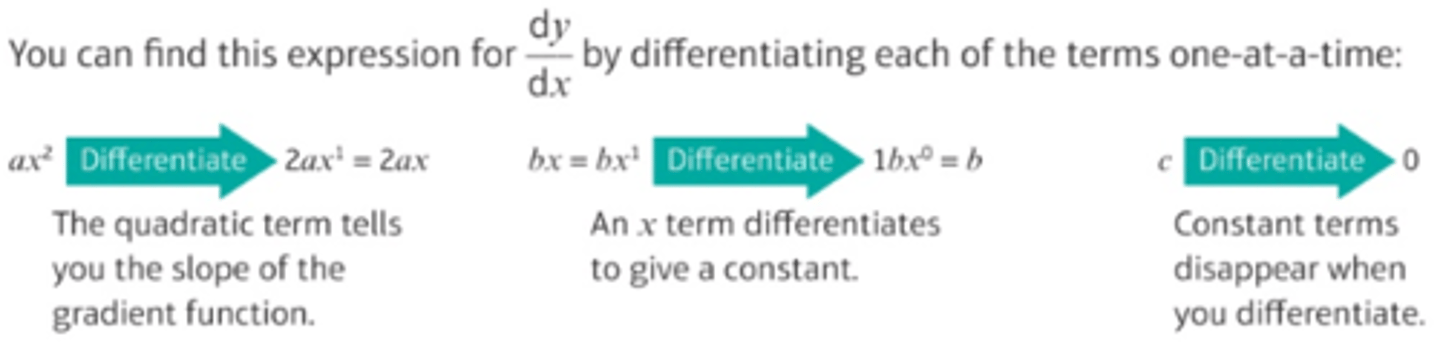
What are examples of differentitating functions with more than one term?
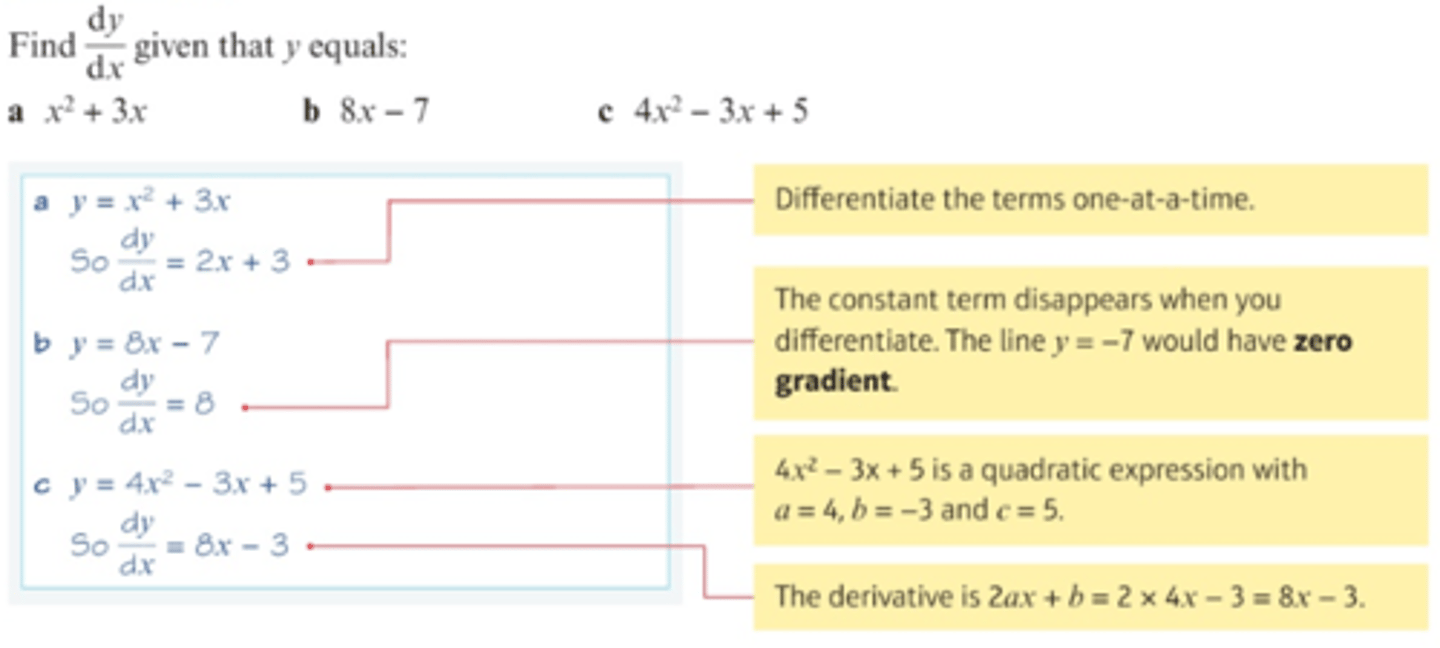
What is a more complex example of a problem involving differentitating functions with more than one term?
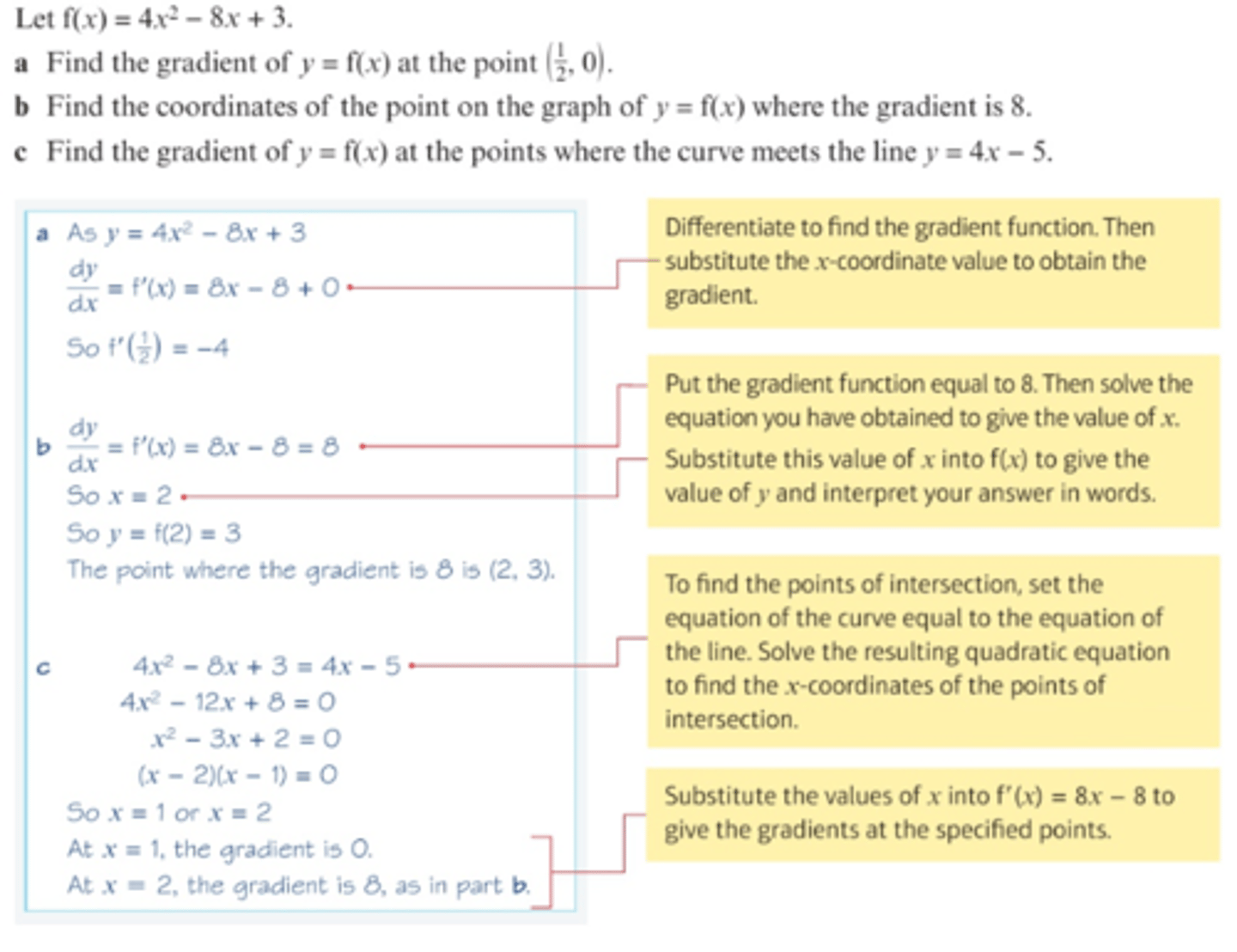
How can you differentiate functions with two or more terms?
- You can use the rule for differentiating axⁿ to differentiate with two or more terms.
- You need to be able to rearrange each term into the form axⁿ, where a is a constant and n is a real number.
- Then, you can differentiate the terms one-at-a-time.
- If y = f(x) ± g(x), then dy/dx = f'(x) ± g'(x).
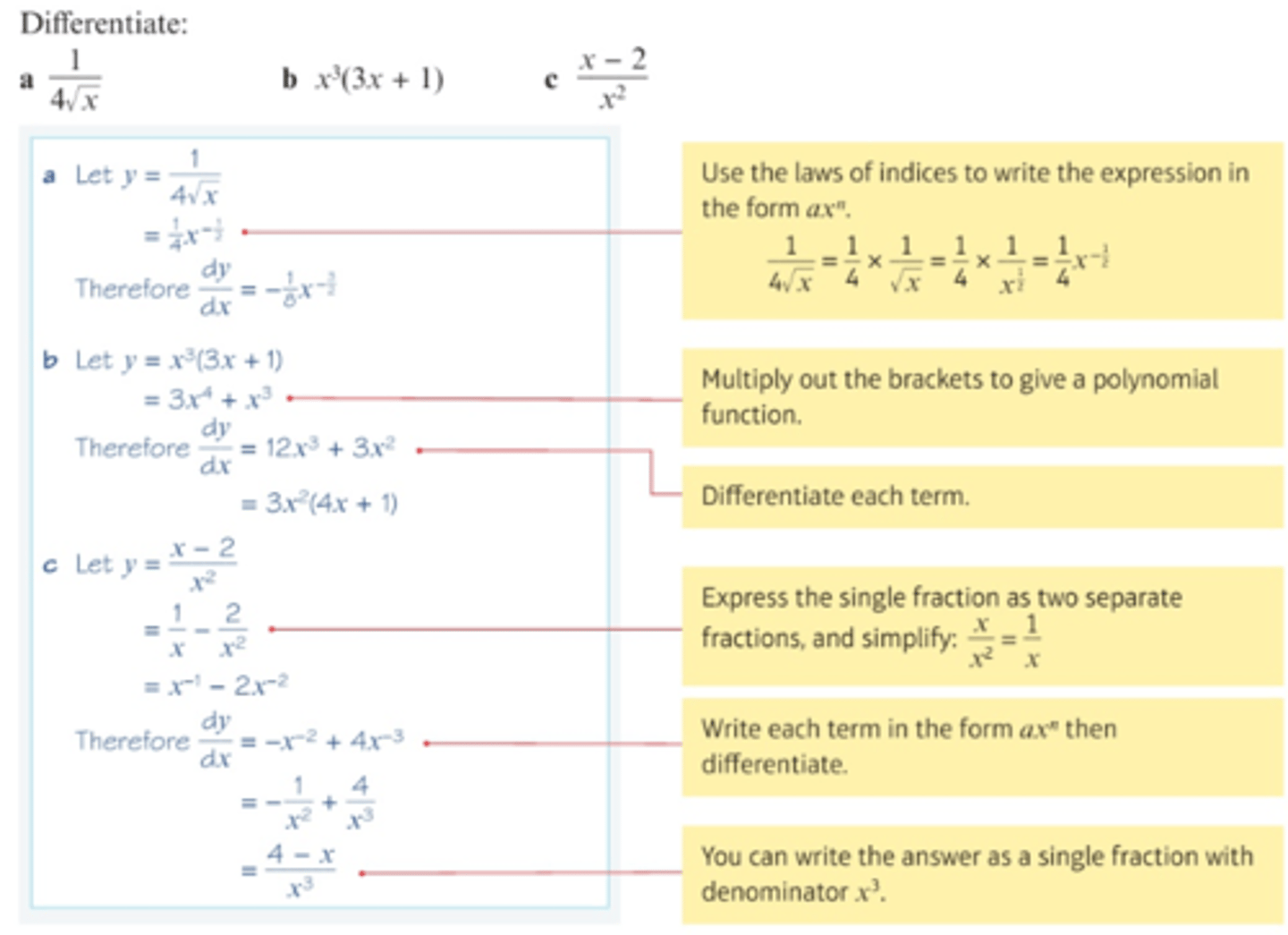
What are examples of differentiating functions with two or more terms?
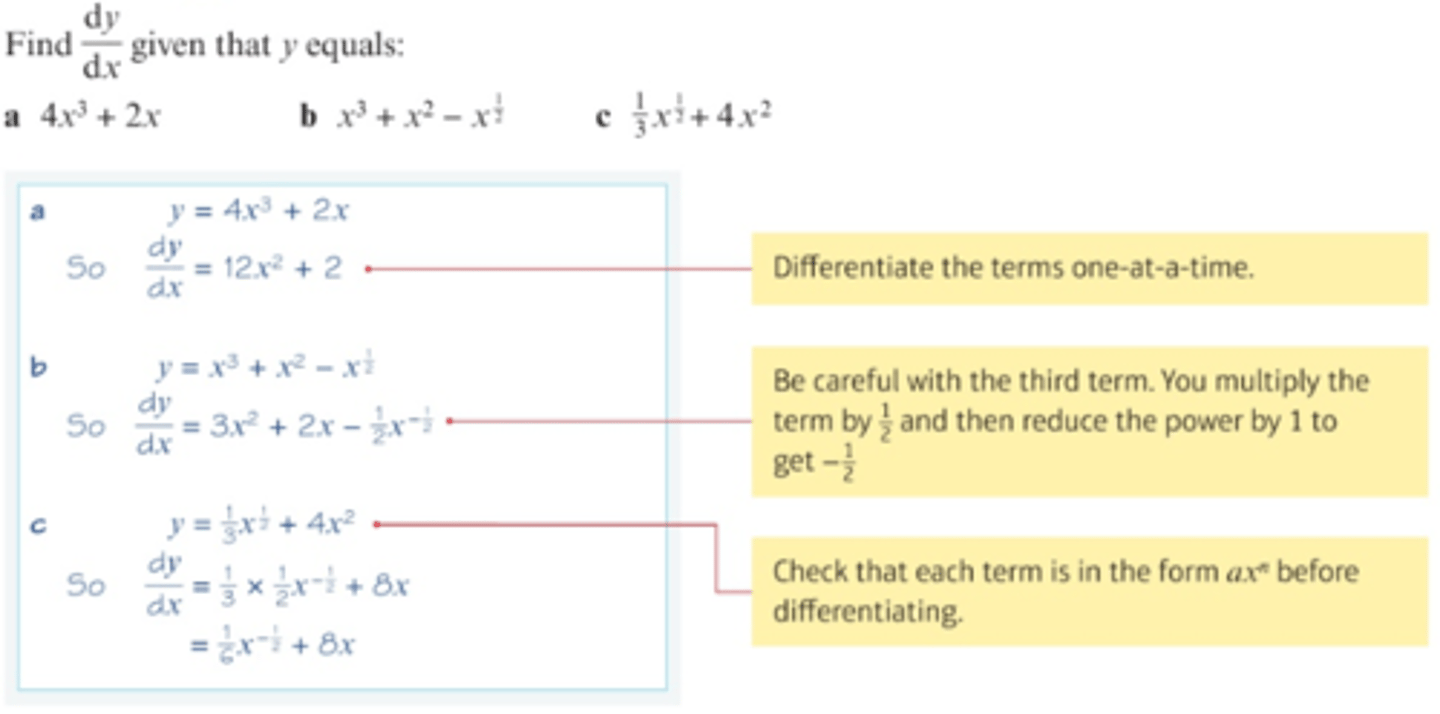
What are more examples of differentiating functions with two or more terms?
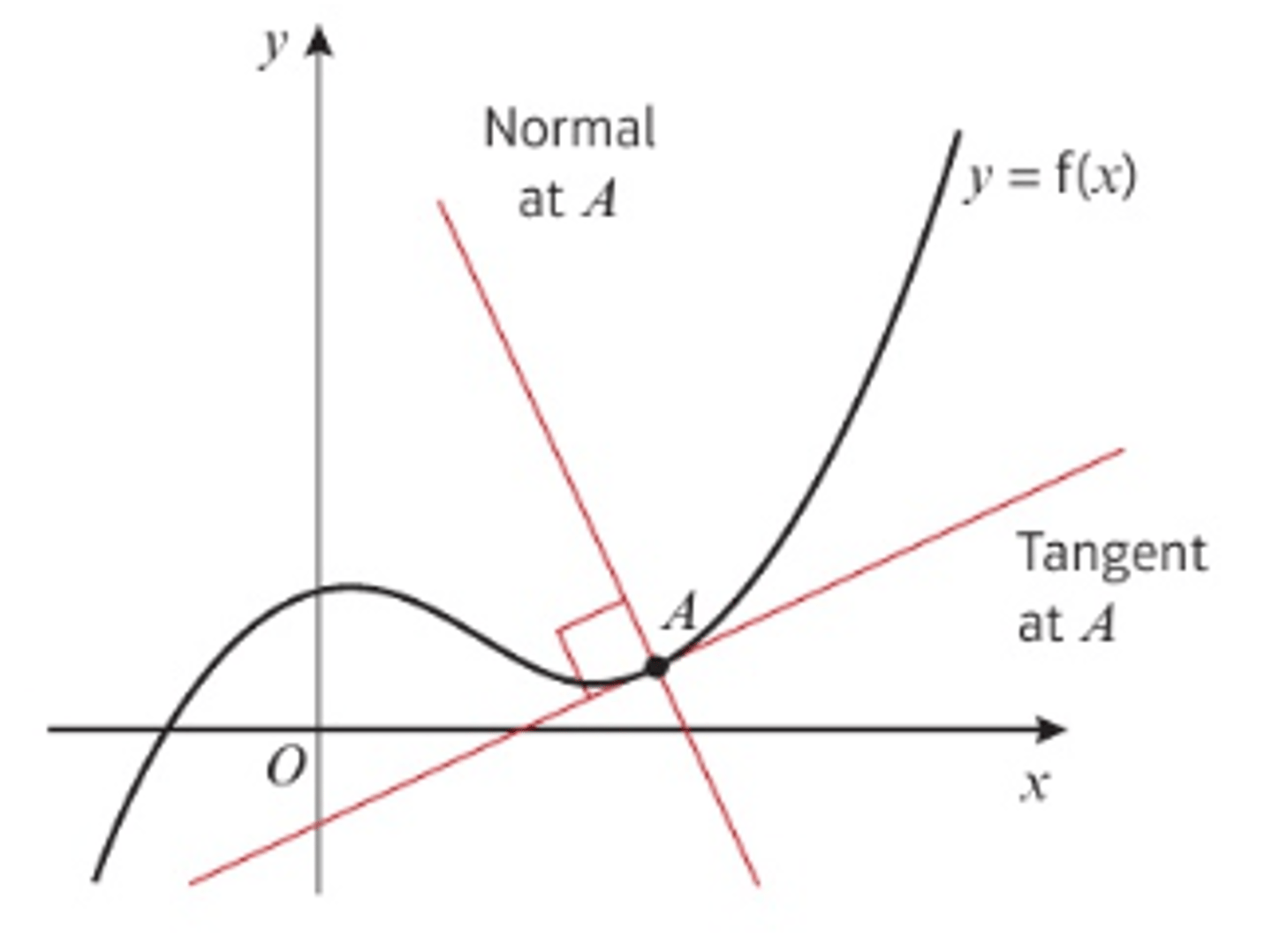
How can you use the derivative to find the equation of the tangent to a curve at a given point?
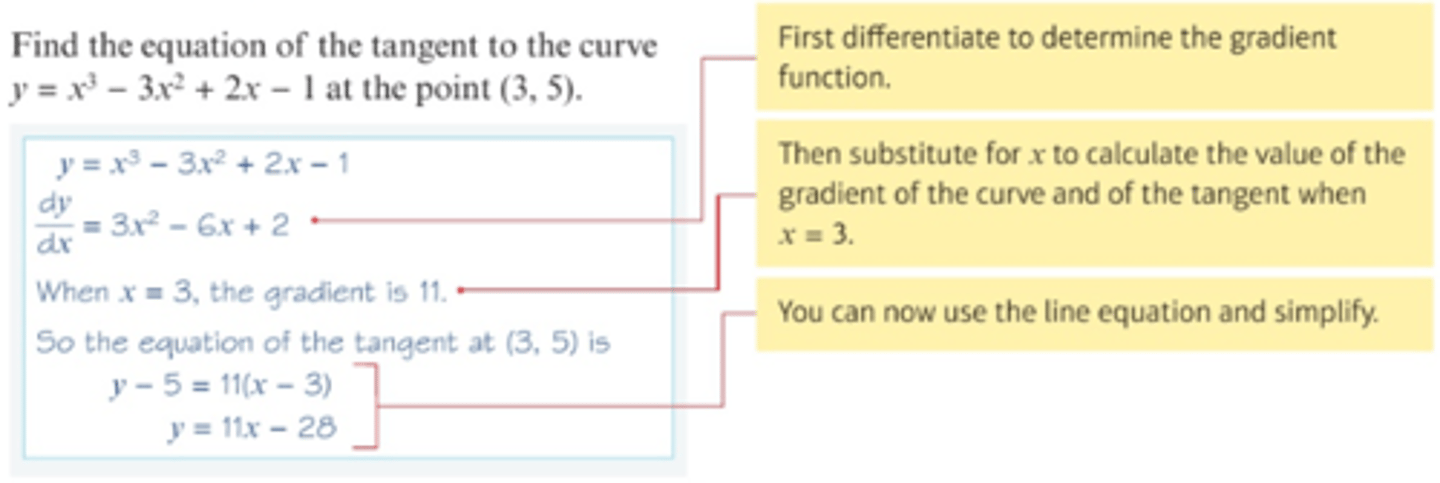
- On the curve with the equation y = f(x), the gradient of the tangent at point A with x-coordinate a will be f'(a).
- The tangent to the curve y = f(x) at the point with coordinates (a, f(a)) as the equation:
y - f(a) = f'(a)(x-a).
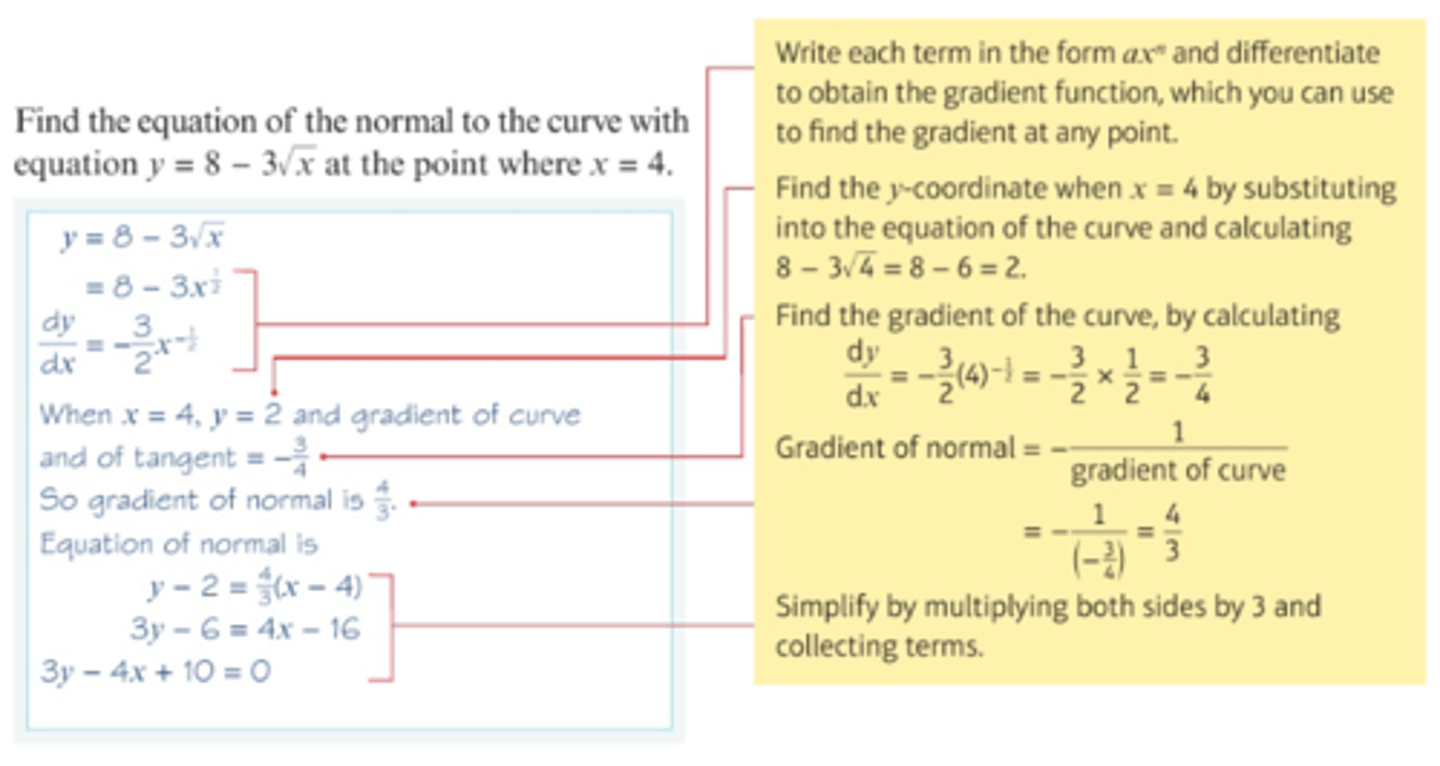
- The normal to a curve at point A is the straight line through A, which is perpendicular to the tangent to the curve at A; the gradient of the normal will be -1/f'(a).
- The normal to the curve y = f(x) at te point with coordinates (a, f(a)) has the equation:
y - f(a) = (-1/f'(a))(x - a)
What is an example of using the derivative to find the equation of the tangent to a curve at a given point?
What is another example of using the derivative to find the equation of the tangent to a curve at a given point?
How can you use the derivative to determine whether a function is increasing or decreasing at any given interval?
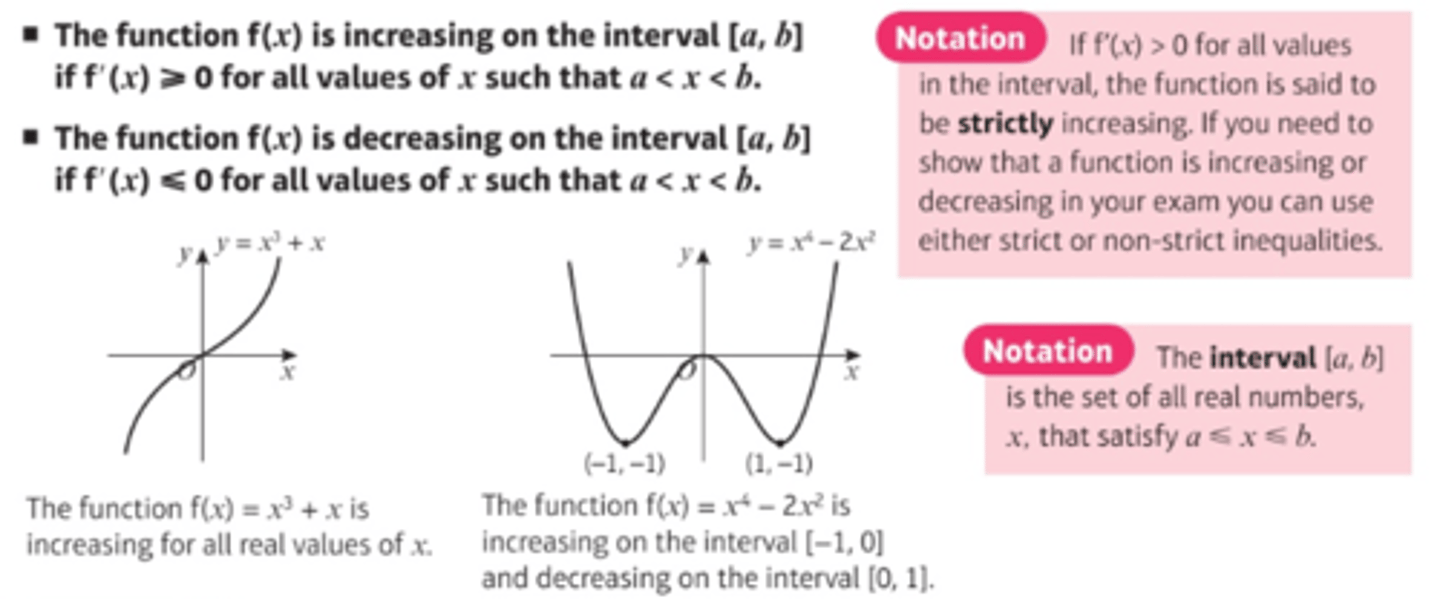
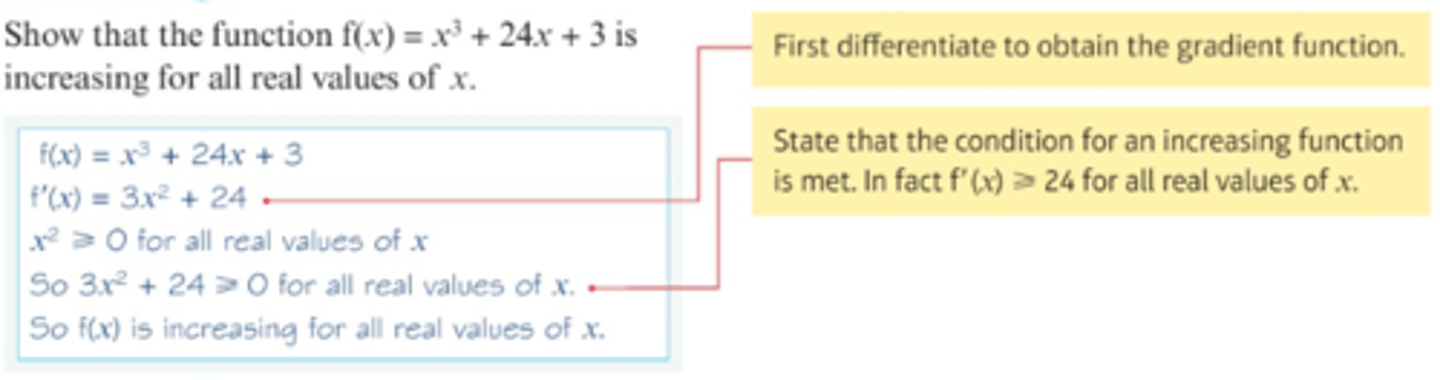
What is an example of using the derivative to prove a function is increasing?
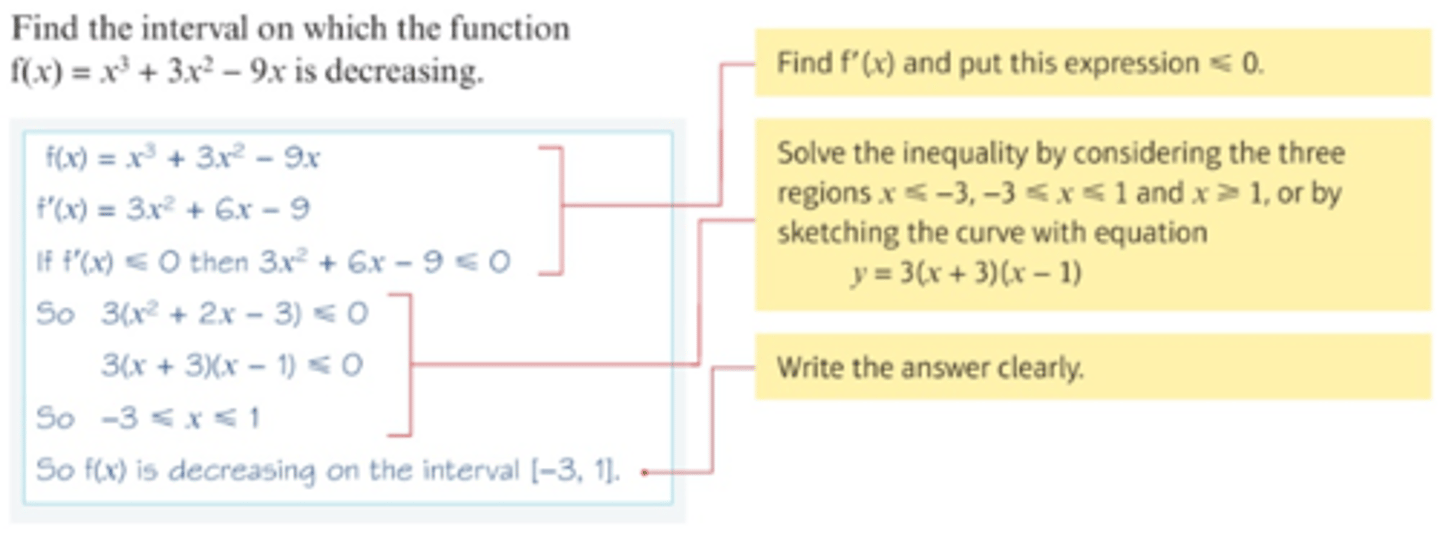
What is an example of using the derivative to prove a function is decreasing?
How can you find the rate of change of a gradient function?
By differentiating the function twice.
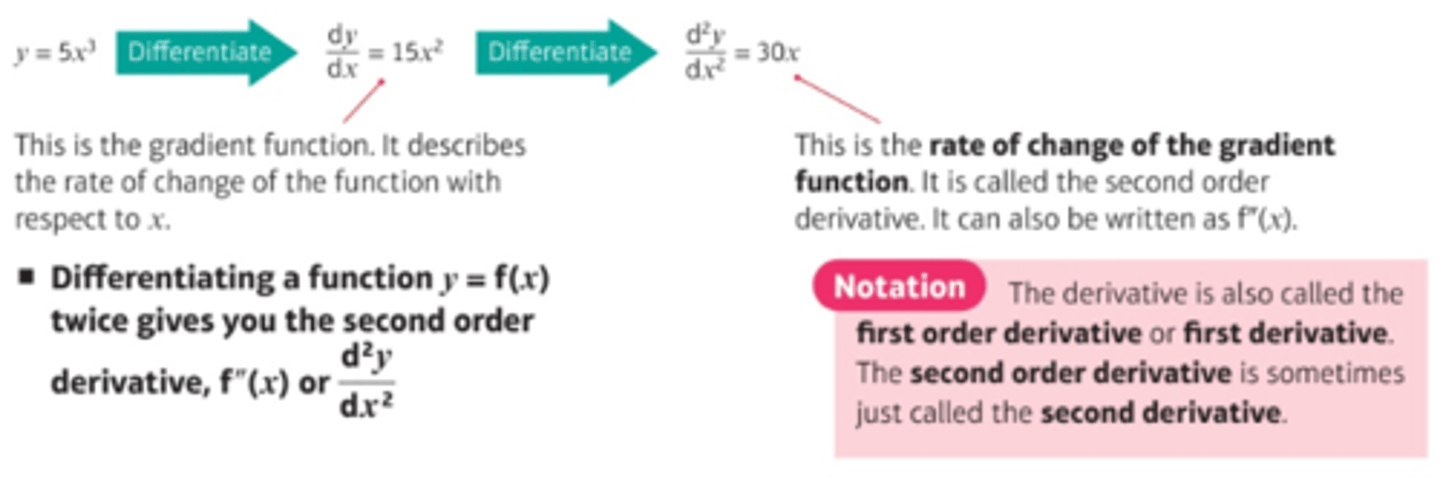
What is an example of differentiating a function twice?
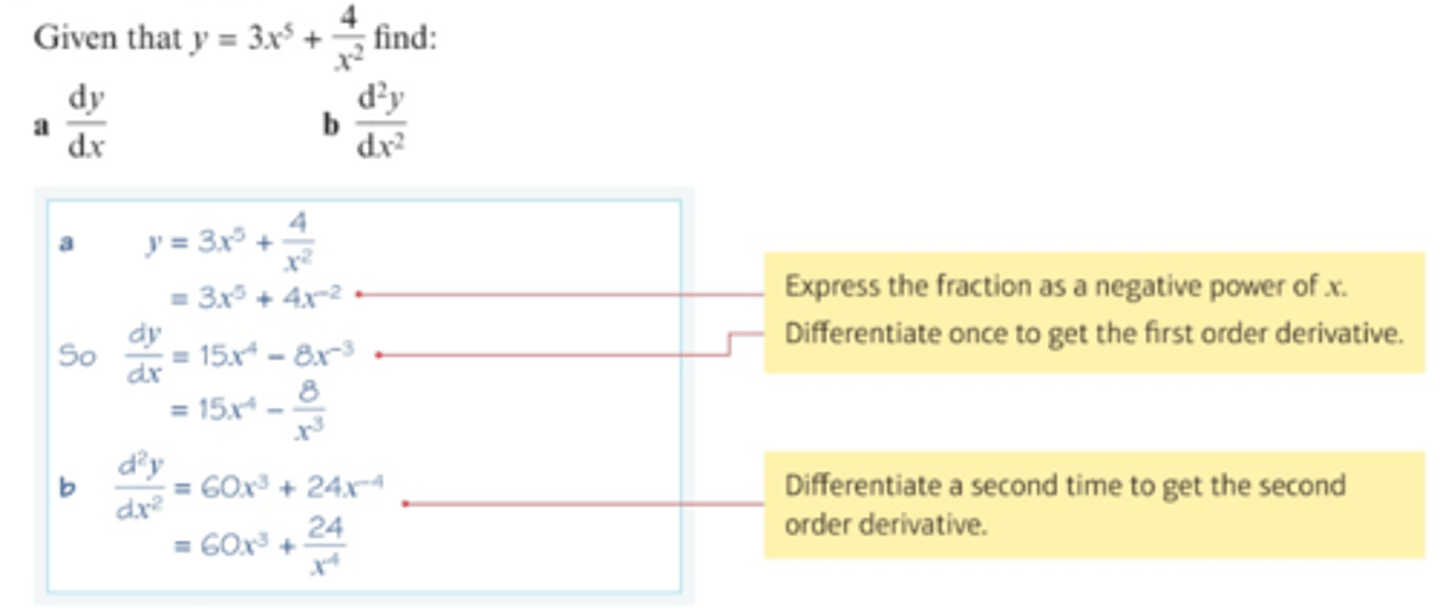
What is another example of differentiating a function twice?
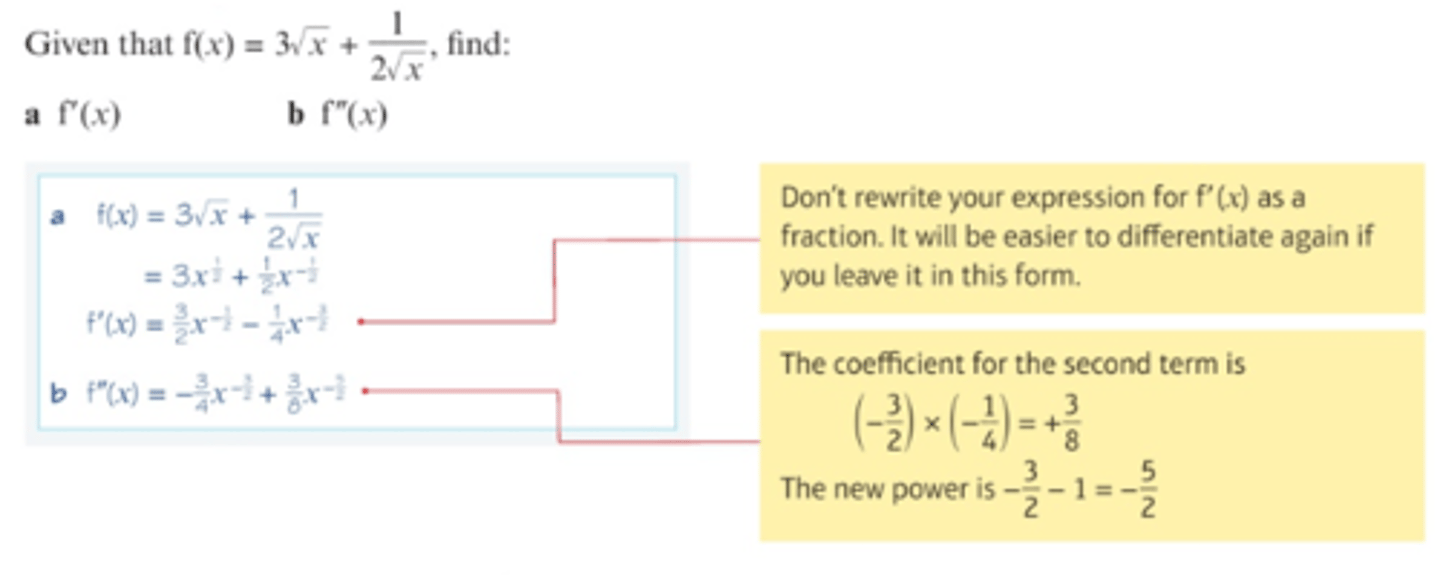
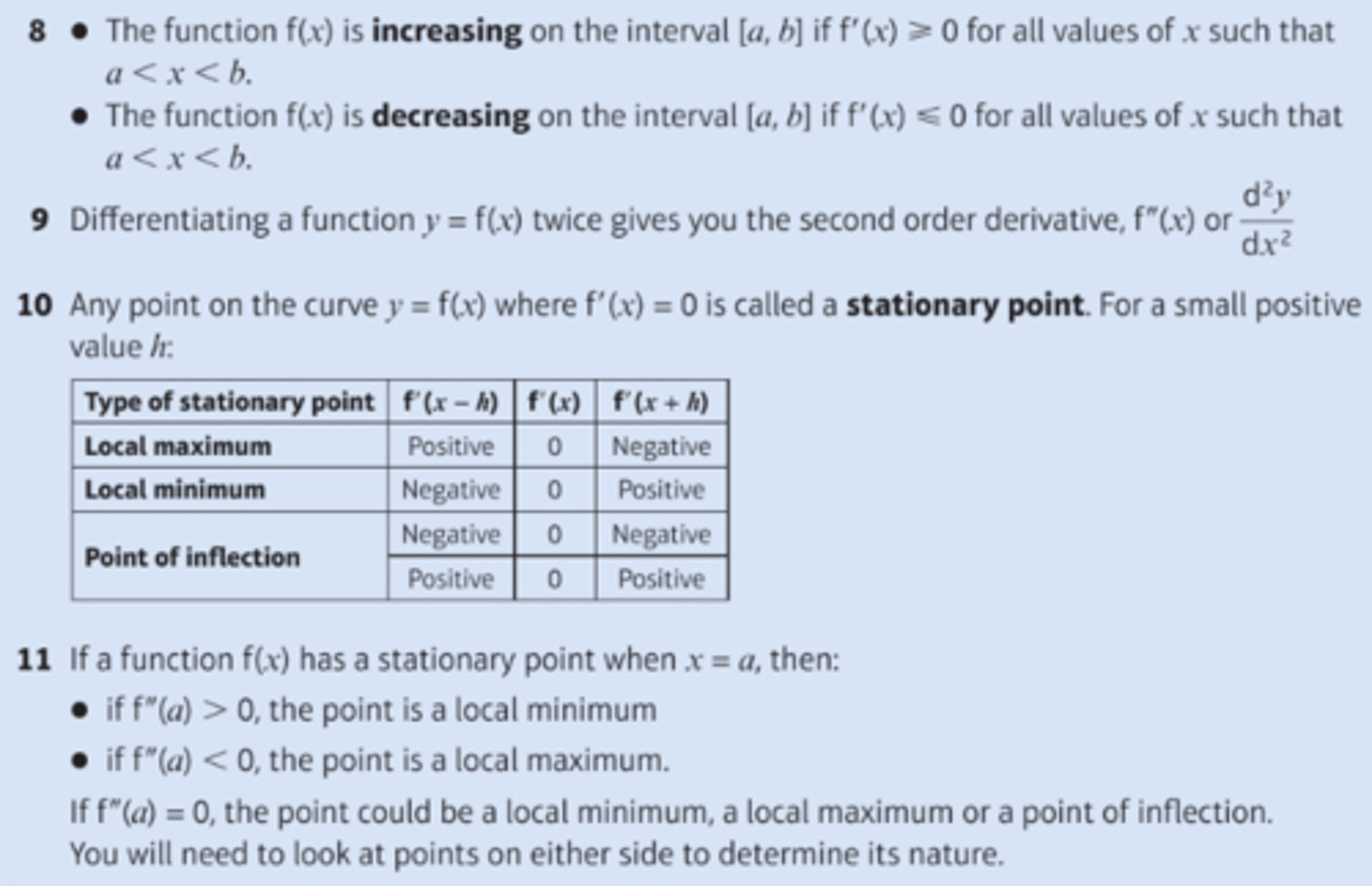
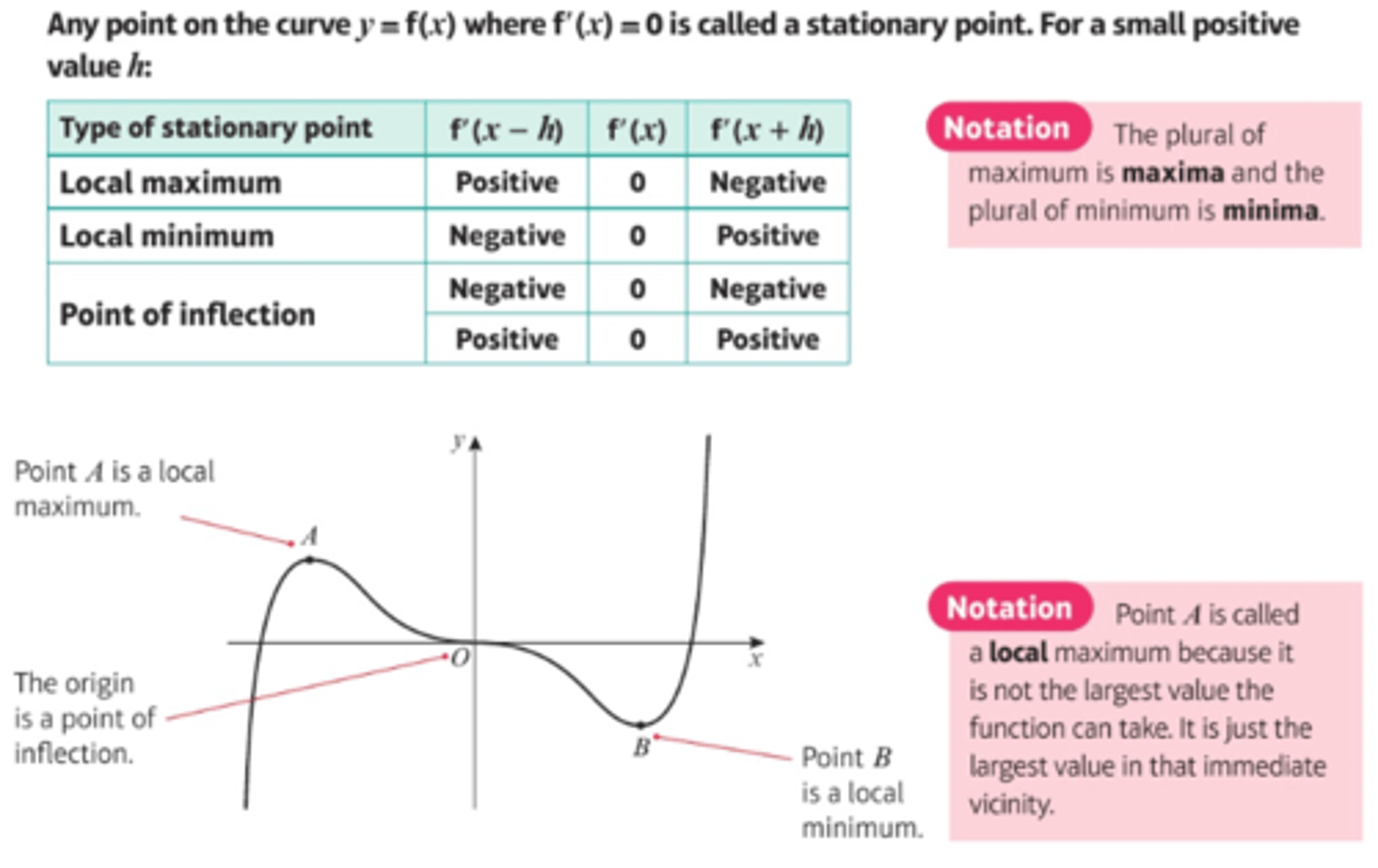
What is a a stationary point?
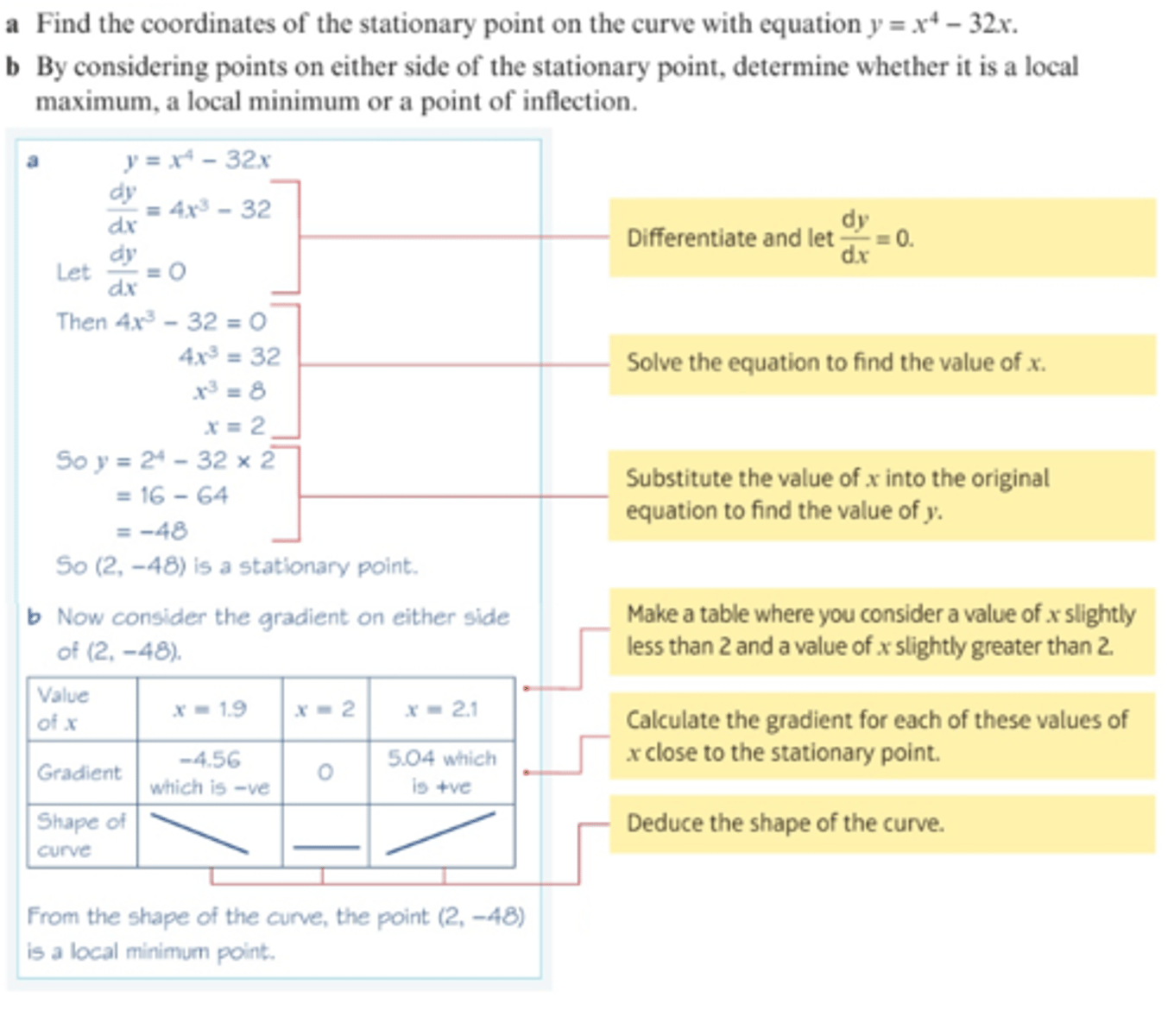
- A stationary point on a curve is any point where the curve has gradient zero.
- You can determine whether a stationary point is a local minimum, local maximum or a point of inflection by looking at the gradient of the curve on either side.
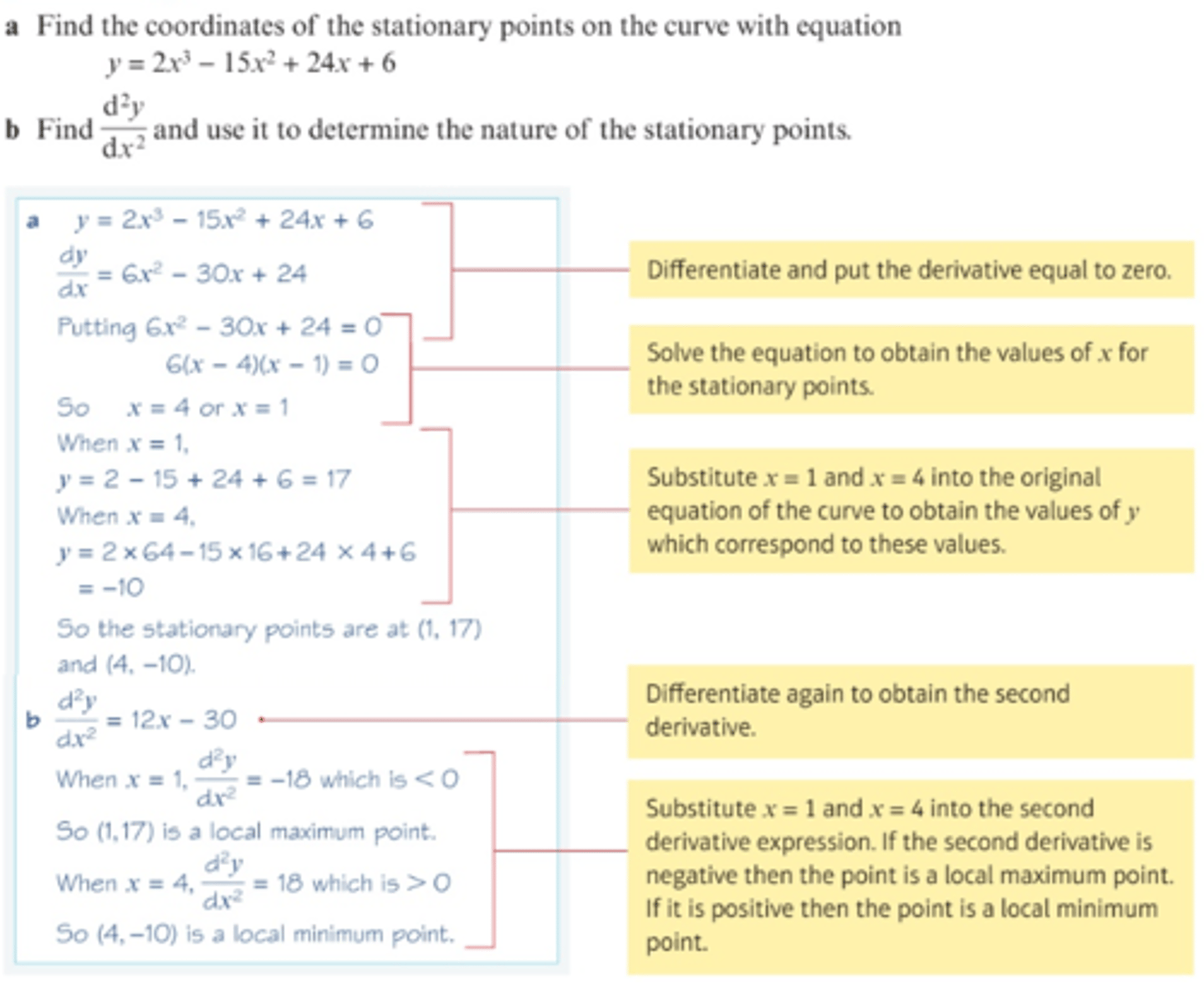
What is an example of finding the coordinates of a stationary point on a curve, and determining it's nature?
What is another method of determining the nature of a stationary point?
- In some cases, you can use the second derivative, f''(x), to determine the nature of a stationary point.
- If a function, f(x), has a stationary point when x = a, then:
1) If f''(a) > 0, the point is a local minimum.
2) If f''(a) < 0, the point is a local maximum.
3) If f''(a) = 0, the point could be a local minimum, local maximum or a point of inflection, so you will need to look at points on either side to determine its nature.
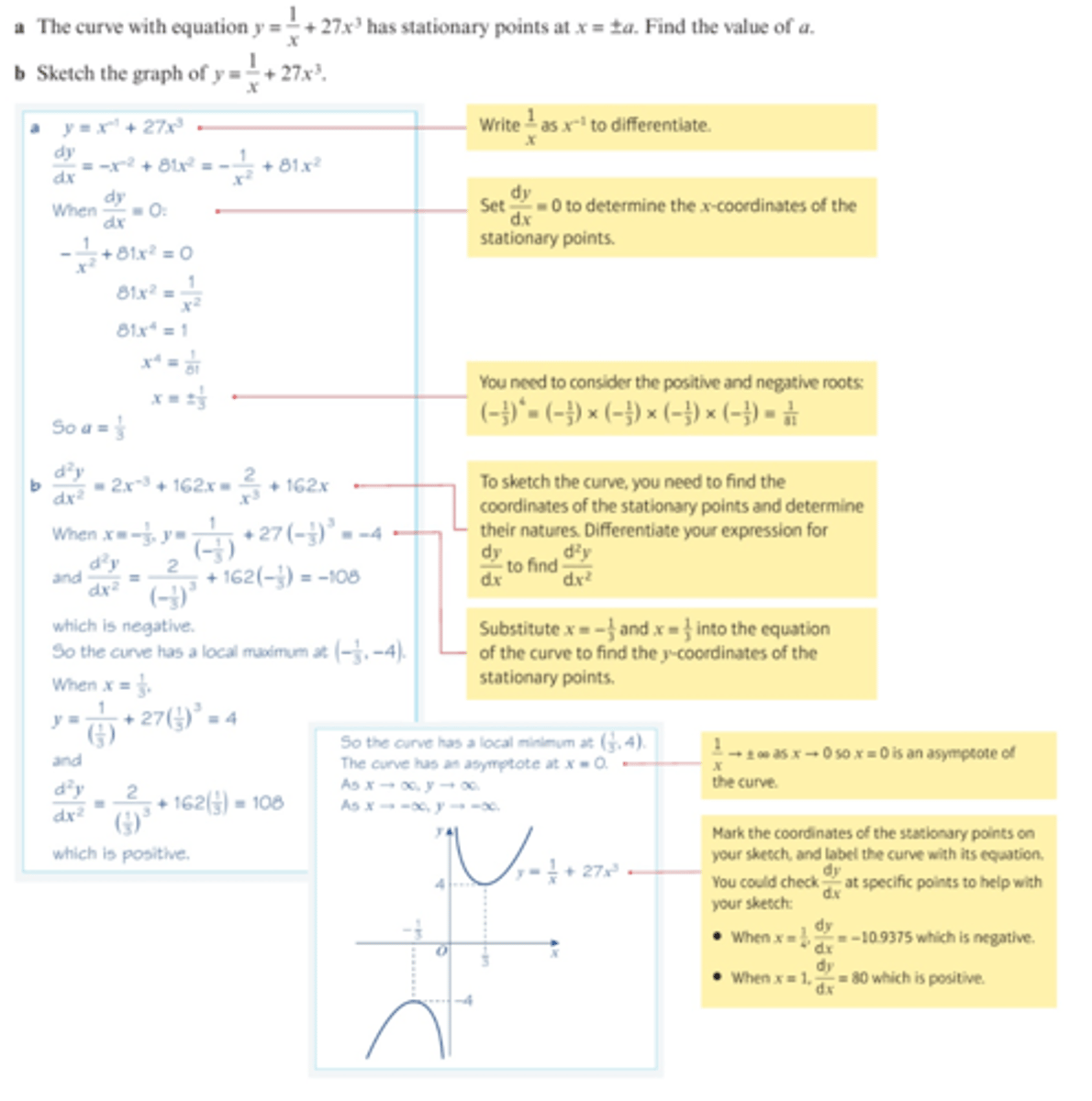
What is an example of finding the coordinates of a stationary point on a curve, and determining it's nature, using the second derivative?
What is another example of finding the coordinates of a stationary point on a curve, and determining it's nature, using the second derivative?
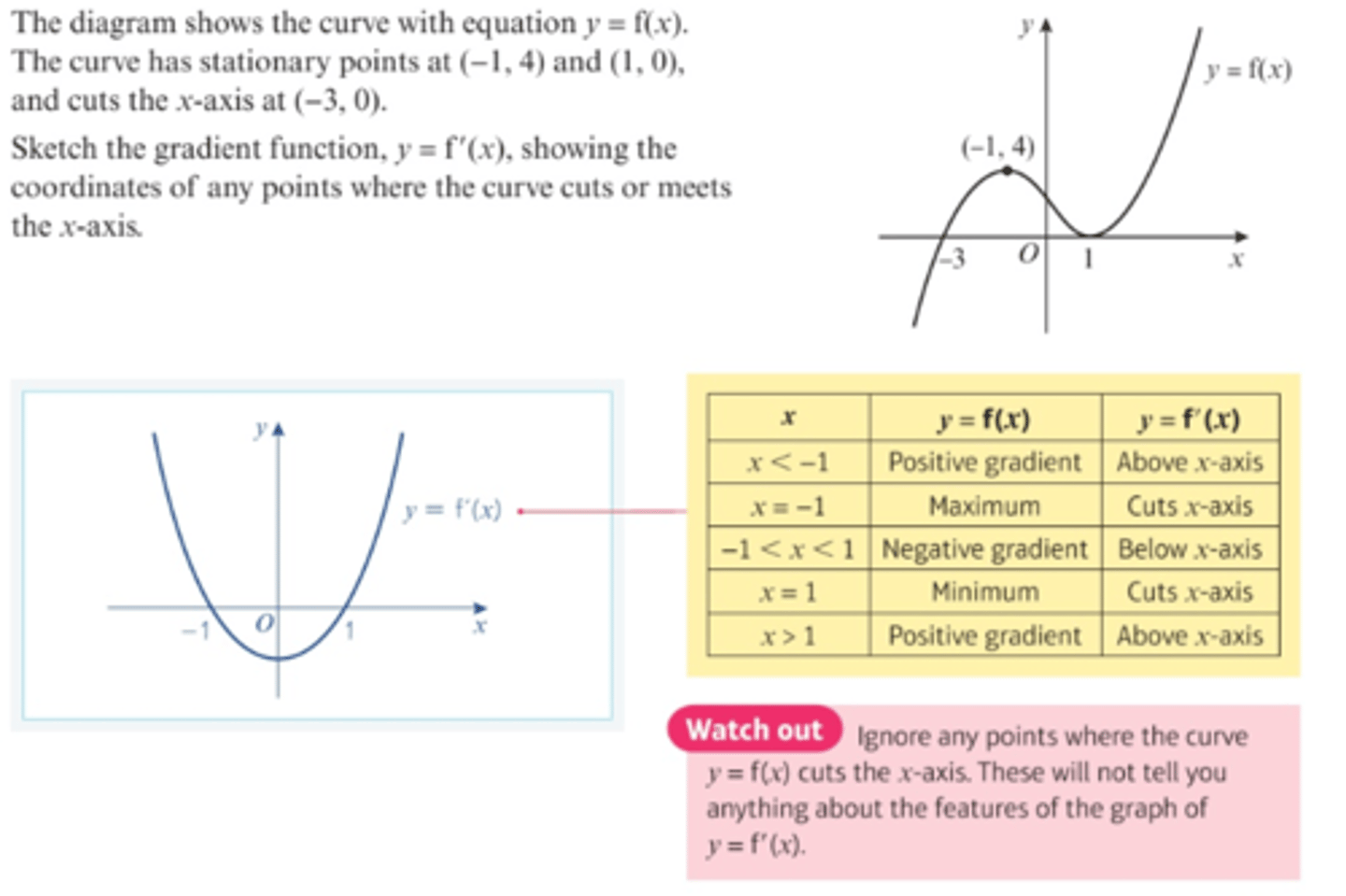
How can you sketch a gradient function when given a function?
- By using the features of the given function.
- The table in the diagram showed the features of the graph of a funtion, y = f(x), and the graph of its gradient function, y = f'(x), at corresponding values of x.
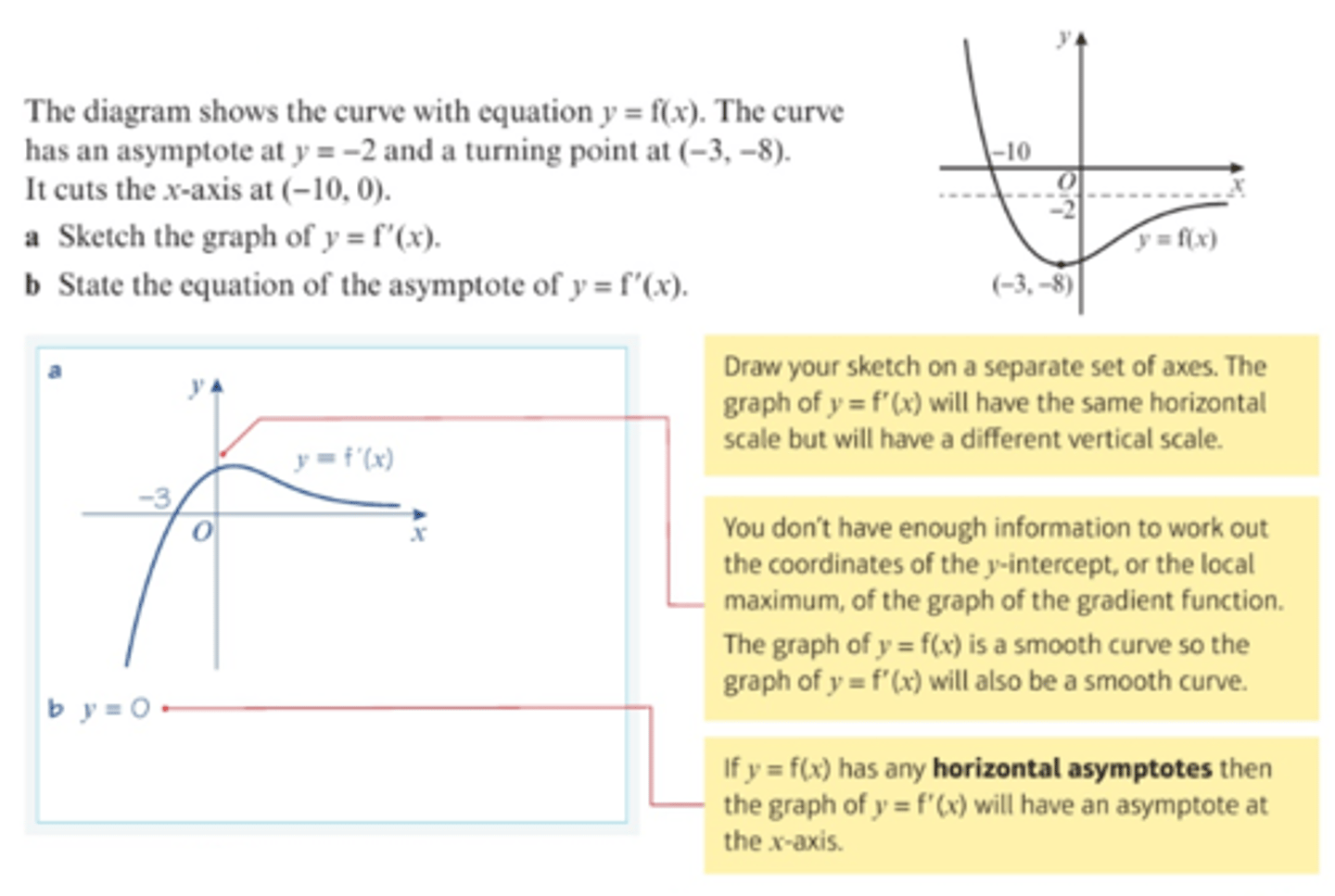
What is an example of drawing a gradient function of a given function?
What is an example of drawing a gradient function of a given function which includes aymptotes?
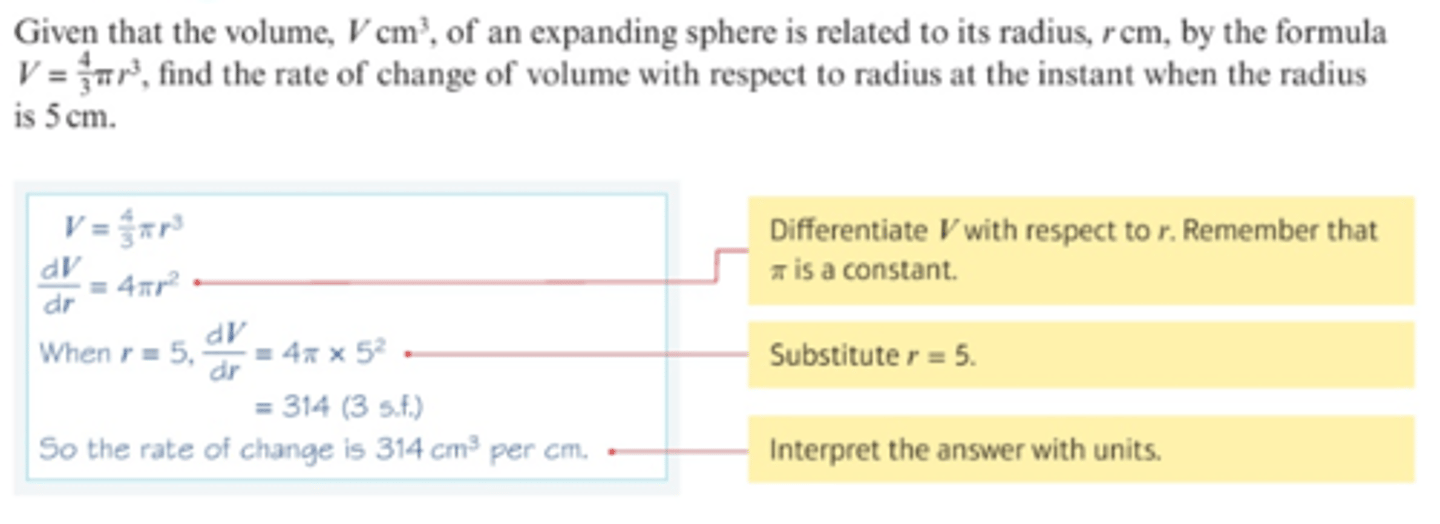
How can you model with differentiation?
- You can think of dy/dx as a (small change in y)/(small change in x).
- It represents the rate of change of y with respect to x.
- If you replace y and x with variables that represent real-life quantities, you can use the derivative to model lots of real-life situations involving rates of change.
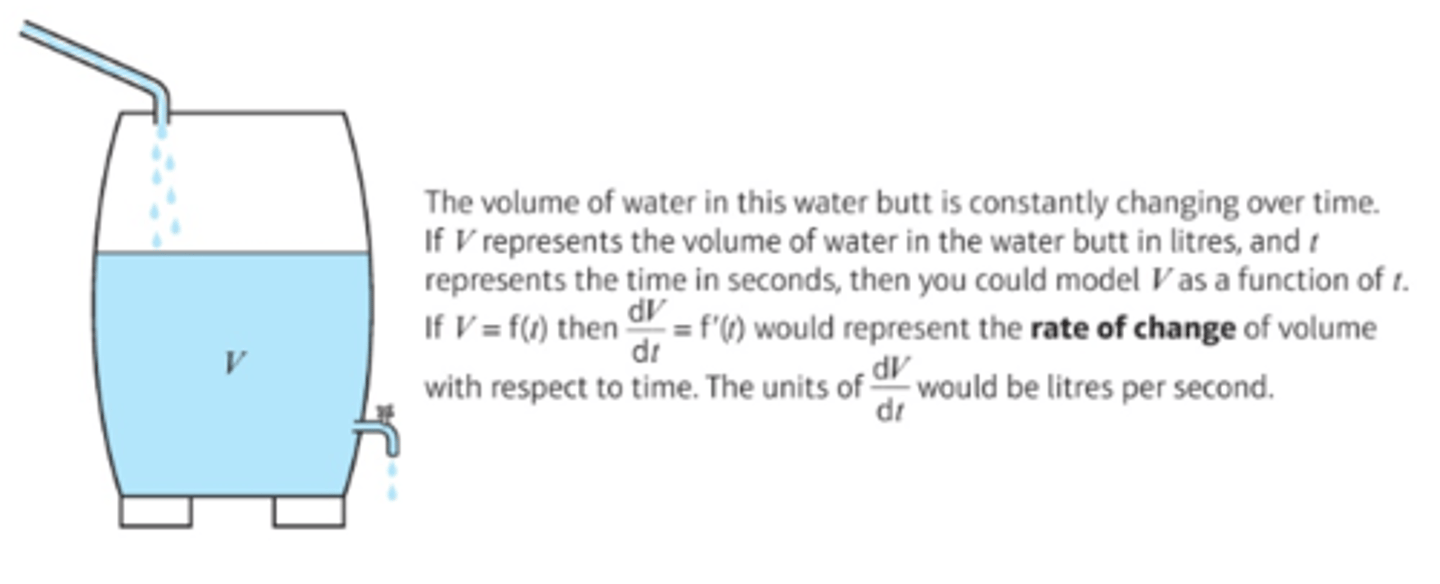
What is an example of modelling with differentiation?
EDEXCEL A-LEVEL PURE MATHS CHAPTER TWELVE: DIFFERENTIATION
(MAKE SURE YOU KNOW THE FOLLOWING)
(1-7)
EDEXCEL A-LEVEL PURE MATHS CHAPTER TWELVE: DIFFERENTIATION
(MAKE SURE YOU KNOW THE FOLLOWING)
(8-11)