UTS - 2 LAST LESSONS
 Call Kai
 Learn
Learn Practice Test
 Spaced Repetition
 Match
Match Flashcards
 Knowt Play
1/55

There's no tags or description
Looks like no tags are added yet.
Name | Mastery | Learn | Test | Matching | Spaced | Call with Kai | Chat |
|---|
No analytics yet
Send a link to your students to track their progress
56 Terms
ERIK ERIKSON
German born psychoanalyst and developmental psychologist
Believed that humans' personalities continued to develop past the age of five
TRUE
During each stage, the person experiences a psychosocial crisis which could have a positive or negative outcome for personality development. TRUE OR FALSE
TRUE
For Erickson, these crises are of a psychosocial nature because they involve psychological needs of the individual (i.e., psycho) conflicting with the needs of society (i.e., social). TRUE OR FALSE
basic virtues
According to the theory, successful completion of each stage results in a healthy personality and the acquisition of
basic virtues
are characteristic strengths which the ego can use to resolve subsequent crises
complete further stages
Failure to successfully complete a stage can result in a reduced ability to ______ and therefore a more unhealthy personality and sense of self.
Psychosocial Theory
Theory is focused on social and psychological development in the different life stages
EPIGENETIC PRINCIPLE
Personality develops in a predetermined order through eight stages of psychosocial development, from infancy to adulthood.
psychosocial crisis
During each stage, the person experiences a _____ which could have a positive or negative outcome for personality development
completion→ competence→ healthy personality
what will happen if there is a successful completion of a crisis?
unsuccess→ inadequacy→ unhealthy personality
what will happen if there is a unsuccessful completion of a crisis?
TRUST VS. MISTRUST, AUTONOMY VS. SHAME & DOUBT, INITIATIVE VS. GUILT
Stages of Psychosocial Development
birth to 1 y/o
TRUST VS. MISTRUST aged?
trust vs mistrust
If the care the infant receives is consistent, predictable and reliable, they will develop a sense of trust which they will carry with them to other relationships, and they will be able to feel secure even when threatened
trust vs mistrust
Failing to acquire the virtue of hope will lead to the development of fear, insecurities, and anxiety.
AUTONOMY VS. SHAME & DOUBT
If children are encouraged and supported in their increased independence, they become more confident and secure in their own ability to survive in the world
AUTONOMY VS. SHAME & DOUBT
If children are criticized, overly controlled, or not given the opportunity to assert themselves, this may lead to overly dependent upon others, lack self-esteem, and feel a sense of shame or doubt in their abilities
AUTONOMY VS. SHAME & DOUBT
The aim has to be“ self-control without a loss of self-esteem”
INITIATIVE VS. GUILT
A healthy balance between initiative and guilt is important. Central to this stage is play, as it provides children with the opportunity to explore their interpersonal skills through initiating activities. Children begin to plan activities, make up games, and initiative and feel secure in their ability to lead others and make decisions.
INITIATIVE VS. GUILT
If children were always been bombarded with criticism or control, children develop a sense of guilt. Too much guilt can make the child slow to interact with others and may inhibit their creativity
INDUSTRY VS. INFERIORITY
Success in this stage will lead to the virtue of competence. Failure leads to inertia. Teachers, peers, and caregivers begin to take an important role in the child’s life as they teach the child specific skills. • It is at this stage that the child’s peer group will gain greater significance and will become a major source of self esteem
IDENTITY VS. ROLE CONFUSION
This is a major stage of development where the child has to learn the roles he will occupy as an adult. It is during this stage that the adolescent will re-examine his identity and try to find out exactly who he or she is. Erikson suggests that two identities are involved: the sexual and the occupational
IDENTITY VS. ROLE CONFUSION
During this period, they explore possibilities and begin to form their own identity based upon the outcome of their explorations. Failure to establish a sense of identity within society ("I don’t know what I want to be when I grow up") can lead to role confusion. Role confusion involves the individual not being sure about themselves or their place in society
INTIMACY VS. ISOLATION
During this period, the major conflict centers on forming intimate, loving relationships with other people.
• Success leads to strong relationships, while failure results in loneliness and isolation.
• Success in this stage will lead to the virtue of love.
GENERATIVITY VS. STAGNATION
Generativity refers to "making your mark" on the world through creating or nurturing things.
• Success in this stage will lead to the virtue of care; while failure to find a way to contribute, we become stagnant and feel unproductive or rejectivity
GENERATIVITY VS. STAGNATION
We give back to society through raising our children, being productive at work, and becoming involved in community activities and organizations. Through generativity we develop a sense of being a part of the bigger picture
GENERATIVITY VS. STAGNATION
Success leads to feelings of usefulness and accomplishment, while failure results in shallow involvement in the world. By failing to find a way to contribute, we become stagnant and feel unproductive.
EGO INTEGRITY VS. DESPAIR
Ego integrity as “the acceptance of one’s one and only life cycle as something that had to be”
It is during this time that we contemplate our accomplishments and can develop integrity if we see ourselves as leading a successful life
EGO INTEGRITY VS. DESPAIR
Individuals who reflect on their life and regret not achieving their goals will experience feelings of bitterness and despair
EGO INTEGRITY VS. DESPAIR
Erik Erikson believed if we see our lives as unproductive, feel guilt about our past, or feel that we did not accomplish our life goals, we become dissatisfied with life and develop despair, often leading to depression and hopelessness.
erik erikson
Burrhus Frederic Skinner
American Psychologist • Developed the “Skinner Box” or the Operant Conditioning Chamber • Father of Operant Conditioning
BEHAVIORIST PERSPECTIVE
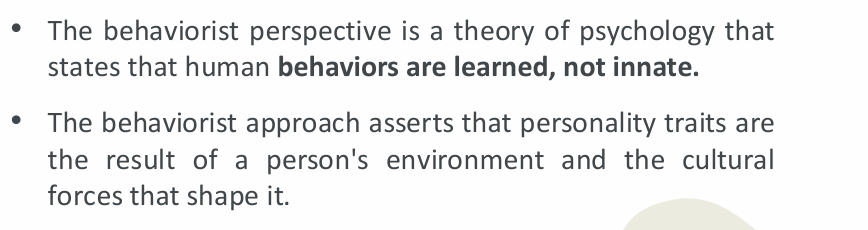
tabula rasa (blank slate)
WHEN BORN OUR MIND IS
learned from environment
according to the behaviorist perspective, behavior is
stimulus-response(S-R)
Behavior is the result of this according to the behaviorist perspective
science
psychology should be seen as
THORNDIKE’S LAW OF EFFECT (1898)
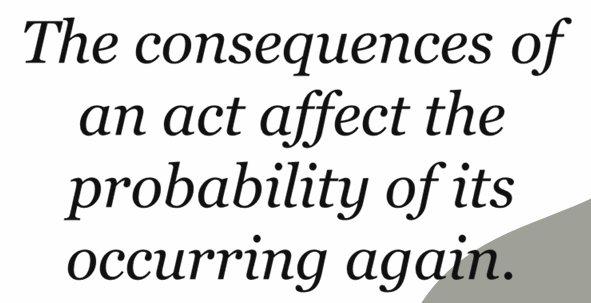
According to this principle, behavior that is followed by pleasant consequences is likely to be repeated, and behavior followed by unpleasant consequences is less likely to be repeated
OPERANT CONDITIONING
is a method of learning that occurs through reinforcements/rewards and punishments for behavior
an individual makes an association between a particular behavior and a consequence(Skinner,1938)
reinforcement, punishment, and extinction
CATEGORIES OF REINFORCEMENT
positive and negative reinforcement
categories of reinforcement
positive and negative punishment
categories of punishment
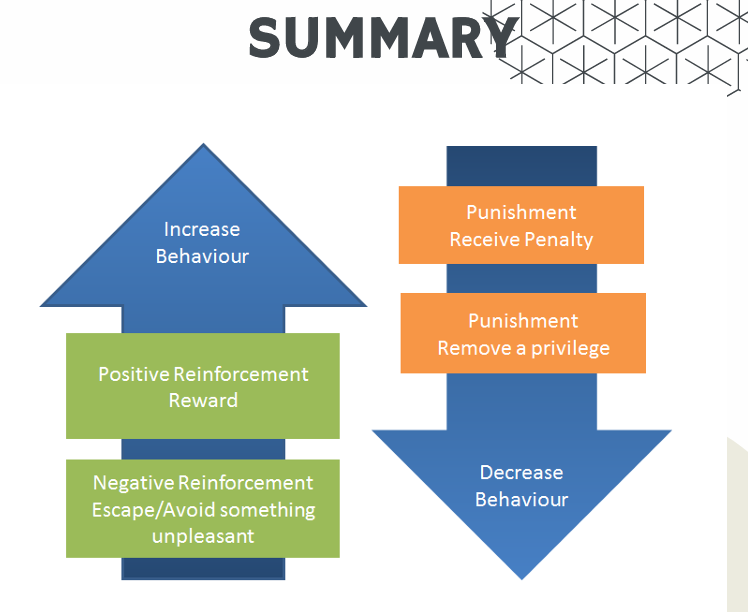
positive reinforcement
it strengthens a behavior by providing a consequence (an individual finds rewarding)
negative reinforcement
strengthens behavior because it stops or removes unpleasant experiences
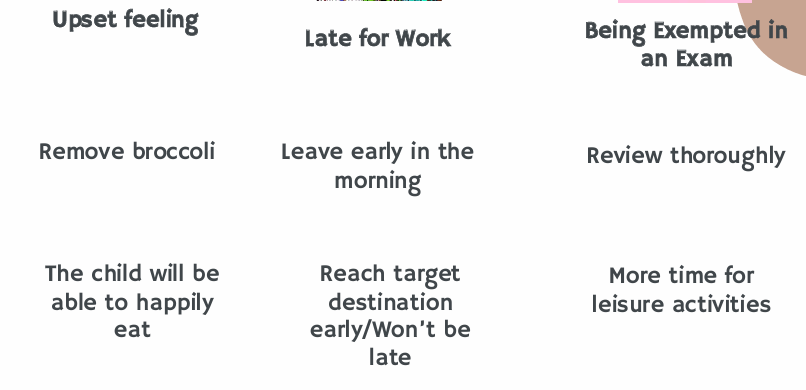
positive reinforcement
these are example of what type of reinforcement?
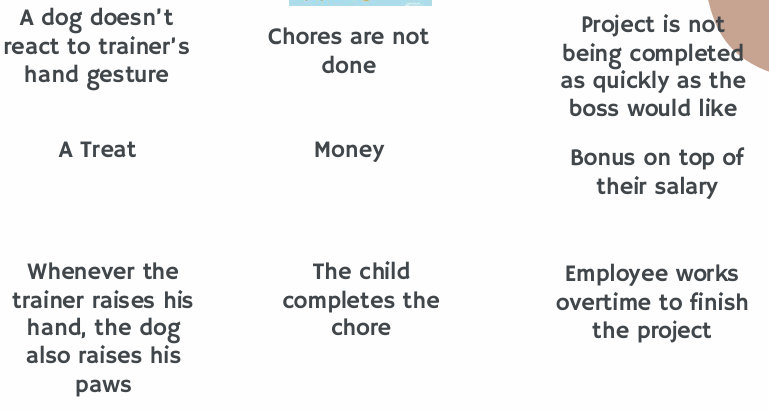
negative reinforcement
these are example of what type of reinforcement?
positive punishment
adding an undesirable stimulus to stop or decrease a behavior
negative punishment
taking away unpleasant stimulus to decrease or drop the stimulus
true
Fixed Ratio (FR), Fixed Interval (FI), Variable Ratio (VR), Variable Interval (VI)
schedule for reinforcements
Fixed Ratio (FR)
a response is reinforced only after a specified number of responses
Fixed Interval (FI)
where the first response is rewarded only after a specified amount of time has elapsed.
Variable Ratio (VR)
a response is reinforced after an unpredictable number of responses.
Variable Interval (VI)
a response is rewarded after an unpredictable amount of time has passed
extinction
Extinction is a process in which reinforcement that is provided for problem behavior is discontinued in order to decrease or eliminate the behavior
Burrhus Frederic Skinner