ch4 qs
 Call Kai
 Learn
Learn Practice Test
 Spaced Repetition
 Match
Match Flashcards
 Knowt Play
1/48

There's no tags or description
Looks like no tags are added yet.
Name | Mastery | Learn | Test | Matching | Spaced | Call with Kai |
|---|
No analytics yet
Send a link to your students to track their progress
49 Terms
Glucose is a 6-carbon carbohydrate (sugar) with the chemical formula C6H12O6. The bonds in this molecule represent chemical energy. Which of the following is correct about these bonds?
A) It will take an input of energy from the environment to cause the bonds to break
B) The energy stored in these bonds will be released as heat when the bonds break
C) The energy stored in these bonds will cause them to spontaneously break on their own
A (Bonds form between atoms because it is energetically favorable for them to do so, resulting in greater stability. It therefore takes an input of energy to break the bonds and drive the atoms back to their less energetically stable states.)
Carbon (C) and hydrogen (H) exhibit very similar electronegativities. When carbon and hydrogen share electrons, what kind of C-H bond results?
A) Polar covalent, with the electrons generally remaining closer to the hydrogen on average
B) Nonpolar covalent, with the electrons remaining equally distant from carbon and hydrogen on average
C) Polar covalent, with the electrons generally remaining closer to the carbon on average
B (Because their electronegativities are similar, the shared electron will have no tendency to remain closer to one over the other, resulting in equal sharing between them.)
Oxygen is the second most electronegative element, behind only fluorine in its tendency to pull electrons close to its nucleus. When oxygen (O) shares electrons with hydrogen (H), will the resulting O-H covalent bond be polar or nonpolar?
A) Nonpolar, with the electrons remaining equally distant from oxygen and hydrogen on average
B) Polar, with the electrons generally remaining closer to the oxygen on average
C) Polar, with the electrons generally remaining closer to the hydrogen on average
B (Because oxygen is much more electronegative than hydrogen, the shared electrons will generally be pulled more tightly toward the nucleus of the oxygen, resulting in a polar bond.)
Which of the following is correct about the charge distribution of C-H or O-H pairings?
a. The O carries a partial negative charge in the O-H pair
b. The C carries a partial positive charge in the C-H pair
c. The O carries a partial positive charge in the O-H pair
d. The C carries a partial negative charge in the C-H pair
a (Carbon and hydrogen have similar electronegativities, so they share the electrons equally. Oxygen is far more electronegative than either C or H, so it will tend to “hog” any electrons it shares with them, giving it a partial negative charge.)
Which covalent bond is more energetically favorable (stable): C-H or O-H?
O-H (O-H is more stable because it is polar: the shared electrons are able to get closer to the nucleus of the more electronegative O than they can to either the C or H in the nonpolar C-H bond.)
The biomolecules of living things are organic molecules, meaning they have carbon backbones that are rich in C-C and C-H bonds. Oxygen in the air occurs as O2, which is formed by a double covalent bond between two oxygen atoms (O=O). Which of the following is correct about these bonds?
A) C-C and C-H are nonpolar, whereas O=O is polar
b) C-C, C-H, and O=O are all nonpolar bonds
c) C-C is nonpolar, whereas C-H and O=O are polar
d) C-C, C-H, and O=O are all polar bonds
b (In each case the pairings are between atoms with either identical or very similar electronegativities, and therefore the pulling of electrons toward their nuclei is the same.)
Suppose that some organic molecules are mixed with atmospheric oxygen, O2. Which of the following would result in the most energetically favorable (lowest energy, most stable) chemical outcome?
a. The atoms of the organic molecules and oxygen separate so they are no longer bound to any other atoms
b. The atoms of the organic molecules and oxygen rearrange to form pure carbon (C-C), hydrogen (H-H), and oxygen (O-O)
c. The atoms of the organic molecules and oxygen rearrange to form CO2 and H2O
d. The organic molecules and oxygen molecules stay as they are: the system is already in its most energetically favorable arrangement
b (It’s more energetically favorable for the atoms to rearrange from the nonpolar C-C, C-H, and O=O bonds of the reactants into the highly polar bonds of CO₂ & H₂O with the energy difference being released as heat and/or light. This is what fire is!)
The 6-carbon sugar glucose, C6H12O6, is a fundamental source of energy for living things. When hit with a sufficient spark of energy to break its bonds, glucose can react with oxygen in the air and burn, recombining with the oxygen to form carbon dioxide CO2 and water H2O while releasing energy as heat and light in the exchange:
C6H12O6+ 6 O2 → 6 CO2 + 6 H2O + energy
Why is energy released as a byproduct of this reaction?
a. Because energy is released whenever bonds are broken
b. Because the polar bonds of carbon dioxide and water are more energetically favorable than the nonpolar bonds of glucose and oxygen
b (Energy is always absorbed by molecules to break bonds, and released from molecules when they form bonds. In this case, the amount of energy released from the newly formed bonds is greater than the amount it took to break the old bonds.)
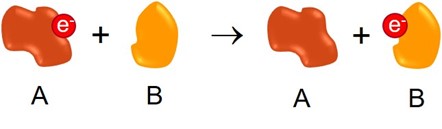
Redox reactions involve electrons moving from one atom or molecule to another. Consider the example below, in which the transferred electrons are represented as an e-. Which of the reactants is oxidized in this reaction, and which is reduced?
a. Molecule A is reduced in this reaction, while molecule B is oxidized
b Both molecules A and B are oxidized in this reaction
c. Molecule A is oxidized in this reaction, while molecule B is reduced
d. Both molecules A and B are reduced in this reaction
c (In this reaction, the electrons transfer from molecule A to B. Molecule A thus loses the electrons = is oxidized, while molecule B gains them = is reduced.)
The 6-carbon sugar glucose, C6H12O6, is a fundamental source of energy for living things Consider the burning of glucose to release energy:
C6H12O6 + 6O2-> 6 CO2 + 6 H2O + energy
This is a redox reaction that cells do to get energy out of sugar, but capturing and using it rather than letting it escape as fire (light and heat). Which of the reactants is oxidized in this reaction, and which is reduced?
a. The glucose is reduced in this reaction, while oxygen is oxidized
b. Both the glucose and oxygen are oxidized in this reaction
c. Both the glucose and oxygen are reduced in this reaction
d. The glucose is oxidized in this reaction, while the oxygen is reduced
d (Yes, in this case the glucose is the electron donor and the oxygen is the electron acceptor: the C6H12O6 is oxidized to CO2, while the O2 is reduced to H2O.)
Glycolysis uses a series of chemical rearrangements to ultimately move some of the chemical energy stored within the nonpolar bonds of glucose into a highly unstable bond within ATP instead. Glycolysis is able to produce a net profit of only 2 ATP molecules for every glucose molecule that is split.
Glycolysis is always an example of which of the following?
a. Phototrophy
b. Chemotrophy
c. Autotrophy
d. Heterotrophy
b (Glycolysis produces energy (ATP) from a chemical (glucose)= chemotrophy.)
An organism produces all of its energy by glycolysis with fermentation. Is this energy production aerobic or anaerobic?
anaerobic (Glycolysis and fermentation do not require oxygen (O2), so they are considered anaerobic processes.)
Is energy production by glycolysis with fermentation an example of anaerobic respiration?
no (glycolysis and fermentation are anaerobic processes, but they are not anaerobic respiration since they do not generate any ATP via an electron transport system / chemiosmosis.)
A certain organism generates ATP via an electron transport system. Which of the following must be correct about this organism?
a. It generates all of its ATP via chemiosmosis
b. It generates most of its ATP via chemiosmosis
c. It is phototrophic
d. It generates all of its ATP via substrate level phosphorylation
e. It generates most of its ATP via substrate level phosphorylation
f. It is chemotrophic
g. It is heterotrophic
h. It is autotrophic
b (Electron transport systems occur across all kinds of feeders, and organisms that use them still produce some of their ATP via substrate level phosphorylation, but will supply much more through chemiosmosis.)
Strips electrons out of water, generating O2
oxygenic photophosphorylation
(which two energy processes) Puts electrons from sugar into NAD+ thus generating NADH
glycolysis and TCA cycle
Transfers electrons from NADH into some other molecule for the sole purpose of recycling NAD+
fermentation
Drops electrons from an electron transport system into oxygen, generating H2O
aerobic cell resp
Drops electrons from an electron transport system into some chemical compound in the environment other than oxygen
anaerobic cell resp
Strips electrons out of some chemical compound in the environment other than water
anoxygenic photophosphorylation
Generates a net profit of 2 ATP and 2 NADH from one molecule of glucose
glycolysis
Utilizes chemiosmosis via an electron transport system
Both photophosphorylation (almost always) and cellular respiration (always)
Do all forms of cellular respiration involve an electron transport system?
yes (Cellular respiration generates ATP from a reduced source (usually sugar) by the electron transport scheme of oxidative phosphorylation, by definition. Therefore all forms of cellular respiration—whether aerobic or anaerobic—have this in common.)
The purple bacteria, green bacteria, heliobacteria, and halobacteria are all phototrophic. The purple and green bacteria are photosynthetic, whereas the heliobacteria and halobacteria are not. Which of the following is correct about these organisms?
a. All of these organisms are photoheterotrophs
b. All of these organisms are autotrophic
c. All of these organisms are eukaryotes
d. None of these organisms produce oxygen during their phototrophy
e. None of these organisms can use the light energy to fix their own carbon
d (Only the cyanobacteria ever evolved oxygenic phototrophy, and the eukaryotes then took it from them. So these are the only two groups that have it, any other kind of phototrophic organism must be anoxygenic.)
Do all forms of phototrophy utilize an electron transport system?
no (Phototrophy is a general term for the use of energy from light to generate ATP, regardless of how. While all oxygenic and most anoxygenic phototrophs use an electron transport system for this, the halobacteria are a remarkable exception.)
The eukaryotic domain of life is mainly dependent on which TWO kinds of energy pathways, as brought in by their original bacterial endosymbionts?
a. Anaerobic respiration
b. Aerobic respiration
c. Oxygenic photophosphorylation
d. Anoxygenic photophosphorylation
b, c (The eukaryotic domain was built on the two most productive energy harvesting pathways, both of which deal in oxygen (either consuming or producing it). Eukaryotes have leveraged these into larger and more complex cells and even multicellularity.)
Water is formed from two hydrogen atoms covalently bonded to an oxygen atom. Which of the following is correct about this arrangement?
a. The oxygen and hydrogens share the electrons unequally, with the electrons being more hogged by the oxygen
b. The oxygen and hydrogens share the electrons unequally, with the electrons being more hogged by the hydrogens
c. The oxygen and hydrogens share the electrons about equally between them
a (Oxygen is much more electronegative than hydrogen (and is actually more electronegative than every element but fluorine). Water molecules are polar because their electrons are held more tightly to the oxygen side.)
Hydrogen bonding between water molecules is responsible for which of the following of water’s properties? Select all that apply.
a. Water has a high specific heat (resists temperature change)
b. Water floats when frozen (is less dense as ice)
c. Water acts as both an acid and a base (can donate or accept a proton)
d. Water is cohesive (sticks together)
a, b, d (Water’s tendency to donate protons is not directly a consequence of its tendency to stick together, but its other key properties are.)
What would happen if water did NOT become less dense as it freezes?
a. Organisms’ bodies would become heavier in winter (sink to the bottom of an aquatic habitat, or just be more difficult to support and move)
b. Any cells that got cold enough would experience extreme damage from shrinkage
c. Aquatic habitats would freeze solid in winter
d. Any cells that froze in winter would sink (either to the bottom of their aquatic habitat for a unicellular organism, or through surrounding cells in a multicellular organism)
c (Water bodies gain and lose heat mainly at the surface, where they interact with the sun and atmosphere. If the water at the surface were to sink instead of float after freezing, entire large bodies of water could freeze solid)
Which of the following statements about energy is correct?
a. Temperature is a measure of random kinetic energy.
b. Heat cannot be transferred from one thing to another.
c. Kinetic energy is the energy associated with light.
d. Heat is taken up from the surrounding environment whenever atoms form chemical bonds.
a
Which of the following statements about atoms is correct?
a. Atoms are more stable when the number of electrons circling them are in balance with the number of protons in their nucleus, or are able to position farther away from them.
b. Atoms that have more electrons than protons are cations.
c. Electrons project an electric field that attracts negative charges.
d. The ion H+ consists of just a single proton with no electrons.
d
What is a polar covalent bond?
a. A bond that forms because of the attraction between two ions (charged atoms or molecules)
b. A bond that forms between atoms when they share electrons unequally
c. A bond that forms between polar molecules
d. A bond that forms between atoms when they share electrons equally
b
Which of the following is correct about various compounds?
a. A salt is a compound that forms because of the attraction between ions.
b. The bond that forms between oxygen and hydrogen is nonpolar.
c. Redox reactions take up more energy than they release.
d. Redox reactions cause all of the participants in the reaction to be oxidized.
a
Which of these statements is correct about metabolism?
a. An organism’s metabolism is the speed at which its biochemical machinery operates.
b. ATP is the energy currency of the cell, in that it delivers energy directly to many chemical reactions in order make them go.
c. Enzymes act to slow the rates of biochemical reactions inside cells so that they do not occur too rapidly.
d. The hydrolysis of ATP absorbs more energy than it releases.
b
Which of these is NOT an organic molecule?
a. Carbohydrate
b. Lipid
c. Carbon dioxide
d. Protein
c
Which of these statements is correct?
a. Energy is released from ADP when a phosphate group is added to it to form ATP.
b. Molecules are generally more energetically stable the more electrons they have around their atoms.
c. Oxidative phosphorylation utilizes an electron transport system to produce ATP.
d. Substrate-level phosphorylation pathways generally yield more ATP than do chemiosmotic pathways.
c
Which of the following is an example of anaerobic respiration?
a. An organism generates ATP by extracting electrons from methane and passing them into sulfate via an electron transport chain
b. An organism generates ATP by substrate-level phosphorylation
c. An organism utilizes fermentation to recycle electrons
d. An organism generates ATP by exciting electrons from chlorophyll and passing them into an electron transport chain
a
Which of the following is correct about oxygenic phototrophy?
a. It only ever evolved once on Earth, specifically in the cyanobacteria
b. It utilizes electrons stripped from carbon dioxide
c. It occurs in all three domains of life
d. It occurs in the archaea and bacteria, but not the eukarya
a
Which of the following statements is correct regarding the energy pathways of living things?
a. Some forms of anaerobic respiration yield more ATP per sugar molecule than does aerobic respiration.
b. Both oxygenic and anoxygenic phototrophy occur in the eukaryotic domain of life.
c. Aerobic respiration involves stripping electrons from oxygen and passing them through an electron transport system.
d. Electrons are stripped from water during oxygenic phototrophy.
d
Which of the following statements is true?
a. Proteins are not a source of energy for heterotrophs.
b. A proton motive force powers the production of ATP during anaerobic respiration.
c. Chlorophyll plays an important role in glycolysis.
d. Electrons are excited from bacteriorhodopsin by photons of light.
b
Which of the following statements is correct about various metabolic processes?
a. Methanotrophy involves using methane as a terminal electron acceptor.
b. Denitrification involves the production of nitrate (NO3-) from nitrogen gas (N2).
c. Without photosynthesis, there would be no life on Earth.
d. Organisms capable of fixing carbon are found among all three domains of life.
d
The evolution of which metabolic pathway almost wiped out life on Earth at the time?
a. Nitrogen fixation
b. Oxygenic photosynthesis
c. Methanogenesis
d. Fermentation
e. Methanotrophy
b
Why did the evolution of the hinged jaw result in a burst of evolution in animals?
a. Because chewing of food greatly reduced the energy required to release chemicals from it during digestion
b. Because being able to forcefully open and close the mouth made it easier to acquire food in large amounts from a wider variety of sources
c. Because being able to close the mouth reduced problems with the gut being invaded by disease-causing pathogens and nutrient-stealing parasites
d. Because being able to change the shape of the mouth opened new avenues of communication between animals, both visual and in terms of the sounds that could be produced
b
Which of the following statements is correct?
a. Ionic bonds dissociate more easily than covalent bonds in water.
b. Hydrogen bonding is generally stronger between less polar molecules.
c. Covalent bonds must be broken for water to evaporate.
d. Carbon dioxide is a polar molecule.
a
Which of the following is part of the reason why water is polar?
a. Because water molecules are hydrophobic
b. Because water molecules have a "bent" geometry
c. Because water molecules can react with each other
d. Because water molecules exhibit hydrogen bonding
b
Which of the following is correct regarding a molecule of water, H2O?
a. One of the hydrogens in the molecule carries a partial positive charge, while the other carries a partial negative charge.
b. The molecule can either donate or accept a proton.
c. The hydrogen and oxygen atoms within the molecule are connected by ionic bonds.
d. Electrons within the molecule are more strongly attracted to the hydrogens than to the oxygen.
b
Which of the following is correct about water?
a. Water is cohesive because of covalent bonds that form between water molecules.
b. Ice floats because of ionic attraction between the ice and surrounding liquid water.
c. Higher amounts of water in a system tend to result in greater temperature swings within the system.
d. Water tends to turn into ice when hydrogen bonds form but do not break again.
d
Which of the following properties of water is NOT due to hydrogen bonding?
a. Its high heat capacity
b. Its ability to mediate acid-base reactions
c. Its cohesiveness
d. Its ability to dissolve salts
b
Identify the hydronium ion.
a. OH-
b. H2O2
c. H+
d. H3O+
d