Social change
 Call Kai
 Learn
Learn Practice Test
 Spaced Repetition
 Match
Match Flashcards
 Knowt Play
1/20

There's no tags or description
Looks like no tags are added yet.
Name | Mastery | Learn | Test | Matching | Spaced | Call with Kai | Chat |
|---|
No analytics yet
Send a link to your students to track their progress
21 Terms
What are the 6 stages in the process of social change?
Drawing attention
Consistency
Deeper processing
Augmentation principle
Snowball effect
Social cryptoamnesia
How to remember → Don’t Care Deeply About Social Systems
How do minority groups draw attention?
By providing social proof of the problem (e.g. protests & marches)
How do minority groups show consistency?
The message provided within marches & protests is displayed consistently & shows the intent
How can minority groups lead to deeper processing?
People who have previously accepted the status quo begin to think about the unjustness of the situation
How do minority groups demonstrate the augmentation principle?
People risk their lives or show personal sacrifice in favour of the cause (e.g. by being arrested, going on hunger strikes or even dying)
How do minority groups demonstrate the snowball effect?
More & more people begin to change their views & eventually, the minority view becomes the majority view
How does the process of social change result in social cryptoamnesia?
People have a memory that change has occurred but don’t remember how it happened (they don’t consciously think about it)
What is an example of social change in the real world?
The Suffragettes
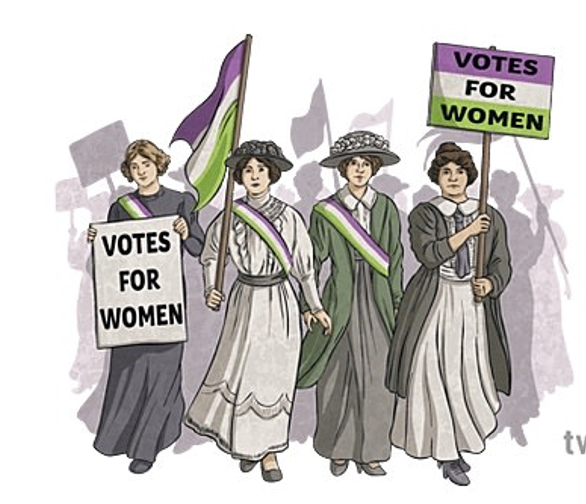
How did the Suffragettes draw attention?
Organised protests & marches
How did the Suffragettes demonstrate consistency?
They wore purple, white & green & made badges/sashes with “Votes for Women” displayed on them
How did deeper processing occur with the Suffragettes?
Several Bills in favour won support in Parliament (but not enough)
How did the Suffragettes demonstrate the augmentation principle?
They began breaking windows, planting bombs, handcuffing themselves to railings, went on hunger strikes & were arrested
Emily Davison stepped in front of a horse & was killed
How did the Suffragettes demonstrate the snowball effect?
1918: bill was passed that allowed some women the right to vote
1928: women received equal suffrage with men
How is social cryptoamnesia demonstrated with the Suffragettes?
Today, women over the age of 18 can vote but many rarely think about what happened through the Suffragette movement to allow this
How is social change related to conformity?
Campaigners draw upon normative social influence (NSI)
How is social change related to obedience?
Gradual commitment takes place
Which explanation for conformity is most associated with the process of social change?
Normative social influence (NSI)
Discuss the role of social influence processes in social change (16 marks)
Write your AO1 paragraph
Social change occurs when whole societies (rather than just individuals) adopt new attitudes, beliefs & behaviours. Minorities can trigger this through a 6-stage process.
Firstly, minorities draw attention by providing social proof of the problem (e.g. the Suffragettes organised protests & marches). Secondly, they show consistency of the message & intent (e.g. Suffragettes wore purple, white & green, as well as badges/sashes with ‘Votes for Women’).
Thirdly, deeper processing of the issue occurs as the majority begin to think about the unjustness of the situation (e.g. several bills in favour of Suffragettes were won in Parliament). Fourthly, the augmentation principle - the minority risk their lives or show personal sacrifice (e.g. Emily Davison stepped in front of the King’s horse & died).
Next, is the snowball effect, which refers to when the minority view eventually becomes the majority view (e.g. in 1918, a bill was passed that allowed some women to vote & in 1920, women received equal suffrage with men). Finally, social cryptoamnesia - people remember that social change has occurred but don’t remember how it happened (e.g. today, women over age 18 can vote but many rarely think about what happened through the Suffragette movement to allow this).
Discuss the role of social influence processes in social change (16 marks)
Write your strength AO3 PEEL (real world application)
Point: One strength of research into minority influence & social change is that it can explain various historical events & how these have influenced modern-day society.
Evidence: For example, psychological theory can be applied to the Suffragettes & how they contributed towards a process of social change where today, women over the age of 18 have the right to vote.
Explain: By consistently protesting for women’s rights, they drew attention to their cause & encouraged the majority to take it seriously. Many also showed personal sacrifice, including imprisonment & hunger strikes (augmentation principle).
Link: Therefore, this shows that the psychological theory not only has high theoretical value but also high practical value.
Discuss the role of social influence processes in social change (16 marks)
Write your strength AO3 PEEL (Nolan et al.)
Point: One strength of research into minority influence & social change is there is research evidence to support NSI in social change.
Evidence: For example, Nolan et al. aimed to see if they could change residents’ energy usage in San Diego by hanging messages on the front doors of houses (every week for a month) saying most people were trying to reduce their energy usage. A control group also received these messages, but no reference was made to the behaviour of others.
Explain: Results found significant decreases in energy usage in the experimental, compared to the control group.
Link: Overall, this suggests that conformity can lead to social change through NSI, as residents changed their behaviour to fit in with what they believed the majority were doing.
Discuss the role of social influence processes in social change (16 marks)
Write your limitation AO3 PEEL (Maass et al.)
Point: One limitation of research into minority influence & social change is that it may require the minority group to be similar to the majority for it to occur (e.g. age, gender, class or sexuality).
Evidence: For example, Maass et al. investigated the idea of group membership & found that a minority of heterosexual men were more likely to convince a heterosexual majority about gay rights, than a minority of homosexual men.
Explain: This suggests that straight men have more persuasive power when discussing gay rights with other straight men, compared to gay men.
Link: Therefore, this supports the idea that similarity in terms of group membership is an important factor for minority influence & social change to occur.