child development - chapter 7
0.0(0)
Studied by 2 people Call Kai
 Learn
Learn Practice Test
 Spaced Repetition
 Match
Match Flashcards
 Knowt Play
Card Sorting
1/26

Earn XP
Description and Tags
Last updated 6:26 PM on 3/7/23
Name | Mastery | Learn | Test | Matching | Spaced | Call with Kai | Chat |
|---|
No analytics yet
Send a link to your students to track their progress
27 Terms
1
New cards
memory during infancy…
* during infancy, memory improves as a result of development of:
* a) hippocampus (formation of memories)
* b) prefrontal cortex (retrieval of memories)
* a) hippocampus (formation of memories)
* b) prefrontal cortex (retrieval of memories)
2
New cards
memory during infancy: Rovee-Collier (1995)
* infants learned to move mobile by kicking leg
* returned several days later
* 3 month olds remembered kicking responses > 1 week later
* 2-4 weeks later: forgot, but remembered when given a cue
* returned several days later
* 3 month olds remembered kicking responses > 1 week later
* 2-4 weeks later: forgot, but remembered when given a cue
3
New cards
encoding
* the process of information into the memory system
4
New cards
storage
* the retention of recorded information over time
5
New cards
retrieval
* the process of getting information out of memory storage
6
New cards
maintenance rehearsal (aka “rote learning”)
* mechanical procedure
* children do this by age 7-8
* children do this by age 7-8
7
New cards
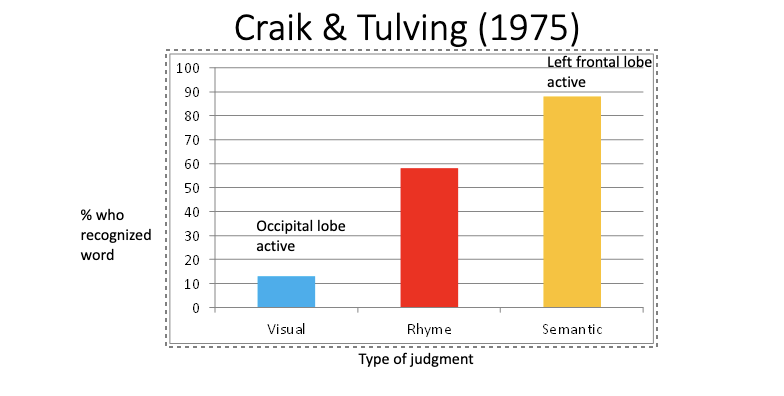
elaborative encoding
* the process of actively relating new information to knowledge that is already in memory
* deep processing promotes memory
* e.g., Craik and Tulving (1975)
* Ps presented with words, asked to make 1 of 3 types of judgments
* 1. visual (e.g., is it written in uppercase letters?)
* 2. rhyme (e.g., does it rhyme with cat?)
* 3. semantic (e.g., is it something you can wear?)
* deep processing promotes memory
* e.g., Craik and Tulving (1975)
* Ps presented with words, asked to make 1 of 3 types of judgments
* 1. visual (e.g., is it written in uppercase letters?)
* 2. rhyme (e.g., does it rhyme with cat?)
* 3. semantic (e.g., is it something you can wear?)
8
New cards
Stein et al. (1982)
* Ps were univ. students (academically successful vs. less successful)
* presented with sentences
* e.g., “the hungry man got into his car…”
* task: write continuations
* stronger students made precise elaborations:
* e.g., “… to go to McDonald’s”
* and were better able to recall them
* presented with sentences
* e.g., “the hungry man got into his car…”
* task: write continuations
* stronger students made precise elaborations:
* e.g., “… to go to McDonald’s”
* and were better able to recall them
9
New cards
organization…
* categorizing info according to the relationships among a series of items
* when relationships are obvious
* e.g., animals, fruits, furniture
* when relationships are obvious
* e.g., animals, fruits, furniture
10
New cards
chunks
* chunking easier when we have expertise in a domain
* most people age 7+ can hold about 7 (+ or -2) items in working memory
* 7 numbers
* 7 letters
* 7 “chunks”
* in general, memory span corresponds with age up to 7
* most people age 7+ can hold about 7 (+ or -2) items in working memory
* 7 numbers
* 7 letters
* 7 “chunks”
* in general, memory span corresponds with age up to 7
11
New cards
superimposed meaningful structure…
* mnemonics - used to aid memory via organization
* e.g., memorizing lines on bass clef
* George Bell Died Friday Afternoon
* e.g., Never Eat Soggy Watermelon
* used to remember direction
* e.g., memorizing lines on bass clef
* George Bell Died Friday Afternoon
* e.g., Never Eat Soggy Watermelon
* used to remember direction
12
New cards
verbal mediator
* involves making an association (“bridge”) between two ideas
* e.g., “hippocampus” \[picture a hippo on campus\]
* e.g., “hippocampus” \[picture a hippo on campus\]
13
New cards
method of loci
* mnemonic technique based on places and images
* e.g., imagine 10 rooms in a house (and place items to remember in each room)
* e.g., imagine 10 rooms in a house (and place items to remember in each room)
14
New cards
autobiographical memory (AM)
* memory for specific experiences from our life, including self-related knowledge (semantic) and memory for events (episodic)
* multidimensional
* prone to distortions / errors over time
* multidimensional
* prone to distortions / errors over time
15
New cards
AM: forgetting
* fuzzy trace theory (Reyna & Brainerd)
* explains how false memories can occur
* remembering involves two things;
* 1. a “gist” memory trace (the meaning of an experience)
* 2. a “verbatim” memory trace (memory of specific details)
* fuzzy trace theory
* these gist and verbatim memories are believed to be stored and recalled separately
* therefore, prone to confusion (if one trace is strong, and the other is weak)
* explains how false memories can occur
* remembering involves two things;
* 1. a “gist” memory trace (the meaning of an experience)
* 2. a “verbatim” memory trace (memory of specific details)
* fuzzy trace theory
* these gist and verbatim memories are believed to be stored and recalled separately
* therefore, prone to confusion (if one trace is strong, and the other is weak)
16
New cards
infantile amnesia…
* try to recall your earliest autobiographical memory
* adults unable to recall events from before approx. age 3
* reason: hippocampus and areas of frontal lobe not fully developed
* adults unable to recall events from before approx. age 3
* reason: hippocampus and areas of frontal lobe not fully developed
17
New cards
suggestibility & false memories
* false memories for entire episodes can be implanted in people’s minds
* e.g., Wade et al. (2002)
* showed Ps photoshopped picture of hot air ballon (with them and relative in it)
* 50% of Ps later recalled fictitious ride
* e.g., Wade et al. (2002)
* showed Ps photoshopped picture of hot air ballon (with them and relative in it)
* 50% of Ps later recalled fictitious ride
18
New cards
Ceci & Crotteau Huffman (1997)
* “mouse-trap” study
* study involved 3-6 year olds
* after 10 weekly interviews, 50% of 3-4 year olds, 40% of 5-6 year olds recalled fictional event (finger being caught in mouse-trap)
* study involved 3-6 year olds
* after 10 weekly interviews, 50% of 3-4 year olds, 40% of 5-6 year olds recalled fictional event (finger being caught in mouse-trap)
19
New cards
younger children have higher suggestibility than older children & adults…
* implication: officials need to be careful when interviewing child witnesses
* esp. suggestible when:
* asked specific questions
* questions are repeated
* interviewer provides info. before child has supplied info.
* interviewer is of high status
* esp. suggestible when:
* asked specific questions
* questions are repeated
* interviewer provides info. before child has supplied info.
* interviewer is of high status
20
New cards
problem solving…
* at every age, we face problems (of varying complexity)
* e.g.,
* age, 3: how do I reach those cupcakes?
* e.g.,
* age, 6: what moves do I have to make to win this game?
* e.g.,
* age, 16: how do I sneak out of the house undetected to get to the party?
* e.g.,
* age, 3: how do I reach those cupcakes?
* e.g.,
* age, 6: what moves do I have to make to win this game?
* e.g.,
* age, 16: how do I sneak out of the house undetected to get to the party?
21
New cards
problem
* obstacle between present state and goal
22
New cards
problem solving
* active efforts to discover what must be done to overcome obstacle and achieve goal
23
New cards
problem solving encoding
* forming mental representation of problem
24
New cards
problems of transformation
* carry out sequence of transformation to reach a specific goal
* initial state (knowledge at outset)
* operators (actions that change your state)
* goal state (solution)
* path constraints (limitations that rule out certain solutions)
* e.g., In this problem, you’re a farmer who needs to get a fox, a chicken, and a bag of corn to the other side of the river in a boat. There are several path constraints in this problem. First, you can only take one item at a time in the boat. Second, you can’t leave the fox alone with the chicken as the fox will eat it! And third, you can’t leave the chicken alone with the corn, as the chicken will eat the corn. What would be the first action (operator) to take in this situation?
* initial state (knowledge at outset)
* operators (actions that change your state)
* goal state (solution)
* path constraints (limitations that rule out certain solutions)
* e.g., In this problem, you’re a farmer who needs to get a fox, a chicken, and a bag of corn to the other side of the river in a boat. There are several path constraints in this problem. First, you can only take one item at a time in the boat. Second, you can’t leave the fox alone with the chicken as the fox will eat it! And third, you can’t leave the chicken alone with the corn, as the chicken will eat the corn. What would be the first action (operator) to take in this situation?
25
New cards
tower of Hanoi problem…
* often solved using a means-end analysis
* goal is to reduce the difference between the initial and goal states
* set up series of subgoals
* e.g., free up largest disc, move to right peg
* goal is to reduce the difference between the initial and goal states
* set up series of subgoals
* e.g., free up largest disc, move to right peg
26
New cards
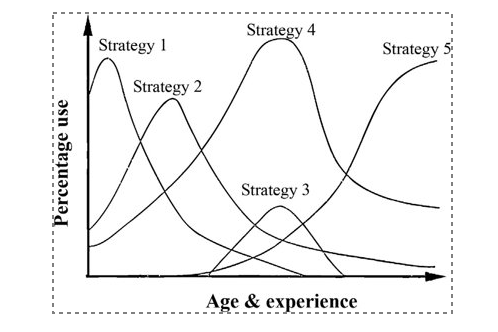
use of various strategies…
* Siegler’s overlapping waves model of strategy use
* E.g., 4 + 7
* Strategy 1: count all numbers (“1, 2, 3, … 11”)
* Strategy 2: start at 4 (“4, 5, … 11”)
* Strategy 3: start at higher number (“7, 8, … 11”)
* Strategy 4: retrieve answer from memory (11)
* E.g., 4 + 7
* Strategy 1: count all numbers (“1, 2, 3, … 11”)
* Strategy 2: start at 4 (“4, 5, … 11”)
* Strategy 3: start at higher number (“7, 8, … 11”)
* Strategy 4: retrieve answer from memory (11)
27
New cards
Limitations to children’s problem solving…
1. over-reliance on heuristics
* e.g., “only take steps that move you closer to goal”
* to solve lilies on pond problem, have to start at the end and work backwards
2. problems with planning
* overoptimism
* difficulty inhibiting desire to solve problems immediately
\