Week 1
 Call Kai
 Learn
Learn Practice Test
 Spaced Repetition
 Match
Match Flashcards
 Knowt Play
1/65

There's no tags or description
Looks like no tags are added yet.
Name | Mastery | Learn | Test | Matching | Spaced | Call with Kai | Chat |
|---|
No analytics yet
Send a link to your students to track their progress
66 Terms
Assumptions in Capital Budgeting
-Accounting profits equal cash flows
- Asset is depreciated straight line over project’s life
-All cash flows occur at end of year
NPV cash flow formula picture
.
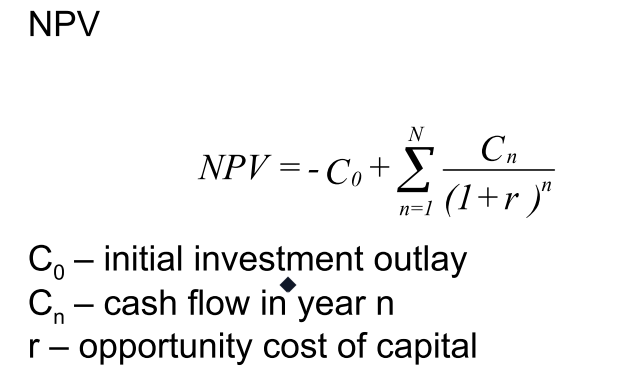
What does r stand for in NPV formula?
Discount rate/required rate of return
What does Time Value of Money allow?
Future values to be discounted( translated into today's money) at the required rate of return subtracting the initial investment
What is the generalised formula for NPV?
- initial investment + cash flows discounted
If NPV is more than 0 is it worth pursuing?
Yes as it is profitable
If comparing two Positive NPVs which is preferred?
The highest positive NPV
In a mutually exclusive project which is prioritized higher NPV or higher IRR?
Higher NPV
What is Payback period?
How long it takes a company to recover its initial investment
If an investment takes longer for it to be paid back what does this mean?
It is more risky
What does a positive NPV mean for IRR?
IRR is higher than cost of capital/discount rate
What does a negative NPV mean for IRR?
IRR is lower than capital/discount rate
What should you do for residual value in last year of cash flow?
Add it to the last year of cash flow
Differentiation of accounting vs finance profit from cash flows?
Accounting focus on periodic performance versus finance focus on cash coming in and cash going out
What do accounts focus on then just cash?
Money earned over cash so we need to adjust accounting profits to calculate actual operating cash flows
Is tax depreciation = accounting depreciation?
No
When is tax paid for “small” companies?
9 months after year-end
When is tax paid for “large” companies?
Quarterly basis
Common assumption in capital budgeting?
Tax is paid in year during which it arises or one year later
What is straight line depreciation?
An expense spread out evenly over the assets useful life
Formula for straight line depreciation?
1/useful life in years * (asset cost- residual value)
Example question
Moga’s toy manufacturing is considering the purchase of a new machine facility for £120,000. The facility is to be fully depreciated on a straight-line basis for tax and accounting purposes over its expected 6 year useful life and will have no resale value in year 6. Assume tax is paid during the year in which it arises and the corporate tax rate is 30%.
• Operating revenues from the project are expected to be £50,000 in each year and production costs are expected to be £20,000 in each year. Should the company undertake the project if the opportunity cost of capital is 20%?
.
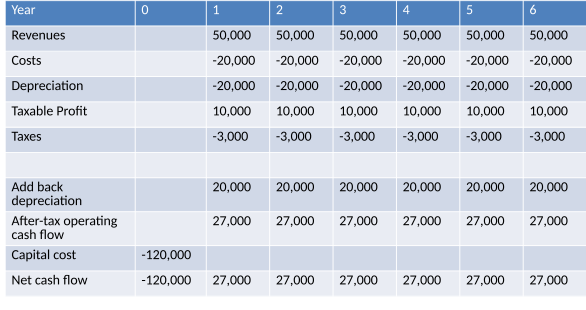
What is the 3 steps in capital budgeting?
-1.Calculate annual tax depreciation allowances
-2.Calculate accounting profit each year
-3.Calculate NPV
What is tax depreciation set by?
The government
Is tax depreciation a cash flow?
No
What is the tax depreciation?
-Tax depreciation (in our context) will be an annual accounting charge for using an asset
What is the final year charge in capital budgeting?
Difference between written down(machinery) value and resale value
How do you calculate annual profit?
Income statement
What is IRR?
Discount rate when NPV=0
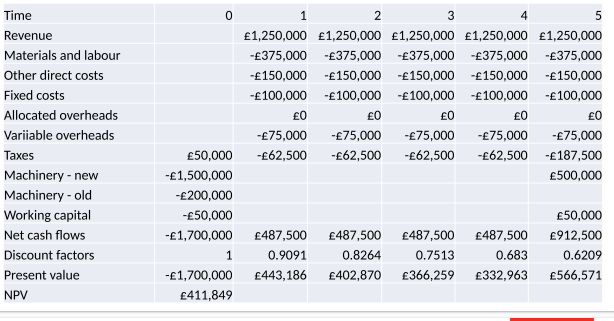
What is net cash flow for a project?
-After-tax cash flows from operations
-Cash flows from working capital
-Cash flows from investment
What does IRR have to be in comparison to discount rate r to make project worth pursuing?
IRR should be more
Cash flow schedule
.
What is a perpetuity?
An infinite stream of equal cash flows that occur at regular intervals and continue forever
Formula of a zero growth perpetuity?
Cash flow/ Discount rate ( C/r)
What is a growing perpetuity
An infinite stream of cash flows that continue forever, but increase by a constant percentage each period
Formula of a growing perpetuity
PV = C1 / r-g
C1 - The expected cash flow in the very next period (Year 1).
r - The discount rate, cost of capital, or required rate of return.
g - The constant growth rate at which the cash flow increases each year.