Chapter 1 Atoms
 Call Kai
 Learn
Learn Practice Test
 Spaced Repetition
 Match
Match Flashcards
 Knowt Play
1/35

There's no tags or description
Looks like no tags are added yet.
Name | Mastery | Learn | Test | Matching | Spaced | Call with Kai | Chat |
|---|
No analytics yet
Send a link to your students to track their progress
36 Terms
Chemistry
The study of the composition, properties, and interactions of matter
It is also interconnected to a lot of other stem disciplines
_____ is a science based on observation
Chemists
____ study and describe how he behavior of matter and energy in 3 different domains
1) macroscopic domain
2) microscopic domain
3) symbolic domain
Hypothesis
A tentative explanation of observations.
Matter
Anything that occupies space and has mass
Theory
A well-substantiated, comprehensive, testable
explanation of a particular aspect of nature
Macroscopic domain
The realm of everyday things that are large enough to be sensed directly by human sight or touch
Microscopic domain
Almost always visited in the imagination. Micro also comes from Greek and means “small.” Some aspects of the microscopic domains are visible through a microscope
Symbolic domain
the specialized language used to represent components of the macroscopic and microscopic domains, such as chemical symbols
Plasma
A gaseous state of matter that contains an appreciable amount of electrically charged particles
Mass
A measure of the amount of matter in an object
Weight
Force that gravity exerts on an object
Law of conservation of matter
There is no detectable change in the total quantity of matter present when a phase change occurs
Element
Type of pure substance that cannot be broken down into simpler substances by chemical changes.
Compund
Pure substances that can be broken
down into simpler substances by chemical changes
Mixture
Composed of two or more types of
matter that can be present in varying amounts and
can be separated by physical changes
Homogeneous mixture
A uniform composition and appears visually the same throughout.
Heterogeneous mixture
A composition that varies from point to point
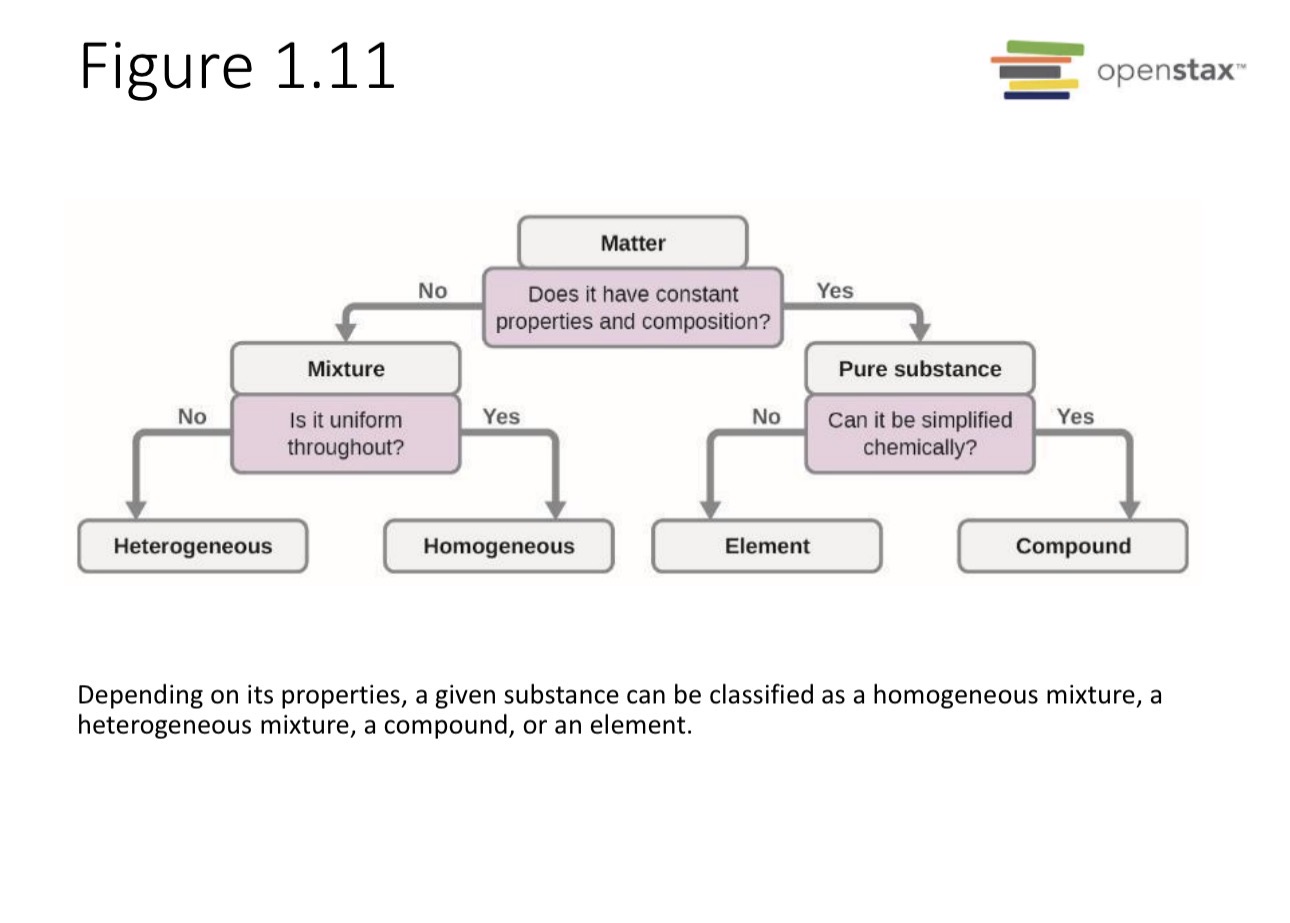
Just look at pic
Atom
The smallest particle of an element that has the properties of that element and can enter into a chemical combination
Physical properties
characteristic of matter that is not associated with a change in its chemical composition
Chemical property
The change of one type of matter into another type
(or the inability to change)
Extensive property
Depends on the amount of matter present.
Examples: mass, volume, heat
Intensive property
Does not depend on the amount of matter present.
Examples: density, temperature
The size or magnitude of the measurement: a number
A standard of comparison for the measurement: a unit
An indication of the uncertainty of the measurement
Every measurement provides three kinds of
information:
Units
Without ____ a number can be meaningless or
confusing
Volume
The measure of the amount of space occupied by an object
Density
Mass divided by volume
Exact number
Result of counting measurements
Counting
The o my type of measurement free from uncertainty
Uncertain
Quantities derived from measurements other than counting are ____ to varying extents
Significant figures (sig fig)
All the digits in a measurement including the uncertain last digit
Precise
A measurement is said to be ____ if it yields very similar results when repeated in the same manner
Accurate
A measurement is considered ____ if it yields a result that is very close to the true or accepted value
2.54cm
1in