BYU Anatomy Lecture 2 (Embryology)
 Call Kai
 Learn
Learn Practice Test
 Spaced Repetition
 Match
Match Flashcards
 Knowt Play
1/61

There's no tags or description
Looks like no tags are added yet.
Name | Mastery | Learn | Test | Matching | Spaced | Call with Kai | Chat |
|---|
No analytics yet
Send a link to your students to track their progress
62 Terms
pre-embryonic (period)
the gestational period of prenatal development from weeks 1-2 (fertilization to implantation)
embryonic (period)
the gestational period of prenatal development weeks 3-8 (implantation to organogenesis)
fetal period
the gestational period of prenatal development weeks 9-38 or birth
embryonic (period)
the gestational period of prenatal development where the baby grows from about a millimeter to about an inch in size
oocyte
the developed female egg awaiting fertilization
fertilization
the act of conception: when a sperm and egg come together
zygote
the product of when a sperm and egg come together. it will undergo mitotic cell divisions as it moves towards the uterus
cleavage
the mitotic cell divisions that the zygote undergoes on its way to the uterus
morula
the product of the zygote undergoing enough mitotic cell divisions to total at least 16 cells.
blastocyst
the product of a morula undergoing enough mitotic cell divisions to total at least 100 cells
trophoblast
the outer layer of the blastocyst
inner cell mass
the portion of the blastocyst that will eventually become the embryo
blastocoel
the fluid-filled portion of a blastocyst
implantation
when the blastocyst hits the uterine lining and successfully burrows inside, ending the pre-embryonic period
cytotrophoblast
one of the two types of cells that the trophoblast cells transform into after making first contact with the uterine lining (endometrium). This type remains in a cellular form/structure
syncytiotrophoblast
one of the two types of cells that the trophoblast cells transform into after making first contact with the uterine lining (endometrium). This type is the result of trophoblast cells fusing together and breaking down endometrium cells for nutrients.
chorion
the outermost extra-embryonic membrane that surrounds the yolk sac, epiblast, etc.
placenta
takes over the yolk sac's job of nourishment of the embryo around week 4
inner cell mass
the part of the blastocyst that becomes the bilaminar disc
bilaminar disc
the epiblast and hypoblast cells developed from the inner cell mass make up the:
epiblast
the upper layer of the bilaminar disc that separates the amniotic sac (amnion) from the hypoblast cells
hypoblast
the layer of the bilaminar disc that separates the epiblast cells from the yolk sac.
epiblast
the layer that becomes the three primary germ layers of the embryo
primitive streak
the cavity that forms in the epiblast just prior to gastrulation. it's formation means that the embryonic stage has already ended
gastrulation
the process that causes the epiblast and hypoblast to develop into the 3 primary germ layers.
invagination
Name the process of the migration of epiblast cells through the primitive streak becoming the mesoderm and ectoderm
ectoderm
In the transformation of the epiblast during gastrulation into this germ layer, this layer faces the amnion and later becomes the nervous system and skin
mesoderm
In the transformation of the epiblast during gastrulation into this germ layer, this layer is in the middle of the three and later becomes the muscular and skeletal systems (also the heart and kidneys).
endoderm
In the transformation of the epiblast during gastrulation into this germ layer, this layer faces the yolk sac and later becomes the respiratory and digestive systems
transverse (body folding)
the folding of the 3 primary germ layers into a tube-like structure
cephalocaudal (body folding)
the "head-to-tail" folding of the 3 primary germ layers after they have already folded into the tube-like structure. induces pinching off of yolk sac
neurulation
the process of the ectoderm transforming into the neural tube
neural plate
a special, thickened portion of the ectoderm (induced by the notochord) that is destined to become the neural tube
notochord
a special portion of the mesoderm that induces neurulation
neural groove
the intermediary structure in neurulation that folds the neural plate into a crevice-like structure
neural tube
the resulting structure of neurulation that is destined to become the brain and spinal cord.
organogenesis
the process through which we have all organs present in some form by about week 8, ending the embryonic period
premature (birth)
any birth that takes place before week 38
30
at which week of development could an infant technically be born and possibly not require any lifesaving measures?
22
at which week of development could an infant technically survive, but likely requiring significant lifesaving measures.
Epiblast
"A"
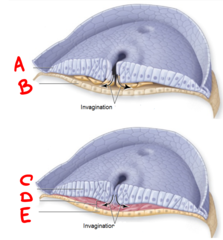
Hypoblast
"B"

Ectoderm
"C"
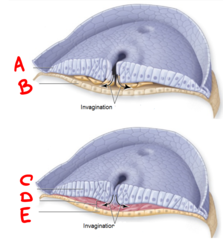
Mesoderm
"D"

Endoderm
"E"

trophoblast
"A"

inner cell mass
"B"

hypoblast
"C"

epiblast
"D"
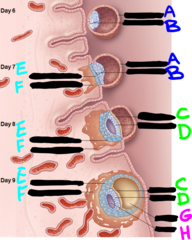
Cytotrophoblast
"E"

Syncytiotrophoblast
"F"

Yolk Sac
"G"

Amnion
"H"
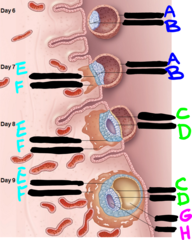
neural plate
"A"

ectoderm
"B"

mesoderm
"C"

notochord
"D"

neural groove
"E"

ectoderm
"F"

neural tube
"G"

epiblast
Does the epiblast, hypoblast, trophoblast, endoderm, mesoderm, or ectoderm represent what will later become the entire embryo?
trophoblast
What helps to build the placenta, as well as the chorionic membrane surrounding the fetus?