Organic Chemistry Chapter 1
 Call Kai
 Learn
Learn Practice Test
 Spaced Repetition
 Match
Match Flashcards
 Knowt Play
1/32

There's no tags or description
Looks like no tags are added yet.
Name | Mastery | Learn | Test | Matching | Spaced | Call with Kai | Chat |
|---|
No analytics yet
Send a link to your students to track their progress
33 Terms
Atoms
All matter is composed of
Nucleus (protons & neutrons; most of mass of atom)
Electron Cloud (electrons, volume of atom)
Two main components of atoms
number of protons = number of electrons
In a neutral atom…
Positively (fewer electrons than protons)
Cation is a ___ charged atom
Negatively (more electrons than protons)
Anion is a ____ charged atom
Isotopes (Isotopes also have different mass numbers)…..Mass number = number of protons + number of neutrons
Two atoms of the same element with a different number of neutrons are called ___
Similar in size and have same number of shells
Elements in the same row are ___
Similar electronic/chemical properties and same number of valence electrons
Elements in the same column have ___
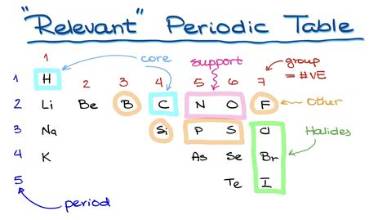
Common Elements seen in O-Chem
shells closest to the nucleus
Electrons are first added to ___

S: Sphere of electron density; lower in energy (because closer to positively charged nucleus); only one S orbital per shell
P: dumbell shape (contains node of e density “no e density”); higher in energy than S orbital in same shell; 3 P orbitals per shell
S orbital has ___
P orbital has ___
Two electrons
Each orbital can have max of ___
8 electrons
Second shell or “second row” has capacity for ___
Valence electrons: only electrons that participate in chemical reactions
Outermost electrons are called ___ and what is special about them?
Atoms gain, lose, or share electrons to attain electronic configuration of the noble gas closest to them
One general Bonding rule:
Transfer of electrons (metal with nonmetal), typically known as salts
Usually occurs when elements on the far left combine with elements on the far right
Ionic bonding is ___
Sharing of electrons ( each atom contributes 1 e to the bond)
Occurs with elements in the middle like C, when they would have to gain or lose several e to form complete valence shell
Covalent bonding is ___
Atoms with one, two, three, or four valence e form 1,2,3, or 4 bonds respectively
Atoms with 5 or more valence e form enough for octet ( # bonds = 8 - valence e)
Rules for Number of Bonds
Unshared e = lone pair
Non-bonded pair of electrons =
RELEASES ENERGY, forming bonds ReLeAsEs energy!
REMEMBER!! Formation of bonds does what??
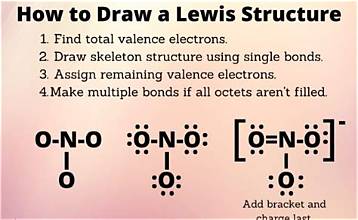
Step 1. Have a piece of paper ;D
THENNN, Step 1 arrange atoms next to each other in a logical manner
Step 2. count # of valence e
Step 3. Arrange e around the atoms
Step 4. assign formal charges (# of valence e - # of e an atom owns)
How to Draw Lewis Structures (e representation of molecules)
Isomers
Different molecules that have the same molecular formula
Constitutional Isomers
Same chemical formula; different connectivity
Resonance Structures (THEY ARE NOT ISOMERS)
Molecules that share the same molecule connectivity but have electrons that have moved
Resonance Hybrid
The actual structure of a molecule is the combination of resonance structures. This is called ___
Delocalize the electrons over two or more atoms, stabilizing the molecule
Importance of resonance structures?
differ in position of multiple bonds and non-bonded e
must have the same number of e
must be a valid Lewis structure (Octet Rule!)
Resonance Structure Rules

shows the movement of an e pair (SUPER IMPORTANT!)
Curved Arrow Notation
Decreases across a row (as size of atom decreases)
Increases down a column (as size of atom increases)
The shorter the bond, the stronger the bond
Bond Length
Determines the shape of the molecule
Takes into account atoms & lone pairs of e
VSPER Theory- e repel each other
Bond Angle

Two groups-linear
Three groups- trigonal planar (1 lone pair = bent)
Four groups- tetrahedral (1 lone pair = trigonal pyrimidal, 2 lone pair = bent)
Molecular Geometry for Second Row Elements
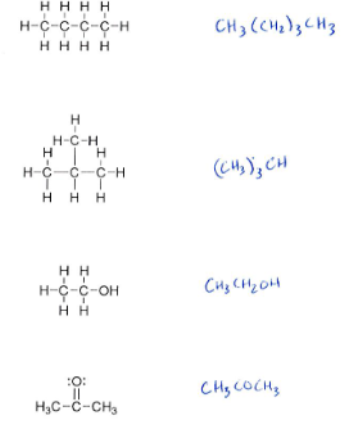
All atoms are drawn, no bond lines
Atoms drawn next to atom in which they are bonded
() used around similar groups bonded to same atom
Condensed Structures
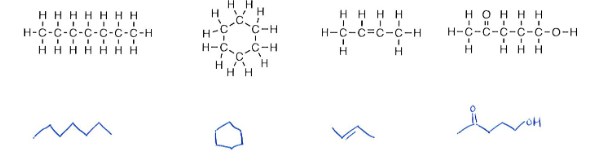
Assume a carbon atom is at any “point” or end of the line
Assume enough H atoms to make each carbon atom tetravalent
Draw in all heteroatoms and the H atoms bonded to them
Draw double and triple bonds
Skeletal Structures