psych history + contemporary psych
 Call Kai
 Learn
Learn Practice Test
 Spaced Repetition
 Match
Match Flashcards
 Knowt Play
1/11

Earn XP
Description and Tags
psych people and what they did
Name | Mastery | Learn | Test | Matching | Spaced | Call with Kai | Chat |
|---|
No analytics yet
Send a link to your students to track their progress
12 Terms
Wilhelm Wundt
introspection, people reported their own thoughts and feelings to stimuli
his student made structuralism
focus on contents of mental process rather than function - break down mental processes, analyze structure of the mind
ex. measured reaction times
understanding inner experience
William James
functionalism
how mental activities helped organism fit into environment
WHOLE MIND, not parts (diff from structuralism)
purpose behind mental processes
also believed in introspection
led to evolutionary psych
understanding inner experience
Sigmund Freud
studied hysteria & neurosis
studied the unconscious mind through dream analysis
psychoanalytic theory - role of a person’s unconscious & early childhood experiences
structural model of the psyche - instinctual desires, ego (rational thought), and superego (moral standards)
understanding inner experience
Gestalt Psychology
Max Wertheimer, Kurt Koffka, and Wolfgang Köhler
sensory experience broken down into different parts, but how those parts relate to each other is how a person responds in perception
perception depends on the whole, not the parts
contradict wundt’s idea of structuralism, breaking down mental processes doesn’t allow us to understand perception
understanding inner experience
Ivan Pavlov
classical conditioning
worked with conditioned reflexes (like salivation)
stimulus → response → learning
influenced behaviorism, learning occurs through conditioning

John Watson
believed objective analysis of the mind was impossible, unlike wundt and james
focus on observable behavior & controlling that
coined behaviorism!
CBT
no introspection
used animals to experiment since that could be applied to humans
B.F. Skinner
behaviorist
operant conditioning
response → outcome → learning
how behavior was affected by consequences
modify behavior through reinforcement and punishment
positive & negative reinforcement
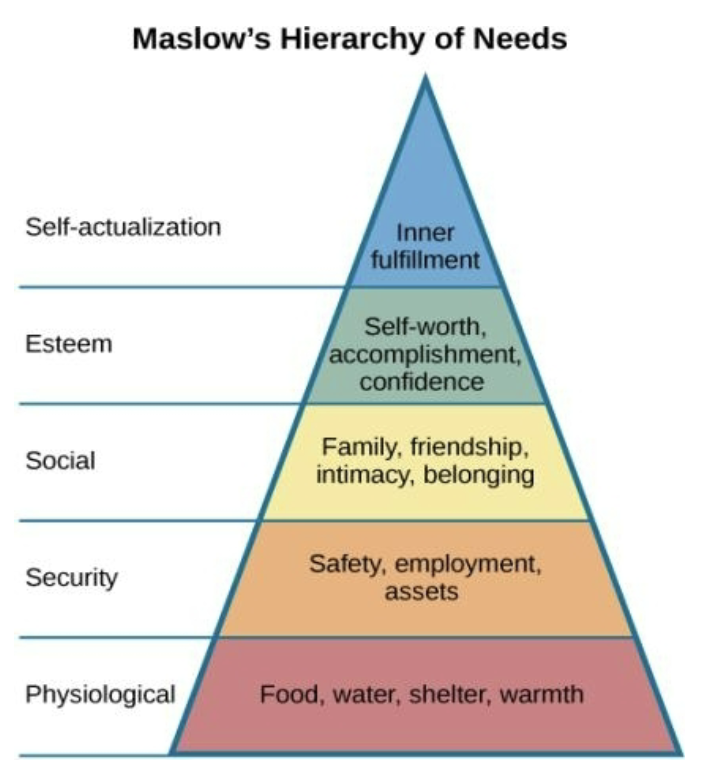
Abraham Maslow
humanism
humans have capacity for good
hierarchy of human needs
objected pessimism and determinism of freud
behaviorism was too simple
basic level needs met → higher level needs motivate behavior
Carl Rodgers
client centered therapy
patient takes lead
unconditional positive regard, genuineness, and empathy
Cognitive Revolution
human as a whole
study mind
incorporate mental functioning
thru tasks (stroop task)
W.E.I.R.D
western, educated, industrialized, rich, democratic
the communities that most psychological research studies
subdivisions of psych
biopsychology
evolutionary
sensation and perception
cognitive psychology
developmental psychology
personality psychology (five factor model)
social psychology
health psychology
sport/exercise psychology
clinical psychology
forensic psychology