Neuro Exam 1 Review Questions
 Call Kai
 Learn
Learn Practice Test
 Spaced Repetition
 Match
Match Flashcards
 Knowt Play
1/102

There's no tags or description
Looks like no tags are added yet.
Name | Mastery | Learn | Test | Matching | Spaced | Call with Kai | Chat |
|---|
No analytics yet
Send a link to your students to track their progress
103 Terms
Arrange by size: mitochondria, a molecule of neurotransmitter, pyramidal neuron, cell nucleus, ion channel, cerebellar cortex, water molecule, synaptic vesicle.
Water molecule, a molecule of neurotransmitter, Ion channel, Synaptic vesicle, Mitochondria, Cell nucleus, Pyramidal neuron, Cerebellar cortex
What are the main differences between Cajal's Neuron Doctrine and Golgi's Reticular Doctrine?
Golgi said that the nervous system is one continuous network (reticulum), and Cajal said the nervous system is made up of individual cells called neurons
Who invented the Golgi staining method, and who used the camera lucida?
Camillo Golgi, Santiago Ramon y Cajal
What is the functional significance of neurons being polarized (i.e., asymmetrical)?
their structure creates a preferred direction for information flow
What are the signals that travel inside neurons?
Action potentials
What are the different neuronal compartments called?
Dendrites, soma (cell body), axon hillock, axon, axon terminal
In what direction (from what to what neuronal compartment) does the signal inside neurons travel?
Dendrites → Cell body (soma) → Axon hillock → Axon → Axon terminals (synaptic terminals)
Define synapse structure and function.
The synapse enables communication between neurons; Presynaptic terminal, Synaptic cleft, Postsynaptic membrane
Are synapses placed at all points of contact between neurons?
No, only specialized contact sites become synapses
What is the functional significance of synaptic selectivity (i.e., Cajal's principle of Connectional Specificity)?
The functional significance of synaptic selectivity is that it allows the nervous system to form precise, organized neural circuits, enabling accurate information processing, specialized functions, and learning.
Are neurons born asymmetrical?
No. Neurons are not born asymmetrical. They start symmetrical and become polarized during development.
Give a few examples illustrating the functional specificity of brain regions.
Visual processing; The primary visual cortex (V1) in the Occipital lobe , Movement control in the primary motor cortex in the Frontal lobe, Speech production in Broca's area, Language comprehension in Wernicke's area
Give a few examples illustrating structural, molecular, and functional differences between somato-dendritic and axonal neuronal compartments.
Somato-dendritic compartment is for Input and integration, has branched dendrites + soma, has receptors, protein synthesis machinery for molecular components, and receives and processes signals
The Axonal compartment is for output and transmission, has long axons with terminals, has sodium channels, vesicles, release machinery molecular compartments, and Conducts action potentials and releases neurotransmitter
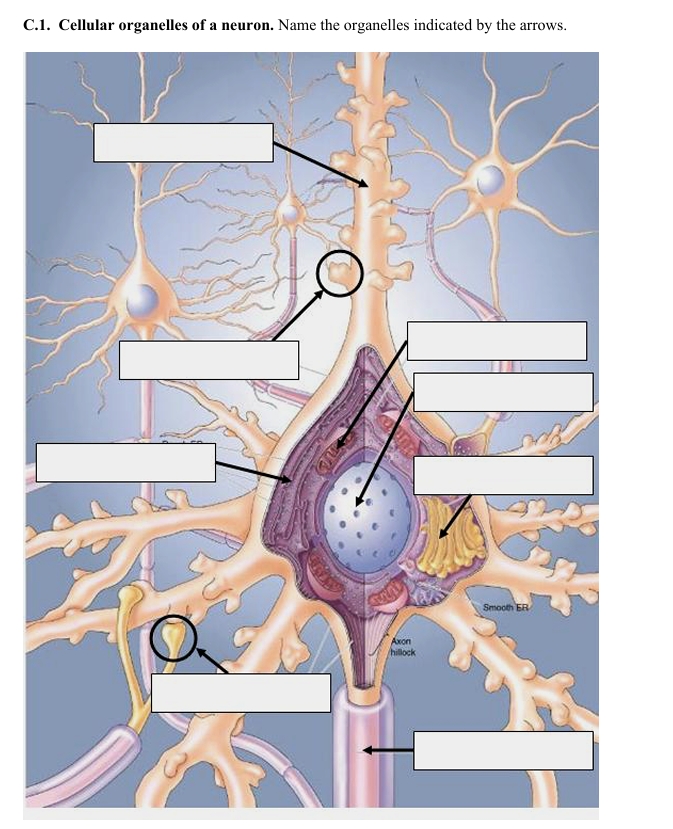
Identify the Cellular Organelles of a Neuron.
1st: Dendrite, Dendritic Shaft
Top left: Dendritic Spine
Top right: Mitochondria
Middle left: Soma, Endoplasmic Reticulum
Middle right: Nucleus
Middle right: Golgi Apparatus
Bottom left: Synapse, presynaptic terminal
Bottom right: Axon

Name the Synapse components indicated by the arrows.


What type of Central Synapses are illustrated below?
(a) Axo-Dendritic
(b) Axo-Somatic
(c) Axo-Axonal

Describe the two types of chemical synapses shown bellow (including Gray’s designation, location on the dendrite, excitatory vs. inhibitory, structural distinguishing features).
(a) Gray’s Type 1, on spine, excitatory, large postsynaptic density (asymmetrical)
(b) Gray’s Type 2, on shaft, inhibitory, smaller postsynaptic density (symmetrical)

This diagram shows a model for the functioning of the voltage-gated sodium channel.
Name and briefly describe each of the three steps in the diagram.
(1) When membrane potential is at rest, channel is closed
(2) When membrane is depolarized to threshold, the voltage gate opens, allowing influx of Na+
(3) Inactivation gate closes blocking ion flow. Inactivation gate will remain closed until membrane returns to resting potential.

Name the Neuronal Types
(a) Sensory
(b) Motor
(c) Local interneuron
(d) Projection interneuron
Give an example of a multipolar neuron
Pyramidal neuron, Pyramidal neuron
Give an example of a bipolar and a pseudo-unipolar neuron.
Retinal bipolar cell ; Sensory neuron
Give examples of input, intermediary, and output neurons.
Sensory neurons, Local circuit neurons, Motor neurons
Give an example of an excitatory neuron in the CNS. What is the most common
excitatory neurotransmitter?
pyramidal neuron ; Glutamate.
Give an example of an inhibitory neuron in the CNS. What is the most common inhibitory neurotransmitter?
basket cell; Gamma-aminobutyric acid (GABA).
What is wider: primary or tertiary dendrite?
primary dendrite
Do axo-axonal synapses exist?
Yes; they modulate neurotransmitter release rather than directly exciting or inhibiting the postsynaptic neuron, and cause Presynaptic inhibition + Presynaptic facilitation
What is the difference between afferent and efferent?
Afferent neurons carry information toward the central nervous system, Efferent neurons carry information away from the CNS to the body
In all neurons, what are the four functional regions?
Input region, Integration region, Conduction region, Output region
What features of neurons allow them to communicate with each other?
Synapses are specialized junctions where neurons communicate, Neurons produce chemical messengers that carry signals between cells, Neuronal membranes contain ion channels that allow ions (Na⁺, K⁺, Ca²⁺, Cl⁻) to move across the membrane, and Neurons have a polarized organization that directs signal flow (dendrite, soma, axon, axon terminal), Synaptic vesicles and release machinery
What structural and molecular properties distinguish each of the four neuronal functional regions, allowing them to perform their function in neuron communication?
Input region (dendrites and soma) receives signals from other neurons, Integration region (axon hillock / initial segment) decides whether to generate an action potential, Conduction region (axon) carries the electrical signal along the neuron, and Output region (axon terminals) transmits signals to the next cell.
What staining method did Korbinian Brodmann use to identify structurally distinct brain regions?
Nissl staining method to identify structurally distinct brain regions.
How many structurally distinct brain regions did Korbinian Brodmann identify?
52
Did Korbinian Brodmann study the cerebral or the cerebellar cortex?
Korbinian Brodmann studied the cerebral cortex, not the cerebellar cortex.
What is aphasia?
language disorder caused by damage to brain regions responsible for language, leading to problems with speaking, understanding, reading, or writing
Damage to what brain regions is associated with aphasia?
language areas in the left hemisphere of the cerebral cortex; Broca's area & Wernicke's area
What are the differences between Broca's and Wernicke's aphasia?
Broca's aphasia: know what to say but can't say it easily.
Wernicke's aphasia: can speak easily but the words don't make sense.
How did the study of aphasia patients contribute to the Distributed Processing hypothesis?
showed that language is not controlled by a single brain area, but instead depends on multiple interacting regions. This evidence helped support the Distributed Processing hypothesis, which proposes that cognitive functions arise from networks of brain regions working together
How do modern methods in neuroscience research, such as optogenetics, contribute to the understanding of the brain structures and mechanisms that govern behaviors?
Modern neuroscience tools let researchers move from simply observing the brain to directly controlling and testing neural circuits. One powerful example is Optogenetics, which has dramatically improved our understanding of how brain structures generate behavior.
Are excitatory synapses usually located on dendritic spines or shafts? How about inhibitory synapses?
Excitatory synapses are usually located on dendritic spines, Inhibitory synapses are usually located on dendritic shafts/ soma
Are the mushroom spines usually stable or dynamic?
Mushroom spines are usually stable.
What type of spines (mushroom or filopodial) are associated with mature synapses and stable, long-term memories?
mature synapses and stable, long-term memories
How are myelinating CNS glia called?
Oligodendrocytes; Produce the myelin sheath that wraps around axons in the CNS.
How are myelinating PNS glia called?
Schwann cells
What are the resident immune cells of the CNS called?
Microglia
Define cathode, anode, electric potential, voltage, resistance, current, conductor, and insulator
What is Ohm's law?
What is the difference between a conductor and an insulator?
What particles carry electric current in living cells?
What parts of living cells are conductors, and what are insulators?
What properties of water molecules allow cells to conduct electrical current?
Is distilled water a good conductor?
What is Brownian motion?
What is diffusion?
If there is a difference in the concentration of molecule X, and nothing prevents its diffusion, would it move up or down its concentration gradient?
What is the mechanism allowing the generation of current in neurons?
What is resting potential? What is a typical number (in mV) for the resting potential in an average neuron?
What parameters define the equilibrium potential of an ion?
Name the four most relevant ions that play a role in the electrical excitability of neurons.
At resting potential, which of these are more concentrated inside the cell than outside?
Which are positively, and which are negatively charged?
In what direction would these ions flow if their corresponding ion channels would open? For each of these, would the opening of their ion channel hyperpolarize or depolarize the neuron?
What are the main functional differences between ion pumps and channels?
What ion pump is responsible for the maintenance of the resting membrane potential?
What is the difference between depolarization and hyperpolarization?
What is the difference between passive (electrotonic) and active propagation of
electrical signals in neurons?
What ion channels play a key role in initiating and actively propagating the Action
Potential?
What is the role of a selectivity filter in ion channels? Give examples of ion channel
selectivity.
How are ion channels gated? Name several different gating mechanisms.
What is a refractory period for an ion channel?
If a ligand binds to a receptor, causing the receptor to be activated - is it an agonist or an antagonist?
What ion channels does tetrodotoxin (TTX) block?
What ion channels are blocked by tetraethylammonium (TEA)?
How do the properties of voltage-gated Na+ and K+ channels explain the properties of the action potential?
What contributes to the undershoot phase of the action potential?
What is paired-pulse inhibition?
What is back-propagation of action potentials, and how does it influence NMDA
receptors in dendritic spines?
Explain how action potentials propagate down myelinated axons through saltatory
conduction.
What are the nodes of Ranvier?
Where in the axon would you see the highest density of voltage-gated sodium channels?
Relative to the myelin wrapping of the axon, where does electrical charge propagate passively, and in what stretches is it amplified?
What are the main structural and functional differences between electrical and chemical synapses?
What are the main structural elements of electrical synapses?
What are the main structural elements of chemical synapses?
What are the main functional advantages of electrical synapses?
What are the main functional advantages of chemical synapses?
Which (electrical or chemical synapses) are more prevalent in the neurons in adult vertebrate brains?
What is the difference between ionotropic and metabotropic postsynaptic receptors?
Name some small molecules and some peptide neurotransmitters and
neuromodulators
Name several common ionotropic excitatory postsynaptic receptors.
Name metabotropic excitatory receptor.
Name ionotropic and metabotropic inhibitory postsynaptic receptors.
The cannabinoid signaling system is one of the most common neuronal retrograde
neuromodulatory systems.
Where (pre or postsynaptically) are cannabinoid receptors
usually located?
Are cannabinoid receptors ionotropic or metabotropic?
What is the integration of receptor potentials?
What is the difference between spatial and temporal summation?
Why are inhibitory synapses important - how do they shape firing in neuronal circuits?
How does depolarization (action potential arriving at a presynaptic terminal) trigger
neurotransmitter release?
What voltage-gated channels are expressed in presynaptic terminals and play a critical role in neurotransmitter release?
Explain vesicle exocytosis and endocytosis.