Ch 1 Practice Quiz
 Studied by 0 people
 Call Kai
 Learn
Learn Practice Test
 Spaced Repetition
 Match
Match Flashcards
 Knowt Play
1/61

There's no tags or description
Looks like no tags are added yet.
Name | Mastery | Learn | Test | Matching | Spaced |
|---|
No study sessions yet.
62 Terms
The smallest living unit is:
A) a molecule
B) an organ
C) a human being
D) a cell
D
This system forms the external body covering:
a. skeletal system
b. exocrine system
c. nervous system
d. integumentary system
d. integumentary system
This system transports blood to all body
tissues.
a. nervous system
b. muscular system
c. cardiovascular system
d. digestive system
c. cardiovascular system
This system eliminates nitrogenous wastes
from the body.
a. urinary system
b. digestive system
c. reproductive system
d. lymphatic system
a. urinary system
Its organs secrete hormones that help regulate
homeostasis.
a. nervous system
b. endocrine system
c. skeletal system
d. respiratory system
b. endocrine system
This is the fastest-acting system of the body.
a. muscular system
b. nervous system
c. endocrine system
d. skeletal system
b. nervous system
Pedal is an anatomical synonym of
__________.
a. the hand
b. the foot
c. the mandible
d. the mind
b. the foot
A lay term for the femoral region is the
_______.
a. leg
b. hip
c. calf
d. thigh
d. thigh
As you might guess, the antebrachial region
refers to the __________.
a. knee
b. foot
c. thoracic area
d. forearm
d. forearm
Dorsum refers to the __________.
a. abdomen
b. thorax
c. palms of the hands
d. back
d. back
The head is __________ to the abdomen.
a. inferior
b. medial
c. proximal
d. superior
d. superior
Your chest is ______________ to your back.
a. anterior
b. posterior
c. interior
d. frontal
a. anterior
The word for “away from the midline of the
body” is _________.
a. medial
b. proximal
c. lateral
d. deep
c. lateral
The word for “away from, and more internal to,
the surface of the body” is __________.
a. superficial
b. exteral
c. medial
d. deep
d. deep
The word for “on the same side of the body”
is __________.
a. equilateral
b. ipsilateral
c. unilateral
d. contralateral
b. ipsilateral
If a forearm is stroked from the wrist to the
elbow, in which direction is such action taken?
a. proximal
b. deep
c. contralateral
d. distal
a. proximal
The word for “toward or at the body surface”
is __________.
a. contralateral
b. superficial
c. deep
d. proximal
b. superficial
The outermost layer of the lung consists of the
__________ and is surrounded by serous
fluid.
a. parietal pleura
b. visceral pleura
c. parietal pericardium
d. visceral pericardium
b. visceral pleura
A human body is divided into anterior and
posterior parts by the __________ body plane.
a. transverse
b. sagittal (median)
c. oblique
d. frontal (coronal)
d. frontal/coronal
In anatomical position, the coxal region is
________ to the inguinal region.
a. contralateral
b. medial
c. lateral
d. superficial
c. lateral
If the left side of the brain controls a specific
action of the right arm, the orientation of this
cerebral control is __________.
a. Ipsilateral
b. ambidextrous
c. distal
d. contralateral
d. contralateral
The spinal cord is located in __________.
a. the cranial cavity
b. the vertebral cavity
c. the ventral cavity
d. both a and b
b. the vertebral cavity
Most of the liver is located in the __________
abdominal quadrant.
a. right upper
b. left upper
c. right lower
d. left lower
a. right upper
A histologist examines a specimen that has an epithelium overlying some smooth muscle. This specimen is part of:
A. a cell
B. an organ
C. a molecule
D. a tissue
B. an organ
An example of a tissue in the body is:
A) the stomach.
B) a macromolecule.
C) a muscle cell.
D) epithelium.
D. epithelium
4) An example of an organ is
A) the cardiovascular system (but not the circulatory system).
B) epithelium.
C) a fat cell.
D) the intestine
D) an intestine
5) The chest is ________ to the abdomen.
A) lateral
B) superior
C) deep
D) proximal
E) anterior
B) superior
6) The sternal region is ________ to the scapular region.
A) superior
B) deep
C) proximal
D) anterior
E) lateral
D. anterior
7) Which of these terms refers to the head?
A) caudal
B) cranial
C) frontal
D) sacral
E) medial
B) cranial
8) The brain is ________ to the skull.
A) superior
B) lateral
C) anterior
D) proximal
E) deep
E) deep
9) The thumb is ________ to the index finger.
A) superior
B) lateral
C) anterior
D) proximal
E) deep
B) lateral
10) A frontal plane is the same as a ________ plane.
A) midsagittal
B) coronal
C) sagittal
D) transverse
B) coronal
11) A coronal section through the human body can
A) lie in a horizontal plane.
B) pass through both the nose and the occipital region.
C) pass through both ears.
D) provide mirror right and left images.
C) pass through both ears.
12) Which statement about visceral serosa is false?
A) It is continuous with the membrane that covers the outer body wall.
B) It is deep to the parietal serosa.
C) It lines the internal surface of hollow organs.
D) It clings to the surface of organs
C) It lines the internal surface of hollow organs.
13) The popliteal region is
A) the inferior part of the gluteal region.
B) the side of the leg.
C) the posterior surface of the knee.
D) in the cervical region.
C) the posterior surface of the knee.
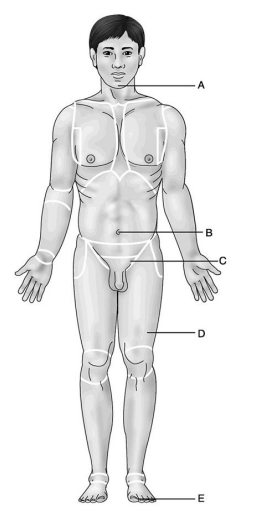
14) Which letter indicates the mental region?
A) A
B) B
C) C
D) D
E) E
A
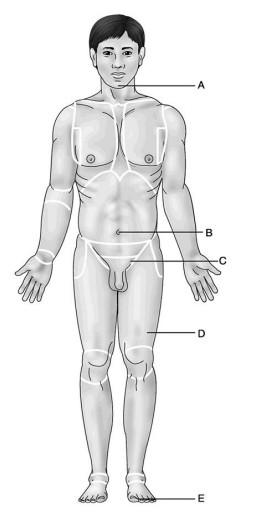
15) Which letter indicates the inguinal region?
A) A
B) B
C) C
D) D
E) E
C
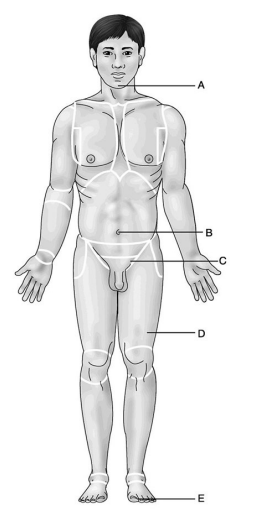
16) Which letter indicates the femoral region?
A) A
B) B
C) C
D) D
E) E
D
17) The coxal region is
A) the skin over the "tailbone."
B) the posterior surface of the wrist.
C) the same as the inguinal region.
D) the hip.
D) the hip.
18) Which organ is not found in the ventral body cavity?
A) spinal cord
B) heart
C) liver
D) urinary bladder
A) spinal cord
19) The ankle lies ________ to the thigh.
A) distal
B) proximal
C) inferior
D) lateral
A) distal
20) The axillary artery is found in the region of the
A) vertebral column.
B) long axis of any limb.
C) armpit.
D) posterior surface of the knee.
C) armpit.
21) A physician viewing an injury to the back would look at the patient's ________ side.
A) posterior
B) ventral
C) lateral
D) crania
A) posterior
22) The main purpose of fixation is
A) to mend breaks in tissue sections.
B) to stick tissue sections to a glass slide.
C) to preserve the tissue.
D) to make an organ easier to section
C) to preserve the tissue.
23) Muscles are ________ to the skin.
A) superior
B) lateral
C) anterior
D) proximal
E) deep
E) deep
24) The axillary region is ________ to the sternum.
A) superior
B) lateral
C) anterior
D) proximal
E) deep
B) lateral
25) The gluteal region is ________ to the popliteal region.
A) superior
B) lateral
C) anterior
D) proximal
E) deep
A) superior
26) Which structure is not present in the mediastinum?
A) trachea
B) esophagus
C) heart
D) lung
D) lung
27) The cervical region is the
A) thigh.
B) head.
C) calf.
D) neck.
D) neck.
28) Which statement concerning the anatomical position is false?
A) The person is lying down, as straight as possible.
B) The knees, elbow, and neck are straight (not bent).
C) The toes point anteriorly, but the fingers point inferiorly.
D) The palms face anteriorly.
A) The person is lying down, as straight as possible.
29) Which structure is not covered by visceral serosa?
A) stomach
B) uterus
C) lungs
D) ribs
D) ribs
30) What point or structure in the body is located farthest laterally? (Hint: Questions always refer to the body in the anatomical position.)
A) the coxal region
B) little toe
C) ear
D) tip of thumb
D) tip of thumb
31) Which organ system consists of vessels that do not carry blood, but pick up fluids (and some cells) that are leaked from the blood?
A) integumentary
B) lymphatic
C) endocrine
D) urinary
B) lymphatic
32) Which organ system covers the external surface of the body, but not the internal surface of the mouth?
A) digestive
B) cutaneous
C) integumentary
D) lymphatic
C) integumentary
33) Which organ system includes the spinal cord?
A) nervous
B) integumentary
C) muscular
D) skeletal
A) nervous
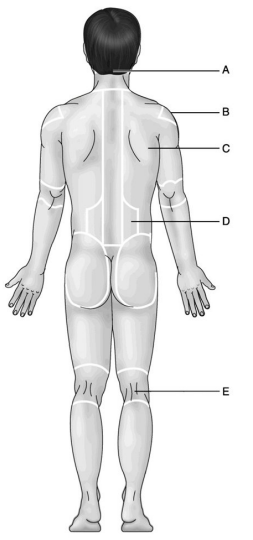
34) Which letter indicates the lumbar region?
A) A
B) B
C) C
D) D
E) E
D
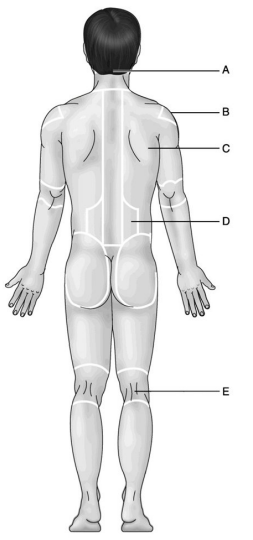
35) Which letter indicates the acromial region?
A) A
B) B
C) C
D) D
E) E
B) B
36) The elimination of nitrogenous wastes from body fluids is regulated by the ________ system.
A) endocrine
B) urinary
C) integumentary
D) lymphatic
B) urinary
37) The dimensions of cells and organelles would best be described using which units of measurement?
A) µm
B) m
C) mg
D) ml
E) cm
A) µm
38) Which organ system includes the pancreas, thymus, testes, and pituitary gland?
A) endocrine
B) integumentary
C) reproductive
D) lymphatic
A) endocrine
39) Which organ system keeps blood constantly supplied with oxygen, removes carbon dioxide, and contains many air tubes?
A) endocrine
B) urinary
C) circulatory
D) respiratory
D) respiratory
40) The ________ cavity contains the heart and lungs.
A) dorsal
B) abdominopelvic
C) thoracic
D) lateral
C) thoracic