BSC 1005 - EXAM 1
 Call Kai
 Learn
Learn Practice Test
 Spaced Repetition
 Match
Match Flashcards
 Knowt Play
1/59

There's no tags or description
Looks like no tags are added yet.
Name | Mastery | Learn | Test | Matching | Spaced | Call with Kai | Chat |
|---|
No analytics yet
Send a link to your students to track their progress
60 Terms
What is biology?
the study of life and living organisms
Viruses are considered living by all scientists because they contain DNA or RNA.
True
False
False
What are the properties of life?
1. Order
2. Sensitivity / Response to Stimuli
3. Reproduction
4. Adaptation
5. Growth & Development
6. Regulation
7. Homeostasis
8. Energy Processing
Explain each of the properties of life.
Order: Organisms are highly organized structures that consist of one or more cells. Even very simple, single-celled organisms are remarkably complex. Inside each cell, atoms make up molecules. These in turn make up cell components or organelles.
Sensitivity or Response to Stimuli - .Organisms respond to diverse stimuli. For example, plants can bend toward a source of light or respond to touch
Reproduction - able to reproduced, where DNA- contaning genes is passed along to an organism's offspring.
Adaption - All living organisms exhibit a fitness for their environment by having characteristics that allow them to survive and thrive in their environment. he superbly camouflaged wings of some insects allow them to appear identical to dead leaves and escape detection by potential predators.
Growth and Development - Organisms grow and develop according to specific instructions coded for by their genes.
Regulation - such as the transport of nutrients, response to stimuli, and coping with environmental stresses. For example, organ systems such as the digestive carry oxygen throughout the body.
Homeostasis - cells require appropriate conditions such as proper temperature, pH, and concentrations of diverse chemicals. Organisms are able to regulate their own body. E.g Polo Bear is structured for the cold.
Energy Processing - use a source of energy for metabolic activities, capture energy from the sun and convert it into chemical energy.
A living individual, one bird, one bug, one human is a ?
Organism
A group of the same kind of individuals living in the same area at the same time. All humans in the classroom.
Population:
What is a cell?
the smallest unit of life that can function independently and perform all the necessary functions of life, including reproducing itself.
What are organelles?
Organelles are small structures that exist within cells and perform specialized functions.
Contain aggregates of aggregates of macromolecules surrounded by membranes.
What is a molecule?
A group of atoms bonded together.
( phospholipid- including a lipid containing a phosphate group in its molecule, e.g., lecithin.
What is the atomic?
A basic unit of matter that consist of a dense central nucleus surrounded by a cloud of negatively charged electrons.
What is a community?
ll living things in the same area at the same time. All plants, bugs and animals in the garden area.
For instance, all of the trees, flowers, insects, and other populations in a forest form the forest's community
What is an ecosystem?
all of the living and nonliving things interacting in an area.
e.g all entities of a pond.
Abiotic or nonliving e.g nitrogen in the soul or rainwater.
Ecosystem interactions involve living (biotic) communities and nonliving (abiotic) components.
What is the difference between biotic and abiotic,
Biotic: living environment
– includes all organisms
Abiotic : non-living or physical environment
– Solar energy, Temperature , Water, Nutrients
What is the biosphere?
all life on earth ecosystems.
Which scientists first proposes organizing species into hierarchical taxonomy?
Carl Linnaeus
What are the 8 levels of taxonomic?
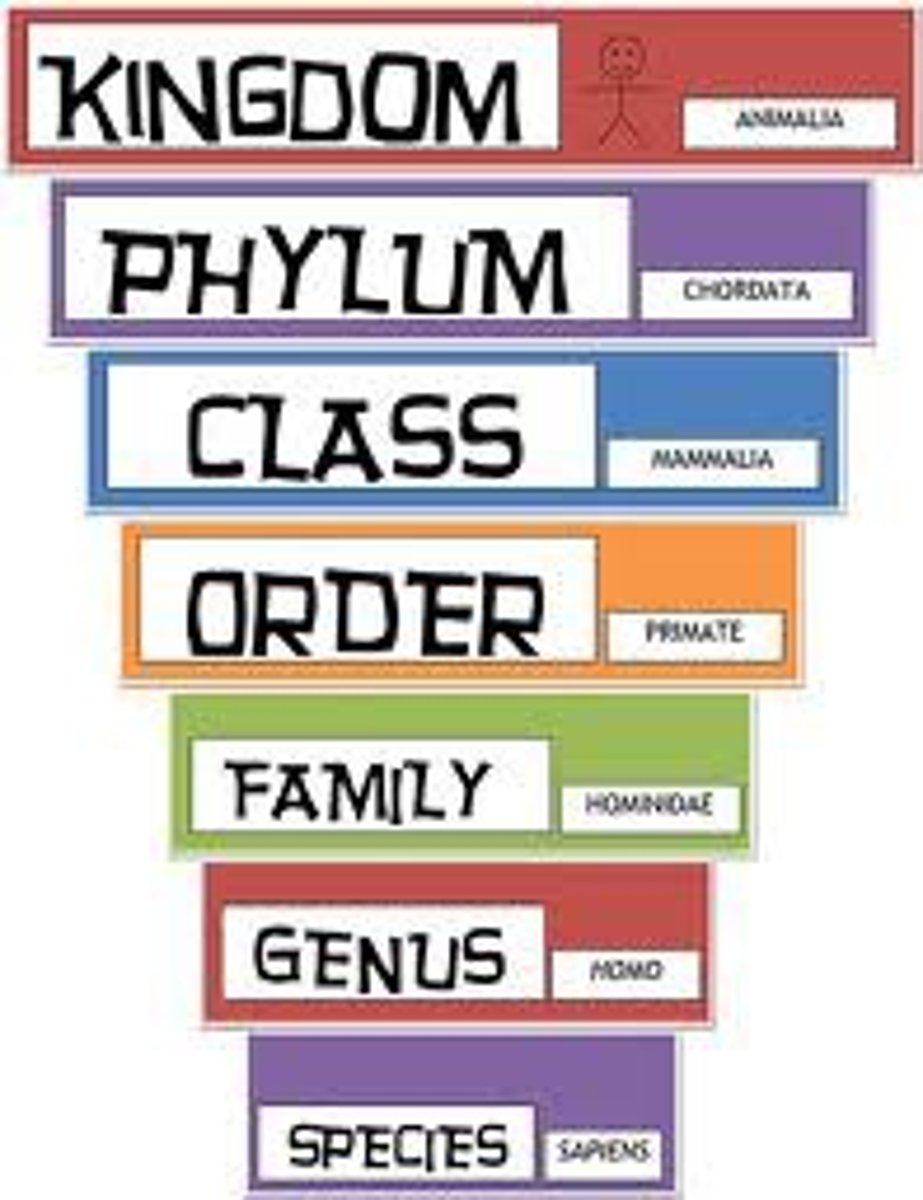
To which of the 3 domains of life do we belong?
Eukarya -contains organisms that have cells with nuclei It includes the kingdoms of fungi, plants, animals, and several kingdoms of protists.
Archaea -single-celled organisms without nuclei and include many extremophiles that live in harsh environments like hot springs
Bacteria -single-celled organisms without nuclei
What name is given to cells without nuclei?
prokaryotes.
Both the Archaea and the Bacteria are prokaryotes, an informal name for cells without nuclei.
What is a phylogenetic tree?
A phylogenetic tree is a diagram showing the evolutionary relationships among biological species based on similarities and differences in genetic or physical traits or both.
What is the level of organization?
atom, molecule, organelles, cell, tissue, organ, organ system, organism/individual
What steps does the scientific method includes?
observation,
record keeping,
logical and
mathematical reasoning,
experimentation, and s
submitting conclusions to the scrutiny of others.
What are biotic factors in an ecosystem?
Producers
Consumers
Decomposers
Who are producers?
Producers are Autotrophs
They make their own food by performing photosynthesis.
Who are the consumers of the biosphere?
heterotrophs
Feed on other organisms
-includes herbivores, carnivores, omnivores, and detritivores
Who are the decomposers of the ecosystem?
Decomposers
Breakdown organic detritus into simpler inorganic compounds
Release nutrients back into the environment
Bacteria and fungi are important decomposers in ecosystems
Which of the following is a biotic factor?
sunlight
soil nutrient
bacteria
dissolved oxygen
bacteria
What is trophic structure?
Feeding relationships between organisms in a community.
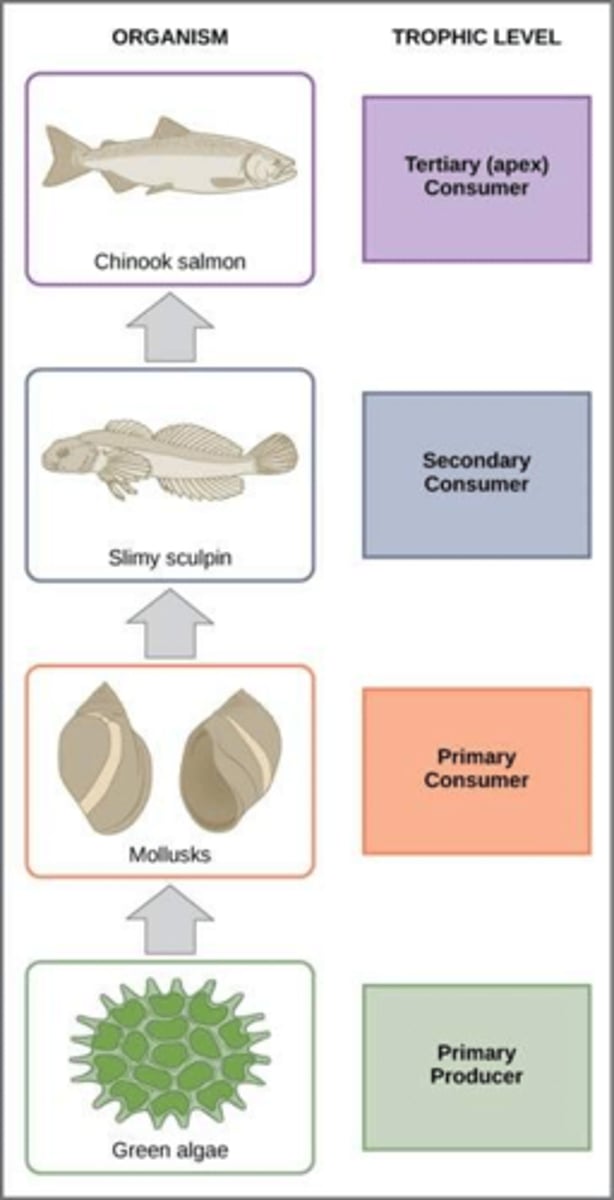
In a hypothetical food chain consisting of grass, grasshopper, mouse, hawk, the grasshopper represents a:
Primary Consumer
What is a food web and how is it different from a food chain?
A food web consists of many food chains. A food chain only follows just one path as animals find food.
eg: A hawk eats a snake, which has eaten a frog, which has eaten a grasshopper, which has eaten grass.
A food web shows the many different paths plants and animals are connected.
A human that eats tuna which eats small fish that eats algae is feeding as a:
Tertiary Consumer
What is the ultimate source of energy?
sun
How is solar energy passed on?
Solar energy is captured by producers and energy passes from one organism to the next with each transfer of energy.
Only 10 % is passed through from the producer to primary which then passes on 1%
It's better to eat lower or closer on the food web to the producer to get enough energy.
Humans are primary consumer when they eat vegetable in comparison to eating secondary or tertiary.
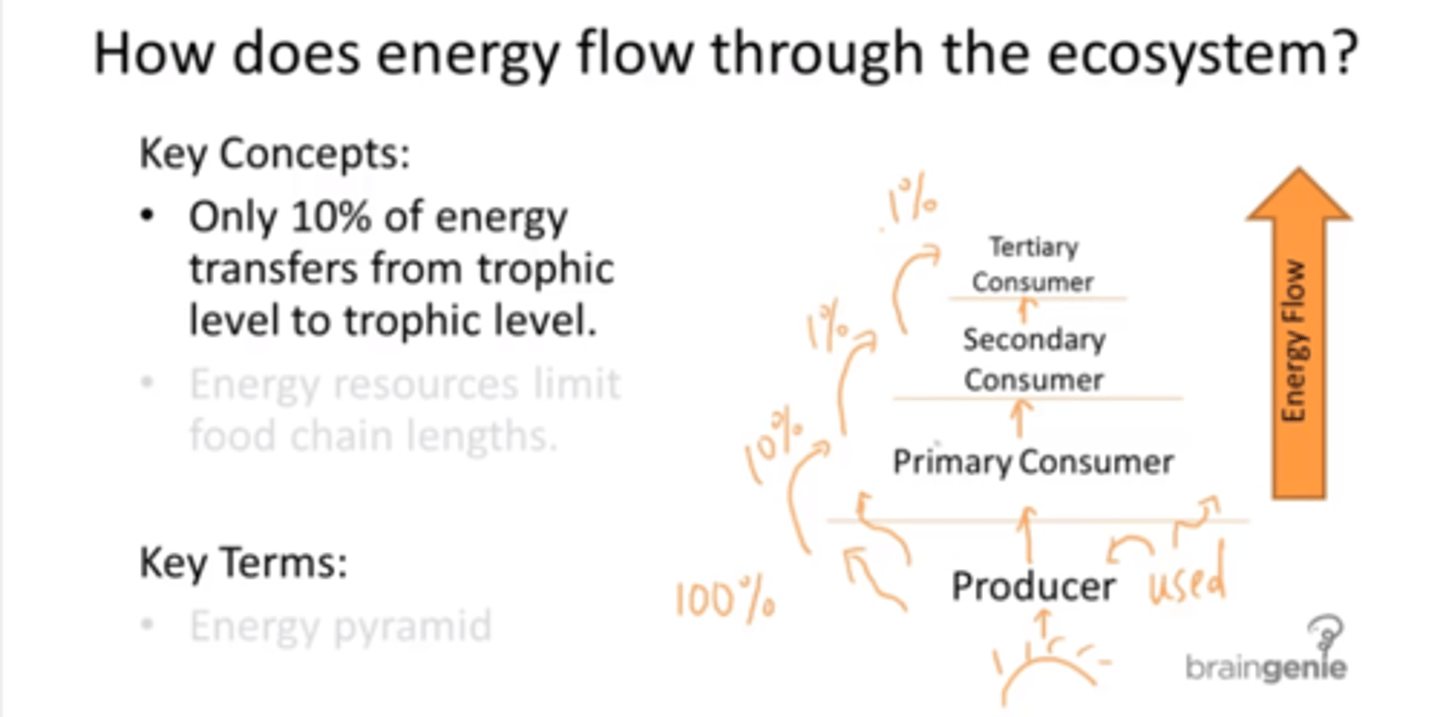
How is the tropic level represented?
Through the energy level.
Surface waters and transformed to water vapor bu the sun's energy.
Evaporation
Water evaporates from the leaves of plants due to the sun's energy.
Transpiration
Droplets return to land in the form of rain, snow, sleet.
Precipitation
Water vapor rises in the atmosphere where it cools, and condenses into droplets.
Condensation
Explain a biogeochemical cycle.
Recycling of chemical nutrients is important to life.
Organism receive chemicals as nutrients and also lose chemicals as waste products.
Chemicals are cycled between organic matter and abiotic reservation.
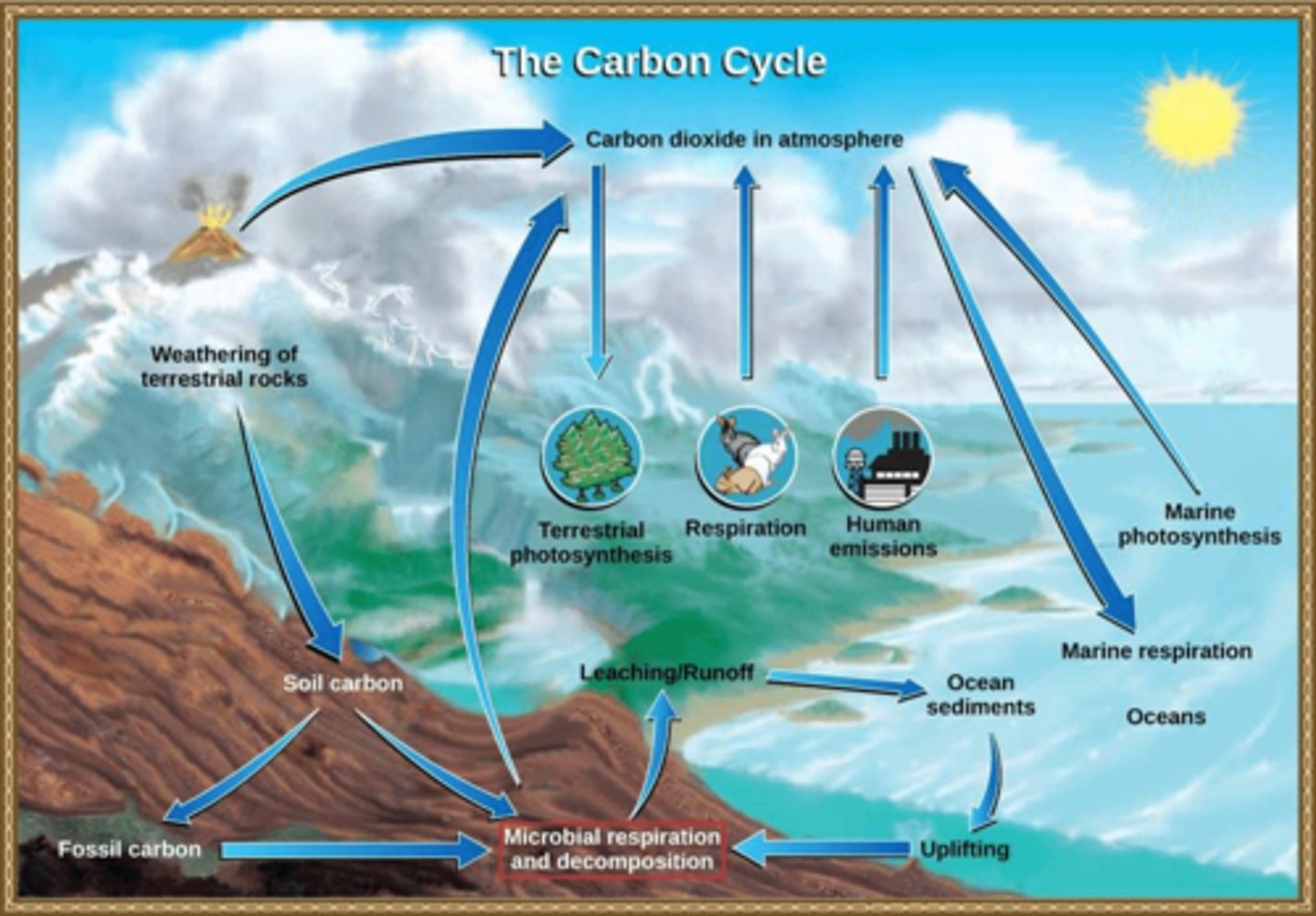
Decomposers play a central role in biogeochemical cycles, such as the carbon cycle.
What is the major ingredient of all organic molecules?
Carbon
What is the importance of the carbon cycle?
The carbon cycle depends on photosynthesis and respiration
CO2 is returned to the atmosphere by respiration
CO2 is removed by photosynthesis
What Evolution by natural selection?
describes a mechanism for how species change over time.
A leaf floating down a stream is a demonstration of water's property of
cohesion
adhesion
high specific heat
evaporation
cohesion
Two atoms of the same element with a different number of ________, are called ___________.
protons; elements
electrons; ions
neutrons; isotopes
neutrons; isotopes
When a substance readily hydrogen-bonds with and dissolves in water, it is known as "water-loving" or
hydrophilic
All atoms of an element have the same number of _______.
protons
electrons plus neutrons
protons plus neutrons
electrons
protons
What is the fundamental difference between covalent and ionic bonding?
In covalent bonding, both partners end up with filled outer electron shells; in ionic bonding, one partner ends up with full outer electron shells and the other does not.
Covalent bonding involves the giving and receiving of electrons from one atom to another; ionic bonding involves the sharing of electrons.
In a covalent bond, atoms share at least one pair of electrons to fill electron shells; in an ionic bond, one atom atoms accepts electrons from the other to fill electron shells.
Covalent bonds form between atoms of the same element; ionic bonds form between atoms of different elements.
In a covalent bond, atoms share at least one pair of electrons to fill electron shells; in an ionic bond, one atom atoms accepts electrons from the other to fill electron shells.
An atom with an electrical charge is a(n) _______.
ion
radioisotope
compound
isotope
ion
1.one pair of electrons are shared
2.attraction between oppositely charged ions
3.weak bonds that are easily broken and reformed
4.two pairs of electrons are shared
5.positively charged ion
6.negatively charged ion
_3__hydrogen bond
__1__single covalent bond
__6__anion_
_5__cation
__4__double covalent bond
_2__ionic bond
The atomic number equals the number of
protons
What is the name of this molecule?
Which part of the molecule is negatively charged? (Please type the word RED or GRAY as your answer.)
A structure formed of tissues operating together to perform a common function is a/an
Select correct answer below:
algal bloom
inductive reasoning
non-renewable resource
organ
organ
Variation is the trophic level that obtains its energy from sunlight, inorganic chemicals, or dead or decaying organic material.
True
False
False
A nucleus is the dense center of an atom made up of protons and (except in the case of a hydrogen atom) neutrons.
True
False
True
What is a neritic zone?
Select correct answer below:
a basic unit of matter that cannot be broken down by normal chemical reactions
a biome dominated by grasses and herbaceous plants due to low precipitation, periodic fires, and grazing
the part of the ocean that extends from low tide to the edge of the continental shelf
a community of living organisms and their interactions with their abiotic environment
the part of the ocean that extends from low tide to the edge of the continental shelf
What is a proton?
Select correct answer below:
a part of an experiment that can vary or change
a group of similar cells carrying out the same function
describes a substance that dissolves in water; water-loving
a positively charged particle that resides in the nucleus of an atom; has a mass of 1 and a charge of +1
a positively charged particle that resides in the nucleus of an atom; has a mass of 1 and a charge of +1
What is population?
Select correct answer below:
all of the alleles carried by all of the individuals in the population
the bed and banks of a river or stream
the part of the ocean that begins offshore where the water measures 200 m deep or deeper
all individuals within a species living within a specific area
all individuals within a species living within a specific area
What is a tropical rainforest?
Select correct answer below:
a region where fresh water and salt water mix where a river discharges into an ocean or sea
the point of origin of a river or stream
an organism at the top of the food chain
a biome found near the equator characterized by stable temperatures with abundant and seasonal rainfall in which trees form the structurally important vegetation
a biome found near the equator characterized by stable temperatures with abundant and seasonal rainfall in which trees form the structurally important vegetation
What is called the bed and banks of a river or stream?
Select correct answer below:
base
primary consumer
falsifiable
channel
channel
What is descriptive science?
a unicellular organism that lacks a nucleus or any other membrane-bound organelle
a biome located in the tropics with an extended dry season and characterized by a grassland with sparsely distributed trees
the study of living organisms and their interactions with one another and their environments
a form of science that aims to observe, explore, and find things out
a form of science that aims to observe, explore, and find things out
Cation is a positive ion formed by losing electrons.
True
False
True