Respiratory System Pt.2
 Call Kai
 Learn
Learn Practice Test
 Spaced Repetition
 Match
Match Flashcards
 Knowt Play
1/27

There's no tags or description
Looks like no tags are added yet.
Name | Mastery | Learn | Test | Matching | Spaced | Call with Kai | Chat |
|---|
No analytics yet
Send a link to your students to track their progress
28 Terms
Respiration
4 continuous processes
Pulmonary ventilation
Alveolar gas exchange
Gas transport
Systemic gas exchange
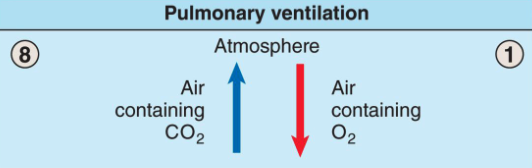
Pulmonary ventilation
Movement of gases between atmosphere and alveoli (breathing)
Involved 4 organ systems: respiratory, skeletal, muscular, and nervous
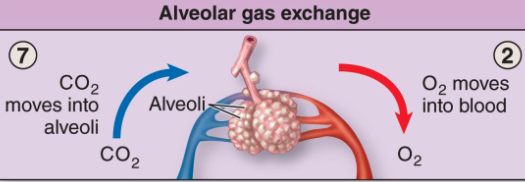
Alveolar Gas Exchange
Exchange of gases between the alveoli and the blood. Exclusively in the lungs
Oxygen diffuses from alveoli into the blood, CO2 transports out
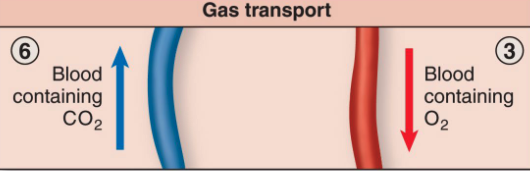
Gas Transport
Movement of gases in the blood between the lungs and erythrocytes
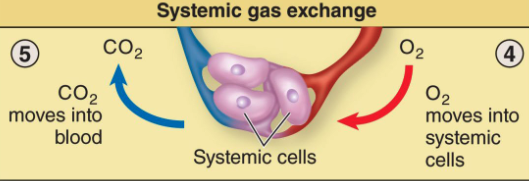
Systemic Gas Exchange/Internal Respiration
Exchange of gases between blood & systemic cells. All throughout the body
Oxygen diffuses from blood into cells/tissues, CO2 transports out
Oxygen diffuses from capillaries (blood) into cells because PO2 is higher in capillaries than in the cells
Carbon dioxide diffuses from cells into capillaries because PCO2 is higher in the cells
Expiration (Thoracic Pressure)
As the diaphragm and external intercostals relax, the volume in the thoracic cavity decreases → increase in both intrapulmonary & intrapleural pressures
When intrapulmonary > atmospheric pressure, the air is forced out of alveoli into the atmosphere
Inspiration (Thoracic Pressure)
As the diaphragm and external intercostals contract, the volume in the thoracic cavity increases → decrease in both intrapulmonary & intrapleural pressures
When intrapulmonary < atmospheric pressure, the air move from atmosphere into the lungs
Breathing Mechanics
Autonomic nuclei triggers skeletal muscles to contract & relax → change in the thoracic cavity volume
Volume changes → pressure change leads to gradient establishes between the lungs and atmosphere
Intrapulmonary Pressure
Pressure exerts by the alveoli within the lungs (alveolar volume)
Intrapleural Pressure
Pressure exerts within the pleural cavity
Always lower than intrapulmonary pressure so the lungs remain inflated
The serous fluid in the pleural cavity create surface tension → the lungs cling to the chest wall as they expand (outward pull)
This inward & outward pull of the lungs create a vacuum and is the main source of the pressure
Lungs remain inflated as long as intrapleural < intrapulmonary
Ventral Respiratory Group
Forced breathing initiates by neutral impulses for inspiration & expiration
Chemoreceptors (Influenced By)
Breathing rate and depth influence by blood CO2 levels
Increase blood CO2 → increase breathing rate
Airflow
Amount of air passes into and out of the lungs with each breath
Resistance
What opposes airflow
Decrease in chest wall and lung elasticity
Change in bronchiole diameter
Collapse of alveoli, the production of pulmonary surfactant decreased (premature infants)
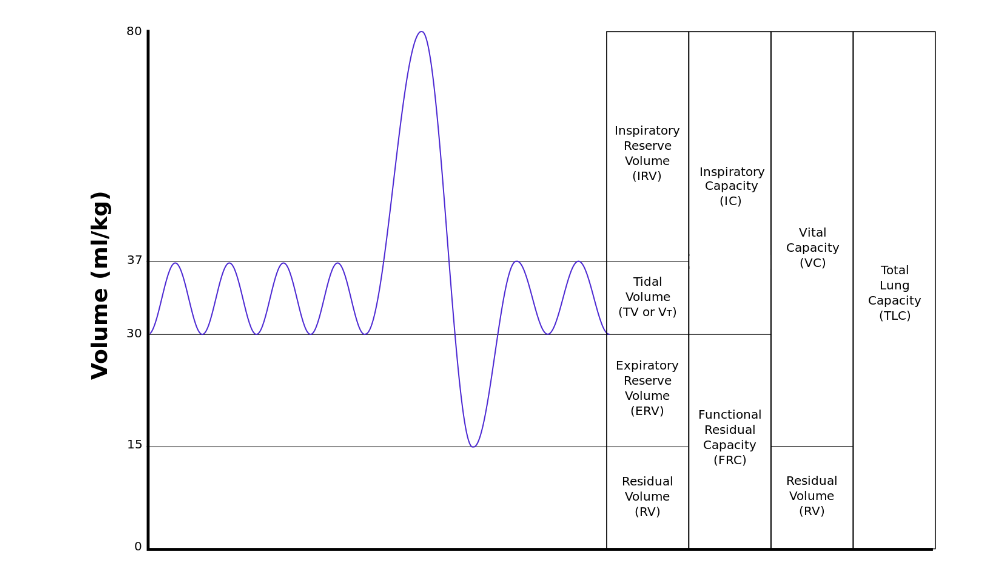
Tidal Volume
Amount of air inhaled or exhaled per breath during quiet breathing
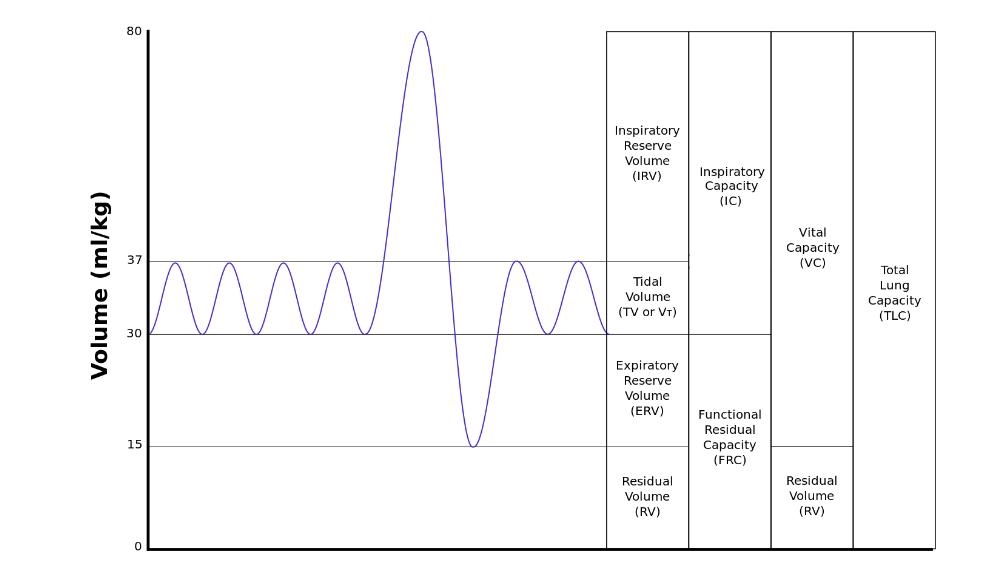
Inspiratory Reserve Volume (IRV)
Maxiumum amount of air that can be inhaled beyond tidal volume
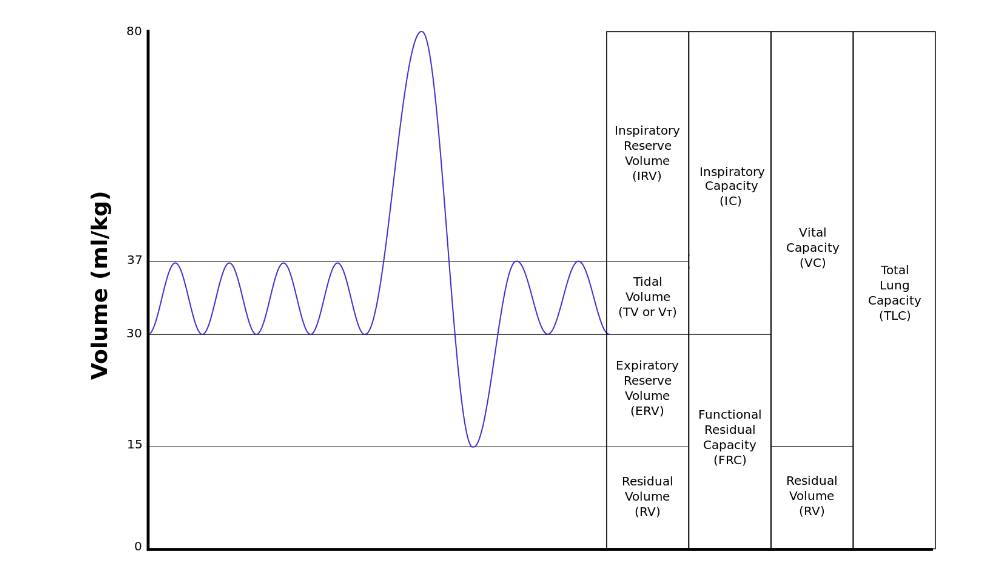
Expiratory Reserve Volume (ERV)
Maximum amount of air that can be exhaled beyond tidal volume
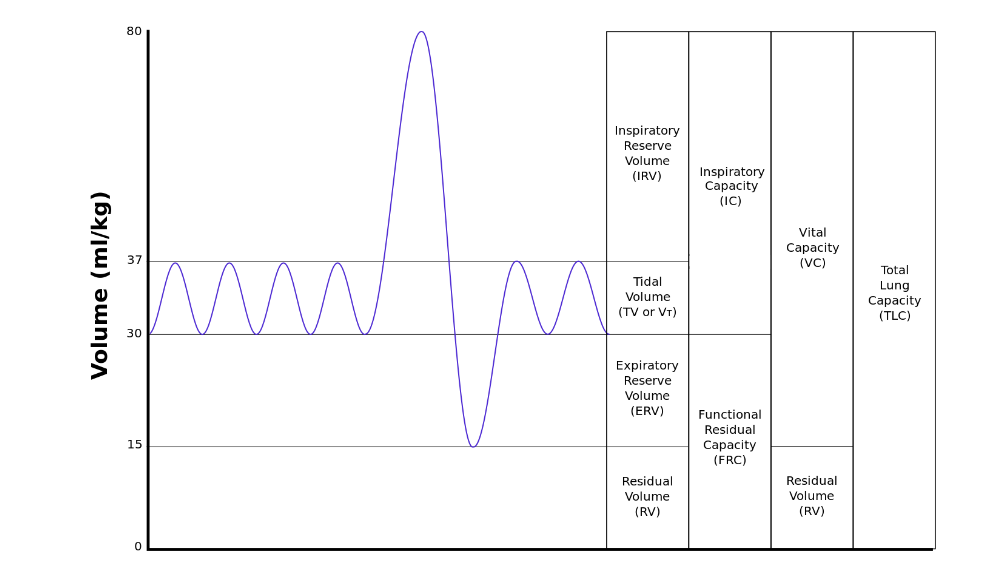
Residual Volume (RV)
Amount of air left in the lungs after forceful expiration (beyond ERV)
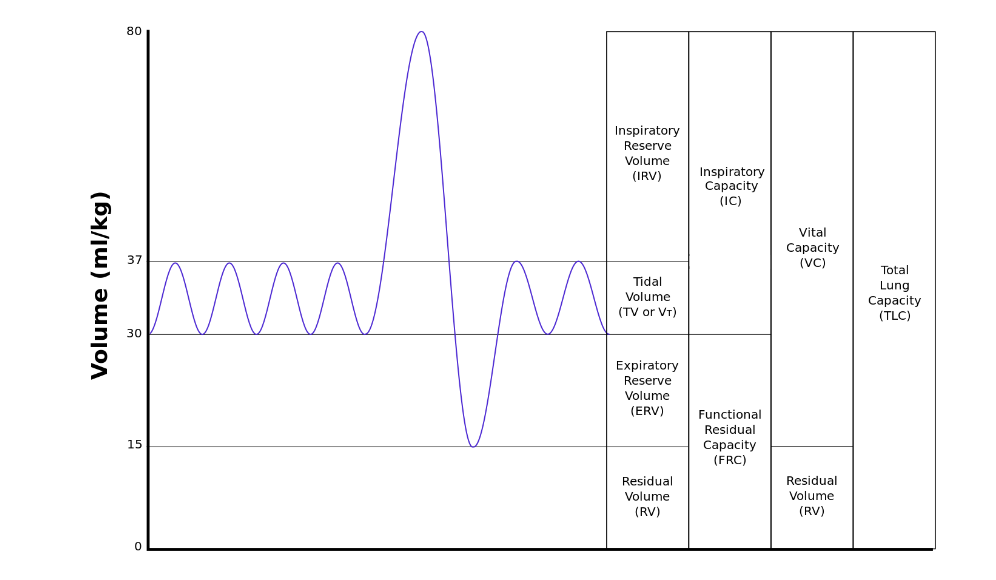
Vital Capacity (VC)
Represents amount of air an individual can exchange through forced breathing
TV + IRV + ERV
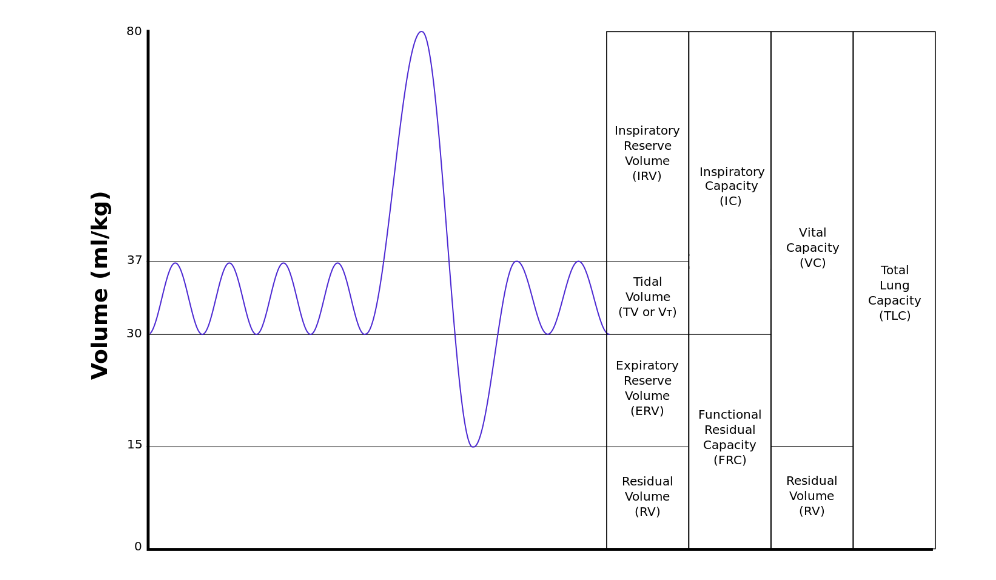
Total Lung Capacity (TLC)
Maximum amount of air the lungs can hold
TV + IRV + ERV + RV
Oxygen Transport
98% of blood’s oxygen transported by the heme group in the hemoglobin
2% of soluble oxygen is dissolved in plasma
Carbon Dioxide Transport
70% of CO2 combines with water to form bicarbonate ion and diffuses into plasma
23% attached to globin portion of hemoglobin
7% dissolved in the plasma
Hemoglobin
Has 4 iron atoms, which means it can bind to maximum of 4 oxygen molecules
As PO2 increases, hemoglobin saturation increases
High partial pressure of oxygen favors loading of O2 onto Hb
Low PP favors unloading of O2 from Hb
pH on Hemoglobin
acidic pH favors unloading of O2 from Hb. Proton binds to Hb and alter it’s structure
basic pH favors loading of O2 from Hb. Hb becomes deprotonated and promote oxygen binding
Increased CO2 → increased H+ → increased O2 from hemoglobin
Respiratory System
Exchange of gases between the atmosphere and lungs
Skeletal & Muscular Systems
Alter the volume → change in pressure → air moves in & out of the lungs
Nervous System
Innervate & coordinates the muscle of breathing
Cardiovascular System
Transport oxygen and carbon dioxide between the lungs & cells