Quantitative Methods- Definitions and Formulas - CFA L1
 Call Kai
 Learn
Learn Practice Test
 Spaced Repetition
 Match
Match Flashcards
 Knowt Play
1/108

There's no tags or description
Looks like no tags are added yet.
109 Terms
Equilibrium Interest Rate
Required rate of return for a particular investment, in the sense that the market rate of return is the return that investors and savers require to get them to willingly lend their funds.
Real risk-free rate
theoretical rate on a single-period loan that contains no expectation of inflation and zero probability of default.
Time preference
the degree to which current consumption is preferred to equal future consumption. Represented by the real-risk free rate
Nominal risk free rate
Nominal risk-free rate = real risk free rate + expected inflation rate + default risk premium + liquidity risk premium + maturity premium
Default risk
This is the risk that a borrower will not make the promised payments in a timely manner.
Liquidity Risk
This is the risk of receiving less than fair value for an investment if it must be sold quickly for cash.
Maturity risk
the prices of longer-term bonds are more volatile than those of shorter-term bonds. Longer-maturity bonds have more maturity risk than shorter-term bonds and require a maturity risk premium.
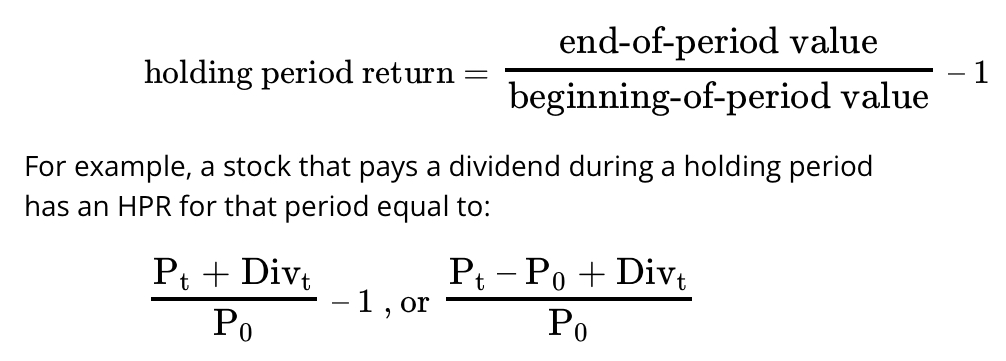
Holding period return (HPR)
the percentage increase in the value of an investment over a given period
Arithmetic mean return
the simple average of a series of periodic returns

Geometric mean return
a compound rate. When periodic rates of return vary from period to period, the geometric mean return will have a value less than the arithmetic mean return

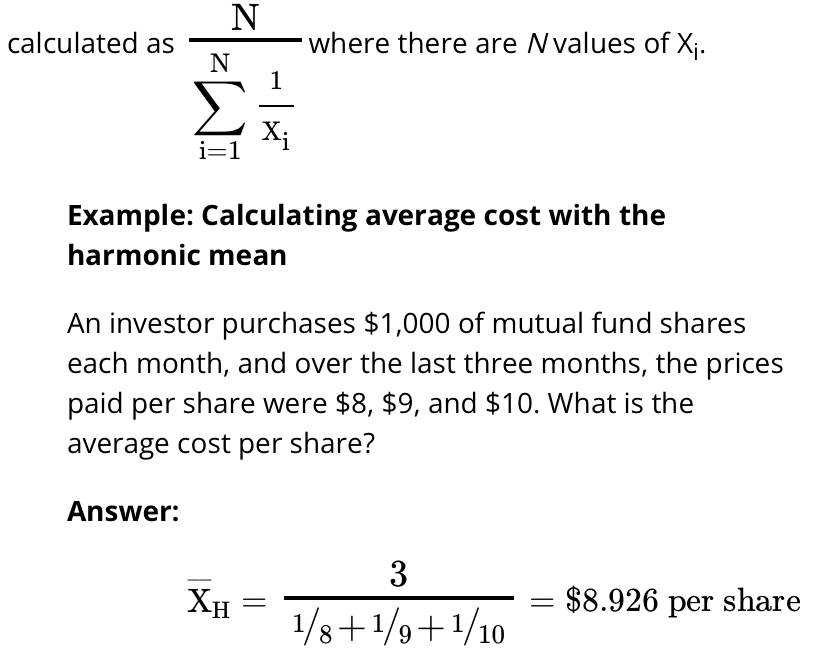
Harmonic mean
used for certain computations, such as the average cost of shares purchased over time
Money weighted return
applies the concept of the internal rate of return (IRR) to investment portfolios. An IRR is the interest rate at which a series of cash inflows and outflows sum to zero when discounted to their present value. That is, they have a net present value (NPV) of zero. defined as the IRR on a portfolio, taking into account all cash inflows and outflows. The beginning value of the account is an inflow, as are all deposits into the account. All withdrawals from the account are outflows, as is the ending value.
Time weighted rate of return
measures compound growth and is the rate at which $1 compounds over a specified performance horizon. Time-weighting is the process of averaging a set of values over time. The annual time-weighted return for an investment may be computed by performing the following steps:
Step 1: | Value the portfolio immediately preceding significant additions or withdrawals. Form subperiods over the evaluation period that correspond to the dates of deposits and withdrawals. |
Step 2: | Compute the holding period return (HPR) of the portfolio for each subperiod. |
Step 3: | Compute the product of (1 + HPR) for each subperiod to obtain a total return for the entire measurement period [i.e., (1 + HPR)1 × (1 + HPR)2 . . . (1 + HPR)n] – 1. If the total investment period is greater than one year, you must take the geometric mean of the measurement period return to find the annual time-weighted rate of return. |
Annualized Return (formula)

Present value of a future cash flow (formula)
because an increase in the frequency of compounding increases the effective interest rate, it also increases the future value of a given cash flow and decreasesthe present value of a given cash flow

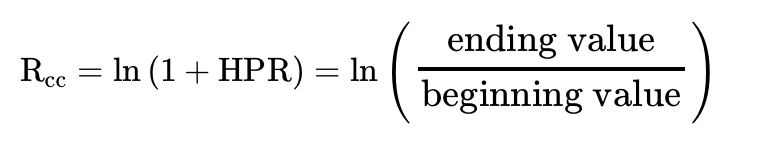
Continuously Compounded Return (formula)
Price relative
end-of-period value divided by the beginning-of-period value
Gross return
total return on a security portfolio before deducting fees for the management and administration of the investment account
Net return
return after these fees have been deducted
Pre-tax nominal return
return before paying taxes
After-tax nominal return
return after the tax liability is deducted
Real return
nominal return adjusted for inflation

Leveraged return
a return to an investor that is a multiple of the return on the underlying asset

Pure Discount Instrument
the investor pays less than the face value to buy the instrument and receives the face value at maturity. For example a zero coupon bond
Yield to Maturity
the discount rate applied to the face value
Fixed coupon bond
the investor receives a cash interest payment each period in addition to the face value at maturity
Coupon rate
percentage of the face value and determines the amount of the interest payments
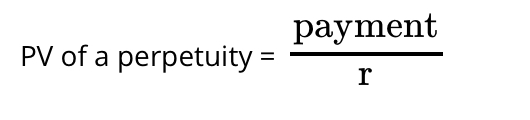
Perpetual bonds (perpetuities)
bonds that have no maturity date
PV of a perpetuity (formula)
Annuity instrument
An instrument that pays a level amount each period, including its maturity period. The difference between an amortizing bond and a fixed-coupon bond is that for an amortizing bond, each payment includes some portion of the principal
Annuity payment (formula)

Preferred stock (definition and formula)
pays a fixed dividend that is stated as a percentage of its par value (similar to the face value of a bond)

Common stock
a residual claim to a company's assets after it satisfies all other claims
Constant growth DDM / Gordon growth model (definition and formula)
Assume a constant future dividend and a constant growth rate of dividends

Multistage DDM
Assume changing dividend growth rates

Cash flow additivity principle
the fact that the PV of any stream of cash flows equals the sum of the PVs of the cash flows
No-arbitrage principle (law of one price)
if two sets of future cash flows are identical under all conditions, they will have the same price today (or if they don't, investors will quickly buy the lower-priced one and sell the higher-priced one, which will drive their prices together)
Forward interest rates
the interest rate for a loan to be made at some future date. 1y1y is the rate for a 1-year loan to be made one year from now; 2y1y is the rate for a 1-year loan to be made two years from now; 3y2y is the 2-year forward rate three years from now; and so on
Spot interest rate
interest rate for a loan to be made today
Exchange rate
the price of one country's currency in terms of another country's currency
Price currency
Numerator in exchange rate
Base currency
Denominator in interest rate
Option
the right, but not the obligation, to buy or sell an asset on a future date for a specified price
Binomial model
Approach to valuing options. based on the idea that, over the next period, some value will change to one of two possible values. To construct a one-period binomial model for pricing an option, we need the following:
A value for the underlying asset at the beginning of the period
An exercise price for the option; the exercise price can be different from the value of the underlying, and we assume the option expires one period from now
Returns that will result from an up-move and a down-move in the value of the underlying over one period
The risk-free rate over the period
Arithmetic Mean
sum of the observation values divided by the number of observations
Median
midpoint of a dataset
Mode
value that occurs most frequently in a dataset
Unimodal
When a distribution has one value that appears most frequently.
Trimmed Mean
excludes a stated percentage of the most extreme observations. A 1% trimmed mean, for example, would discard the lowest 0.5% and the highest 0.5% of the observations.
Winsorized Mean
Instead of discarding the highest and lowest observations, we substitute a value for them. To calculate a 90% winsorized mean, for example, we would determine the 5th and 95th percentile of the observations, substitute the 5th percentile for any values lower than that, substitute the 95th percentile for any values higher than that, and then calculate the mean of the revised dataset.
Quantile
general term for a value at or below which a stated proportion of the data in a distribution lies (i.e quartile, quintile, decile, percentile).
Interquartile Range
difference between the third quartile and the first quartile.
Box and Whisker Plot
In a box and whisker plot, the box represents the central portion of the data, such as the interquartile range. The vertical line represents the entire range

Dispersion
the variability around the central tendency.
Range
distance between the largest and the smallest value in the dataset
Mean Absolute Deviation (MAD)
the average of the absolute values of the deviations of individual observations from the arithmetic mean

Sample Variance (S²)
the measure of dispersion that applies when we are evaluating a sample of n observations from a population

Standard Deviation (Formula/Answer)

Relative Dispersion
the amount of variability in a distribution around a reference point or benchmark. Relative dispersion is commonly measured with the coefficient of variation (CV)
Coefficient of Variation (CV) (Formula)
Measure of relative dispersion

Target Downside Deviation / Target Semideviation (Formula)
A measure of only the downside risk

Skewness
the extent to which a distribution is not symmetrical
Positively Skewed Distribution
characterized by outliers greater than the mean (in the upper region, or right tail). A positively skewed distribution is said to be skewed right because of its relatively long upper (right) tail
Negatively Skewed Distribution
has a disproportionately large amount of outliers less than the mean that fall within its lower (left) tail. A negatively skewed distribution is said to be skewed left because of its long lower tail.
Sample Skewness
the sum of the cubed deviations from the mean divided by the cubed standard deviation and by the number of observations

Kurtosis
a measure of the degree to which a distribution is more or less peaked than a normal distribution. The computed kurtosis for all normal distributions is three.
Leptokurtic
a distribution that is more peaked than a normal distribution
Platykurtic
a distribution that is less peaked, or flatter than a normal one
Mesokurtic
has the same kurtosis as a normal distribution
Excess Kurtosis
A distribution is said to exhibit excess kurtosis if it has either more or less kurtosis than the normal distribution. The computed kurtosis for all normal distributions is three. Statisticians, however, sometimes report excess kurtosis, which is defined as kurtosis minus three. Thus, a normal distribution has excess kurtosis equal to zero, a leptokurtic distribution has excess kurtosis greater than zero, and platykurtic distributions will have excess kurtosis less than zero
Sample Kurtosis (Formula)

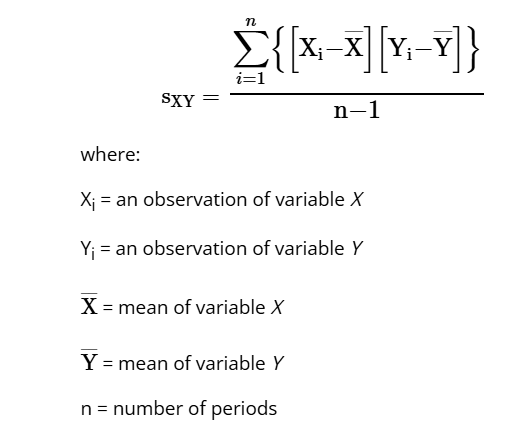
Covariance
measure of how two variables move together
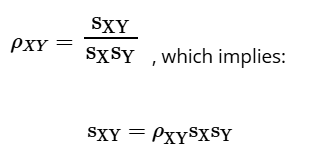
Correlation
A standardized measure of the linear relationship between two variables
Spurious Correlation
correlation that is either the result of chance or present due to changes in both variables over time that is caused by their association with a third variable
Expected Value
the weighted average of the possible outcomes for the variable
Conditional Expected Values
expected values contingent on the outcome of some other event
Bayes Formula
Used to update a given set of prior probabilities for a given event in response to the arrival of new information

Expected Return of a Portfolio
when composed of n assets with weights, wi, and expected returns, Ri, can be determined using the following formula

Portfolio Variance (formula)

Shortfall Risk
the probability that a portfolio value or return will fall below a particular target value or return over a given period
Roy’s Safety First Criterion
the optimal portfolio minimizes the probability that the return of the portfolio falls below some minimum acceptable level. This minimum acceptable level is called the threshold level
Safety First Ration (formula)

Lognormal Distribution
generated by the function ex, where x is normally distributed. Because the natural logarithm, ln, of ex is x, the logarithms of lognormally distributed random variables are normally distributed

Monte Carlo Simulation
technique based on the repeated generation of one or more risk factors that affect security values to generate a distribution of security values
Resampling
another method for generating data inputs to use in a simulation. To conduct resampling, we start with the observed sample and repeatedly draw subsamples from it, each with the same number of observations
Bootstrap Resampling
draw repeated samples of size n from the full dataset, replacing the sampled observations each time so that they might be redrawn in another sample
Probability Sampling
selecting a sample when we know the probability of each sample member in the overall population
Random Sampling
each item is assumed to have the same probability of being selected
Nonprobability Sampling
based on either low cost and easy access to some data items, or on using the judgment of the researcher in selecting specific data items
Systematic Sampling
selecting every nth member from a population
Stratified Random Sampling
uses a classification system to separate the population into smaller groups based on one or more distinguishing characteristics. From each subgroup, or stratum, a random sample is taken and the results are pooled. The size of the samples from each stratum is based on the size of the stratum relative to the population.
Cluster Sampling
assuming that each subset (cluster) is representative of the overall population with respect to the item we are sampling. For example, we may have data on personal incomes for a state's residents by county. The data for each county is a cluster
One-Stage Cluster Sampling
a random sample of clusters is selected, and all the data in those clusters comprise the sample
Two-Stage Cluster Sampling
random samples from each of the selected clusters comprise the sample
Convenience Sampling
selecting sample data based on ease of access, using data that are readily available
Judgmental Sampling
samples for which each observation is selected from a larger dataset by the researcher, based on one's experience and judgment
Central Limit Theorem
for simple random samples of size n from a population with a mean µ and a finite variance σ2, the sampling distribution of the sample mean −x approaches a normal probability distribution with mean µ and a variance equal to σ²/n as the sample size becomes large
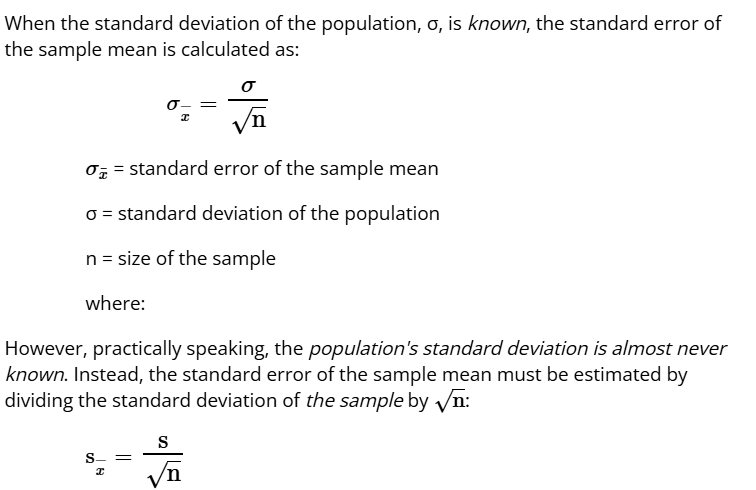
Standard Error of the Sample Mean
the standard deviation of the distribution of the sample means
Jackknife Resampling
calculates multiple sample means, each with one of the observations removed from the sample
Hypothesis
a statement about the value of a population parameter developed for the purpose of testing a theory or belief