lecture 5- experimental design
 Studied by 0 people
 Call with Kai
 Learn
Learn Practice Test
 Spaced Repetition
 Match
Match Flashcards
 Knowt Play
1/12

There's no tags or description
Looks like no tags are added yet.
Name | Mastery | Learn | Test | Matching | Spaced | Call with Kai |
|---|
No study sessions yet.
13 Terms
How can an experiment support causal claims?
if we observe a change in the DV after ONLY the IV was changed, the change must be due to the change in IV
What are confounding variables?
An extraneous variable (not being investigated) that varies systematically with the IV and can explain changes in the DV.
Examples:
ppt characteristics
Situational variables e.g. time of day, environment
What are experimenter expectancy effects?
a special type of confounding variable that varies with IV and explains differences in DV
Occurs when an experimenter’s expectations about how ppts should behave in experiment affects how they behave.
What is the subject expectancy effect?
confounding variable
Occurs when ppts’ knowledge or assumptions about hypothesis influences their behaviour
How do you deal with confounding variables?
keep ppt characteristics between groups the same
Keep situational characteristics the same
Keep ppt and experimenter expectations the same
Standardise procedure
Blinding
Random allocation design
What is standardisation?
Keeping research procedures identical for all ppts.
standardisation of study environment
Standardisation of instructions
Standardisation of stimulus material in each condition
What is blinding?
Blinding protects against subject and experimenter expectancy effects.
double-blind study = neither experimenters nor ppts know what group they are allocated to
Single-blind study = only ppts are naive to condition they are in
What is random allocation design?
ppts are randomly assigned to groups
No reason to assume that ppts with one characteristic would be more/less likely to end up in one of the groups
Groups are expected to be constant with respect to extraneous variables.
What do you use when random allocation is impossible?
natural groups design- use naturally occurring groups e.g. smoker/non-smoker. Does not keep potential confounders constant.
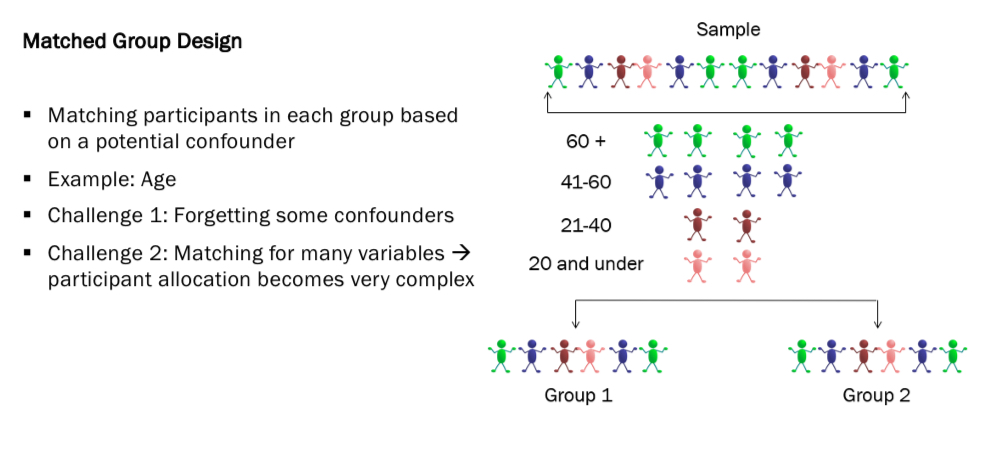
Matched groups design- matching ppts in each group based on a potential confounder
What are the confounding variables in within-subjects designs?
time
Order effects- boredom, practice, habituation, sensitisation, adaptation, comparison
How do you deal with confounding variables in within-subjects design?
Counterbalancing.
Divide ppts into 2 groups
In one group, condition 1 is administered first, in the other group condition 2 is administered first.
Incomplete vs complete within-subjects design?
Incomplete within-subjects design
each ppt experiences each condition only once
Order of administration varies between ppts
Practise effects are balanced between ppts
Complete within-subjects design
each ppt experiences each condition multiple times
Order of administration varies within ppts
Practise effects are balanced within ppts
When do counter-balancing methods differ?
It depends on how many permutations (combinations) of conditions are being considered.
if there aren’t many conditions, it is easy to do all possible orders
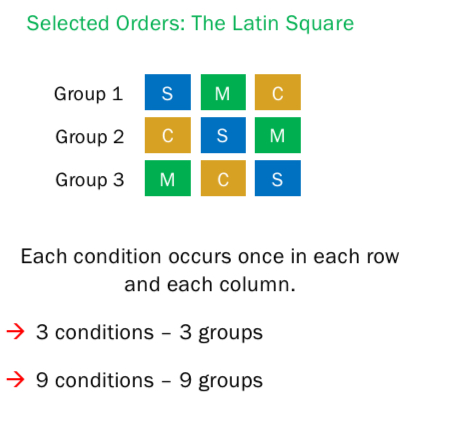
When there is a large number of conditions, the number of possible permutations becomes unmanageable, so use selected orders e.g. the Latin Square