Chapter 13: Viruses, Viroids, and Prions
 Studied by 0 people
 Call Kai
 Learn
Learn Practice Test
 Spaced Repetition
 Match
Match Flashcards
 Knowt Play
1/79

There's no tags or description
Looks like no tags are added yet.
Name | Mastery | Learn | Test | Matching | Spaced |
|---|
No study sessions yet.
80 Terms
Virus
Genetic information (DNA or RNA) contained within a protective protein coat that allows it to attach to specific receptor sites on the host; intracellular, and acellular, infectious agents incapable of metabolism, replication, or motility outside the cell (no ribosomes); hijacks the host cell to reproduce and requires host to live; found in all environments and infect bacteria (bacteriophages), plants, animals, and even fungi but likely only infect only a single species each; can only be visualized with an electron microscope
Viroid
An infectious agent of plants that consists only of RNA; only infect plants
Prions
An infectious protein that causes a fatal neurodegenerative disease; misfolded protien resistant to degradation by host cell protease, causing molecules to become insoluable (clumping); contains no nucleic acid; accumulate in neural tissue for certain disease, neurons die and brain function deteriorates as tissues develop holes; infected proteins are referred to as PrPsc (prion protein, scrapie), normal proteins are PrPc (prion protein, cellular); resistant to heat and chemical treatments
Prion protein scrapie (PrPsc)
Infectious form of prion proteins that accumulate and changes the folding of normal proteins, converting them

Transmissible spongiform encephalopathies (TSEs)
Group of fatal neurodegenerative diseases in which brain tissue develops sponge-like holes
Bacteriophages
A virus that infects bacteria; also called phages; contain tail fibers for attachment to the host receptor sites; typically nonenveloped
Virion
A complete virus in its inert non-replicating form (DNA or RNA); also referred to as a viral particle; can be linear or circular

Capsid
Protein coat that surrounds the nucleic acid of a virus, protecting it from enzymes and toxic chemicals in the environment (DNA or RNA); composed of precisely arranged of capsomeres

Capsomeres
Precisely arranged identical protein subunits that compose the capsid
Nucleocapsid
Viral nucleic acid and its protein coat
Spikes
Structures on the outside of the virion that bind to host cell receptor; commonly found on animal virus protein structures
Non-enveloped viruses
Viruses that do not contain an outer lipid bilayer (envelope); also called naked viruses; more resistant to infection; mature in the cytoplasm
Enveloped viruses
Viruses that have a lipid bilayer surrounding their nucleocapsid originating from the host cell; contain a viral matrix protein that links the envelope to the nuclecapsid; more suseptable to disinfectants due to their damaging nature to the envelope, removing their spikes (making viruses noninfectious); gain their envelope as they exit the cell
Classification of viruses
classified by genomic structure (nucleic acid type (DNA/RNA), single/double stranded), hosts infected, and virus shape
International Committee of Taxonomy Viruses (ICTV)
Maintains online database that publises reports describing the classification, nomenclature, and key features of recognized viruses
Arboviruses
Arthropod-borne RNA virus, carried by vectors such as mosquitoes who tranmit pathogens from one host to another
Productive infection
Virus infection in which more viral particles are produced; some types have the potential to kill their host; a possible outcome of phage replication
Latent state
The state of a phage when its DNA is integrated into the genome of the host bit remains silent within the cell; a possible outcome of phage replication

Lytic phages
Bacteriophages that lyse their host and exit the cell, killing the cell; also known as virulent phages

Attachment stage
Attatchment proteins (spikes) of a virion bind to specific host receptors (glycoproteins on the membrane)
Tissue tropism
The limitation of a particular virus to only one or a certain amount of cells and tissue types because a virions is limited to specific receptors

Host range
The range of cell types, tissues, and species that a virus can infect; explains the resistance of some animals to certain diseases
Penetration stage
Genome entry/uncoating via membrane fusion or endocytosis;
Membrane fusion (penetration)
One mechanism in which enveloped viruses enter the host cell; the lipid envelop of the virion fuses with the host membrane after attachment; nucleocapside is released directly into the host’s cytoplasm
Endocytosis (penetration)
One mechanism in which enveloped (and non-enveloped) viruses enter the host cell; virion binds to the endocytosis receptor, causing the cell to take it up
Uncoating
The separation of the protein coat from the nucleic acid of the virion typically in the host cytoplasm; may occur simultaneously with entry or after the nucleocapsid nears the site of intracellular viral replication (nucleus)
Viral replication requirements
1) Expression of viral genes and 2) synthesis of multiple copies of the viral genome; expression produces structureal and catalytic proteins (e.g. capsid proteins) and other enzymes required for replication
Replication schemes of viruses
DNA virus, RNA virus, and reverse-transcribing viruses
DNA viruses
Replicate in the host’s nucleus and uses its components for DNA synthesis and gene expression; often code their own DNA polymerase, allowing them to replicate even without host cell replication being active

RNA viruses
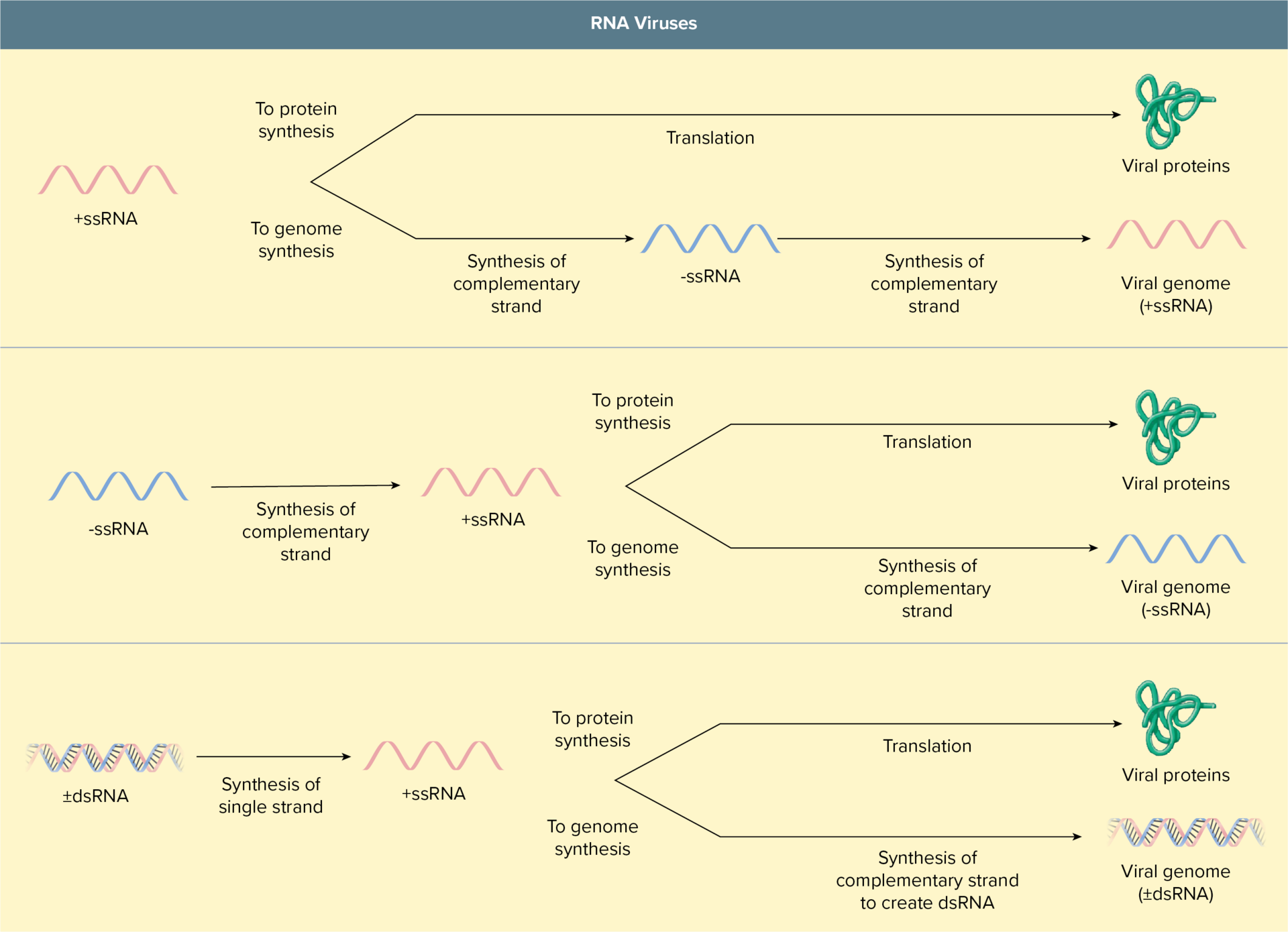
Replicate in the host’s cytoplasm, requiring virally encoded RNA polymerase (replicase); some contain segmented genomes (containing more than one piece of RNA), resulting in reassortment if two stains of a virus effect the same host
Replicase
Any virally encoded enzyme that replicates the genome of an RNA virus; when RNA-dependent RNA polymerase is used to replicate the genome of an RNA virus; lack proofreading ability, making more mistakes than DNA polymerases (mutations)
RNA-dependent RNA polymerase
Uses an RNA template to synthesize a new RNA strand
DNA-dependent RNA polymerase
Synthesizes a strand of RNA from a DNA template
Antigenic drift
Slight changes in a surface antigen of influenza or another virus that render antibodies made against the previous version only partially protective; gene segment reassortment that occurs when two different strains of a segmented virus enter the same cell; a mix of sigments of two strains is created

Reverse transcriptase
Enzyme that synthesizes DNA using RNA as a template; an RNA-dependent DNA polymerase that synthesizes DNA from an RNA template
Transcriptase
An enzyme that uses an RNA molecule as a template to make a complementary copy of DNA
Synthesis stage
Host machinery produces viral components; RNA viruses use reverse transcriptase (replicase)
Assembly & Release stage
virions self-assemble; enveloped viruses bud off, naked viruses cause cell lysis
Assembly (maturation) stage
Requires packaging of nucleic acid into the capsid (encapsidation), ensuring that only viral nucleic acid is incorporated
Release stage
Enveloped viruses are released when the virus acquires its envelope (budding) and non-enveloped viruses are released when the host cell dies usually via a normal programmed cell death (apoptosis)
Temperate phage
A bacteriophage that can either direct a productive infection that leads to host cell lysis or remain silent within the host as a prophage (phage DNA) that replicates along with the host cell genome

Lytic infection
Viral infection of a host cell with a subsequent production of more viral particles and lysis of the cell; an outcome of a temperate phage injected to a cell (productive infection)

Lysogenic infection
Infection in which the phage DNA replicates silently within the host cell as a prophage (usually integrated into the host cell chromosome) instead of directing a productive infection; an outcome of a temperate phage injected to a cell (latent state)

Medical significance of viruses
viruses cause numerous human diseases: Influenza, Measles, Rabies, HIV/AIDS, Herpes, COVID-19; some establish latent or chronic infections (Herpes simplex, Hepatitis B)
Lysogen
A bacterium that carries phage DNA (a prophage) integrated into its genome (latent)

Prophage
Latent form of a temperate phage; the phage DNA has generally been inserted into the host’s chromosome; has the potential to be excised by a phage-encoded enzyme, beginning a lytic infection
Phage-encoded repressor
Prevents expression of excision gene, maintaining the lysogenic (latent) stage; binds to the operator that controls phage expression

Phage induction
Accomplished by treating a lysogenic culture with a DNA-damaging agent (e.g. UV light); activating SOS repair that destroys the repressor, inducing excision of a phage DNA from bacterial chromosomal DNA
Lysogeny drawbacks
Lysogenic conversion and immunity to superinfection
Lysogenic conversion
A change in the properties of a bacterium, conferred by a prophage; if a toxin is encoded exclusively by phage genes, only bacterial strains with the prophage will synthesize that toxin
Generalized transduction
Type of horizontal gene transfer that can occur when a phage carries a random piece of bacterial DNA ; the phage acquires that DNA when a packaging error occurs during the assembly of phage particles; the fragments come from degradation by lytic phages during infection, the fregment is mistakenly packaged into the phage head

Transducing particle
Bacteriophage progeny that contains part of a bacterial genome instead of phage DNA due to an error during packaging; attaches to another bacterial cell and inject its containing DNA, only injecting bacterial DNA which will integrate into the recipient chromosome via homologous recombination
Specialized transduction
Type of horizontal gene transfer that can occur when a temperate phage carries specific bacterial genes, bacterial genes adjecent to the integrated phage DNA; the phage acquires those genes when an error occurs as the prophage excises from a lysogenic cell’s chromosome or the transition from a lysogenic to a lytic cycle
Steps of specialized transduction
1) Temperate phage DNA is injected into bacterial host
2) Phage DNA integrates into the host chromosome (becomes prophage)
3) Prophage is excised from the host cell chromosome to begin the lytic cycle, but instead a short piece of bacterial DNA adjacent is taken and a piece of phage is left behind
4) Excised DNA replicates and becomes incorporated into phage heads, resulting in defective phage particles
5) These particles inject DNA into annother bacterial cell, inserting both phage and bacterial DNA
6) Bacterial DNA integrates into recipient genome and replicated with host DNA, eventually to be degraded

Filamentous phage
Single-stranded DNA phages that look like long fibers (filaments), causing productive infections that do not kill the host cells, but instead slow their growth

Retroviruses
Group of viruses that have a single-stranded RNA genome; their enzyme reverse transcriptase synthesizes a DNA copy that is then integrated into the host cell chromosome
Oncoviruses
Gene whose activity is involved in turning a normal cell into a cancer cell; can trigger cancer formation (e.g., HPV, Epstein–Barr virus); may arise from viral infection or DNA damage from long-term inflammation associated with chronic viral infections
Antiviral drugs
target viral enzymes (e.g., reverse transcriptase inhibitors for HIV); their interference allows for the slower progression of a viral infection, giving the host immune system enough time to eliminate the virus before illness occurs

Acute infections
An infection characterized by symptoms that develop fairly quickly and last a relatively short time; results in a burst of virions being released from infected host cells; examples include influsnza, mumps, and polio
Persistent infections
Infection in which the causative agent remains in the body for long periods of time, often without causing symptoms of disease (chronic or latent)
Chronic infection
Infections that develop slowly and persist for months or years; after initial infection (with or without symptoms), infectious virus is released with no symptoms; people can become carriers
Latent infection
Infection in which the infectious agent is present but not active.; after initial infection, virus is maintained in neurons (non-infectious) and may reactivate to produce symptoms
Provirus
Latent form of a virus in which the viral DNA is incorporated into the chromosome of the host; other virus opposite to this one do not integrate their genome, but replicate independently of the host like a plasmid
Tumor
Abnormal growth of tissue resulting from a malfunction in the normally high regulated process of cell growth; may be benign or malignant (spread)
Proto-oncogenes and tumor supressor genes
The two sets of genes that coordinate to control cell growth and division; one stimulates growth and the other inhibits it; mutations that increase one or decrease another are the most common cause of cancer (abnormal and/or uncontrolled cell growth)
Oncogene
Proto-oncogene whose activity is involved in turning a normal cell into a cancer cell, promoting uncontrolled growth (tumor formation); development of this gene is a result of numerous events including spontaneous and induced mutation *(multiple changes at different sites of DNA regulatory gene sequences
Oncolytic viruses
Viruses that destroy cancer cells directly or by inducing an immune response against tumor cells; specifically target and kill cancer cells, some by directly multiplying within them (inducing lysis) and others by indirectly stimulating the host’s cancer-fighting immune cells

Plaque assays
Method used to measure the number of viral particles present in a sample; demonstrate how bacteriophages are cultivated
Plaque assay stages
1) Inoculate a melted/cooled soft agar medium with a bacterial host and phage-containing specimen
2) Pour the mixture over the surface of a nutrient agar plate, creating a top layer over the base plate
3) Allow the bacter to multiply in the agar, where it will produce a layer of growth (lawn)
4) Lytic phages of the specimen infect bacteria and lyse those cells (progeny phage)
5) Progeny phage created will fuse though the soft agar, infecting and lysing neighboring bacteria
6) Clear zones develop in the lawn from lysis of the bacterial host cells
7) Repeated with several dilutions
Cell culture
Cultivation of animal or plant cells in the laboratory; also referred to as tissue culture
Cytopathic effects
Observable changes in the morphology of virally infected cells in vitro, a virus propagated in cell culture; examples include cell rounding and syncytia formation; characteristics of particular viruses
Inclusion body
Microscopically visible structure within a virally infected cell, representing the site at which the virus replicates; distinct region of culture caused by an infected cell of some viruses (e.g. rabies); the site of viral replication
Quantal assay
A method that uses several dilutions of a virus culture administered to appropriate hosts to determine virus titer (number of infectious particles; dilution at which half of the inoculated hosts are infected or killed)
Hemagglutination assay
A test that relies on clumping of red blood cells to determine the relative concentration of viral particles; used to determine concentration of animal viruses in a sample; high concentrations of certain viruses that cause red blood cells to clump, occuring when indiviual viral particles attach to the surface molecules of multiple RBCs simultaneously, connecting cells to form an clumps; serial dilutions of the viral suspension are mixed with a standard amount of RBCs
Plant infection signs
Yellowing of foliage with irregular lines appearing on fruits and leaves, stunted or stimulated growth (deformation)
Plant infections
Difficult for plants to overcome due to plants lack of a specific immunity development; in severe cases, virions accumulate in enormous numbers; certain plants purposely maintained in a virus-infected state (appearance); occur by infection entrance into wound sites of the cell wall, spreading from cell to cell though interconnected cell channels (plasmodesmata) and vascular tissue (phloem)
Plant infection transmission
Infections are spread through insects, humans, and other animals who contact diseased plants (vectors) or contaminated seeds, tubers, soil, or airborne pollen