Week 3: Fitness Tests
 Call Kai
 Learn
Learn Practice Test
 Spaced Repetition
 Match
Match Flashcards
 Knowt Play
1/83

There's no tags or description
Looks like no tags are added yet.
Name | Mastery | Learn | Test | Matching | Spaced | Call with Kai | Chat |
|---|
No analytics yet
Send a link to your students to track their progress
84 Terms
Physical Fitness Tests
These are activities you can use to determine your current level of fitness.
The different activities that are designed to measure the different health and skill related fitness components that you possess.
Your Current Level of Fitness
One of the importance of fitness tests - where it will help you determine how your body is properly functioning and reacting to the loads that you place upon it at given situations.
This also sets the map for you to begin your fitness journey.
Determining that you are physically fit and well-able to perform strenuous tasks would healp you maximize your time in doing physical activities/exercises.
Overall Progress
One of the importance of fitness tests - In which you are aware where you are weak and strong at, you would be able to determine the pace at how your active lifestyle will go about. Knowing which components of fitness to exactly develop, puts you in the right track to not over-develop or under-develop any of these components.
Body Composition
It refers to your overall physical structure.
Body Composition
The tests you will do for this component of fitness will determine this through the:
Height'
Weight
Bodymass Index
and Waist-Hip Ratio Tests
Measuring Tape
Calculator
Weighing Scale
What are the materials needed for the Body Composition Fitness Tests.
Height
It refers to the total measurement of the length of your body from the head down to your feet. The units of measure used in determining your height could be in feet and inches (ft./in.) or in centimeters (cm.).
Height
Genes
Ethnicity
Gender
Are some of the factors that can affect?
Genes
This factor of height is the biggest factor that can contribute to your height’s unique measurement.
When both of your parents are tall, chances are you will inherit this trait in your genes and you can be tall as well.
This is the reason why you see people who are taller or smalled than you are.
Ethnicity
This factor of height - in which you are bron as, also determines your height. It is actually a fact that westerners possess taller height ranges compared to Asians.
Anywhere you go around the world, height differences are apparent because of unique gene types found in people’s DNA.
Gender
This factor of height - states that due to the given design of nature that we have unique tissue structures, men tend to be taller than women. Even so, men are more muscular than women.
This is because of the presence of the hormone called testosterone that are secreted within a man’s body which contribute greatly to their overall size and built.
0.0254
Comverting height in inches into meaters requires multiplying inches into what real number?
Epiphyseal growth plates.
Located at the top of your long bones (e.g. legs and arms), are __________ responsible for producing new bone tissue within your body. These are sites on your bones that are not ossified yet, allowing you to grow talled as you mature.
13-15.
Females tend to reach skeletal maturity way earlier than male bodies, their growth plates close between the ages of _____. While for males, this growth plate starts to completely ossify at around ages of 15-17
15-17
Females tend to reach skeletal maturity way earlier than male bodies, their growth plates close between the ages of 13-15. While for males, this growth plate starts to completely ossify at around ages of _____.
Weight
This sub-topic of body composition refers to the toatal measurement of how heavy or light you are in relation to the pull of gravity.
Weight
This sub-topic of body composition uses the unit of either, pounds (lbs.) or kilograms (kgs.)
2.2 lbs
1 kilogram is equal precisely to how many pounds?
Bio Electrical Analyzer (BIA)
To measure your Body Mass Index. There is a machine known as, a _________.- This is an electronic equipment that sends static electricity within the body to measure the total amount of your body tissues.
Body Mass Index or BMI
It is a measurement of your body fat based on your height and your current weight.
This test is particularly designed to help you determine your tendencies to acuire possible health related diseases (e.g. heart diseases, stroke, cancer), all based from a nationally accepted standard.
Weight (kg)/Health (m²)
The formula that you can use to calculate your BMI.
Obese (high risk)
BMI over 30 kg/m²
Overweight
BMI = 25-29.9 kg/m²
Normal Weight
BMI = 18.5 - 24.9 kg/m²
Underweight
BMI = Less than 18 kg/m²
Waist-Hip Ratio
This last test used to measure your body compostion involves the ratio between your waist and hip.
Waist-Hip Ratio
Apart from the Body Mass Index, this test is also taken to determine whether you are at high risk for diseases that are associated with fat and weight.
Measuring tape and a calculator
In calculating and measuring your waist to hip ratio, what are some of the materials you need?
Centimeters
In calculating your score in measuring your waist to hip ratio, what should me your measurement?
Waist Measurement
In order to find your natural natural _____, or the smallest circumference of your abdominal area. You should be able to locate this by looking at your abdominals in the mirror or by placing two fingers above your navel or belly button. In this measurement of the waist to hip ratio, is it referring to the hip or waist?
Hip Measurement
In measuring this part of the waist to hip ratio, this is located at the maximum circumference of your buttocks. This is the biggest bulging tip of your buttocks that can be seen better when you are in a side-view position.
Waist (cm)/Hip (cm)
To determine the waist to hip ratio, she needs to simply divide her waist measurement with her hip measurement using this formula:
Waist-Hip Ratio
Just like your BMI, this sub-component of body composition also determines how high your risks are for obtaining health related diseases.
Vary
Notice that the scores for men and women ___. This is ebcause, women tend to have more fat tissues concentrated within their body to support different bodily processes like, the development of mammary glancds and, for pregnancy aswell.
Cardiovascular Endurance
It refers to your ability to perform to perform prolonged, large muscle, dynamic exercise at different intensities.
It is also a measure of how well your heart and lungs work together to supply your body with the necessary oxygen and nutrients to function well.
What test is designed to specifically measure your overall CV Endurance. It also measures how well your heart recovers after an exercise
Step box and a stop watch
Materials needed for the 3 minute step test.
Beats Per Minute
What is the unit of measure for your heart rate?
Below Normal Zone
What zone is indicated where your heart rate is < 60 bpm.
Normal Zone
What zone is Indicated where your heart rate is between 60-100 bpm.
High Zone
What zone is indicated where your heart rate is > is 100+
The Sit and Reach Test
This test is used to measure the flexibility of your trunk, hips, and legs. If these muscles are flexible, you are able to easily bend forward and move with ease.
Yard stick, Tape measure, Mat, and a Partner
Materials for the sit and reach test.
Centimeters.
In the sit and reach test, what is the primary measurement?
High Performance
In the sit and reach table of standards:
Males: 16+ cm
Females: 17+ cm
Is classified to be _________
Good Fitness Zone
In the sit and reach table of standards:
Males: 13-15 cm
Females: 14-16 cm
Is classified to be _______
Marginal Zone
In the sit and reach table of standards:
Males: 10-12 cm
Females: 11-13 cm
Is classified to be _______
Low Zone
In the sit and reach table of standards:
Males: <9 cm
Females: <10 cm
Is classified to be _______
Hamstring Stretches
These are stretches designed to target the muscles at the back of your thighs, known collectively as, hamstrings muscles. These muscles are responsible for preventing your knees and thighs from going beyond their range of movements.
Lying Hamstring Stretch
a. From a lying position you will place both hands at the back of your right thigh.
b. Bring your right leg (RL) upward, with the sole of your foot positioned towards the ceiling.
c. Keep your left leg (LL) at a 45-degree angle, with the sole remained in contact with the floor.
d. From the initial position take an inhale.
e. As you inhale, pull your RL towards your body while keeping it straight, with the sole of the foot still positioned towards the head.
f. Hold the stretch for 20-30 seconds, then do the sequence on the left leg afterwards. Make sure to do 2 or 3 repititions for both sides.
Lying Hamstring Stretch with a towel
This next hamstring stretch is just a variation of the previous exercise. This is because, some people can barely extend their leg towards the ceiling due to inflexibility. When this happens, a towel may come in handy to help and support you in the movement.
You will be in the same position as your regular lying hamstring stretch. Place the towel at the bottom of your foot then pull your leg towards your body using the towel. Don’t forget to do the right breathing technique.
Seated hamstring stretch with one leg on the side
a. In this hamstring stretch, you will be on a seated position on the floor instead of lying down.
b. From the initial position, extend your right leg (RL) diagonally to the side, and keep your left leg (LL) bent closed to your body.
c. Take an inhale from the initial position, and as you exhale, bend your trunk diagonally forward towards your RL.
d. While you are reaching forward, try to reach your right toes with both of your hands.
e. Hold the stretch for 20-30 seconds, then do the sequence on the left leg afterwards. Make sure to do 2 or 3 repetitions for both sides.
Standing Hamstring Stretch
a. In this stretch, you should be standing upright from the initial position.
b. Extend your right leg (RL) forward with your right foot flexed.
c. Bend the left knee while maintaining the extended leg fully stretch.
d. From the initial position, take an inhale.
e. Bend your torso forward and slowly exhale through the movement.
f. Feel the stretch as the back of your RL.
g. Hold the stretch for 20-30 seconds, then do the sequence on the left leg afterwards. Make sure to do 2 to 3 repetitions for both sides.
Hamstring Stretch on the chair
Some people can’t actually perform hamstring stretches while lying down or standing, because of excessive inflexibility. This last exercise is the best modification for you to be able to get pass that and start making your lower limbs flexible.
Gradually, if you can do this exercise already with no pain involved, you can then progress to the other hamstring stretches.
For this exercise you’d need a chair where you can comfortably sit on. Getting the support from a chair lessens the stress on the legs, and on the body, in general.
a. Bend your right knee, and keep your left leg straight.
b. Flex the left foot of your extended leg, then place both of your hands on your bent knee. Take an inhale from this position.
c. As you slowly exhale, you are going to bend your trunk forward towards your extended leg.
e. Hold the stretch for 20-30 seconds, then do the sequence on the left leg afterwards. Make sure to do 2 or 3 repititions for both sides.
Yoga
It is an Indian word for ‘‘union.’’ It is a combination of breathing exercises, physical postures, and meditation that has been practiced for more than 5,000 years.
It is a type of exercise that promotes the wellbeing and mindfulness of an individual.
Aside from your hamstring Stretches, You can use some of these stretches to help release stress and tension from your body, while also improving your overall flexibility.
Standing Forward Bend
Seated Forward Bends
Wide Legged - Seated Forward Bends
Wide Legged - Seated Side Bends
Yoga Poses for flexibility
Standing Forward Bend
a. Begin by extending both arms towards the ceiling, as you do this take in a deep breath.
b. With your arms fully stretched from the top of your head, exhale slowly and bend your trunk towards the ground.
c. Attempt to reach the floor with both of your hands, or bring your trunk closed to your legs.
d. Don’t over stretch, stop only at a point where you can bare the movement and feel no pain.
e. Hold the stretch for 20-30 seconds, then do the sequence for 2 or 3 repetitions.
Seated Forward Bend
This next yoga pose is also a version of the hamstring stretch, only this time you have to incorporate breathing in and out more properly.
a. Perform the same position that you did for the sit-and-reach test but this time keep your feet closed.
b. Reach up with both arms and inhale.
c. As you slowly bend your trunk forward, exhale and attempt to reach your feet.
d. Hold the stretch for 20-30 seconds, then do the sequence all over again for 2 or 3 repetitions.
Wide-legged Seated forward Bends
The next basic yoga pose is just a variation of the seated forward bend. the only difference is the initial position that you should take to begin 10 38
Wide Legged Seated Side Bends
This is a different progression of your wide legged seated forward bend. What you only need to do is to stretch on one side of your body while also trying to reach your toes. Perform this on both side to create balance and don’t forget to breathe in and out of poses
Push up test and Crunch up test
These 2 fitness tests are aimed at measuring both your muscular strength and muscular endurance targeting specific areas of your body.
Push-up Test
This test is designed to measure your upper body strength and endurance. When your upper body is strong, you are well able to perform push and pull movements in your everyday tasks.
Military Push-Ups
In the execution of the push up test, the test varies if you’re a male or a female subject: Males will perform what type of push up in this test?
1. Stopwatch/Timer
2. Non-slip Mat
3. Partner’s Help
Materials needed for Military and Modified Push-up Tests.
Upper Body Exercises
The exercises that are designed to target the following muscle groups, specifically the muscles of the shoulders, chest, and arms are considered to be exercise that target what part of the body?
Shoulder Exercises
These are the following exercises that are resistance exercises designed to target your shoulders.
Shoulder Press
Lateral Raises
Front Raises
Shoulder Press
This is an exercise that targets all the muscle groups of your shoulders.
The upward and downward movements require the contraction of all your shoulder muscles, together with the muscles of your arms and forearms.
Performing this simple activity, enhances the strength and endurance of these muscle groups.
a. Get a set of dumbbells and place them at shoulder level, with your palms facing front.
b. Take an inhale from the initial position.
c. As you slowly exhale, bring the weight all the way upwards while maintaining a slight bend on your elbows.
d. Take an inhale again, and then return the weight to its initial position.
e. Perform the sequence for 2-3 sets of 15-20 repetitions.
Lateral Raises
This second exercise also targets the muscles at the sides of your shoulders.
a. The initial position is to place your arms at the sides of your body with the dumkbbell/weighted object placed in both hands. Take an inhale.
b. As you slowly exhale, bring both your arms to the sides with slightly bent elbows.
c. Go back to the original position, then perform the sequence for 2-3sets of 15-20 repetitions.
Front Raises
The last exercise for your shoulder muscles is known as, ______ - This exercise particularly targets the muscles at the front of your shoulders.
a. The Initial position is to place your arms in front of your body with the dumbbell in your hands
b. Take an inhale from the initial position.
c. As you slowly exhale, bring both your arms to the front with slightly bent elbows
d. Go back to the original position, then perform the sequence for 2-3 sets of 15-20 repetitions.
Anterior, medial, & posterior heads of the deltoids
Each of these shoulder exercises:
Front raises
Lateral raises
Shoulder press
are designed to target three muscles of the shoulders which are?
Tricep-Exercises
The next few exercises are designed to also target your upper body, particularly, the muscles at the back of your arm known as, triceps muscles/brachii. These include:
Triceps Extensions
Bench Dips
Brachii
The muscles at the front of the arms. Without the tricepsmuscles, the elbow joint may over extend and cause you injury/ies.
Triceps Extensions
You can do this exercise with both arms simultaneously or you can alternate one arm then the other - this exercise targets the triceps.
a. On your seat, place a weight in your hands if something around you is available for the extra load.
b. Bring this load upward by raising both your arms up towards the ceilling
c. As you take an inhale, bend your elbows with the weight going towards your back.
d. As you slowly exhale, extend your arms upward with the weight still in your hands.
e. Go back to the original position, then perform the sequence for 2-3 sets of 15-20 repetitions
Bench Dips
This exercise not only targets your upper body but also parts of your abdominals and your lower body.
a. The initial positions is to find a bench stable enough to support your weight.
b. Place your hands on the bench and bring your body off of the bench towards the front, with your elbows positioned at a 90-degree angle.
c. The same with your push-ups, you simply bend your elbows and press upward for the end position.
d. Go back to the original position, then perform the sequence for 2-3 sets of 15-20 repetitions.
Bicep Curl
This exercise targets your bicep muscles that are located at the front of your arms.
a. This initial position is to hold the dumbbells with both hands.
b. Place your arms at the sides of your body, with your elbows in contact to your sides. Take an inhale from this position.
c. As you slowly exhale, bring the dumbbells towards your body while bending you elbows.
d. Then slowly bring down the weight back to its original place. Avoid locking your elbows.
Pectoralis Major and Pectoralis Minor
The muscles called _________ are big and small muscle groups that are located in a successive layer on your chest.
These muscles work together with your shoulder muscles to help support you in almost all of your upper body movements.
If these muscles become weak or are left underdeveloped, you would have a hard time using your upper body, especially in situations where this part of the your body’s strength and endurance is needed.
Chest Press
This second exercise may be done using a
chest press equipment
A pair of dumbbells
a. Find a flat bench where you can lie down and rest your back.
b. Upon getting into this position, bring your feet down to the floow with your back fully extended.
c. Place the weight in your hands and bring it closed to your chest.
d. From this position, start to open your chest and bring the weight to the side of your body in line with your shoulders.
e. Avoid your elbows from dipping exaggeratedly towards the floor and instead, keep maintaining a horizontal line with your shoulders.
f. As you exhale, press the dumbbells upward towards each other. Then return to your original position.
g. Perform the sequence for 2-3 sets of 15-20 repetitions.
Bench press
It is a compound exercise included in the sport of Power Lifting. It is also one of the many upper body exercises that almost all men include in their routines at the gym.
a. The best way to perform a bench press is with the use of a barbell placed on a rack.
b. Make sure to hold the barbell with both of your arms positioned at an angle directly parallel to the barbell.
c. Take an inhale from the initial position; then, as you bend your elbows, slowly lower the barbell towards the midline of your chest.
(Note: don’t let the barbell touch any part of your chest. Just make sure your downward movement is controlled.)
d. As you take an exhale, push the barbell upward back to its initial position.
e. Do these sequence for 2-3 sets of 15-20 repetitions.
3 sets of 15-20 repetitions.
The ideal repetitions and sets for a beginner like you is at ___________. This way you are challenging your upper body muscles to adapt and develop.
The Crunch Test
It is particularly designed to measure the endurance of your abdominal muscles. This makes you relatively aware of how good your center of gravity is and how well you can balance your body while at rest or while in motion.
Simply lie on the floor with your legs bent at a 90 degree angle.
Your feet must remain flat and in full contact with the floor
Place your hands on top of your legs with your palms facing down and your fingertips are extended toward your knees.
With your back flat on the floor, take an inhale.
As you slowly exhale, you need to slide both your hands on top of your legs. Attempt to reach your knees while crunching your abdominals towards the same direction.
Don’t forget to count your repetitions in every upward phase. (note: the upward phase is when your hands have already touched your knees.)
Perform as many crunches as you can in a full minute.
Once you find that you are already tired and you cannot finish the full minute, you can just stop and record your score immediately. If somewhere in between the test you stopped, the test is finished, and whatever results you have that is the score for the test.
Stopwatch or timer - This will be used to time your test the same way that you did in the previous fitness tests.
A partner - Who will be of great help in watching over the time of your test and also in counting the number of repetitions you will do in the execution.
Materials for the Crunch Test
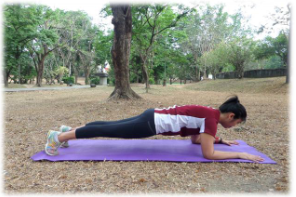
Plack pose
The most basic, yet the most effective and easiest exercise that you can do is known as, the __________
This pose aims to stabilize your core and strengthen the muscles surrounding it. Here are the general instructions on how you can successfully perform a ______:
a. The initial position of this is you lie flat on the floor facing the ground then you slowly lift your body in one line and concentrate your strength in your abdominals.
You must make sure to:
b. maintain this horizontal line intact and not sink your hips and your belly during the pose.
c. removing the weight of your body from your arms and legs and place it on your abdominals instead. You can do this successfully by sucking your tummy in towards your spine.
Elbow/Forearm Planks
This is the most basic plank pose that was presented in the latter part of this module.
Straight Arm Planks
This plank pose variation is where you extend your elbow and increase the lever of your body, mimicking the initial position of a push up