1. Vestibular Ocular Reflex (VOR) EXAM #2 CONTENT - Eye Movements and Binocular Vision Summer 2026
 Call Kai
 Learn
Learn Practice Test
 Spaced Repetition
 Match
Match Flashcards
 Knowt Play
1/47

There's no tags or description
Looks like no tags are added yet.
Name | Mastery | Learn | Test | Matching | Spaced | Call with Kai |
|---|
No analytics yet
Send a link to your students to track their progress
48 Terms
stretch receptors in the neck rather than by the vestibular apparatus
What is the cervico-ocular reflex initiated by?
to that of the VOR
Cervico-ocular reflex gives a response similar to what?
who have lost normal vestibular function (infection, trauma, congenital, etc)
Cervico-ocular reflex is only important in what patients?
This is an antibiotic that can knock out the RVOR system
What does streptomycin have to do with the VOR system?
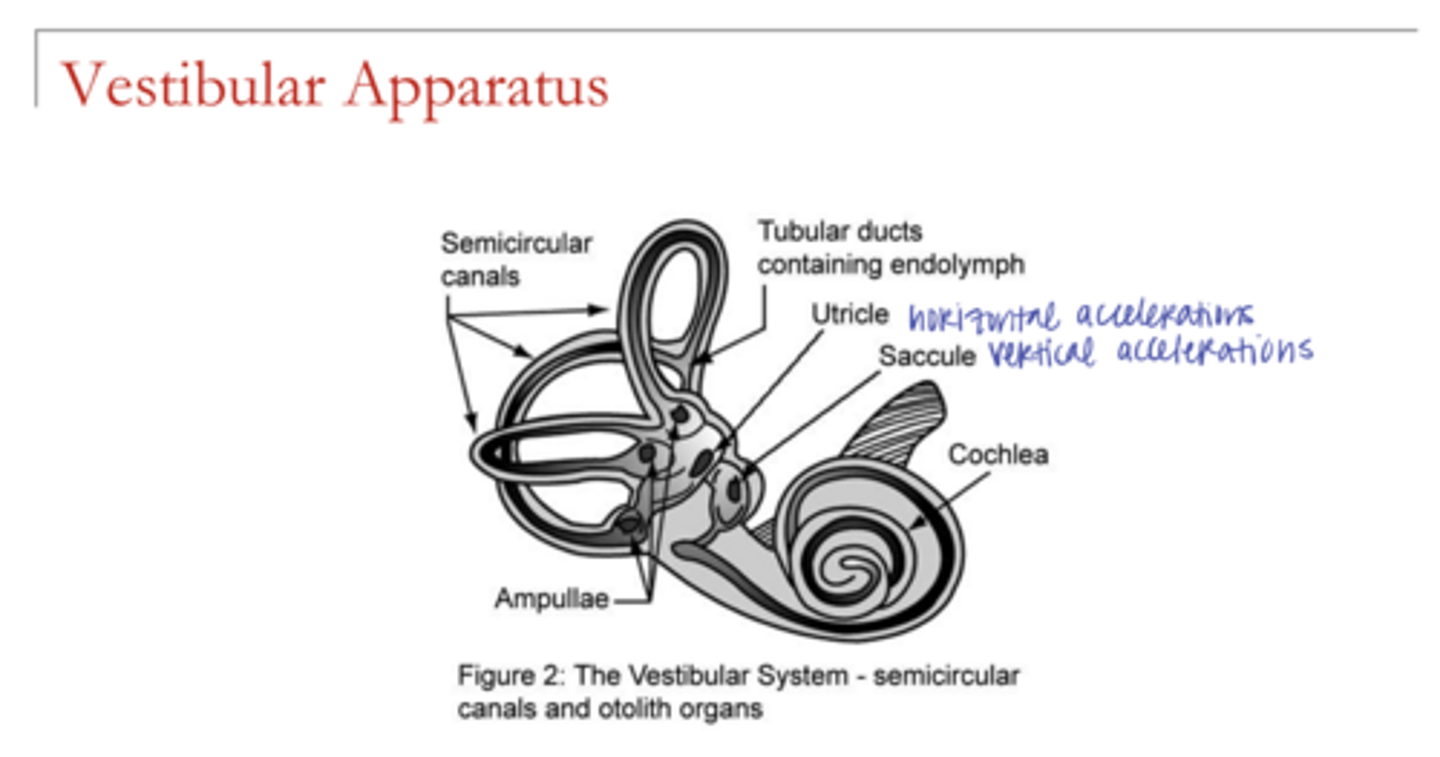
in the inner ear; adjacent and continuous with the cochlea
Where is the vestibular apparatus located?
membranous structure filled with viscous endolymph
What is the vestibular apparatus?
-3 semicircular canals
-otolith
What does the vestibular apparatus consist of?
rotational acceleration
What do the 3 semicircular canals detect?
detect linear acceleration (often gravity)
What does the otolith detect?
2
The otolith organ consists of ____ functional bodies
-Utricle
-Saccule
What are the 2 functional bodies of the otolith organ?
horizontally
The utricle is ________ oriented
-horizontally translational acceleration
-shifts in gravity vector d/t tilt
What does the utricle respond to?
vertically
The utricle is ________ oriented
vertical translational acceleration
What does the saccule respond to?
Vestibular Apparatus (Pic)
Vestibular Apparatus (Pic)
macula
Forces in the utricle and saccule are sensed by the _______
crista
The macula of the utricle and saccule is analogous to the ______ of the semicircular canals
region of epithelium which contains a dense aggregate of hair cells
What is the macula of the utricle and saccule?
true
True or False:
Cilia of the hair cells of the utricle and saccule are much like those of the semicircular canals and contain kilocilium and stereocilia
otolithic membrane
Cilia extend into the ________
calcium carbonate crystals
What does the otolithic membrane contain?
origin of otoconia in BPPV
What is the importance of the otolithic membrane?
In the macula of the utricle and saccule, hair cells have a random orientation. Stimulate based on all different head movements
How are the kinocilium different in the utricle and saccule than in the semicircular canals?
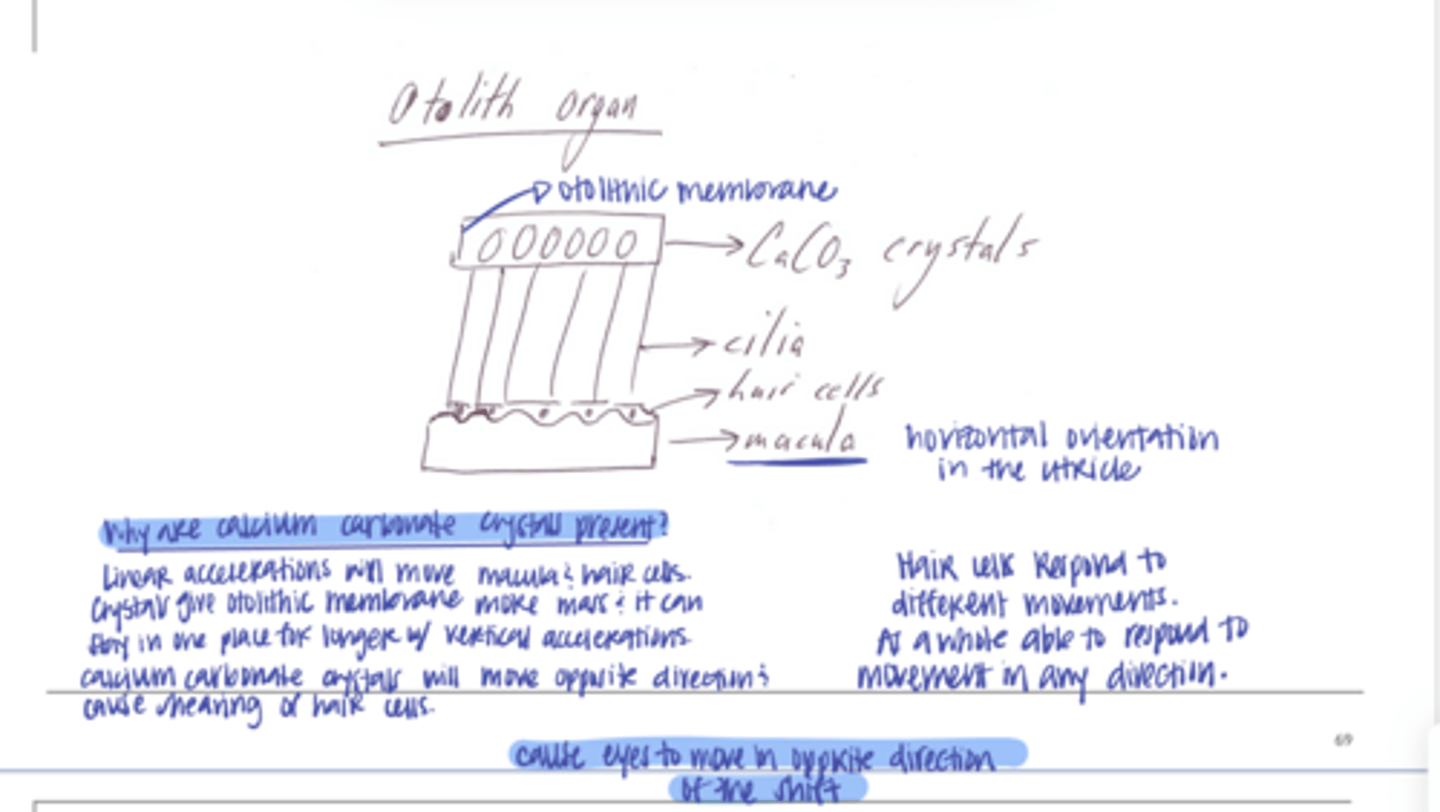
Otolith Organ (Drawing)
Otolith Organ (Drawing)
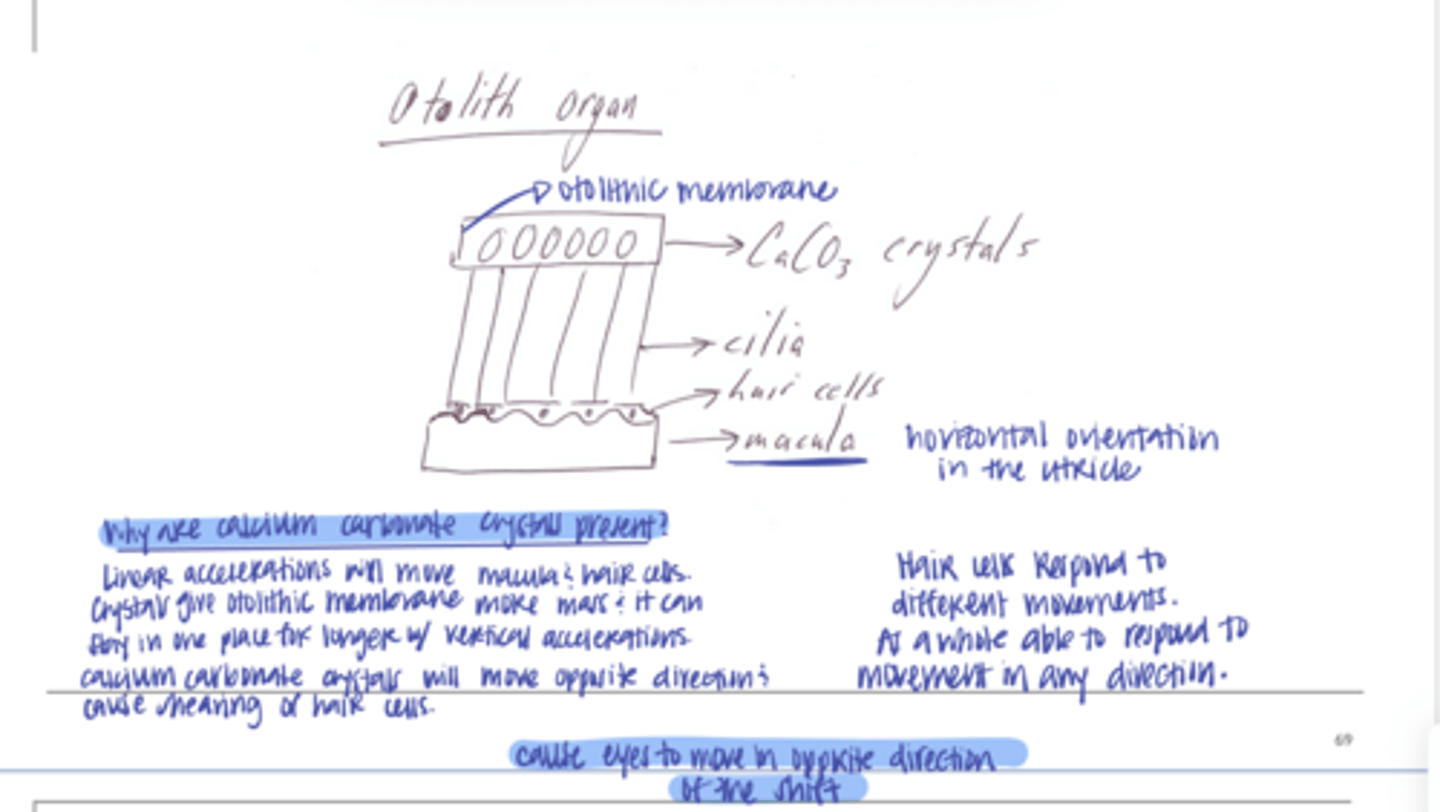
Linear accelerations will move the macula and hair cells. Crystals give the otolithic membrane more mass and it can stay in one place with movements/accelerations. Otolithic membrane seems to move in the opposite direction of the macula/hair cells (causes shearing).
Why are calcium carbonate crystals important?
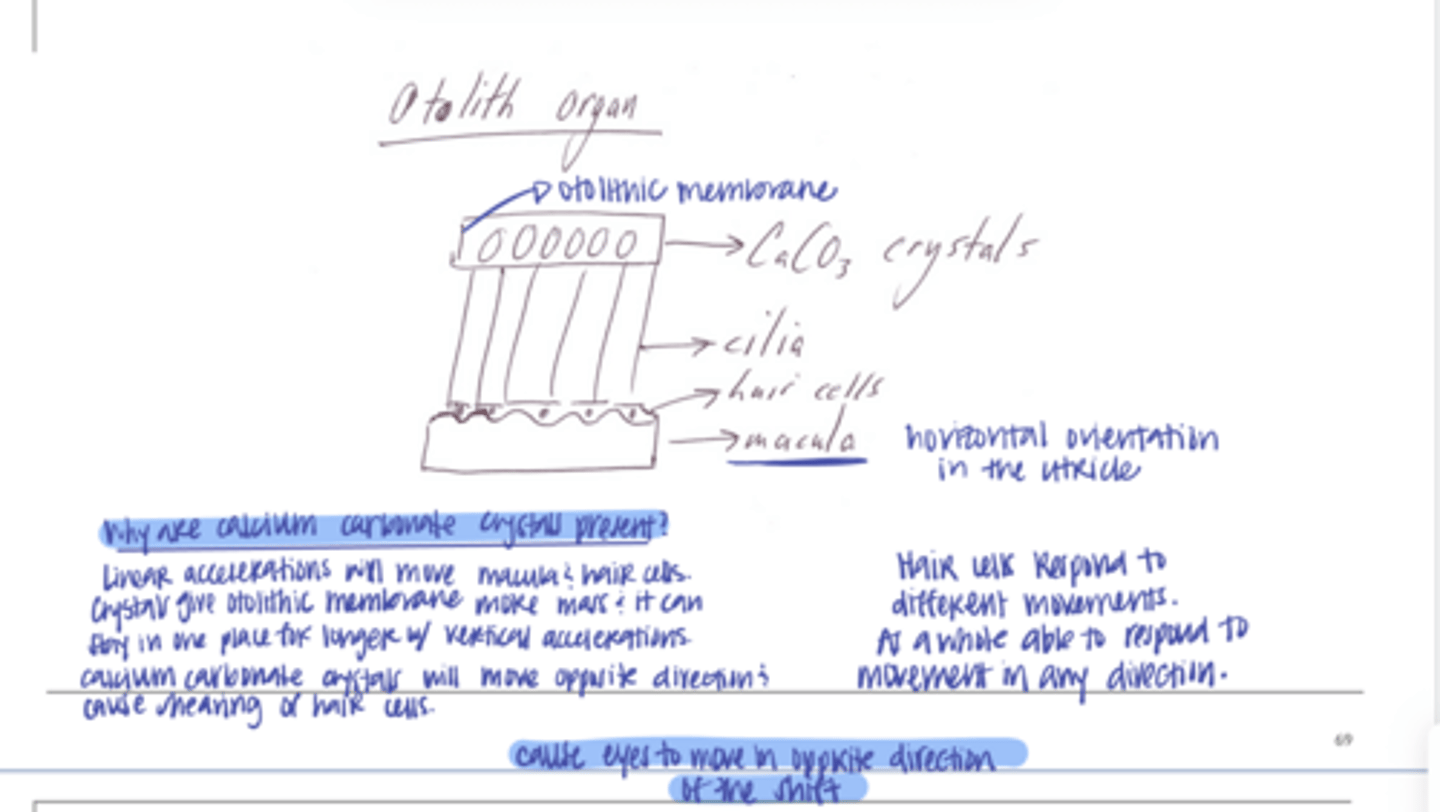
transient linear (translational) accelerations of the head and static head tilt
Shearing of the sensory hair cells with acceleration causes what?
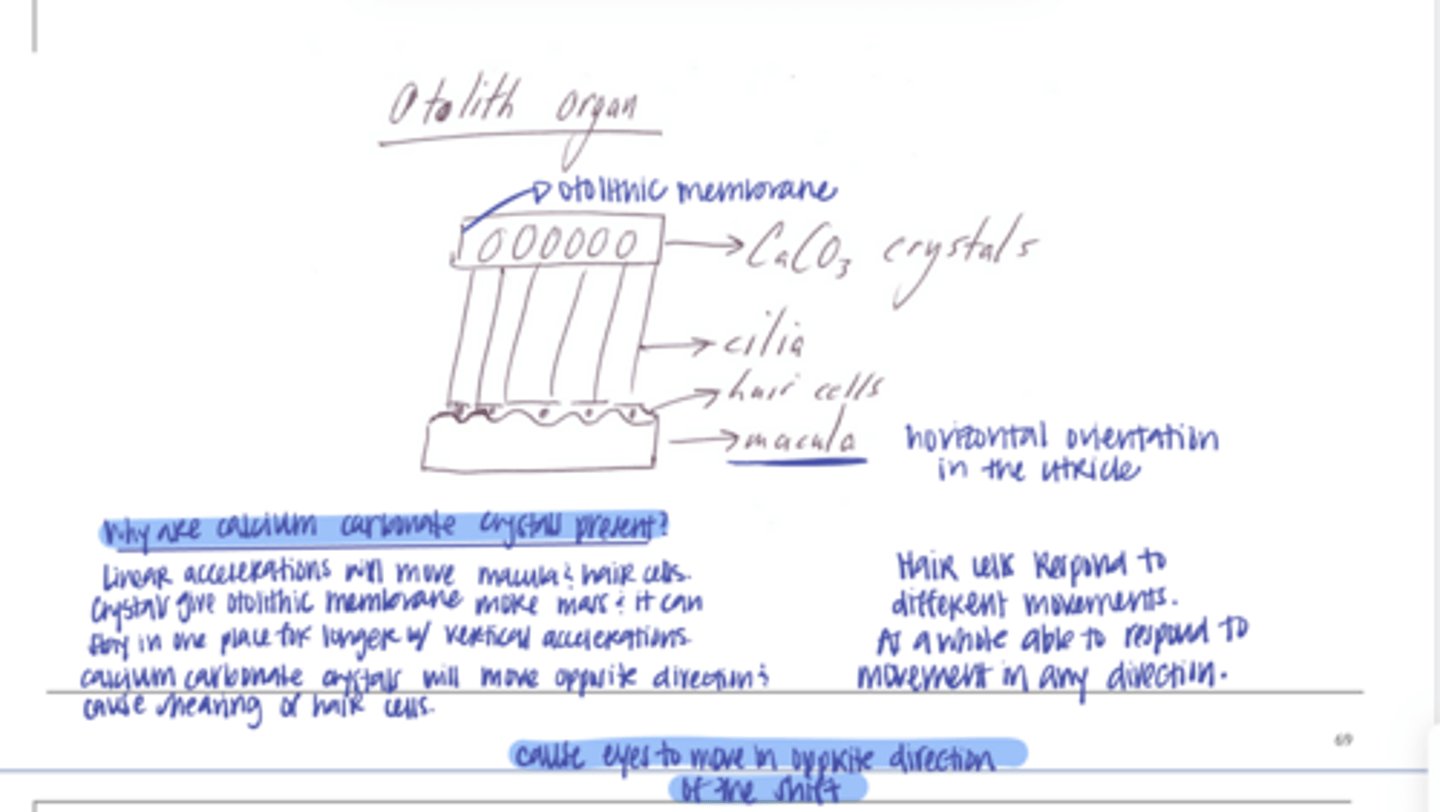
It will slide and pull on the cilia, causing an increase or decrease in the firing rate
When the head translates, what happens to the otolithic membrane?
35ms
What is the latency for T-VOR movement?
R-VOR
Which is faster?
R-VOR or T-VOR
-sustained lateral tilts (head tilt to the shoulder)
-sustained fore-aft tilts (pitch forward or backwards)
-Side to side translations of the head
The utricle will respond best to what?
Responds best to up and down translations of the head
The saccule will respond best to what?
One example of an eye movement which results from the otolith organ; refers to cycloversion that accompanies tilt of the head, tilt head to left or right shoulder.
What is counter-rolling of the otolith organ?
Get a compensatory eye movement in the opposite direction
What happens with counter-rolling?
dynamic response is much better
Which response is better?
Dynamic or static counter-rolling
rotational acceleration
Semicircular Canals vs Otolith
What do the semicircular canals detect?
translational acceleration or static tilt (shift in the gravity vector)
Semicircular Canals vs Otolith
What does the otolith detect?
in the ampulla
Semicircular Canals vs Otolith
Where does detection occur in the semicircular canals?
utricle, saccule
Semicircular Canals vs Otolith
Where does detection occur in the otolith?
Crista
Semicircular Canals vs Otolith
Where is movement detected? Where do the hair cells reside in the semicircular canals?
macula of the utricle and saccule
Semicircular Canals vs Otolith
Where is movement detected? Where do the hair cells reside in the otolith?
stereocilia; kinocilium
Semicircular Canals vs Otolith
In the semicircular canals and in the otolith, each hair cell has multiple ____ and one ______
depolarization -- increased firing rate
Semicircular Canals vs Otolith
Bending of the stereocilia toward the kinocilium causes ______ of the hair cell in both the semicircular canals and the otolith
hyperpolarization -- decreased firing rate
Semicircular Canals vs Otolith
Bending of the stereocilia away from the kinocilium causes ______ of the hair cell in both the semicircular canals and the otolith
symmetrical (kinocilium on same side of each hair cell) and all respond to the same direction of flow
Semicircular Canals vs Otolith
What is the arrangement of kinocilium in the semicircular canals?
Variable orientation -- Different hair cells respond to forces in different directions
Semicircular Canals vs Otolith
What is the arrangement of kinocilium in the otolith?
into the cupula -- dome like structure
Semicircular Canals vs Otolith
Stereocilia and kinocilium extend where in the semicircular canals?
into the otolithic membrane
Semicircular Canals vs Otolith
Stereocilia and kinocilium extend where in the otolith?