11. Contact Lens Solutions for Rigid and Soft Contact Lenses - Contact Lenses I Summer 2026
 Call Kai
 Learn
Learn Practice Test
 Spaced Repetition
 Match
Match Flashcards
 Knowt Play
1/101

There's no tags or description
Looks like no tags are added yet.
Name | Mastery | Learn | Test | Matching | Spaced | Call with Kai | Chat |
|---|
No analytics yet
Send a link to your students to track their progress
102 Terms
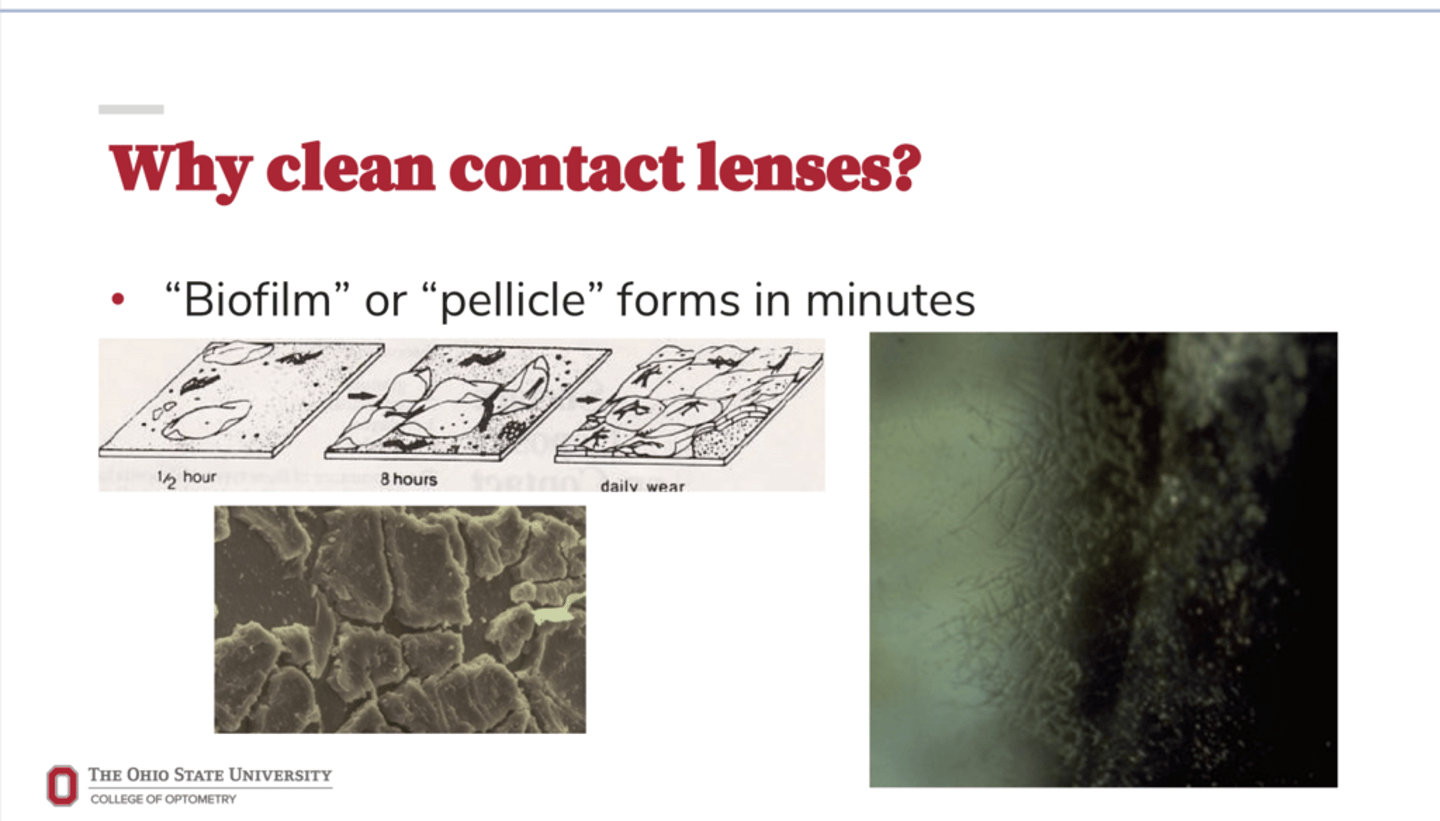
Why is it important to wear contact lenses?
"Biofilm" or "pellicle" will form in minutes
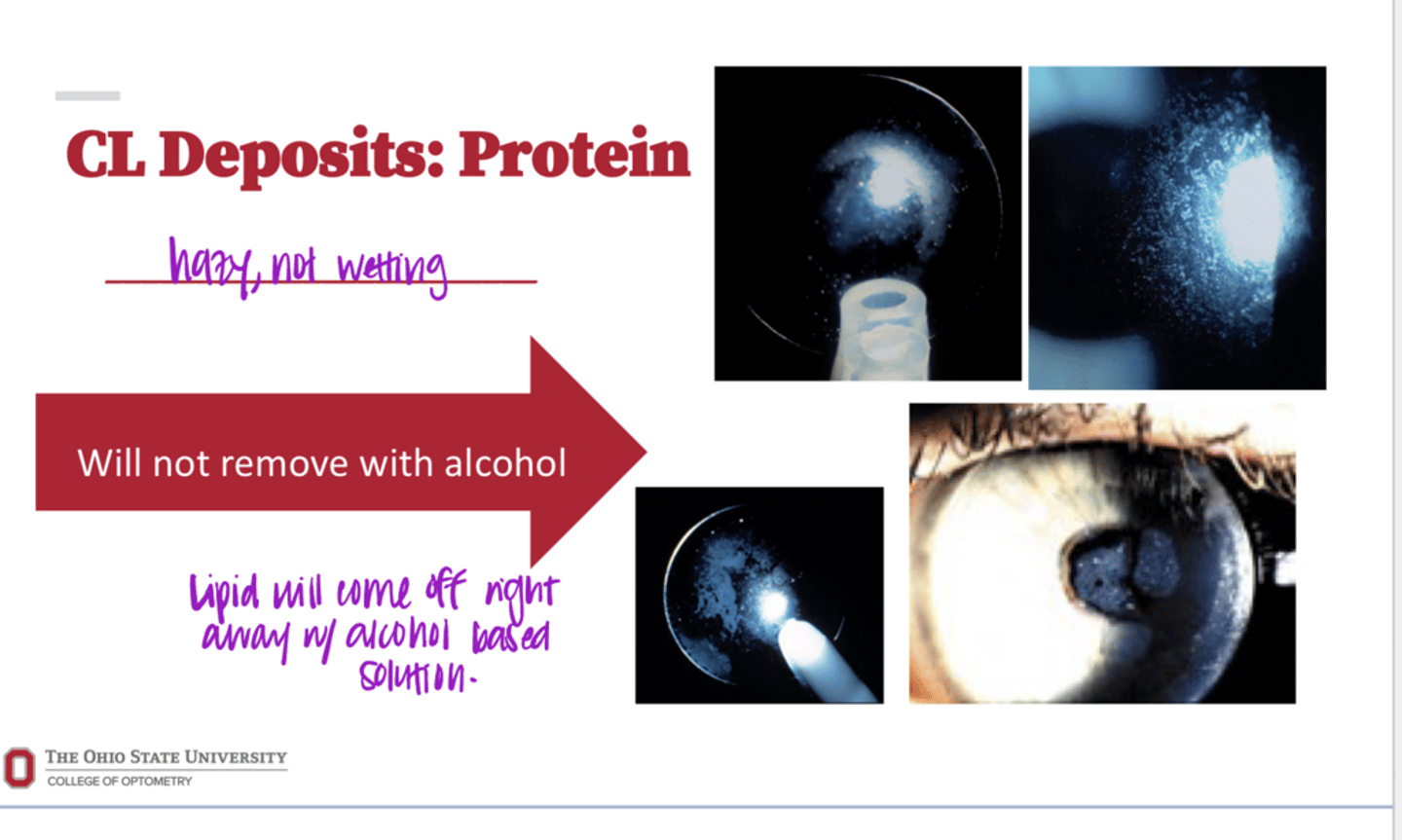
What is the appearance of protein deposits on a CLs?
Hazy, not wetting
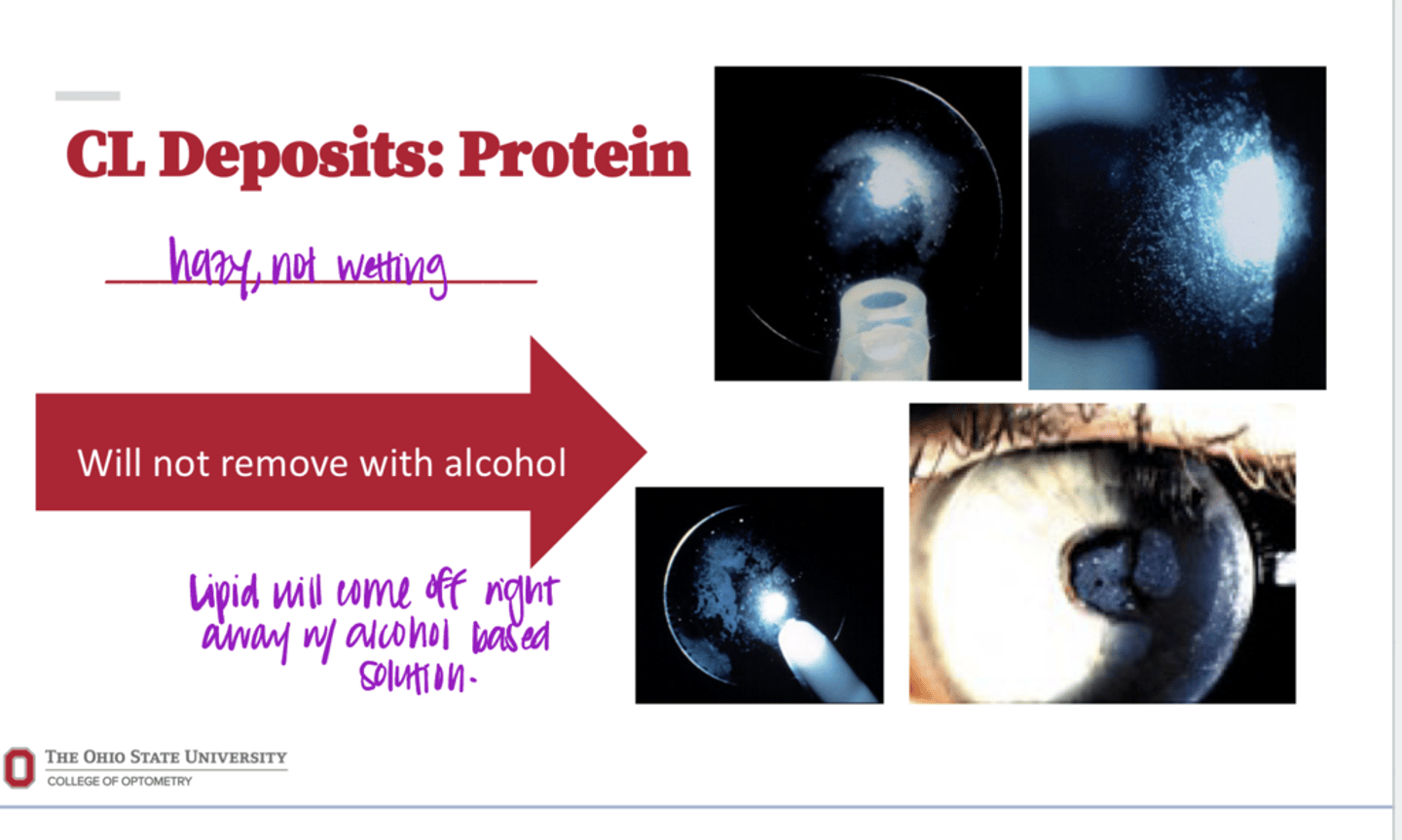
Will protein deposits be removed from CLs with alcohol?
No
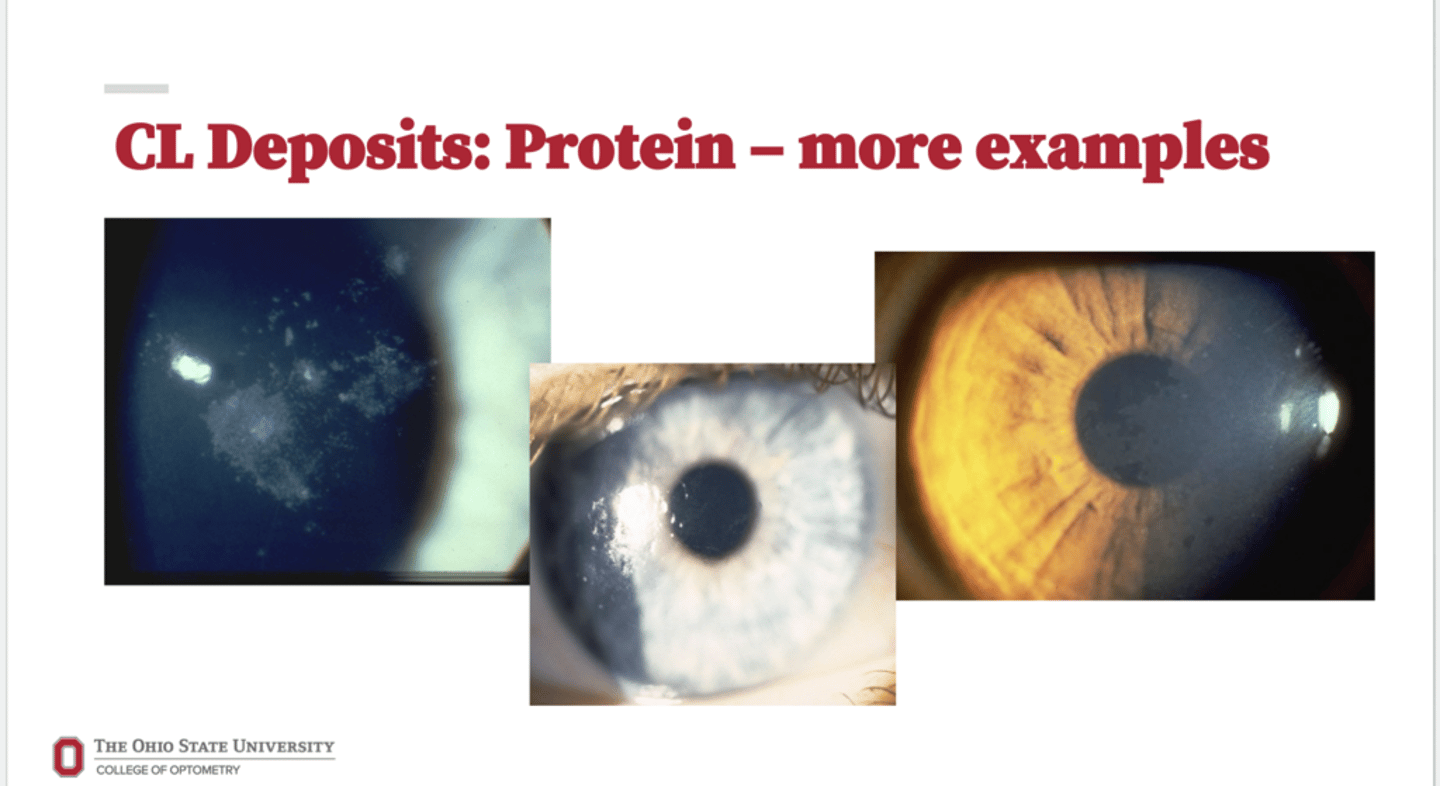
CL Protein Deposits (Pic)
CL Protein Deposits (Pic)
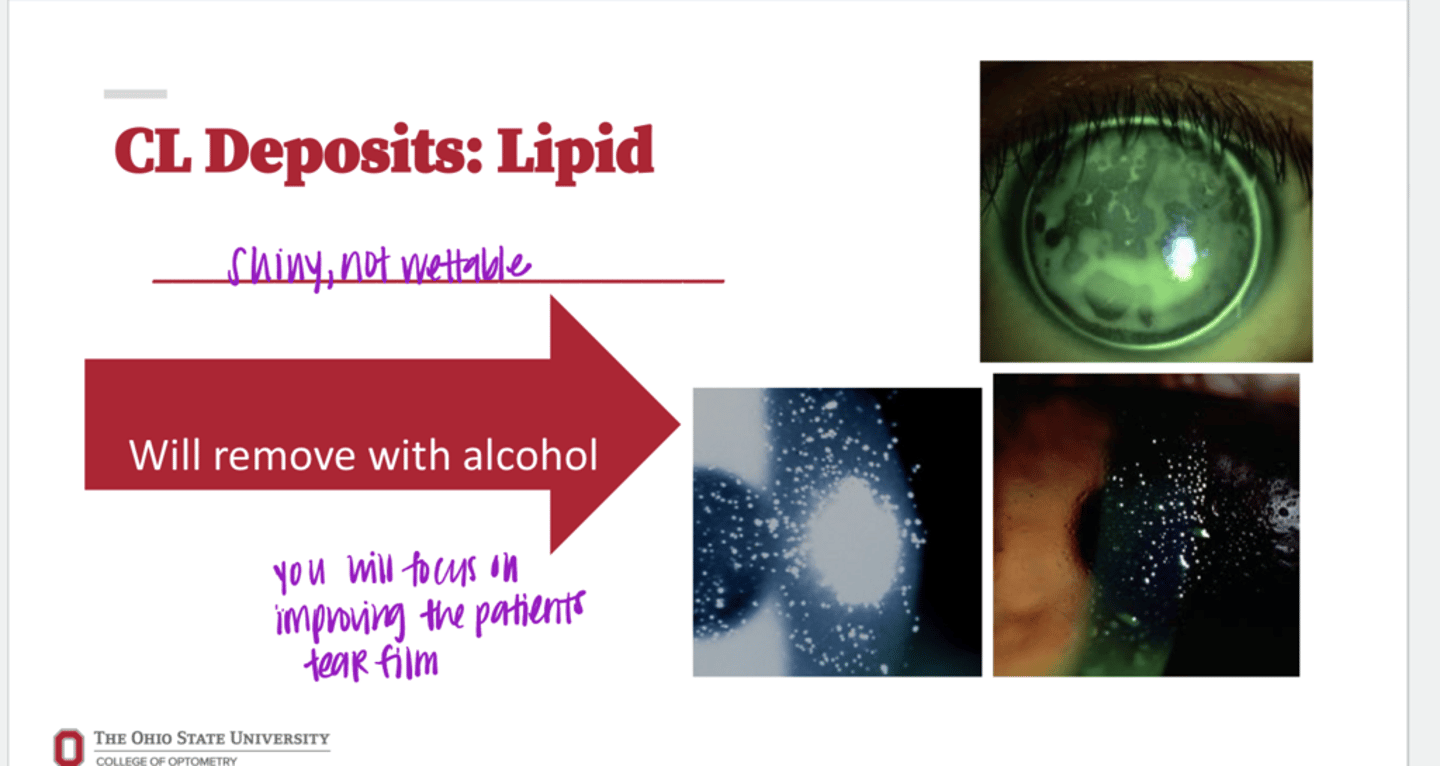
What is the appearance of lipid deposits on a CLs?
shiny, not wettable
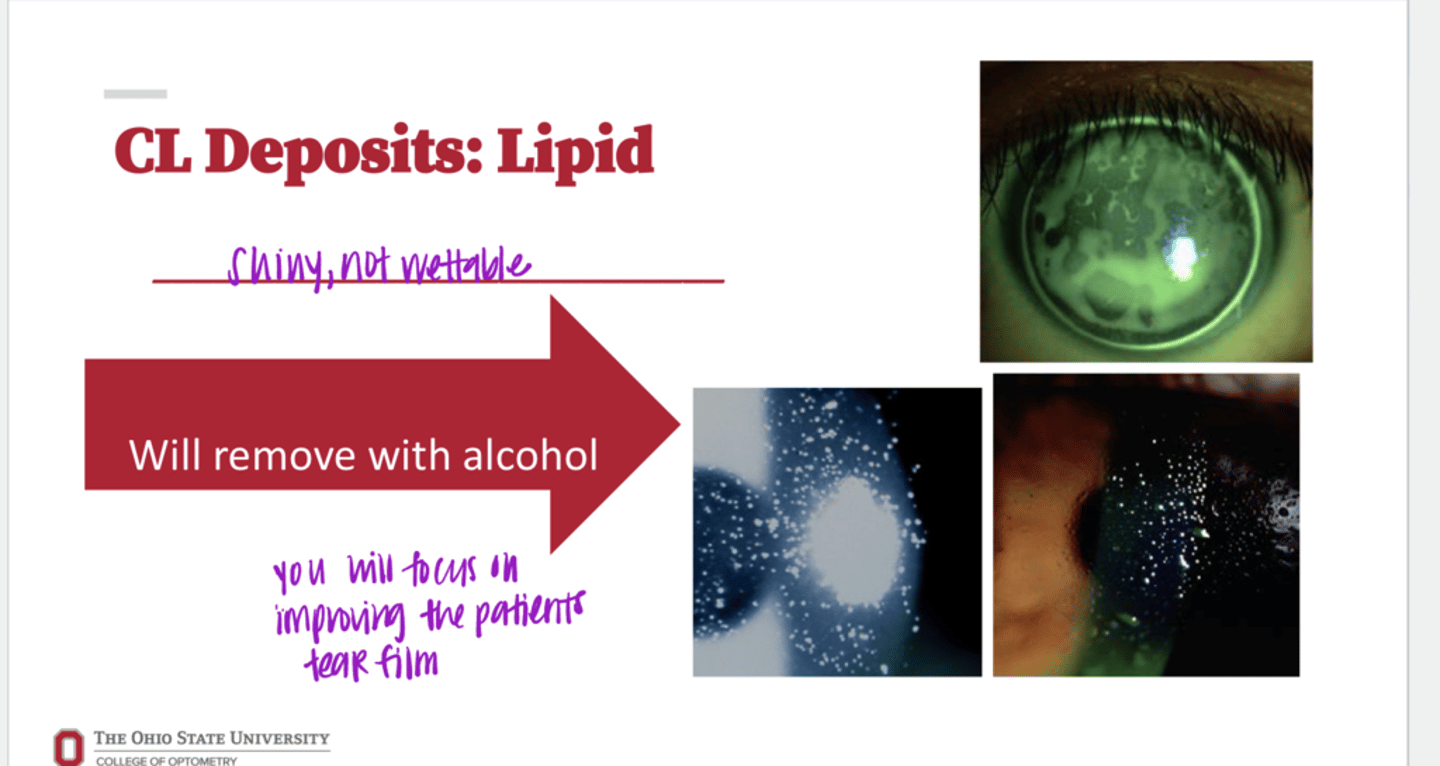
Lipid deposits on CLs will remove with _______
alcohol
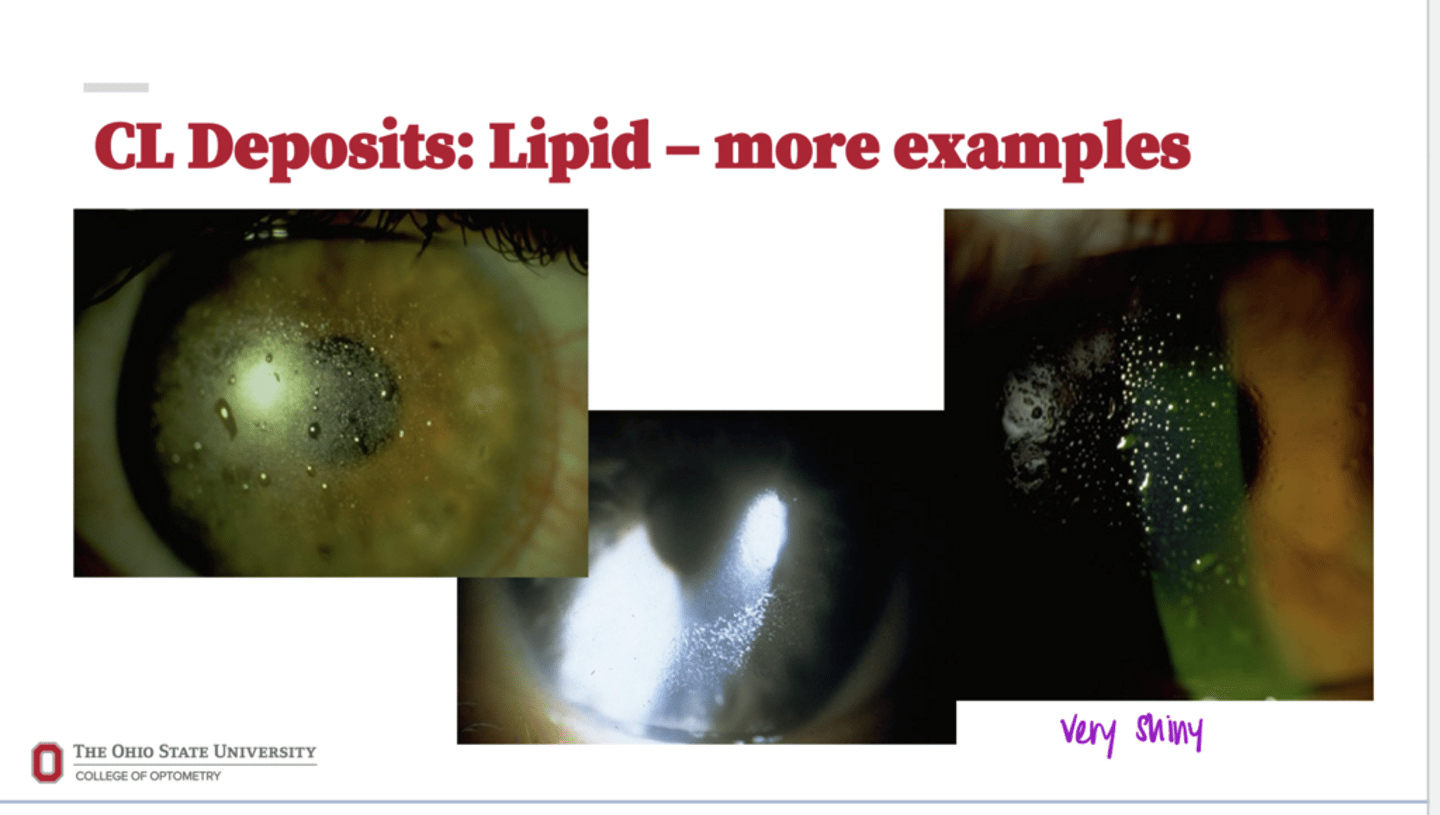
CL Deposits -- Lipids (Pic)
CL Deposits -- Lipids (Pic)
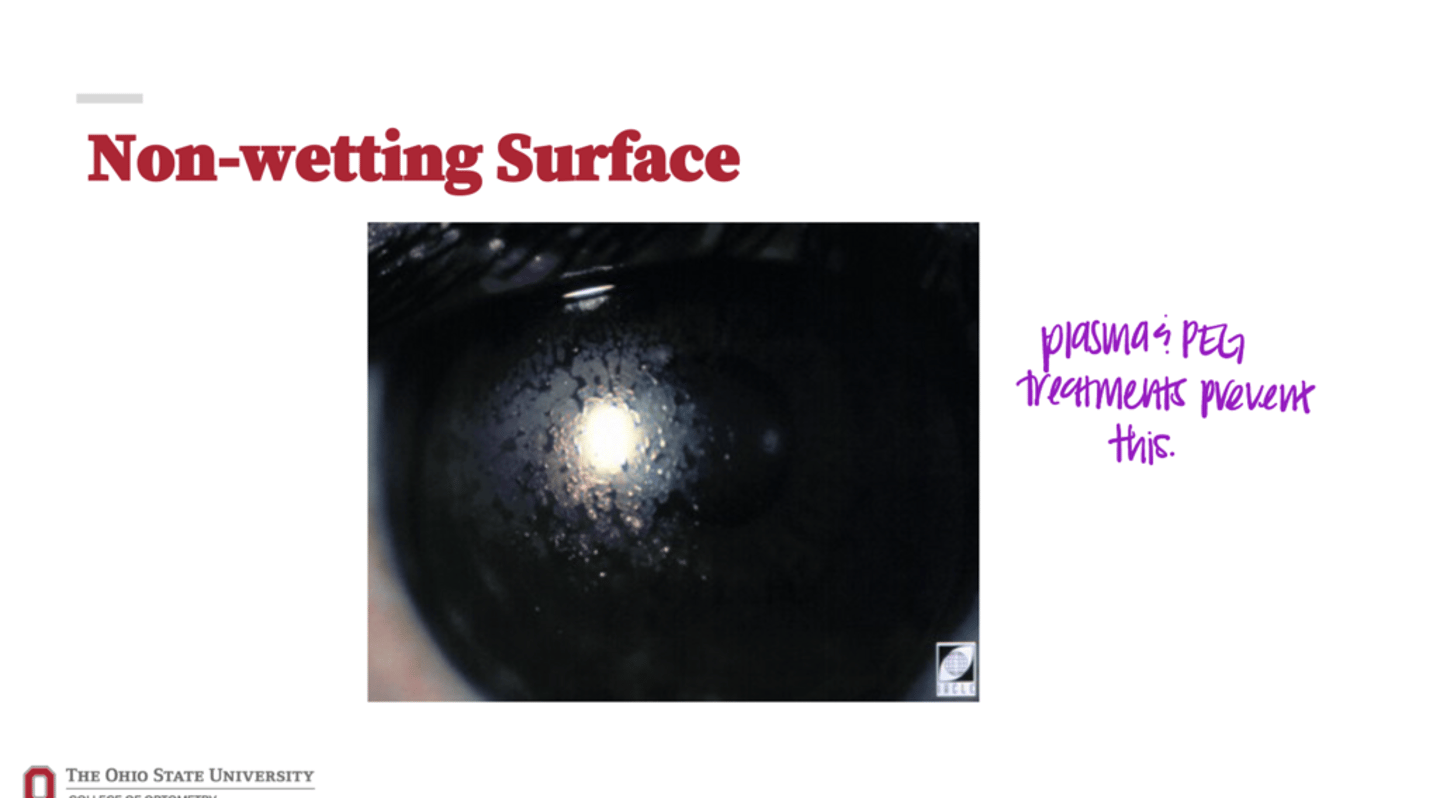
Non-Wetting Surface on Cls (Pic)
Non-Wetting Surface on Cls (Pic)
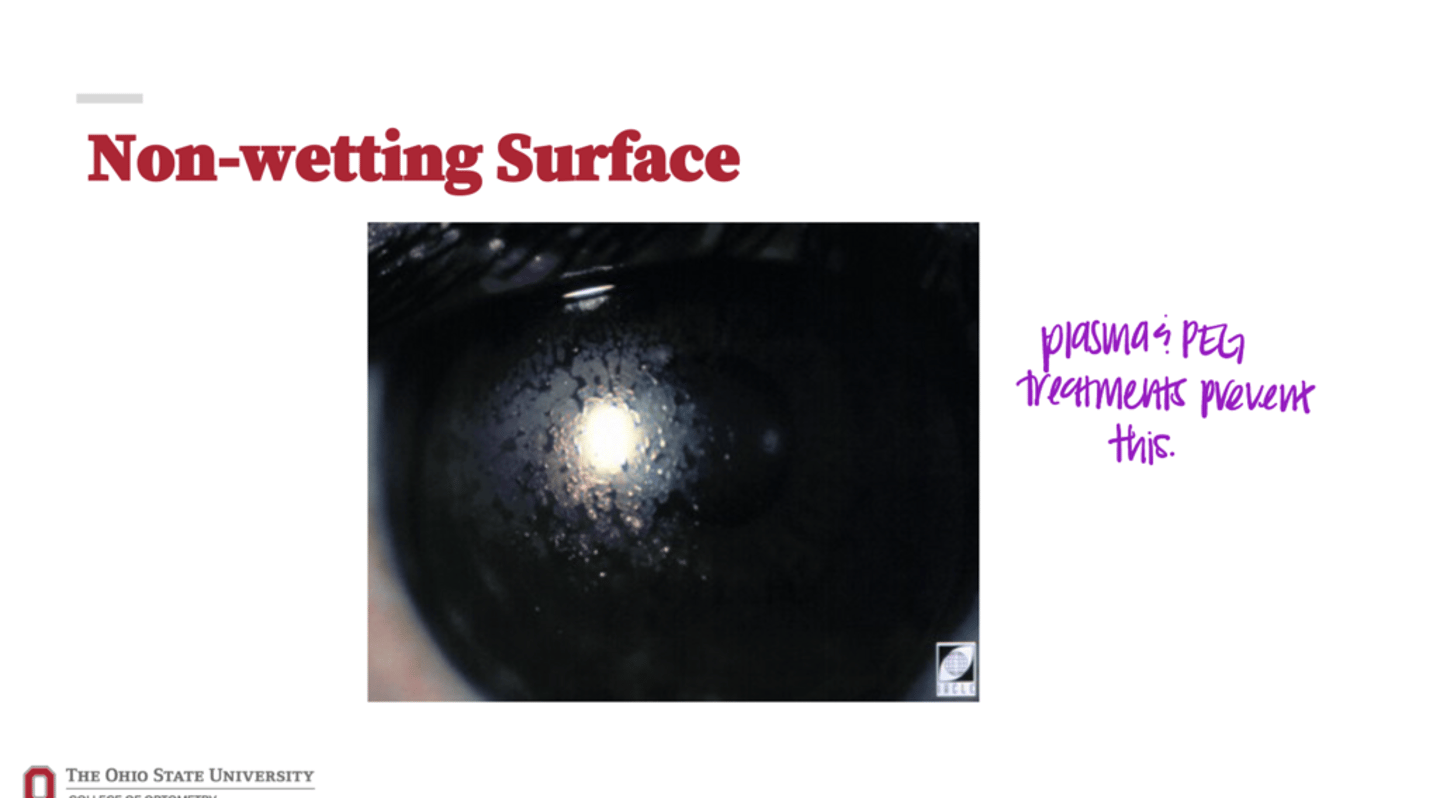
Non-Wetting Surface on CLs does not happen much anymore d/t the addition of what?
HydraPeg or plasma treatment
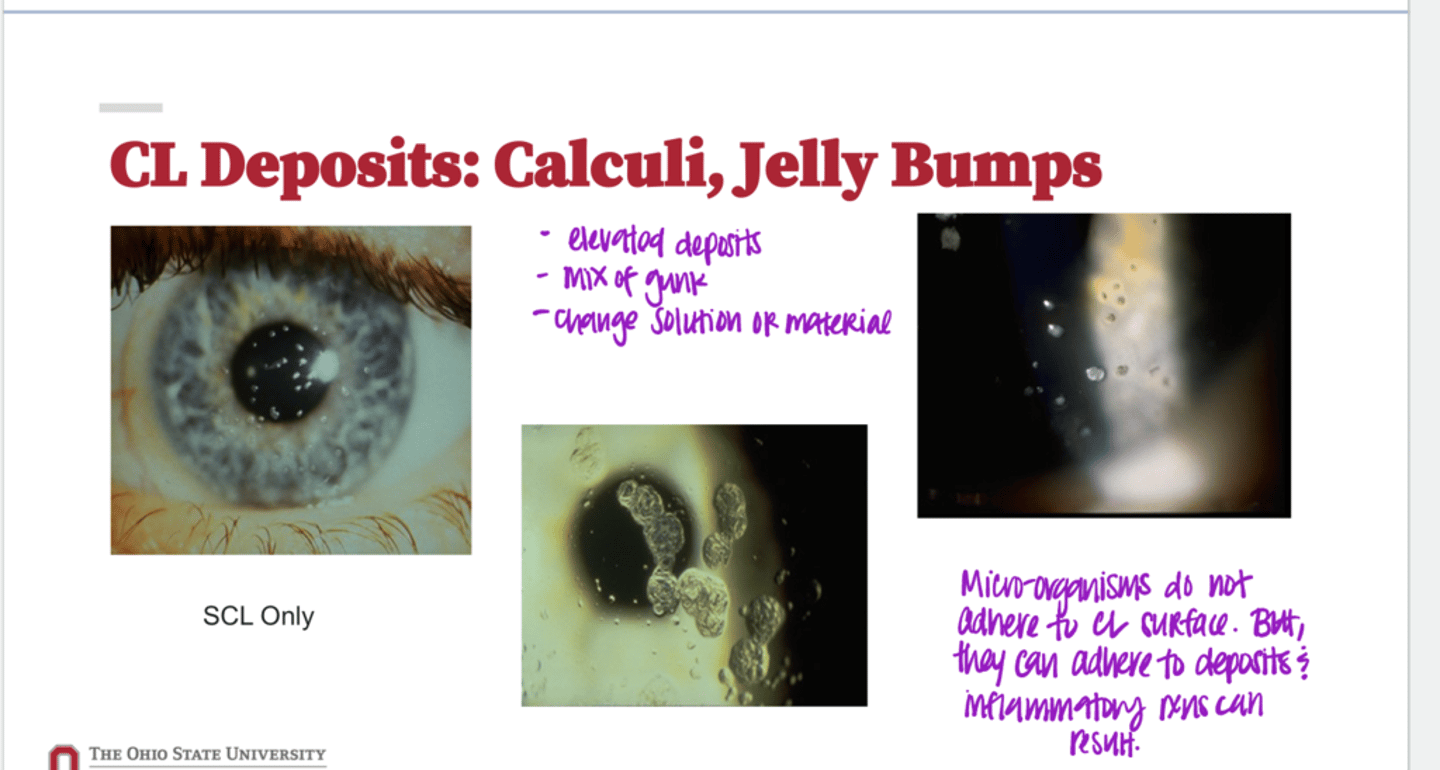
CL Deposits -- Calculi and Jelly Bumps (Pic)
CL Deposits -- Calculi and Jelly Bumps (Pic)
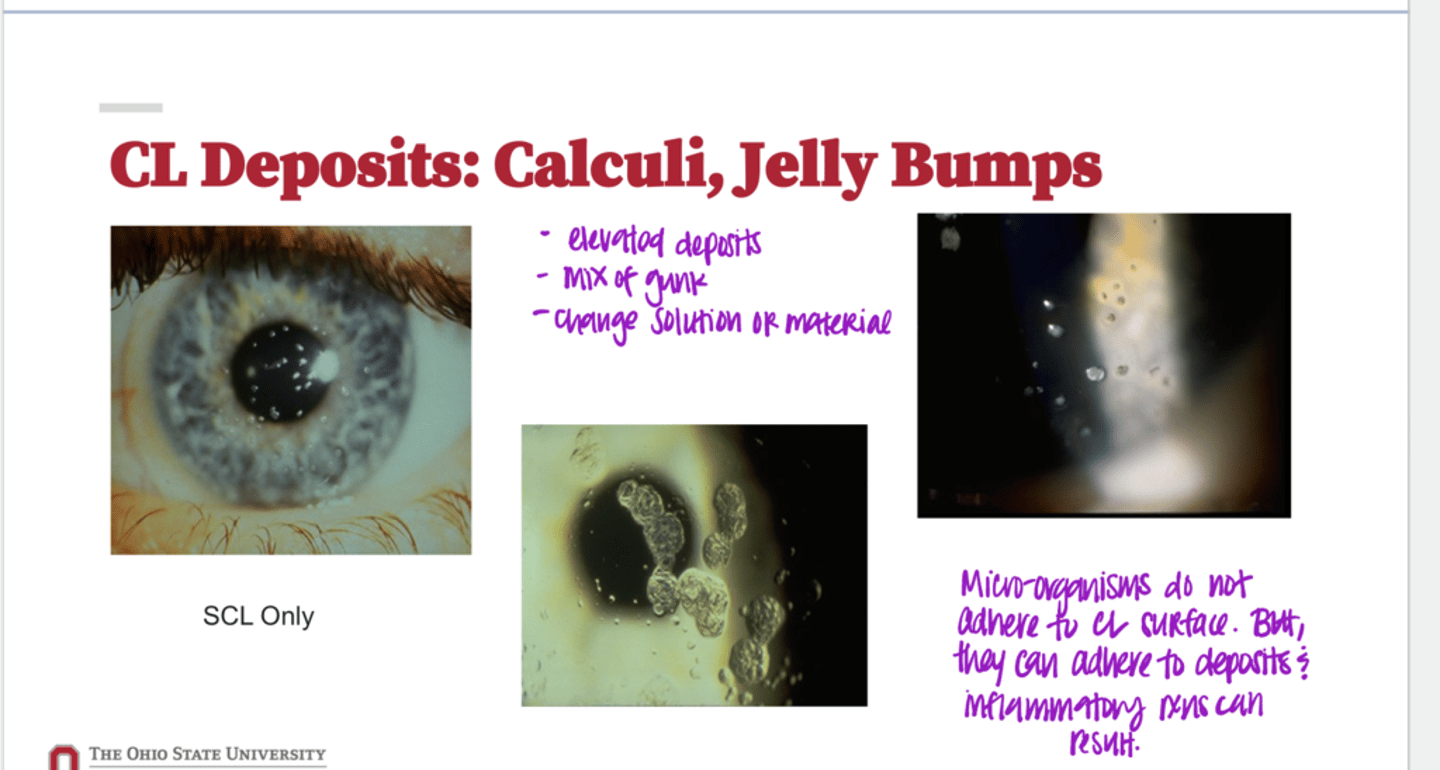
What are calculi/jelly bumps?
elevated deposits that are a mix of junk
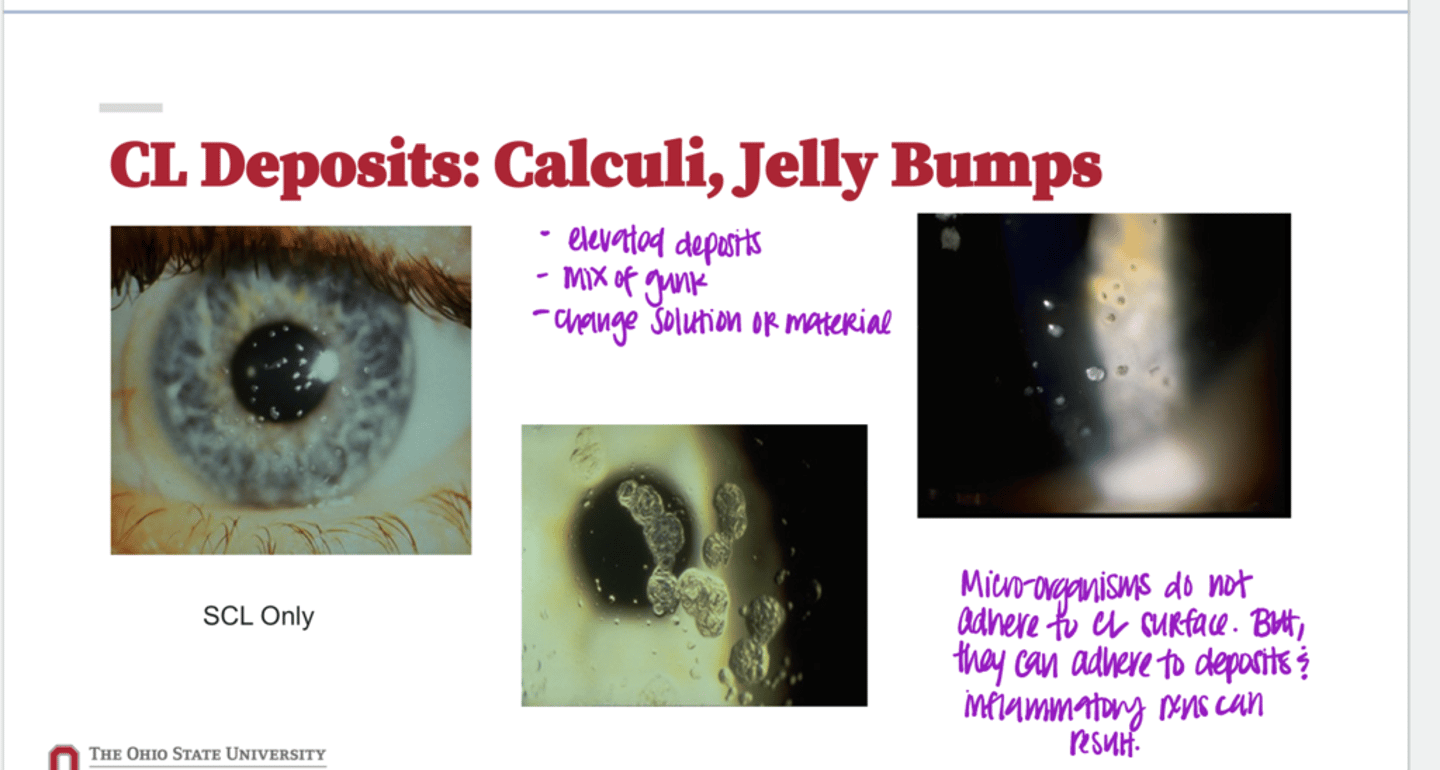
If calculi/jelly bumps are present on CLs, what should you do?
change solution or the material of the CLs
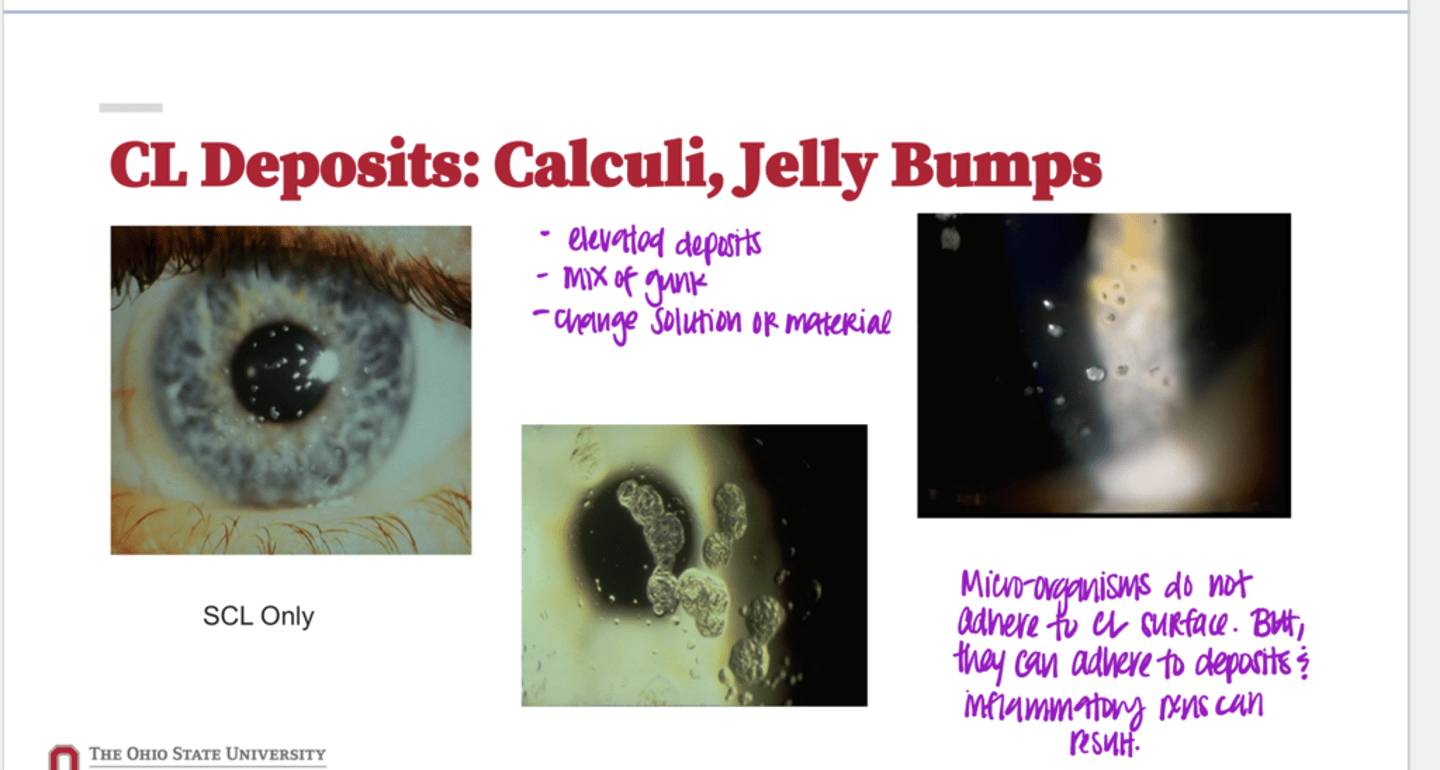
Does material adhere to RGP material?
Not the material itself! It can adhere to the deposits if they are present on the lenses.
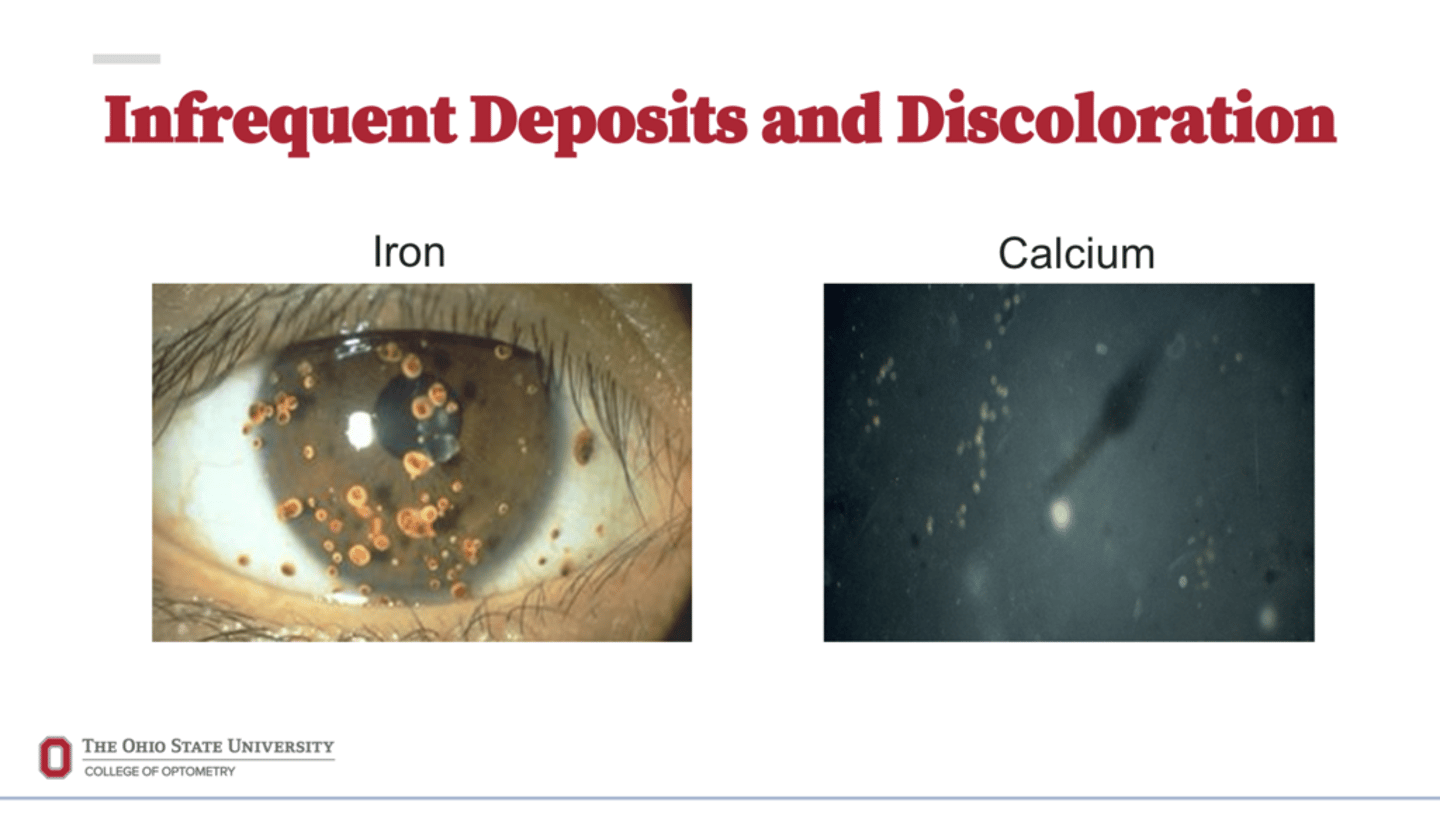
Iron and Calcium Deposits (Pic)
Iron and Calcium Deposits (Pic)
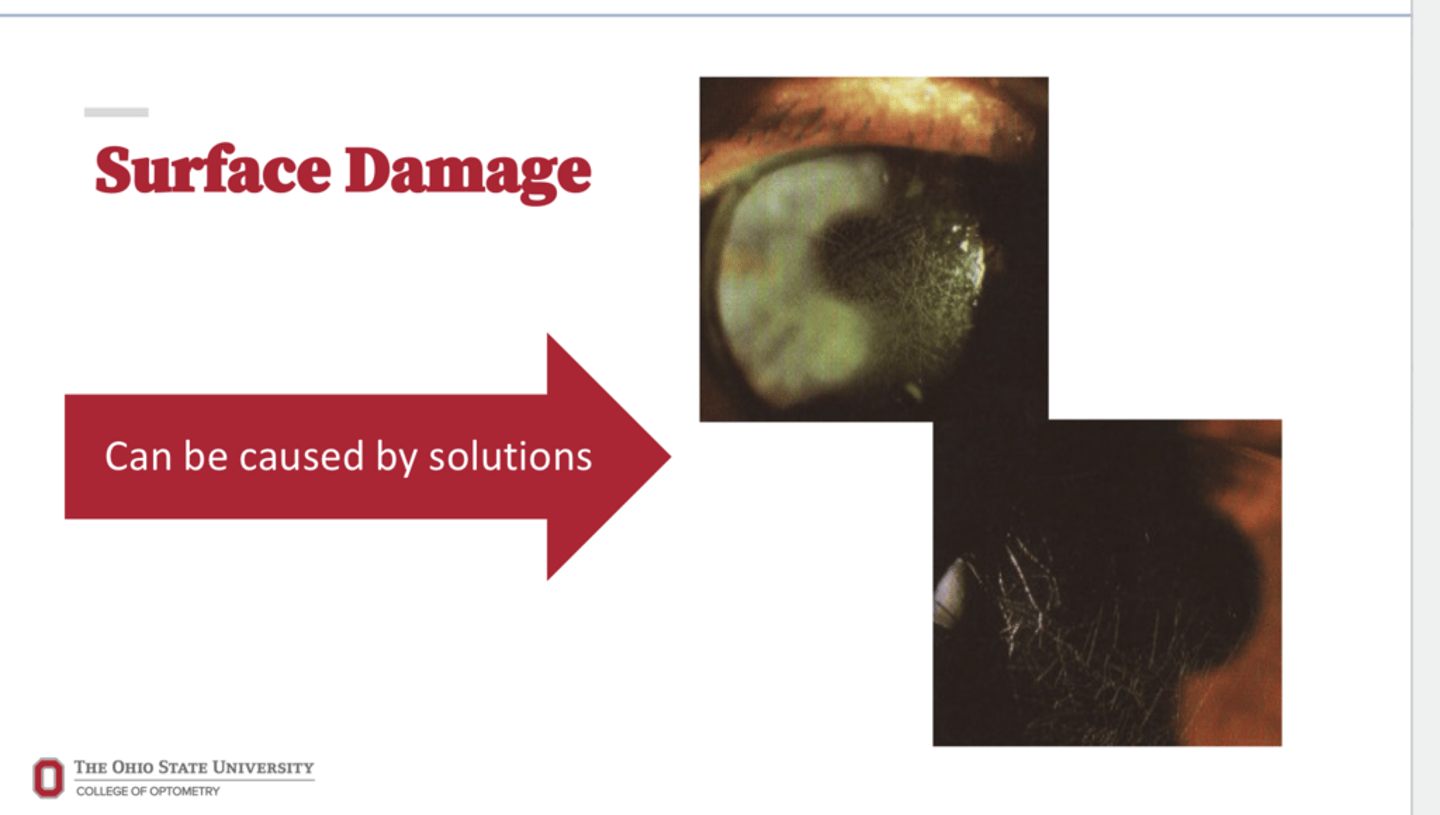
Surface Damage can be caused be ______
solutions
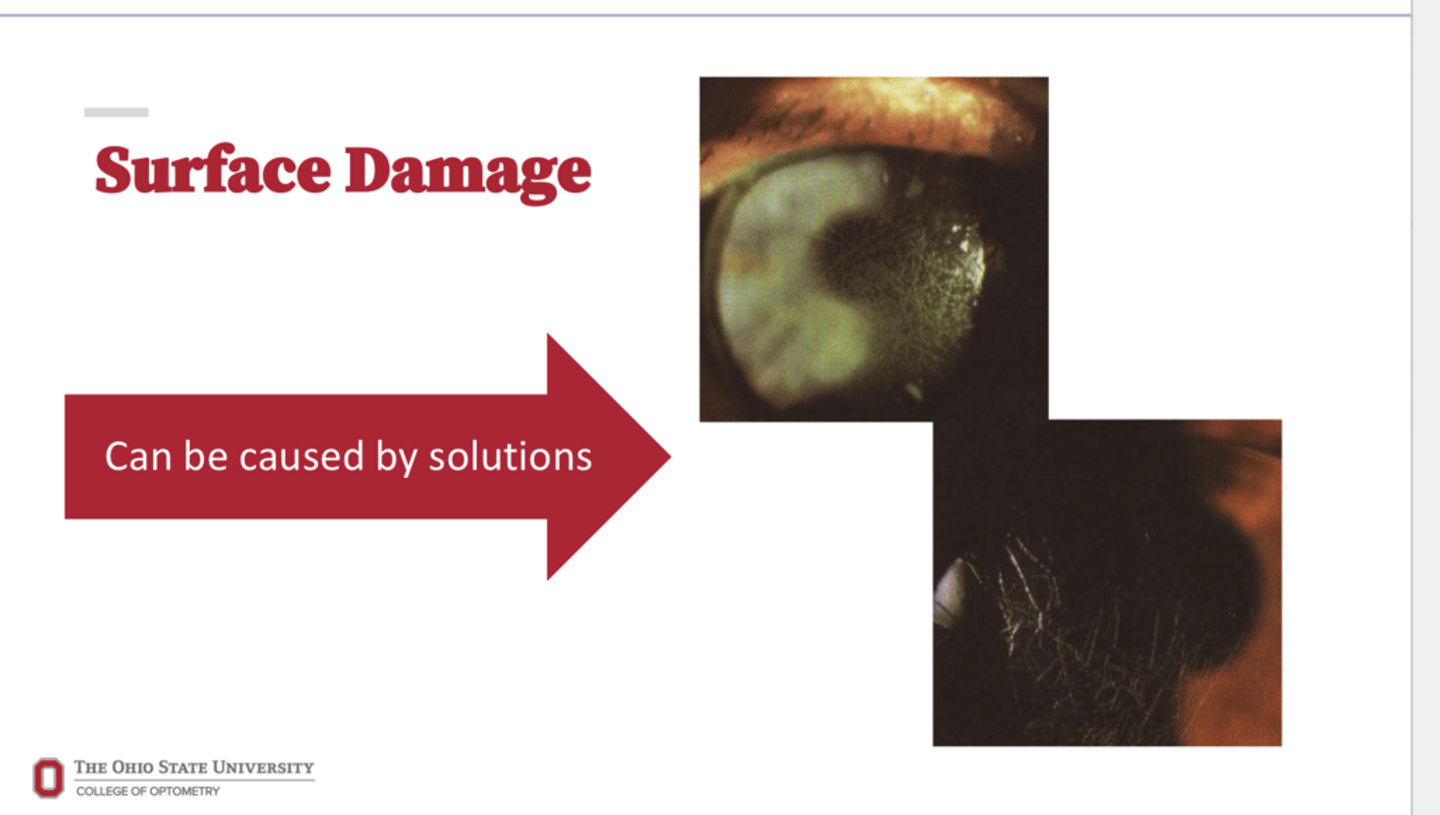
Surface Damage of RGPs (Pic)
Surface Damage of RGPs (Pic)
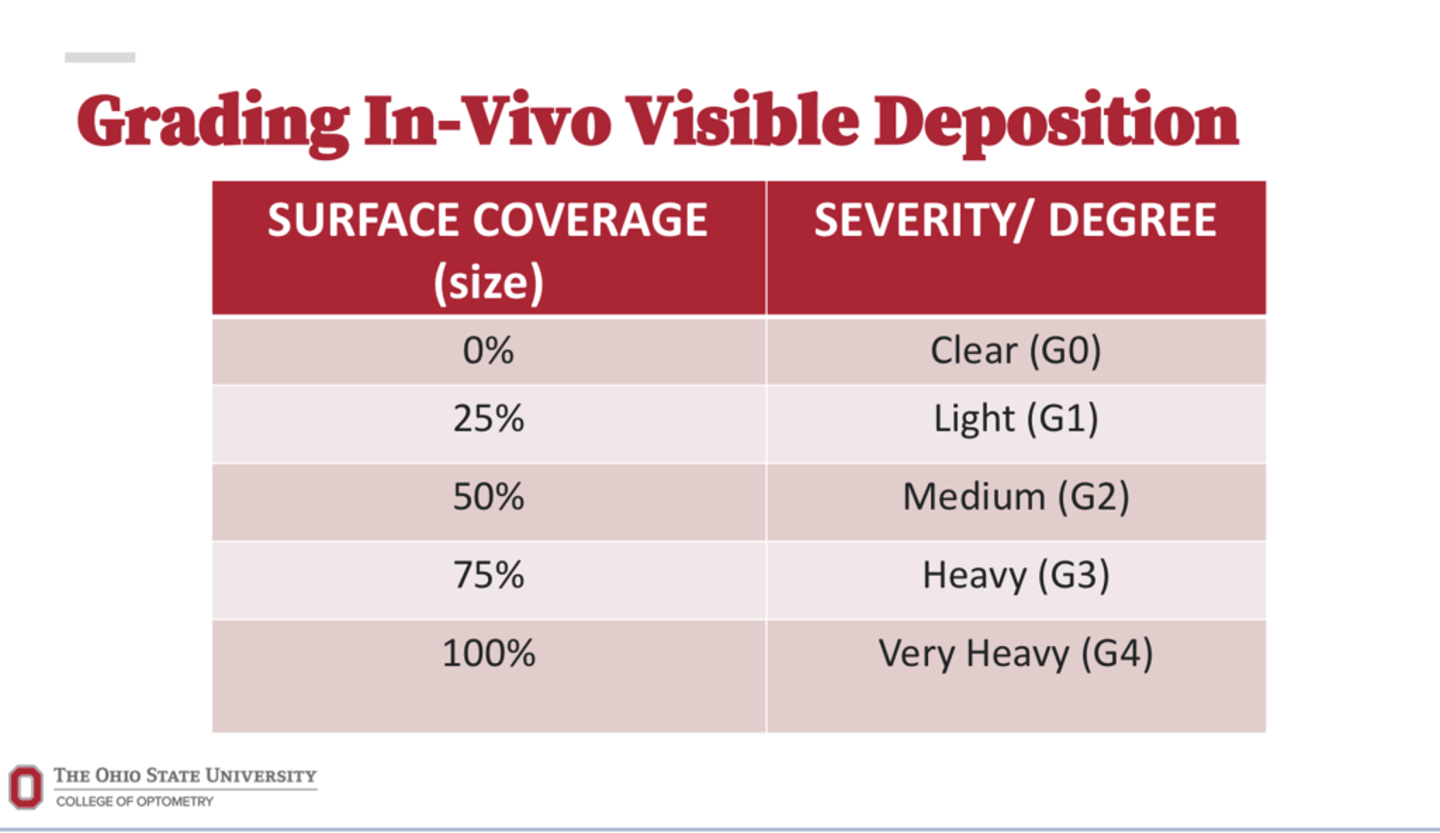
Grading In-Vivo Visible Deposition
Deposition covering 0% of the CLs
Clear (G0)
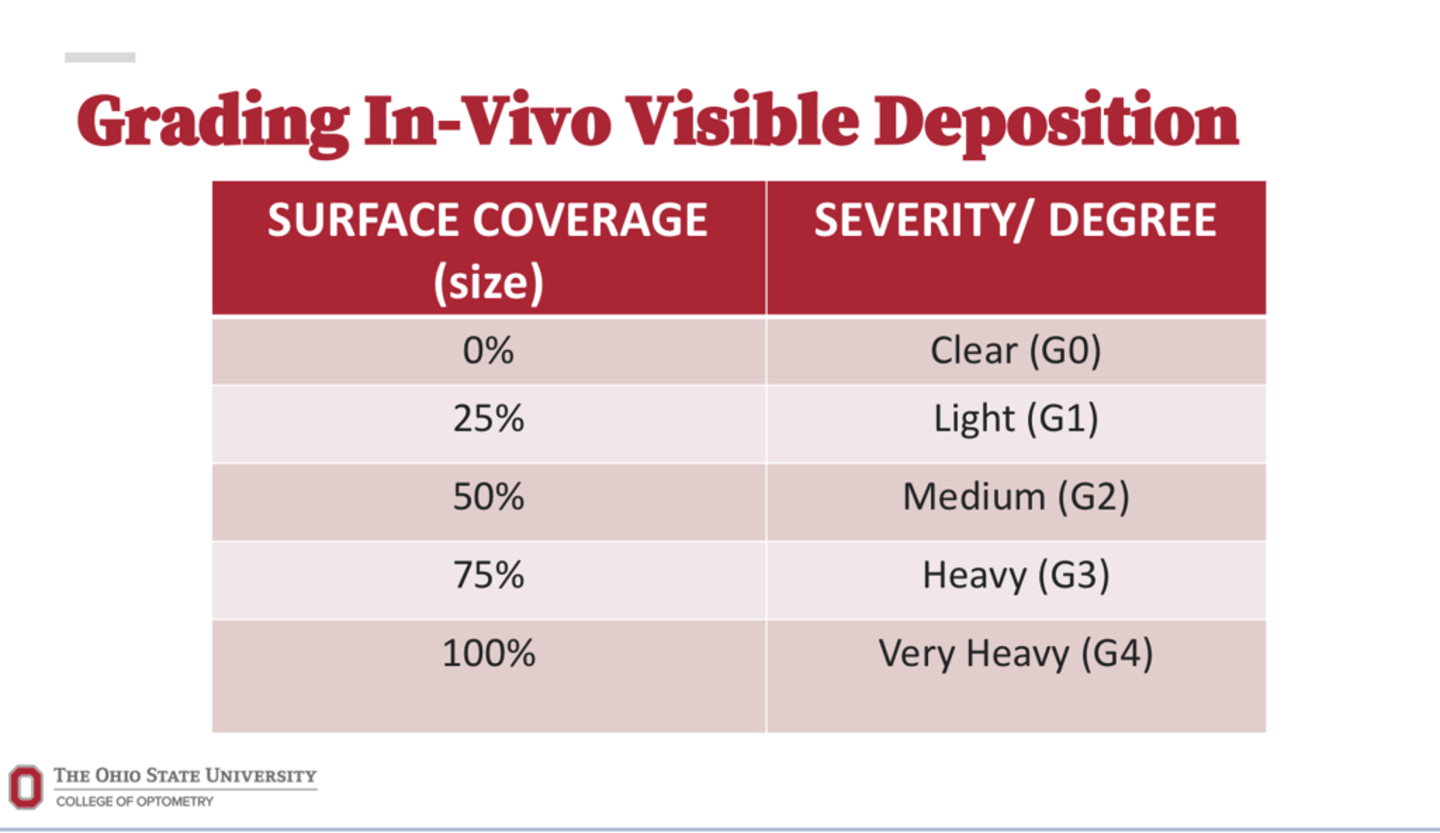
Grading In-Vivo Visible Deposition
Deposition covering 25% of the CLs
Light (G1)
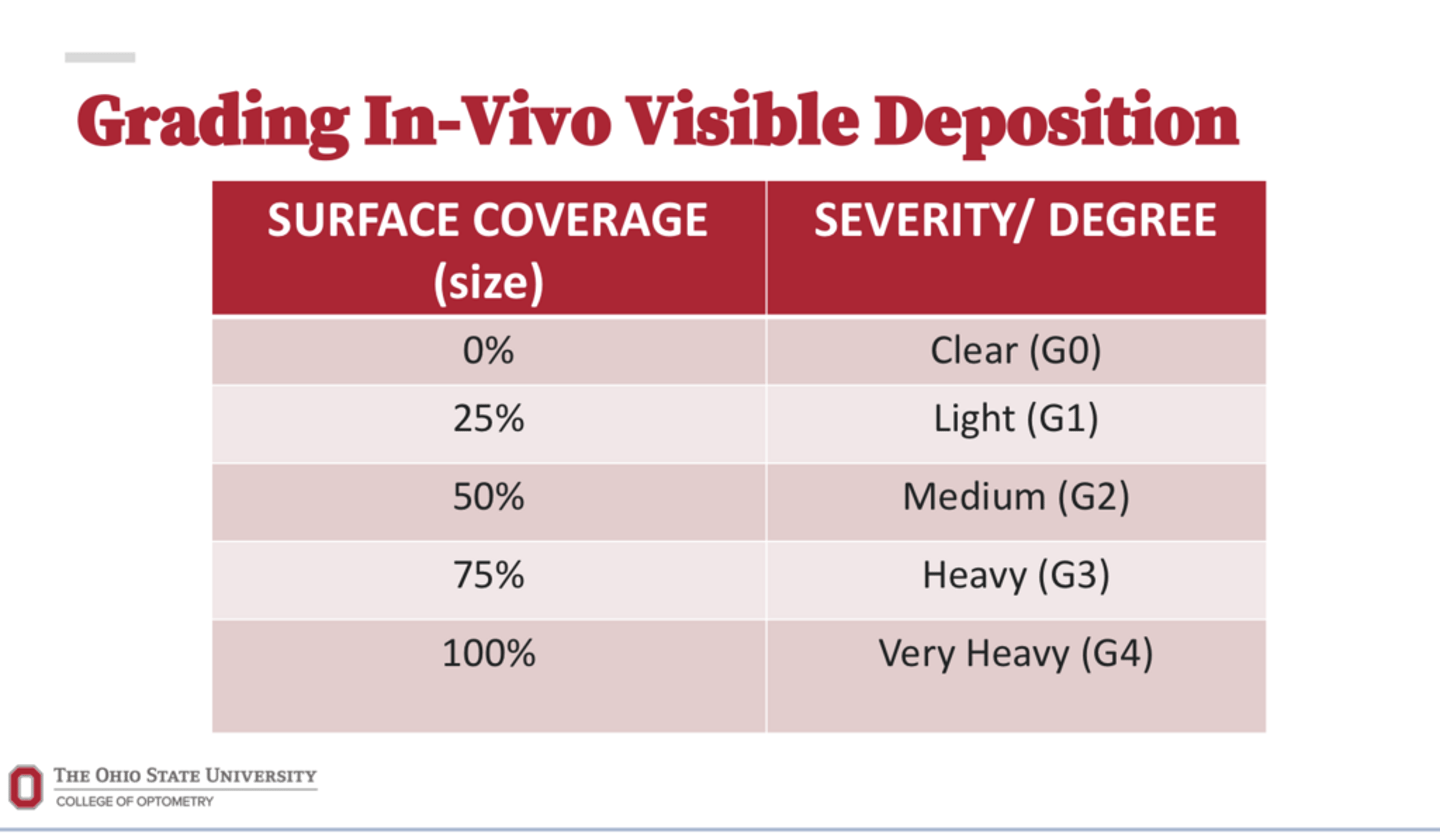
Grading In-Vivo Visible Deposition
Deposition covering 50% of the CLs
Medium (G2)
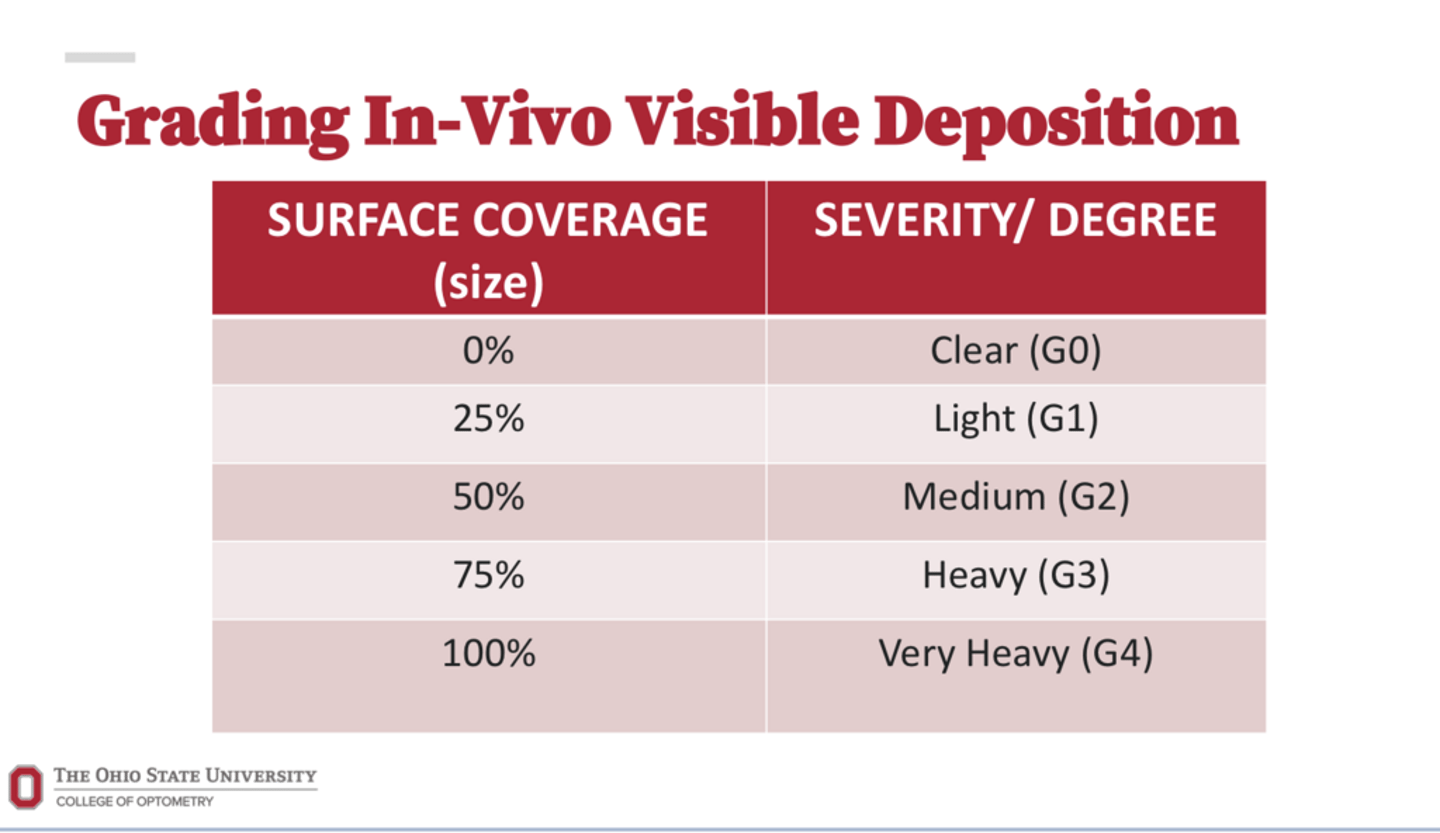
Grading In-Vivo Visible Deposition
Deposition covering 75% of the CLs
Heavy (G3)
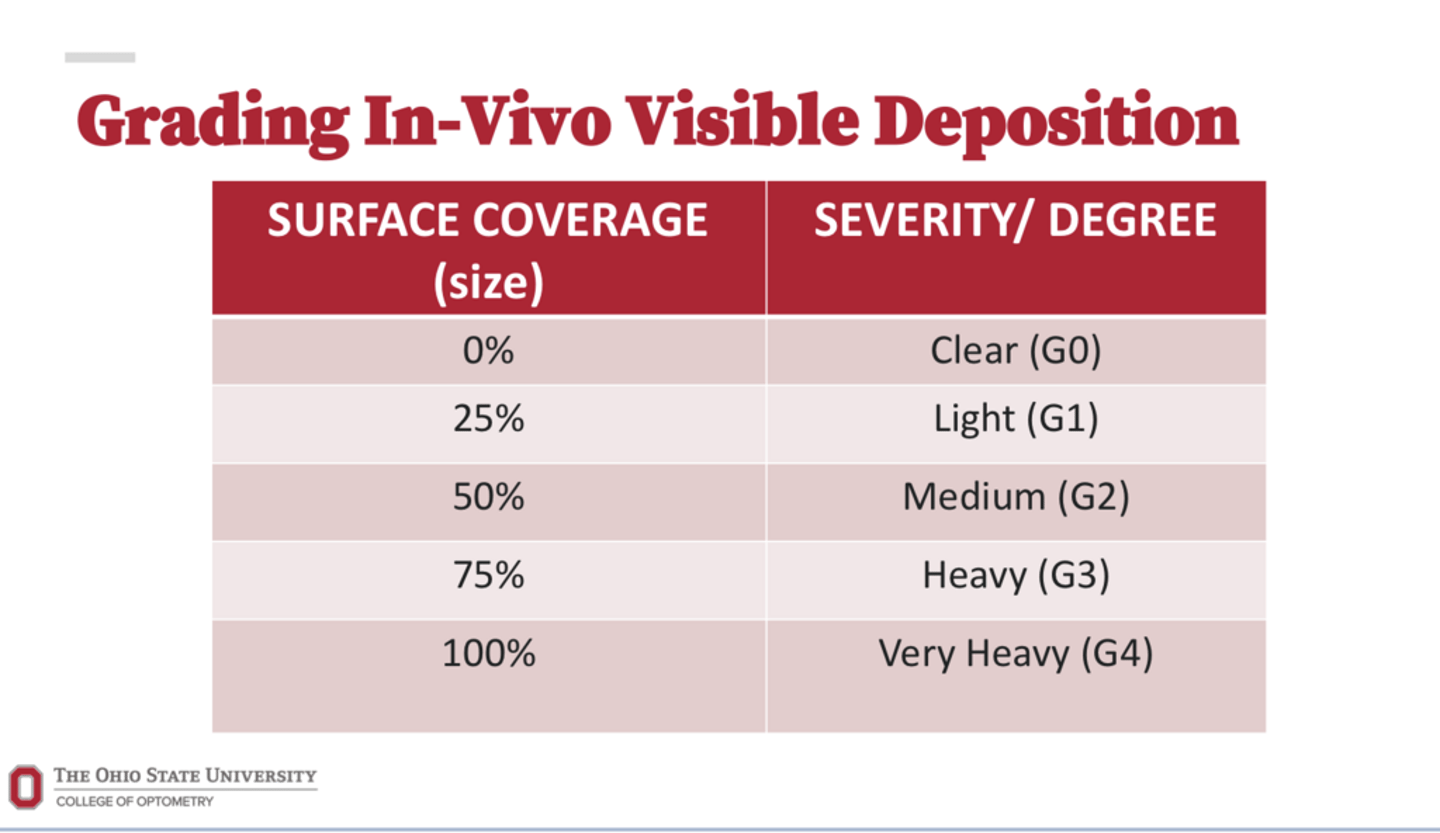
Grading In-Vivo Visible Deposition
Deposition covering 100% of the CLs
Very Heavy (G4)
Is there bacteria present on the cornea?
No the cornea is sterile
What kinds of bacteria is present on the lids and conj?
-Staph
-Propionibacterium
-Corynebacterium
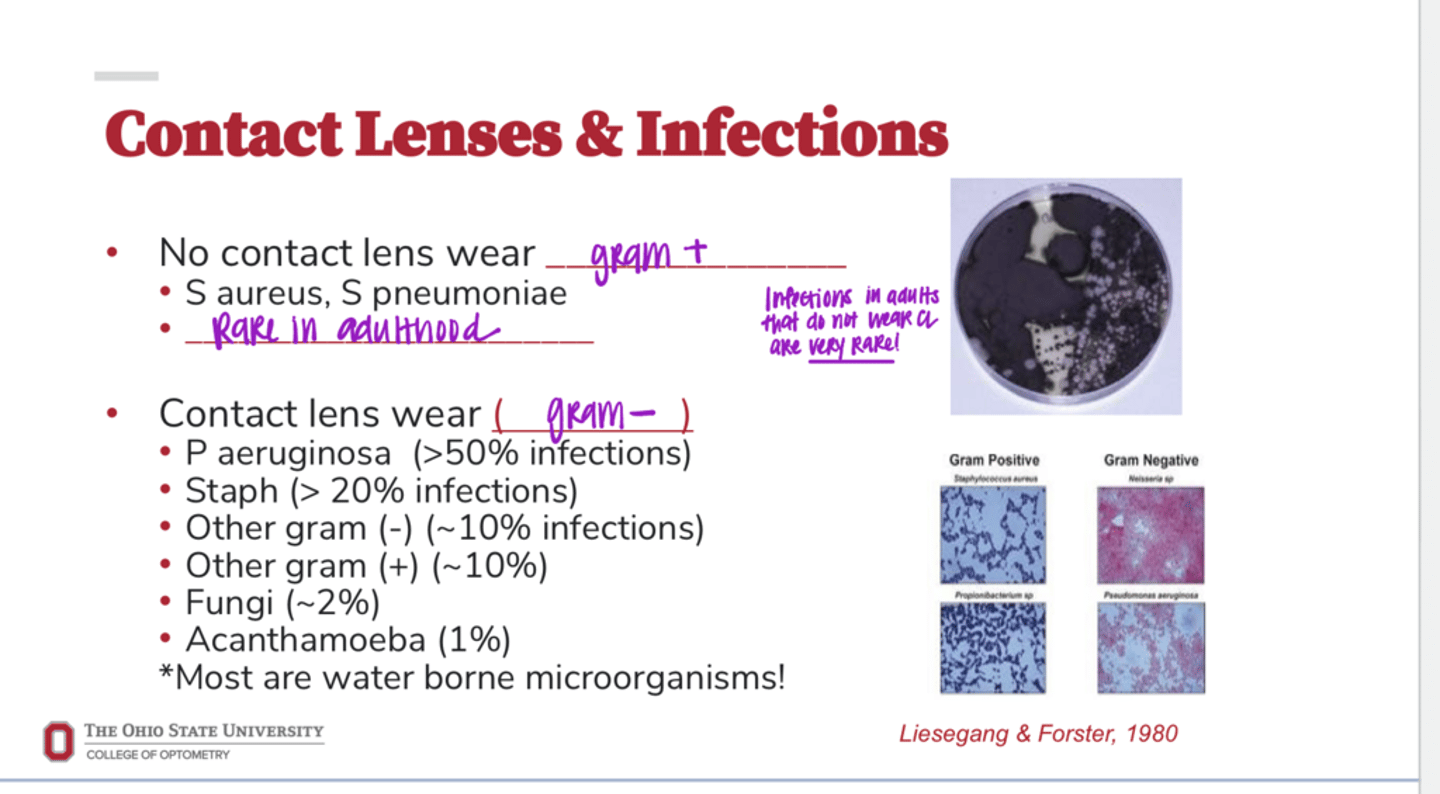
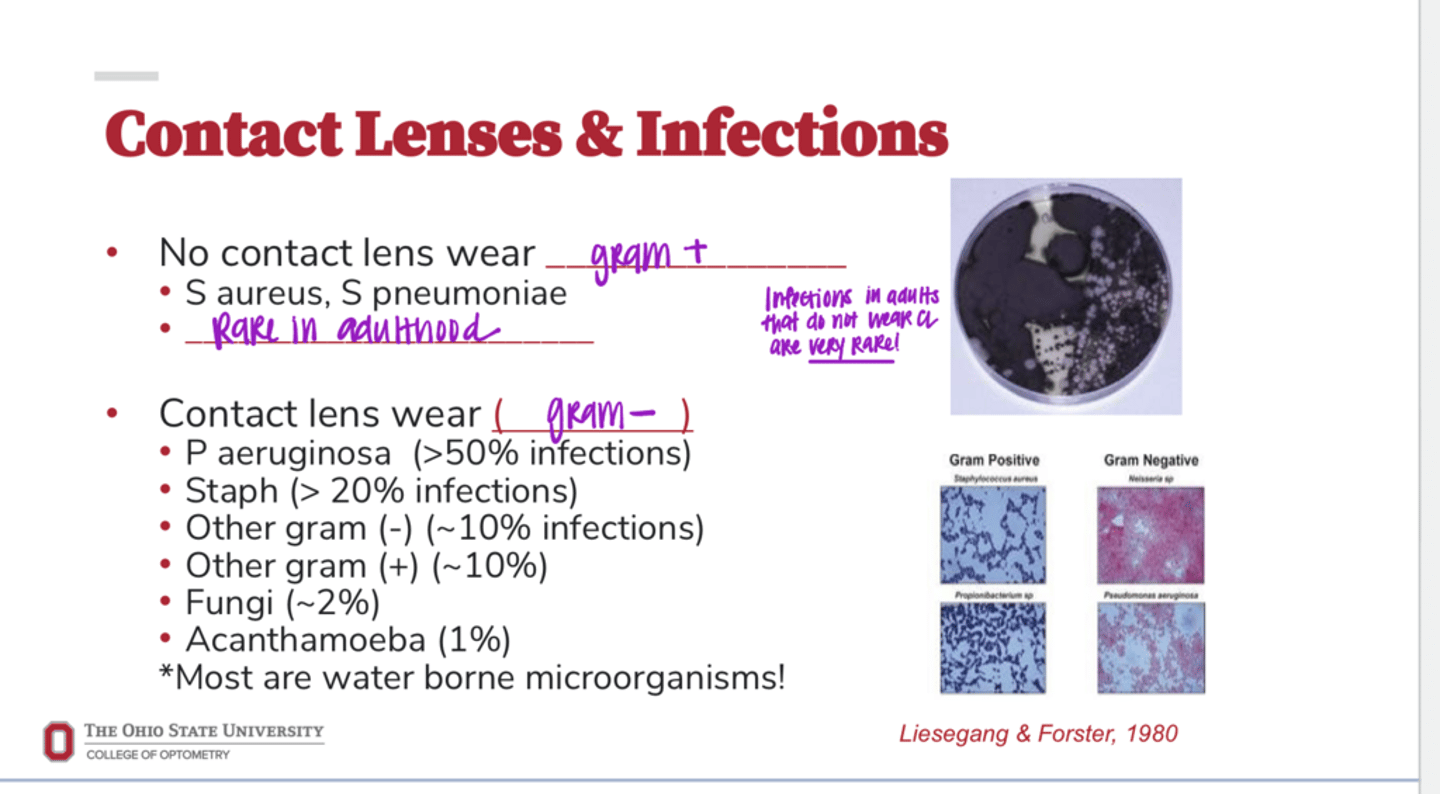
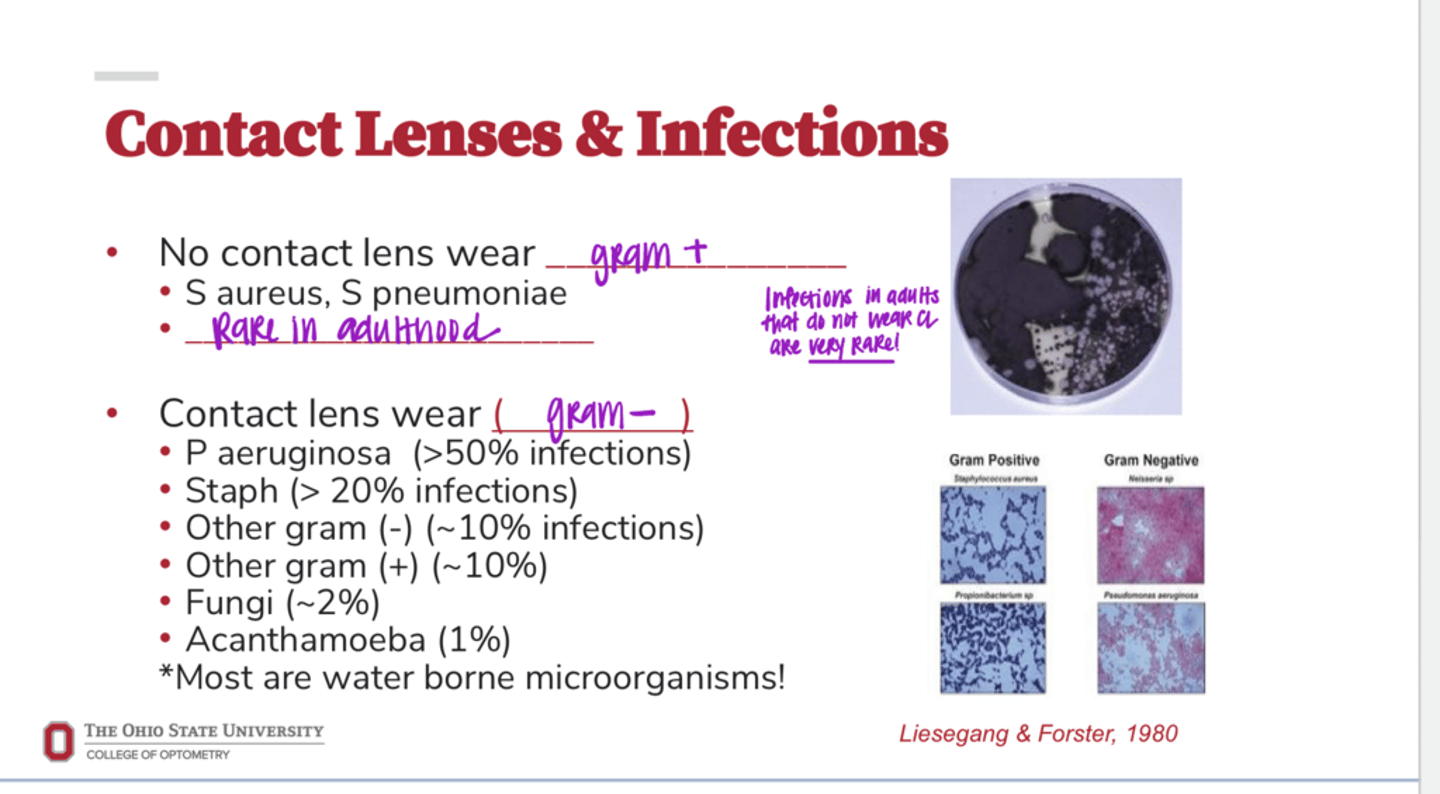
If a patient presents with a bacterial infection that DOES NOT wear CLs, the bacteria is likely gram (+/-)
+
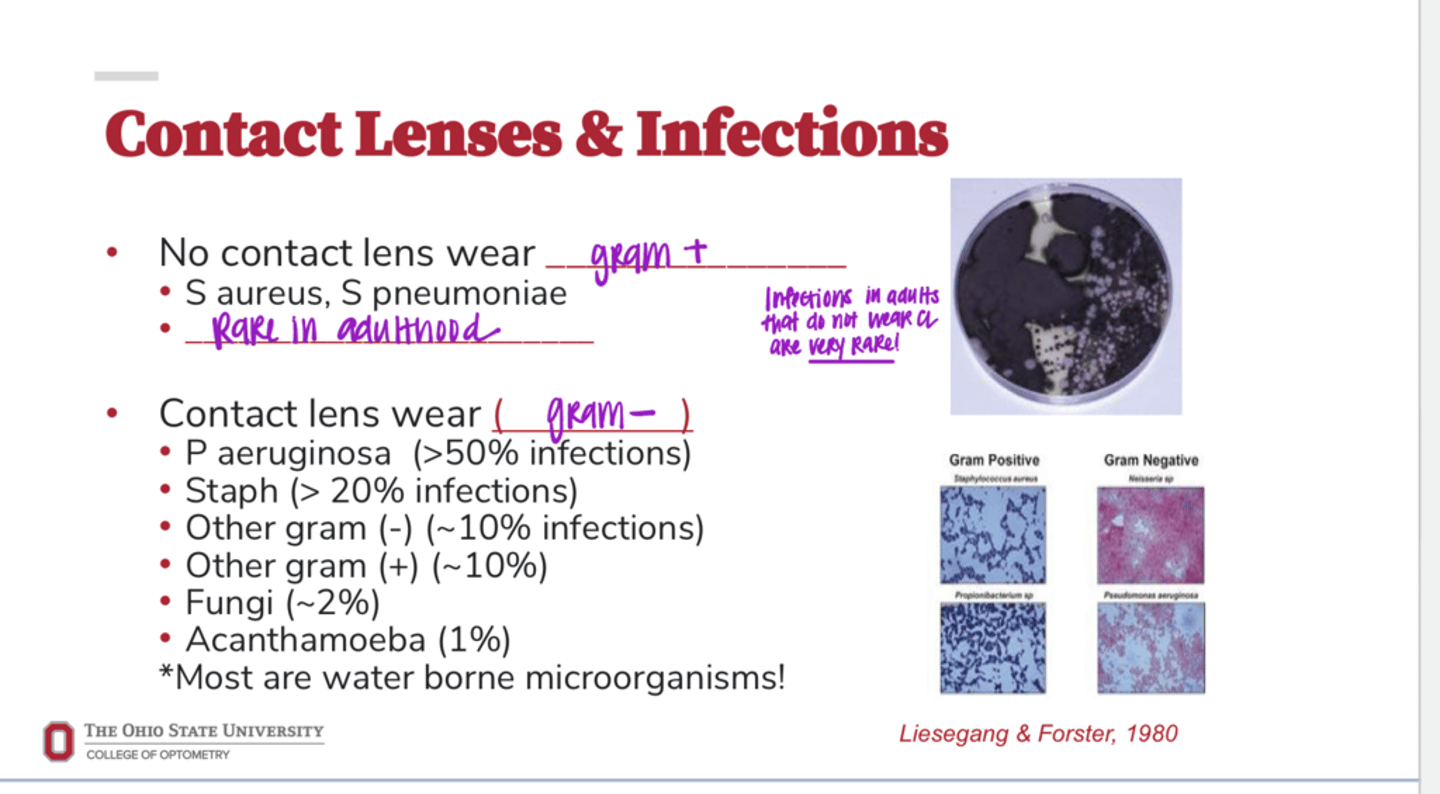
If a patient presents with a bacterial infection that DOES NOT wear CLs, what bacteria are likely causative agent?
-S aureus
-S pneumoniae
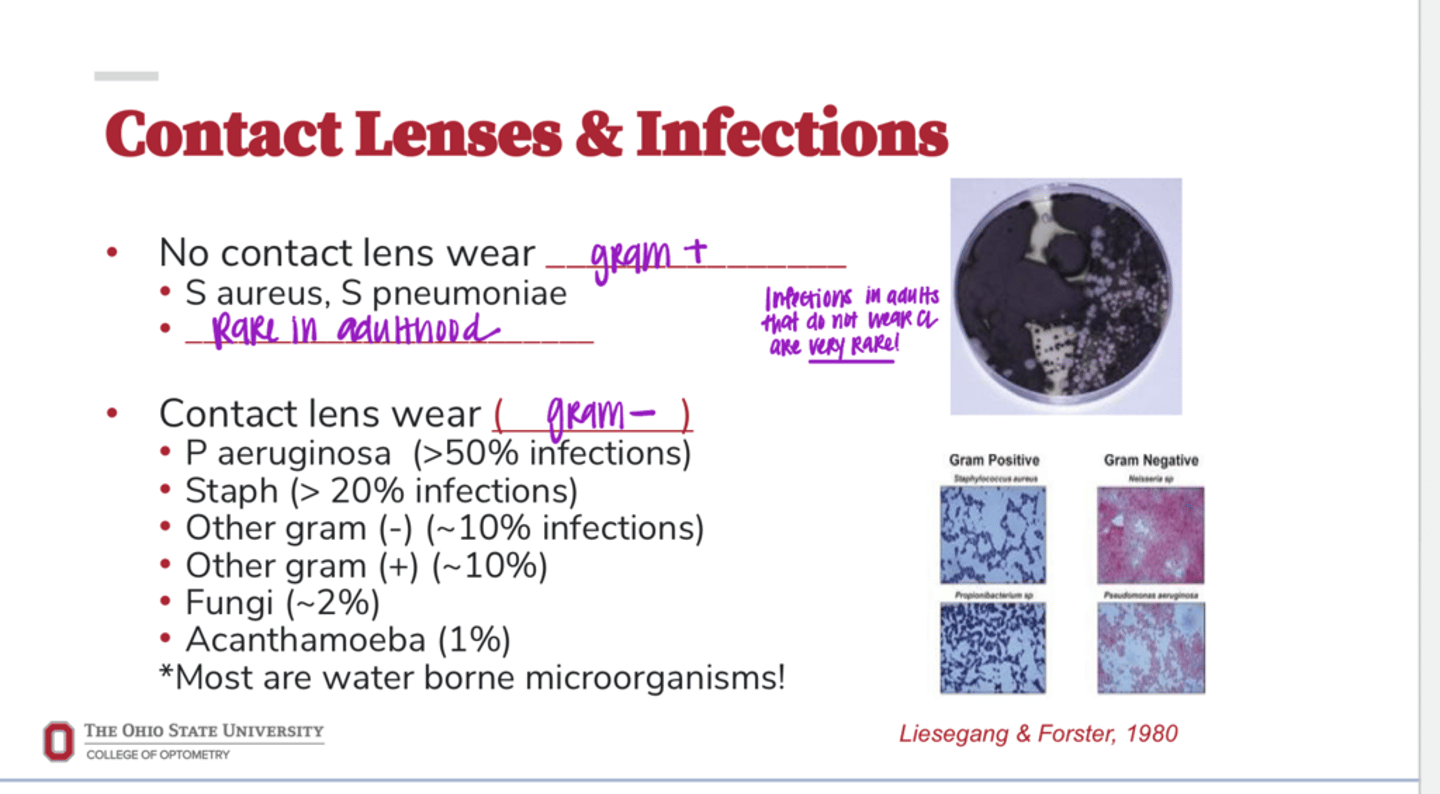
Are bacterial infections in adults who do NOT wear CLs common?
This is rare
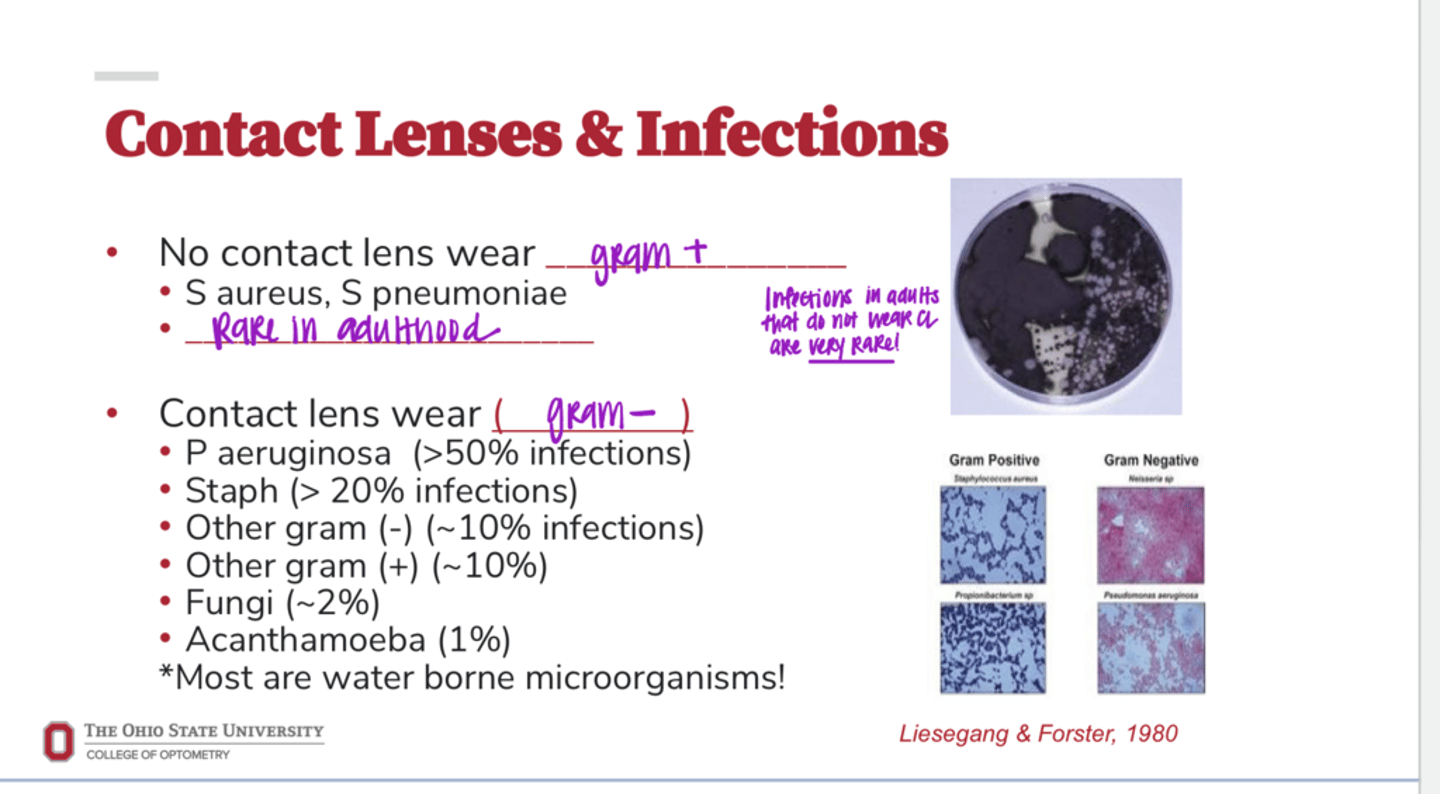
If a patient presents with a bacterial infection DOES wear CLs, the bacteria is likely gram (+/-)
-
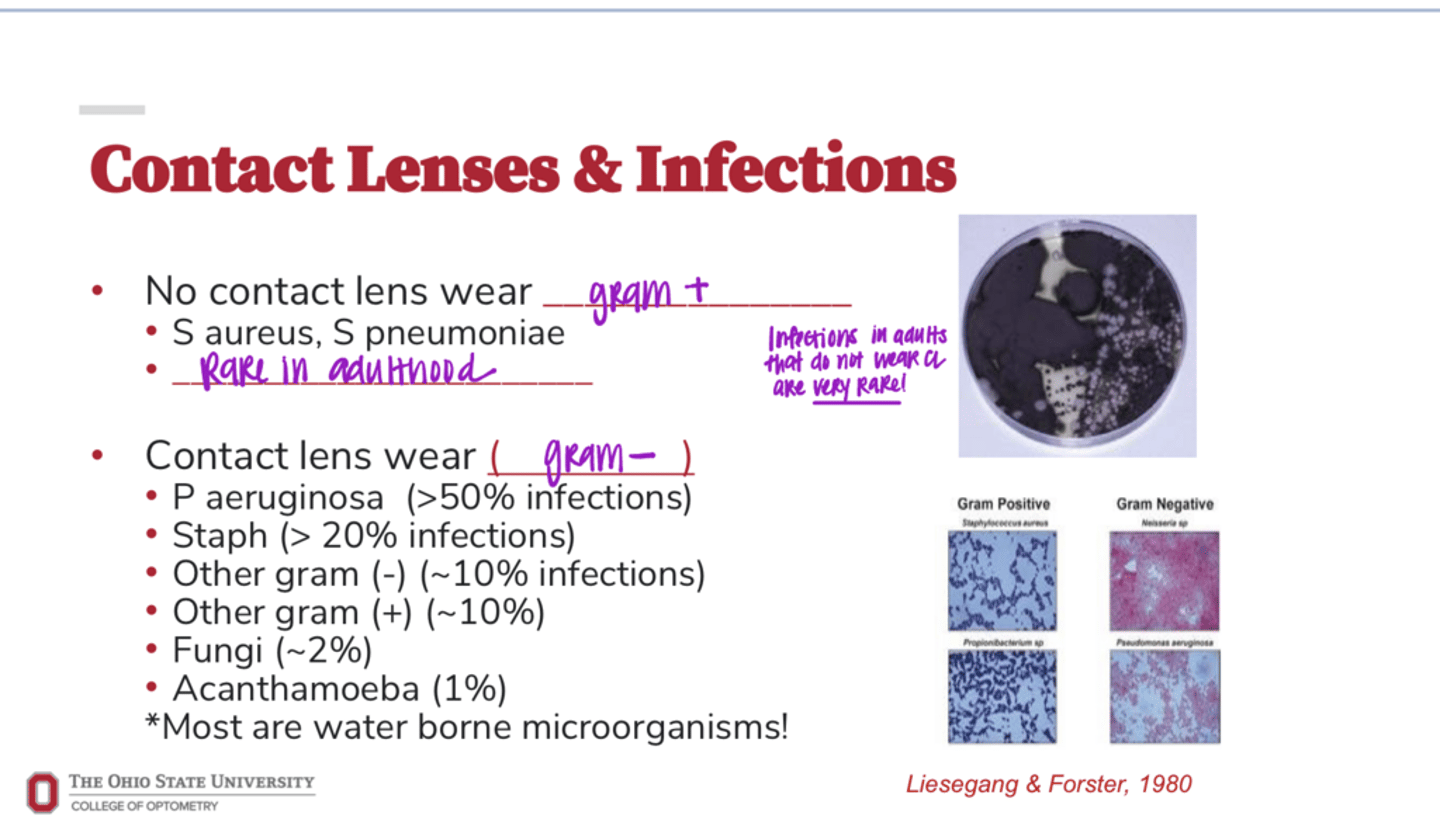
>50% of CLs wear related infections is d/t ________
P aeruginosa
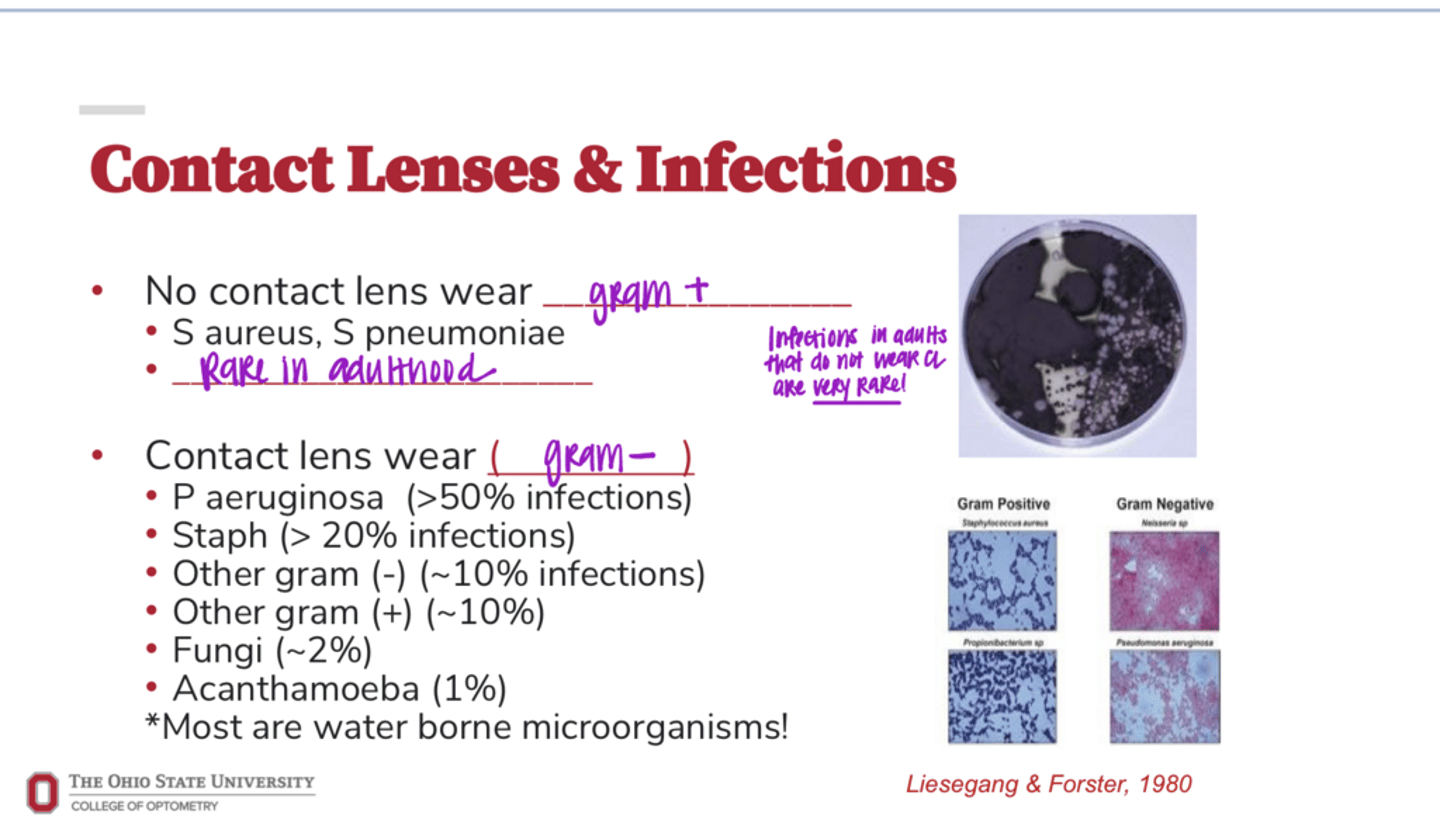
Most microorganisms that infect a patient that wears CLs are _____ borne
water
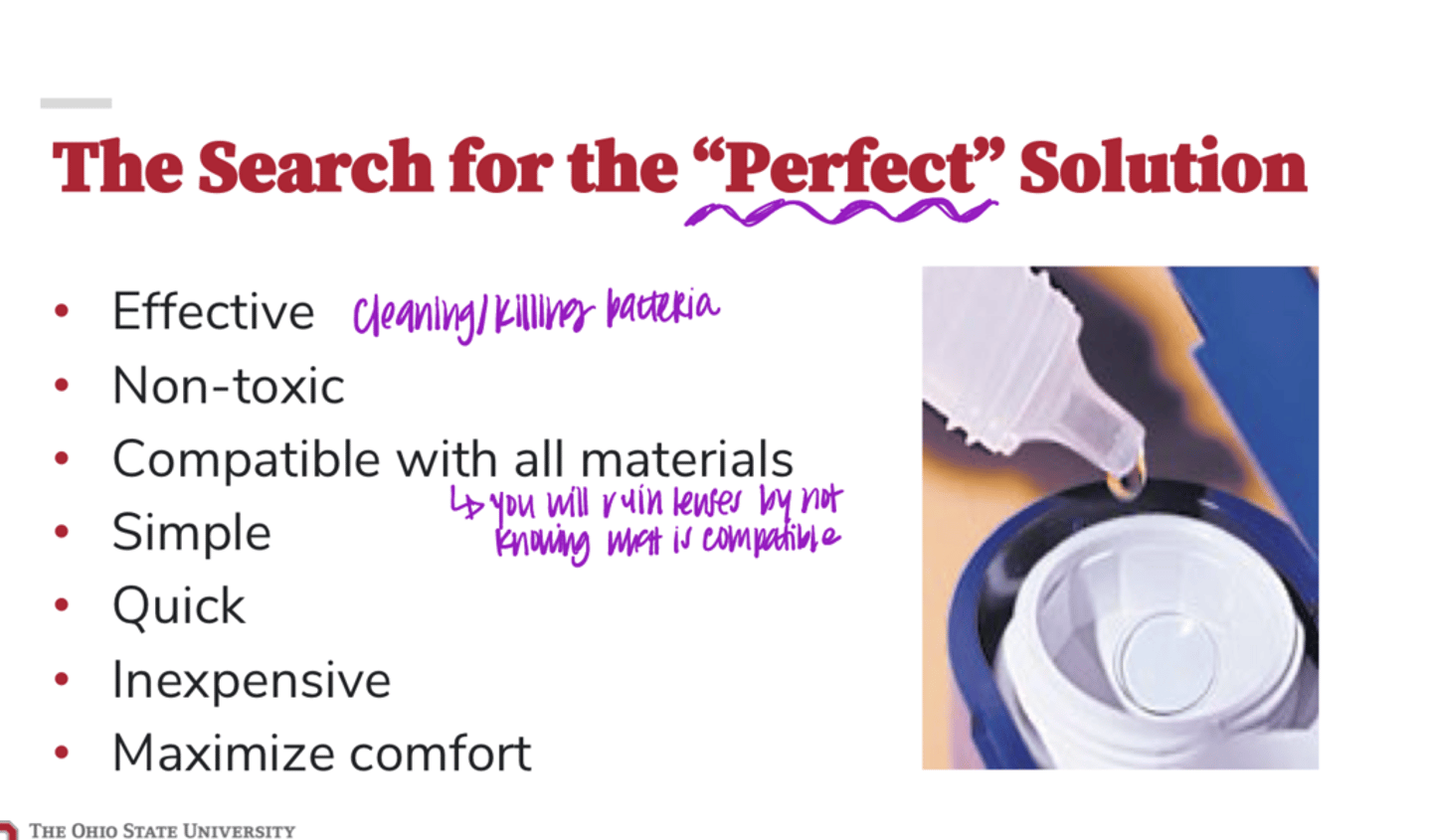
What are characteristics of CLs solutions that are desirable?
-effective
-Non-toxic
-compatible with all materials
-simple
-quick
-inexpensive
-maximize comfort
What are the 4 functions of CLs solutions?
1) Disinfect/Clean/Preserve
2) Enhance surface wettability
3) Keep the lens hydrated
4) Mechanical buffer between the lens and the cornea (RGPs mostly)
Sterilization of a CLs will be (bactericidal/bacteristatic)
bactericidal
Disinfection of a CLs will be (bactericidal/bacteristatic)
bactericidal & bacteristatic
Preservation of a CLs will be (bactericidal/bacteristatic)
bacteristatic
What is a D-value?
Exposure time to kill 90% (1 log unit) of an organism
What does D-Value stand for?
decimal reduction time
True or False:
Each organism will have its own D-value
true
Lower D values = (greater/worse) efficacy
greater
What is the D-value of hydrogen peroxide?
seconds to minutes
What organisms are tested for by the FDA in CLs solutions?
-Staph aureus
-Serracia marcesans
-P aeruginosa
-Candida albicans
-Fusarium sofani
What is missing from the FDA Organism Panel that they test CLs solutions for?
Acanthamoeba
What is the most common FDA Approval of CLs Solution?
Regimen Solution
What does a regimen solution require?
rub, rinse, soak
What does a regimen solution do?
lower log reduction of bacteria and fungi
The rub & rinse lowers the bioburden by _____ log units
5
True or False:
After rub & rinse of CLs, disinfection by soaking will do the rest
true
What is a disinfecting solution?
Stand alone, no rub solution
There is a (lower/higher) log reduction of bacterial and fungi required for soaking only solutions
higher
In order to get FDA approval for a disinfecting (no rub) CLs solution, what needs to be true?
Must achieve at least a 3-log unit reduction for bacteria and at least a 1-log reduction for yeast and mild within the recommended soak time
What is important about disinfecting solutions?
You have to rinse each side of the Cls with solution for 10-20 seconds
What are the MAJOR components of CLs solutions?
-disinfectants/preservatives
-chelating agents
-surfactants (cleaners)
-lubricating agents (viscosity)
-wetting agents
What are the MINOR components of CLs solutions?
-tonicity
-pH/buffers
-stabilizers
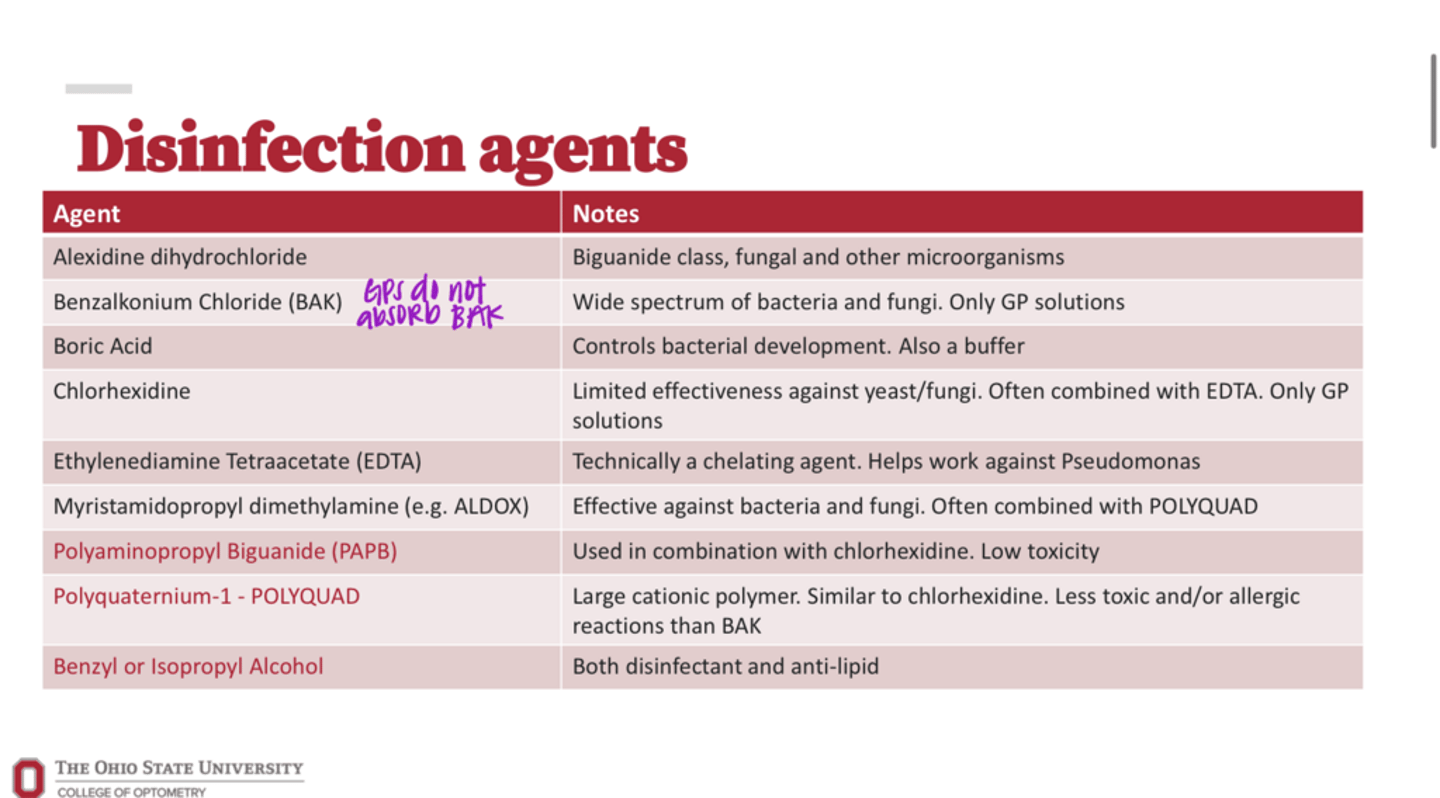
Why do RGP solutions contain BAK?
RGP solutions will not absorb BAK
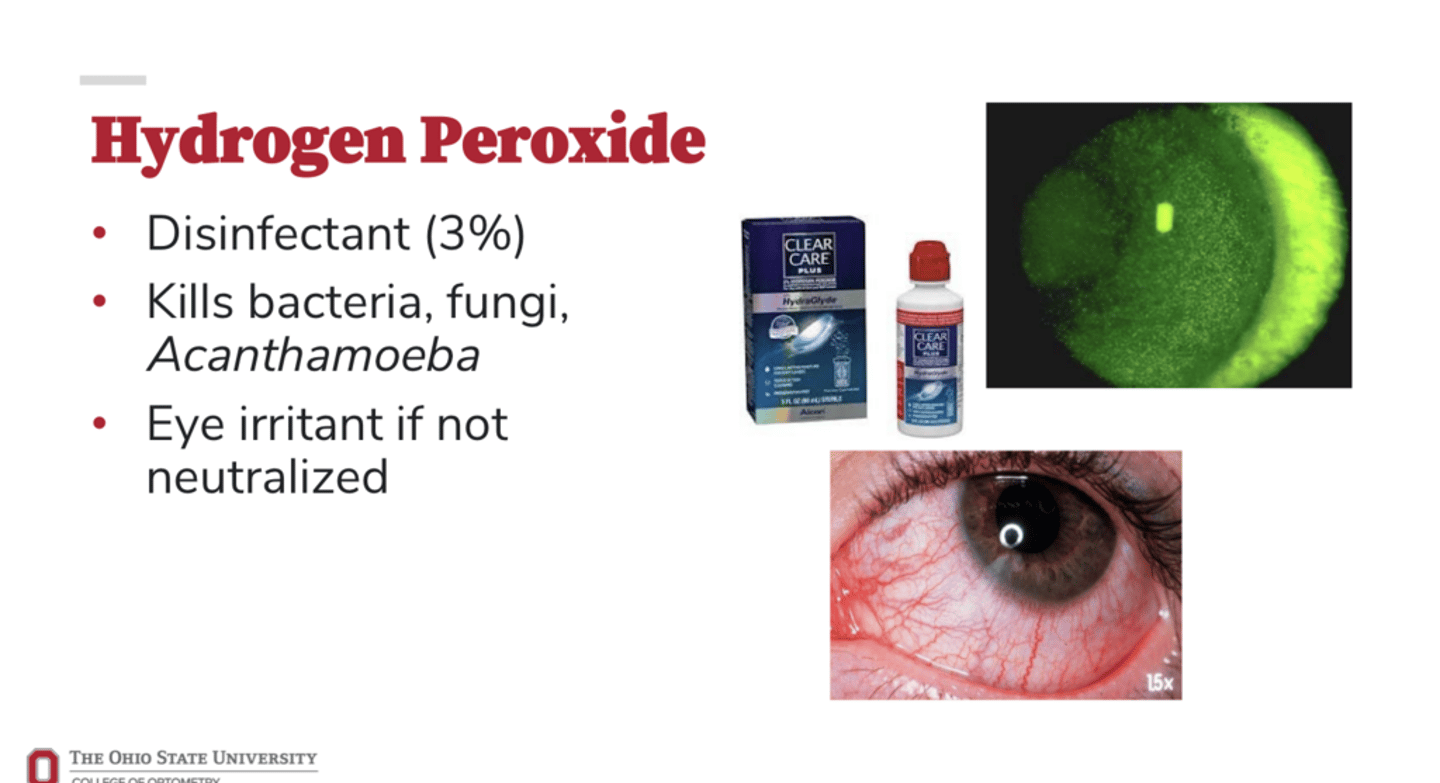
Hydrogen Peroxide (3%) is a _________
disinfectant
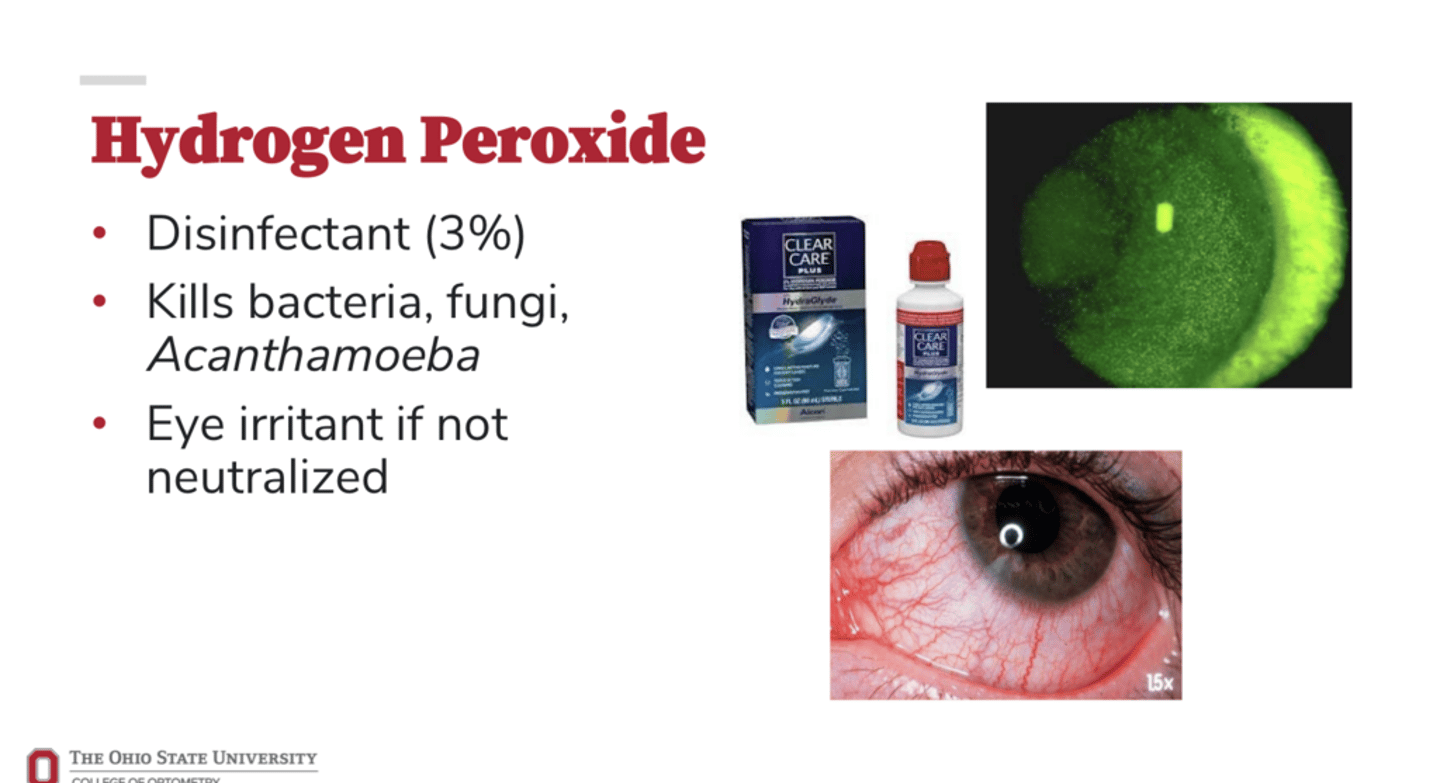
What is the importance of Hydrogen Peroxide?
kills bacteria, fungi, Acanthamoeba
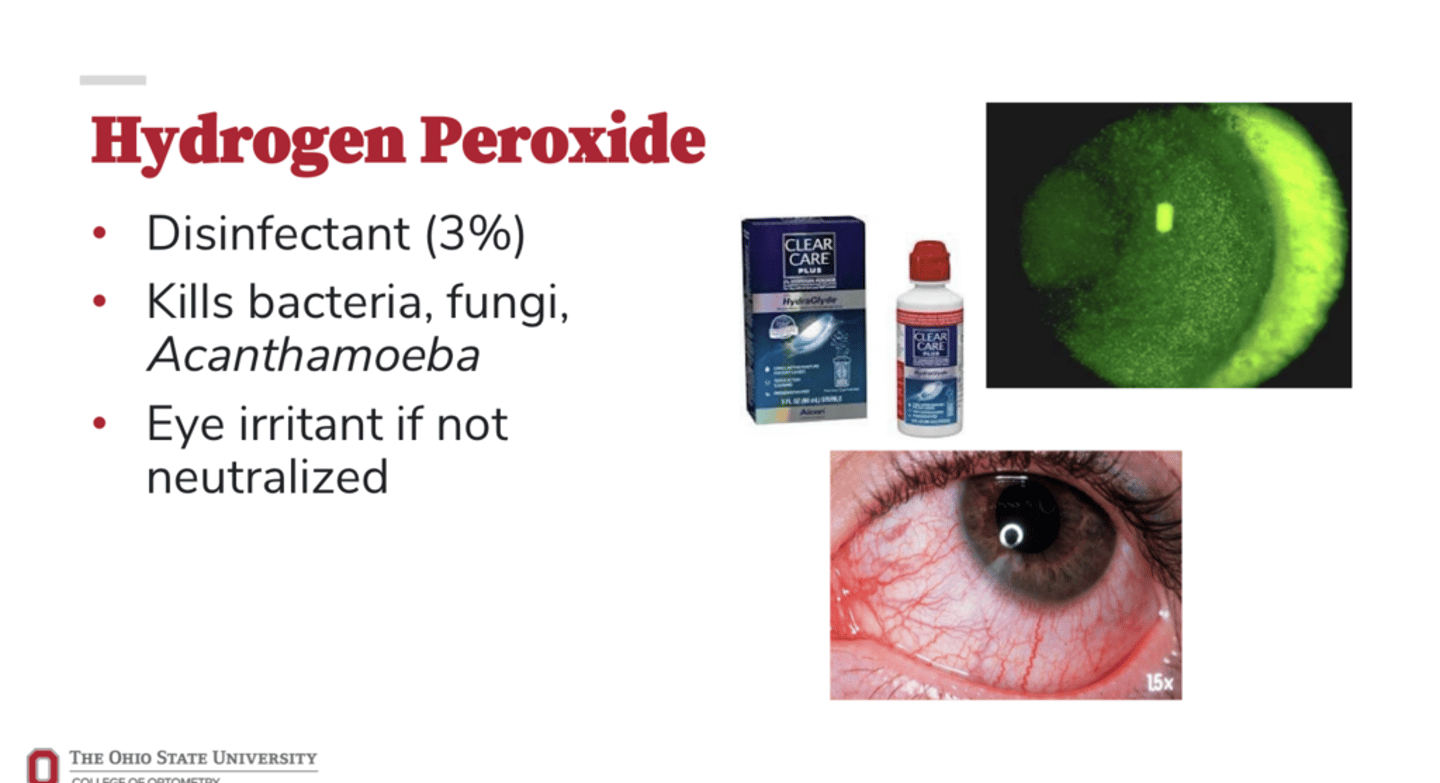
Hydrogen Peroxide is an _______ if not neutralized
eye irritant
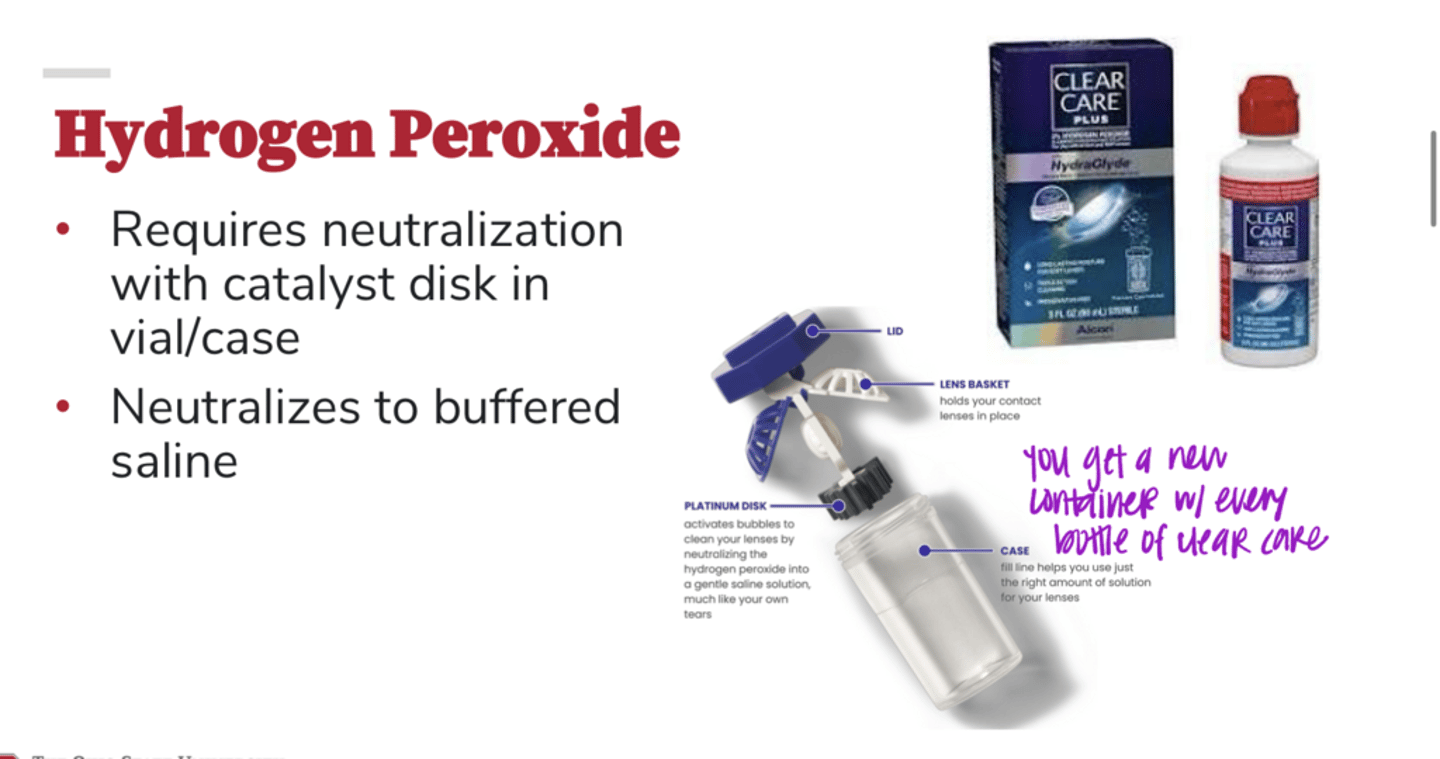
Hydrogen Peroxide requires ________ with catalyst disk in vial/case
neutralization
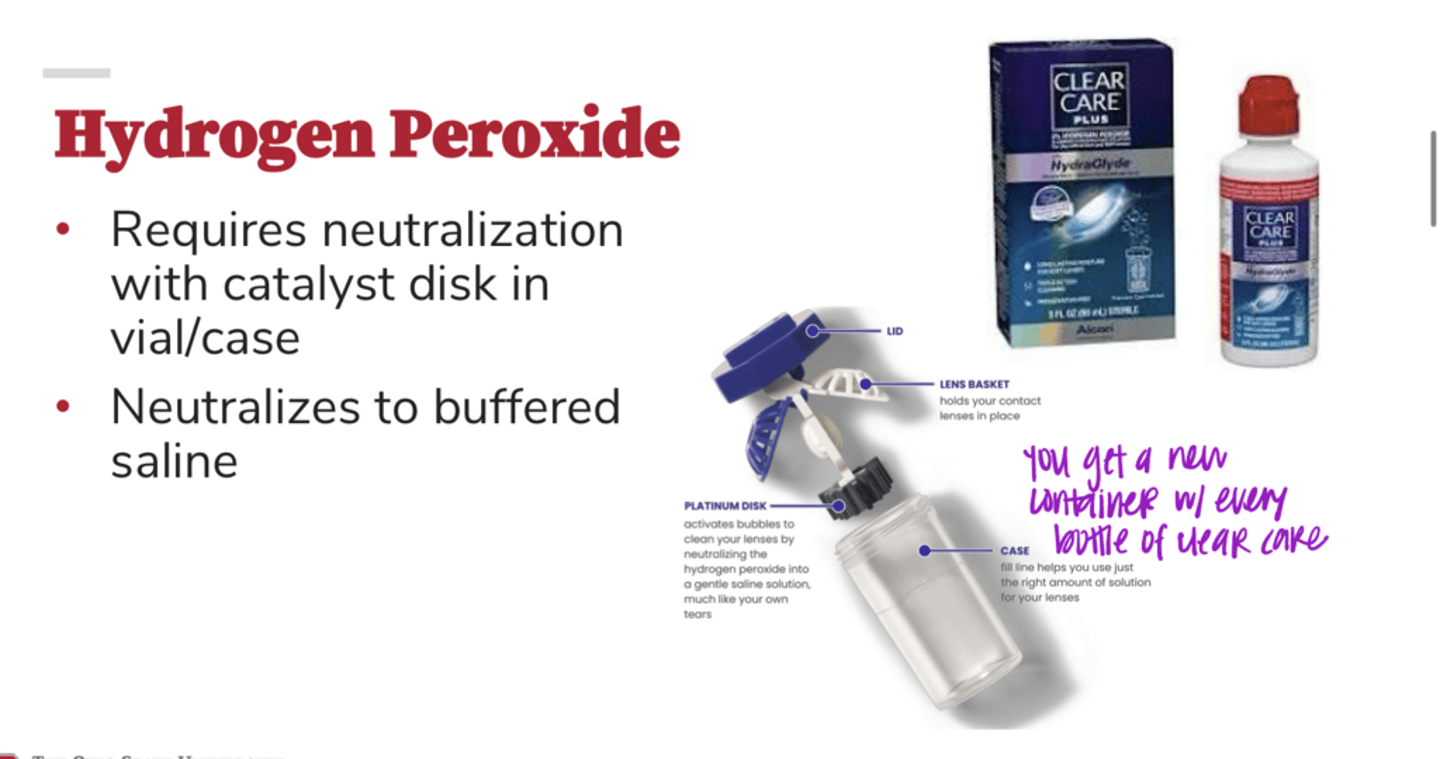
Hydrogen Peroxide neutralizes to __________
buffered saline
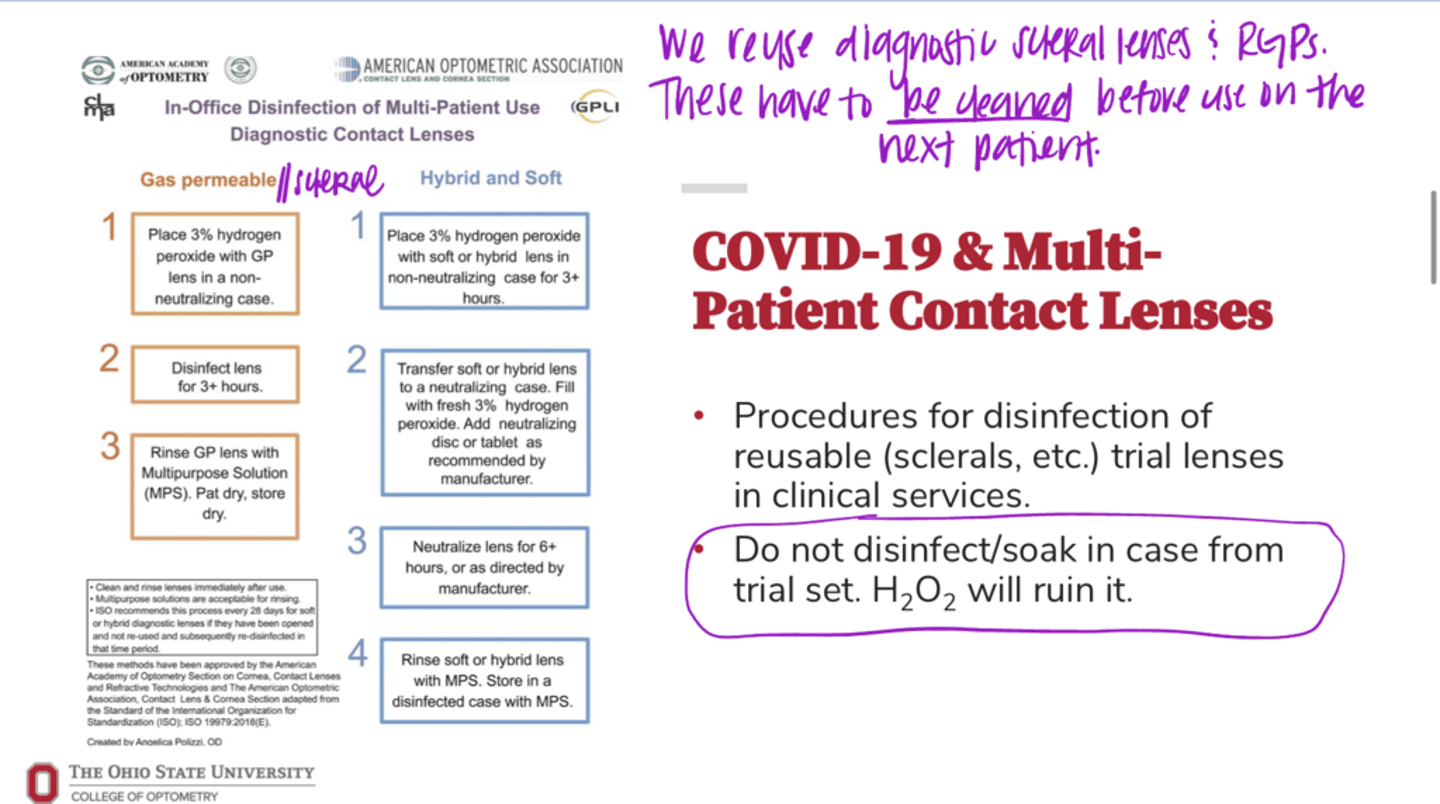
When do we use Hydrogen Peroxide in clinical practice?
Procedures for disinfection of reusable (sclerals) trial lenses
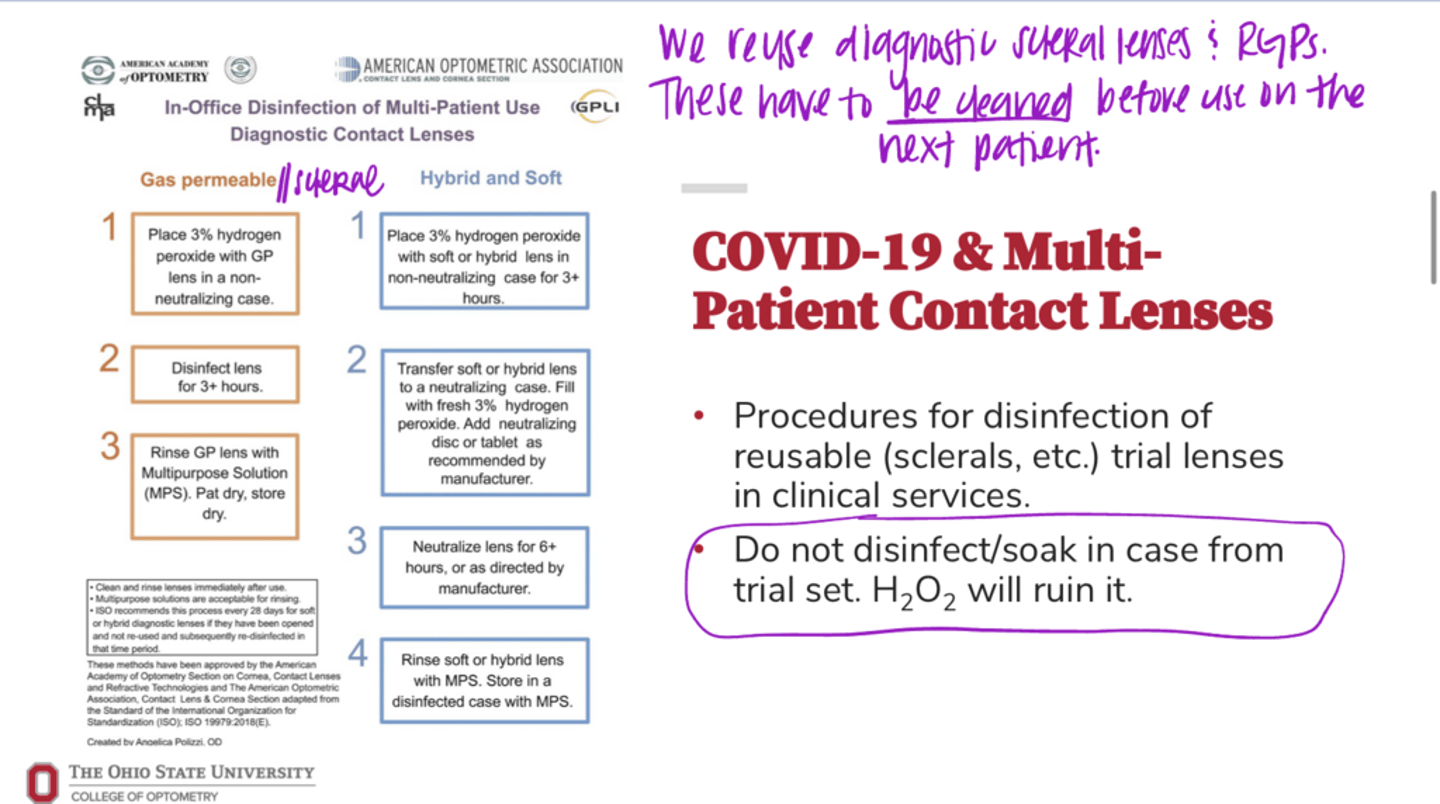
EXAM QUESTION: Should you put Hydrogen Peroxide directly into the case from the trial set?
NO! H2O2 will ruin/crack the trial lens set case
What is the function of a chelating agent?
-act synergistically with other agents to improve disinfection or cleaning
-binds tightly to metal ions needed for cell wall synthesis
What are examples of chelating agents that are added to Cls solutions?
-EDTA
-Citrate
-Hydroxyalkylphosphonate
What are surfactants that are present in Cls solutions?
-detergents solubilise debris from the lens and clean it
-change charge of the surface to improve wettability
-make the lens surface less hydrophobic
What are examples of surfactants that are added to Cls solution?
-Poloxamine
-CP-ED3A
-Isopropyl alcohol
What is Isopropyl alcohol used for?
regular lipid removal from SOFT lenses
Can isopropyl alcohol be used on high Dk lenses?
NO
Can isopropyl alcohol be used on low Dk (<80) lenses?
for brief, in office use. NOT FOR PATIENT USE
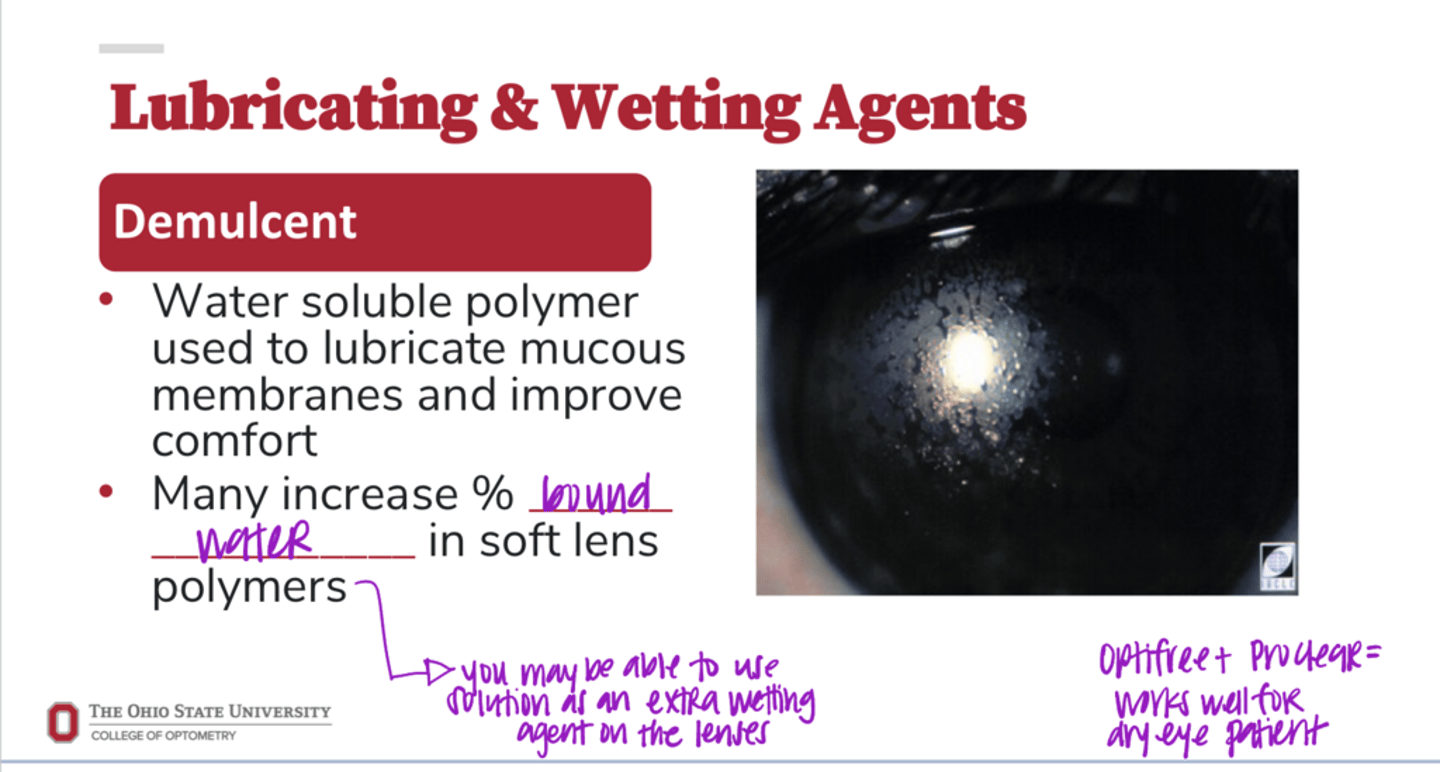
What is a demulcent what is added to CLs solution?
water soluble polymer used to lubricate mucous membranes and improve comfort
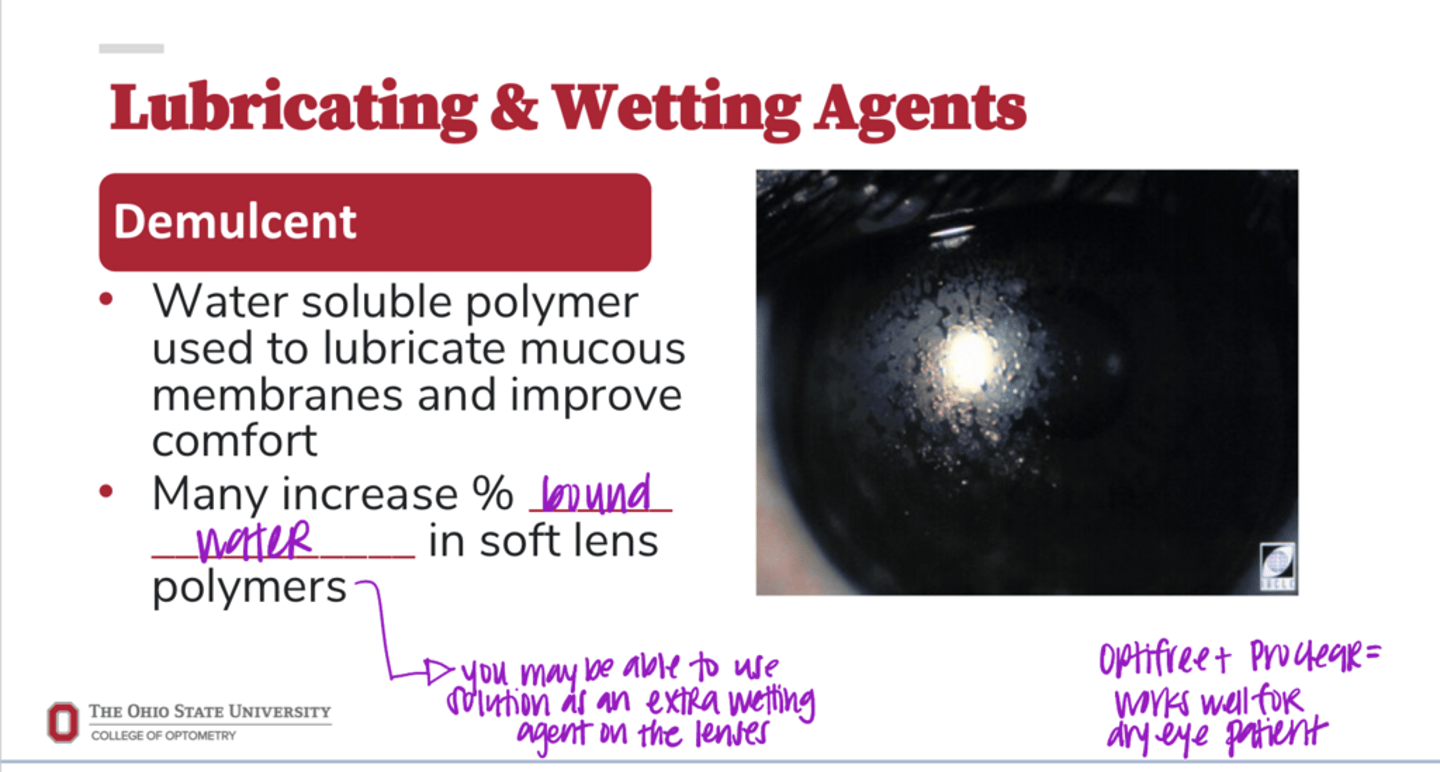
Many demulcents increase % of _________ in soft lens polymers
bound water
What are some available lubricating and wetting agents?
-dextran
-HA
-Hydraglyde
-Mineral oil
-PVP
-Sorbitol
-Tetronic
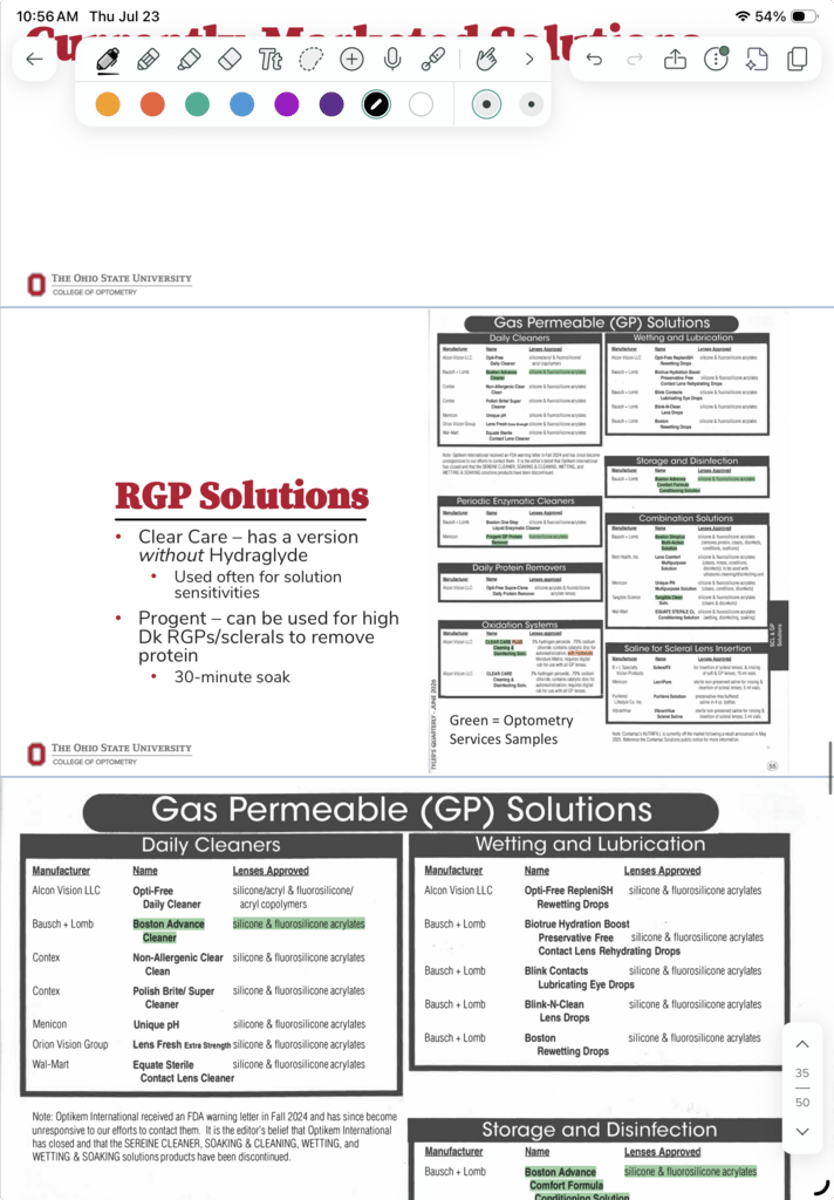
True or False:
Clear Care has a version without Hydraglyde
true
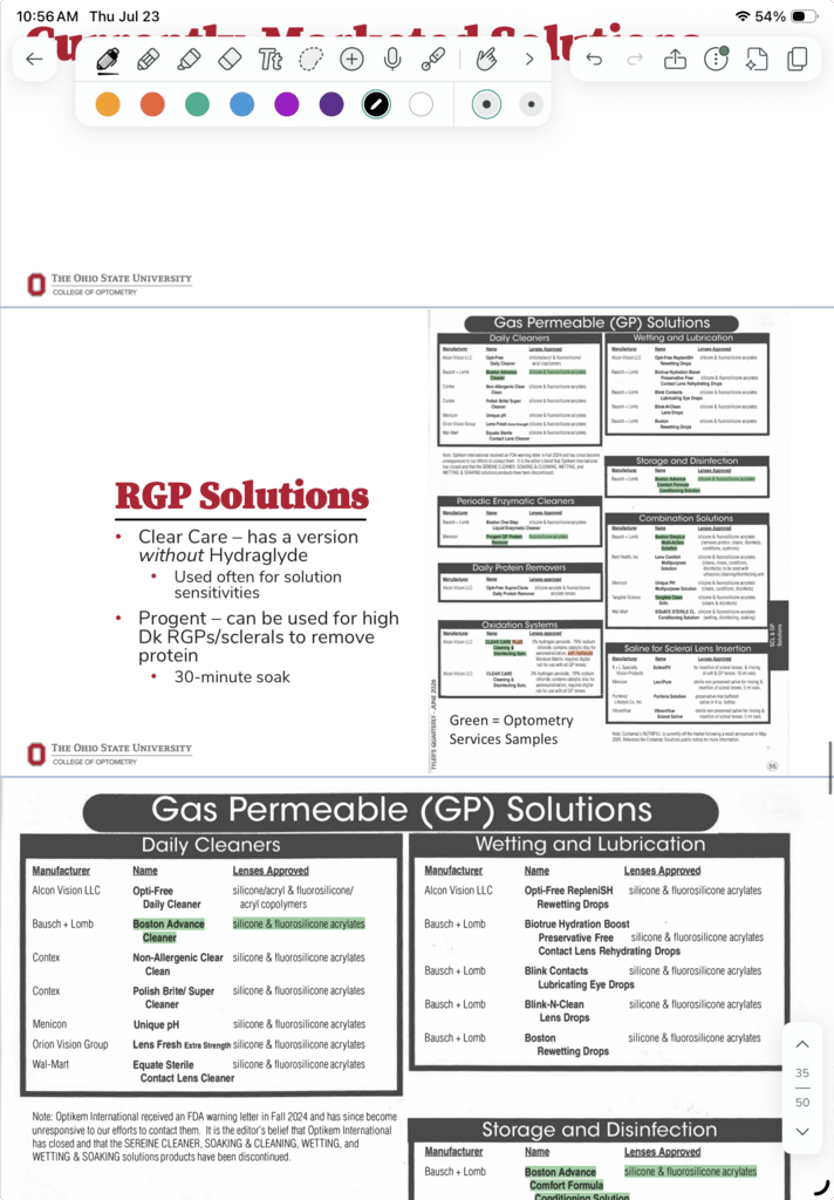
What is regular ClearCare (not plus) used for?
Used often for solution sensitivities
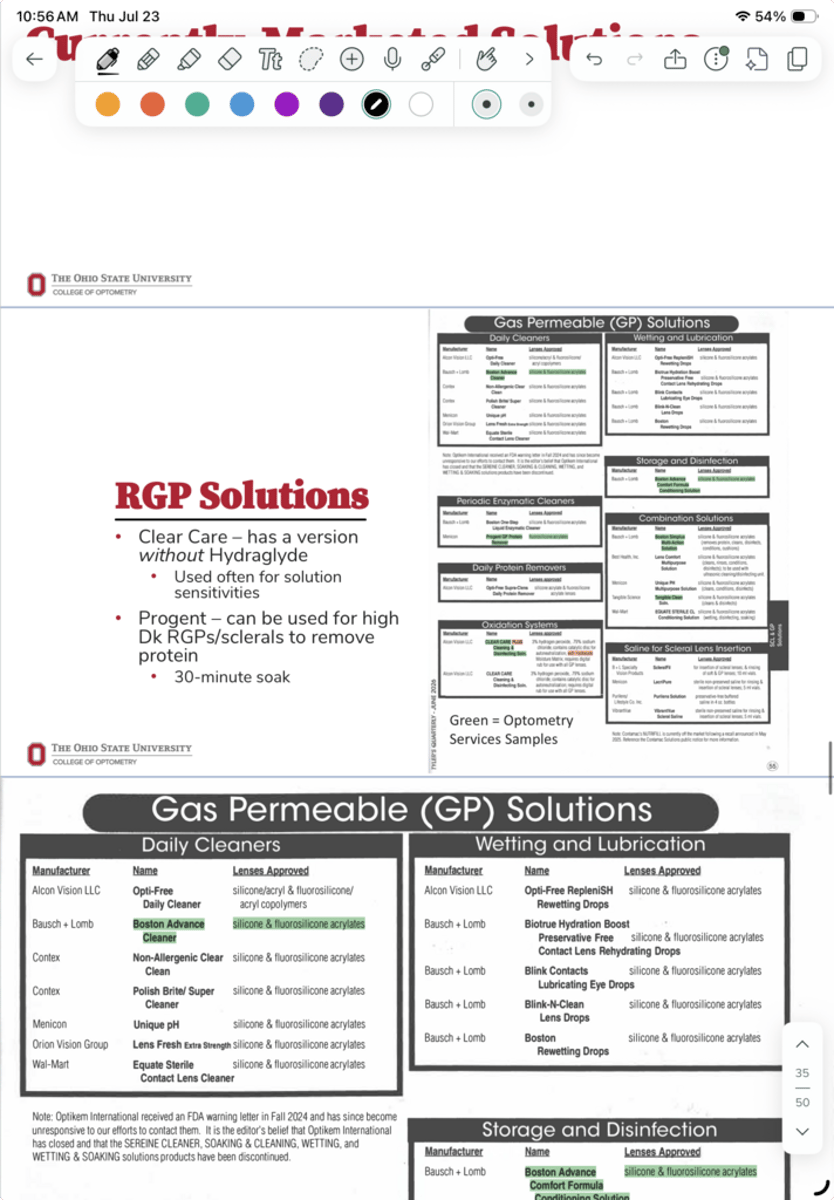
What is Progent solution used for?
Can be used for high Dk RGPs/sclerals to remove the proteins on them
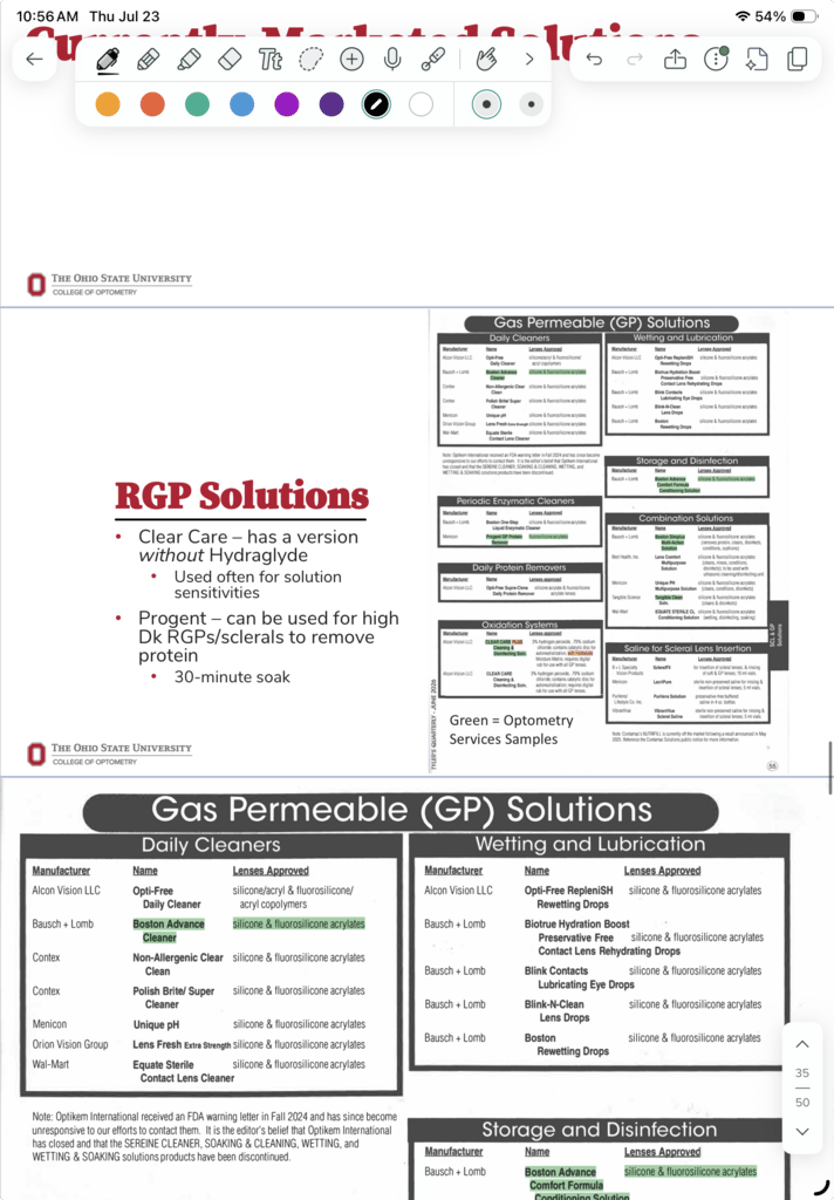
What are the directions on Progent solution?
Soak CLs in the solution for 30 min
Do saline solutions for SCLs clean or sterilize/disinfect/preserve CLs?
No
Are Clear Care and Tangible solutions used for SCLs as well as RGPs?
Yes
What is Miraflow?
-isopropyl alcohol CLs solution
-Extra strength daily cleaner
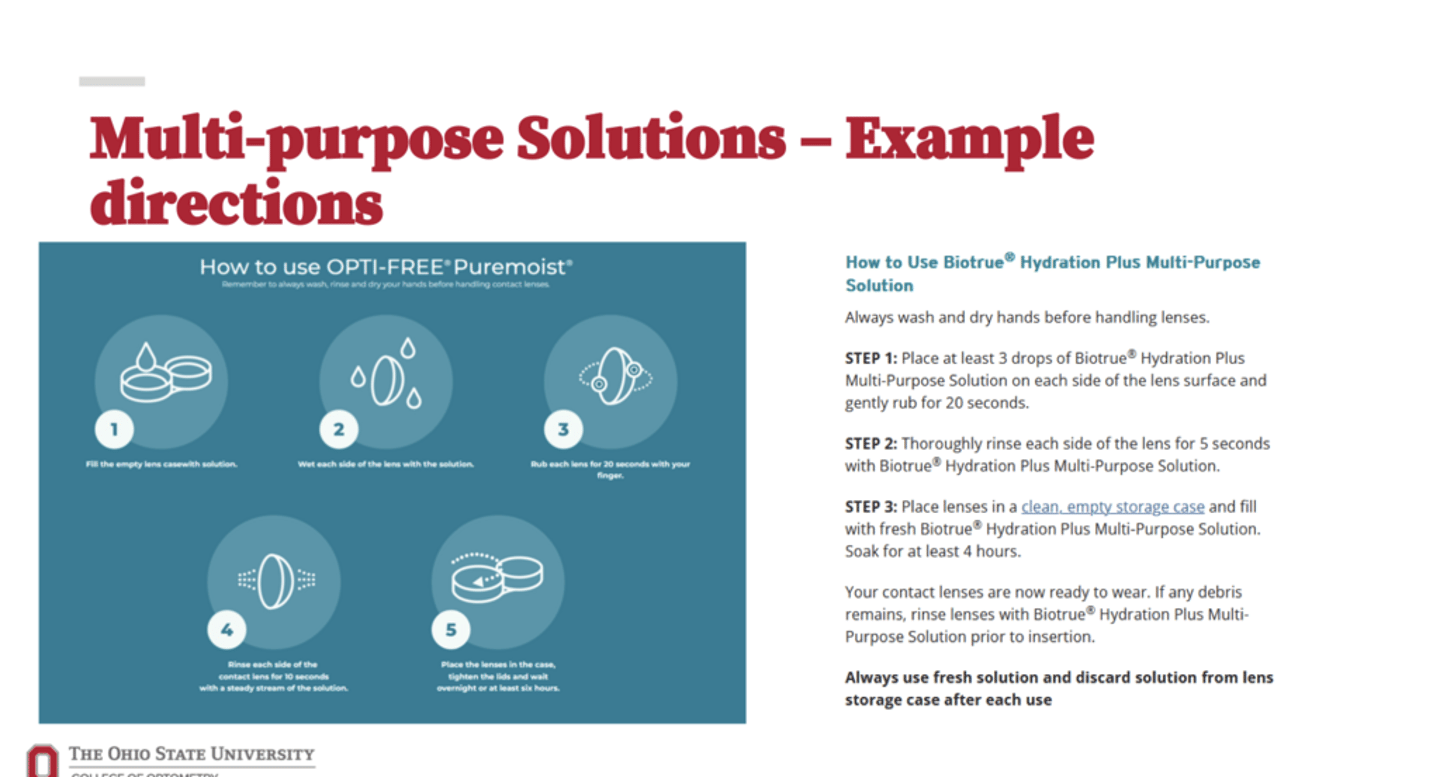
How to Use Opti-Free PureMoist Cls Solution?
-Fill the empty lens case with solution
-Wet each side of the lens with the solution
-Rub each lens for 20 sec with your finger
-Rinse each side for 10 sec with a steady stream of solution
-Place the lenses in the case, tighten the lids and wait overnight or 6h
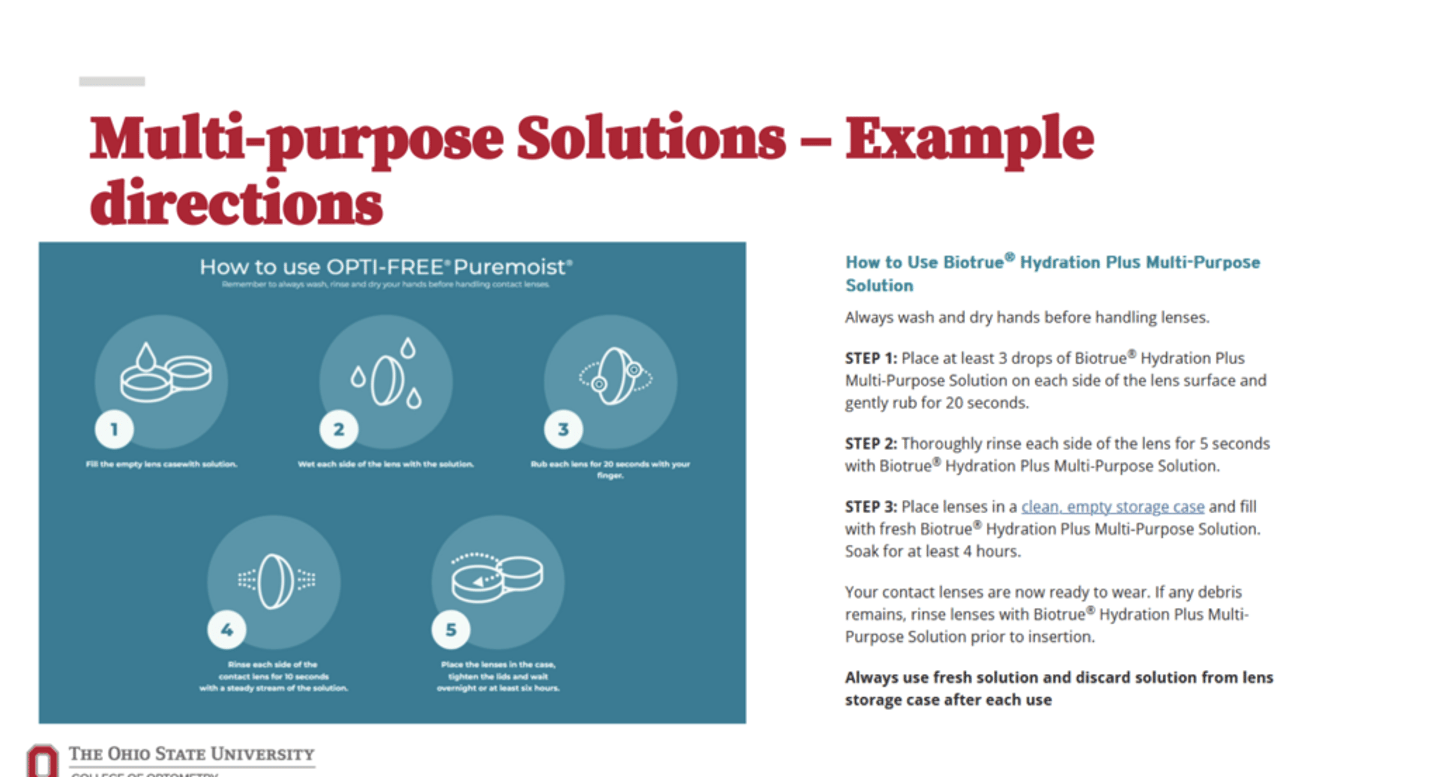
How to Use Biotrue Hydration Plus MP Cls Solution?
-Place at least 3 drops of solution on each side of the lens surface and gently rub for 20 sec
-Thoroughly rinse each side of the lens for 5s with solution
-Place lenses in a clean, empty, storage case and fill with solution
-Soak for 4h
What behaviors do we desire from our patients who wear Cls?
-Hand-washing
-Proper case cleaning and regular lens/case replacement
-Proper care of their lenses/use of the system
-No contact with water
When should we tell patients to wash their hands when dealing with CLs?
Before insertion and removal
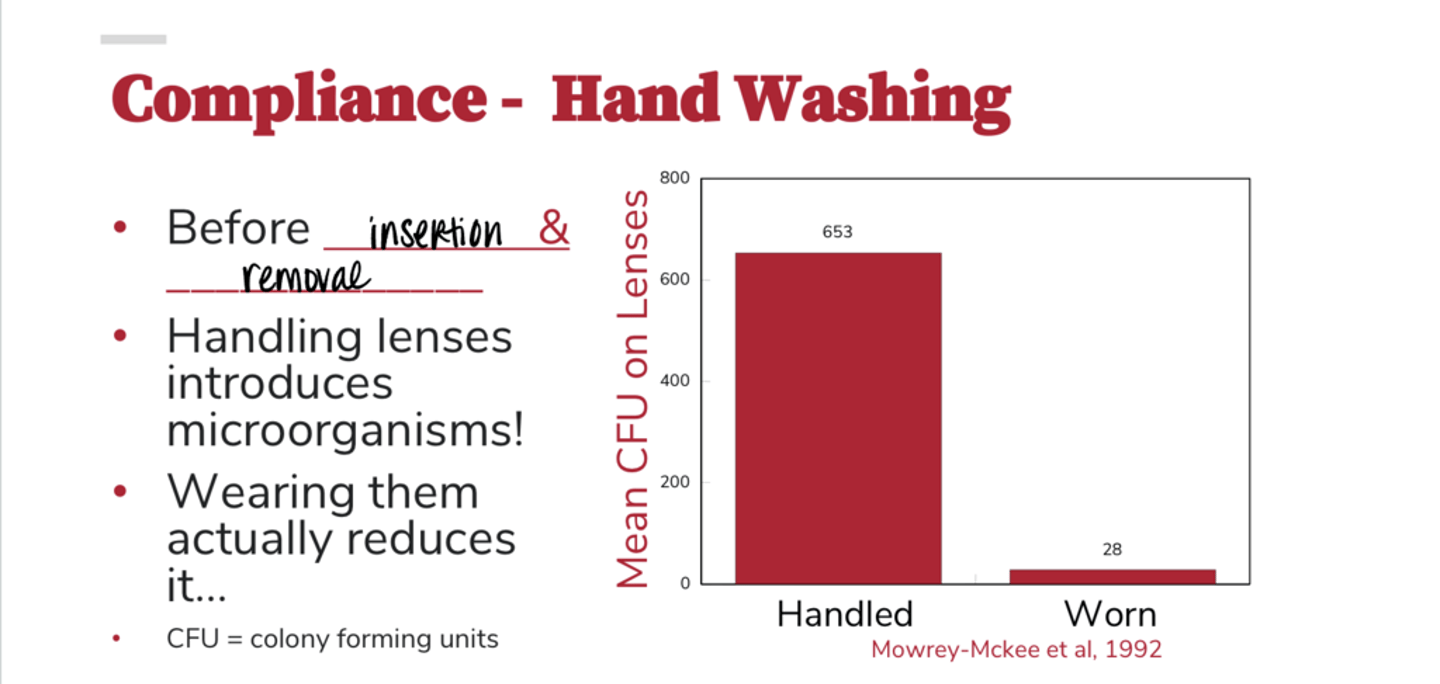
True or False:
Handling lenses introduces microorganisms to the surface of the lens
true
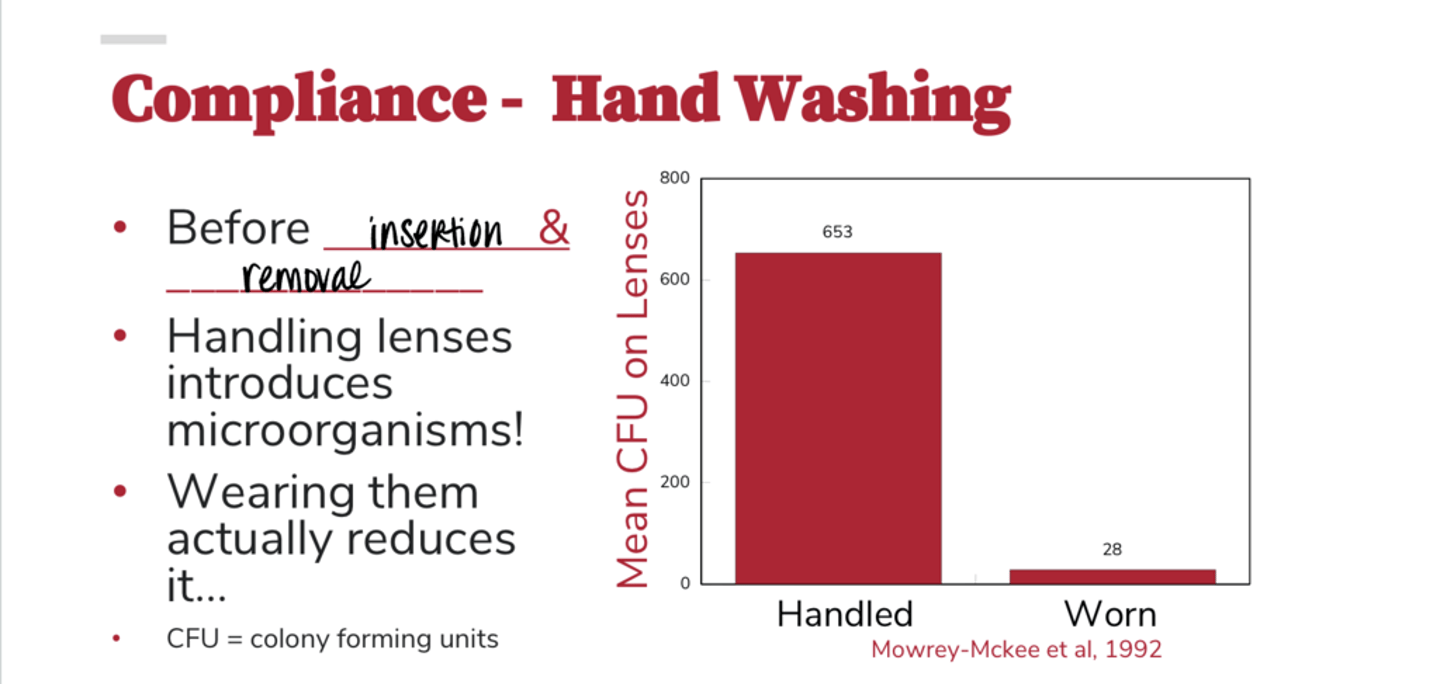
True or False:
Wearing lenses introduces microorganisms to the surface of the lens
False -- actually reduces the amount of microbes on the surface of the lens
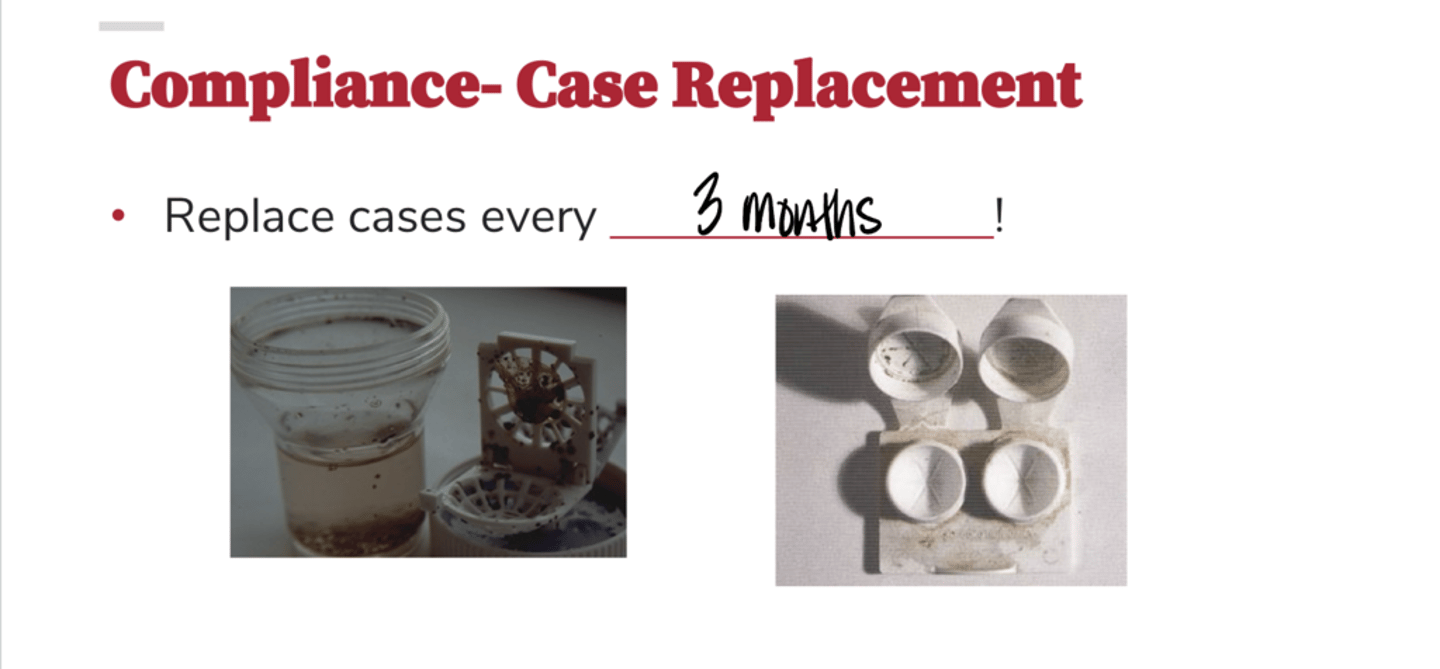
You should replace CLs cases every _______
3 months
What should we be doing with a CLs case EVERY MORNING regarding cleaning and drying?
-Dump all solution every morning
-Place clean tissue or paper towel on counter
-Rinse case with contact lens solution -- NOT WATER
-Place the case and lids upside down on tissue to dry during the day
Why do CLs care systems require rubbing?
Physical removal of the debris by friction
Do ALL Cls solutions require a rinse?
Yes -- for 5-20 seconds for each side of the Cls for physical removal of debris
Do ALL Cls solutions require a soak?
Yes -- a 4-6 hour soak
Should patients TOP OFF their CLs cases with solution day to day?
No
Should contact lens wearers ever wear CLs when in contact with water?
No
Should you shower in Cls?
No -- but you should expect some patients (esp high myopes) to do it anyways
Should you swim in Cls?
No -- if they do, make sure to recommend use of goggles
Should you use hot tubs with CLs in?
No
What CLs solution has the HIGHEST kill rate against trophozoites?
OptiFree Puremoist
What CLs solution has greater than 99.99% kill rate against both forms (cysts and trophozoites) of Acanthamoeba
Acuvue Revitalens
What CLs solution kills both forms of Acanthamoeba within minutes?
Hydrogen Peroxide
If you KNOW the CLs has come in contact with Acanthamoeba, it must be _______
destroyed
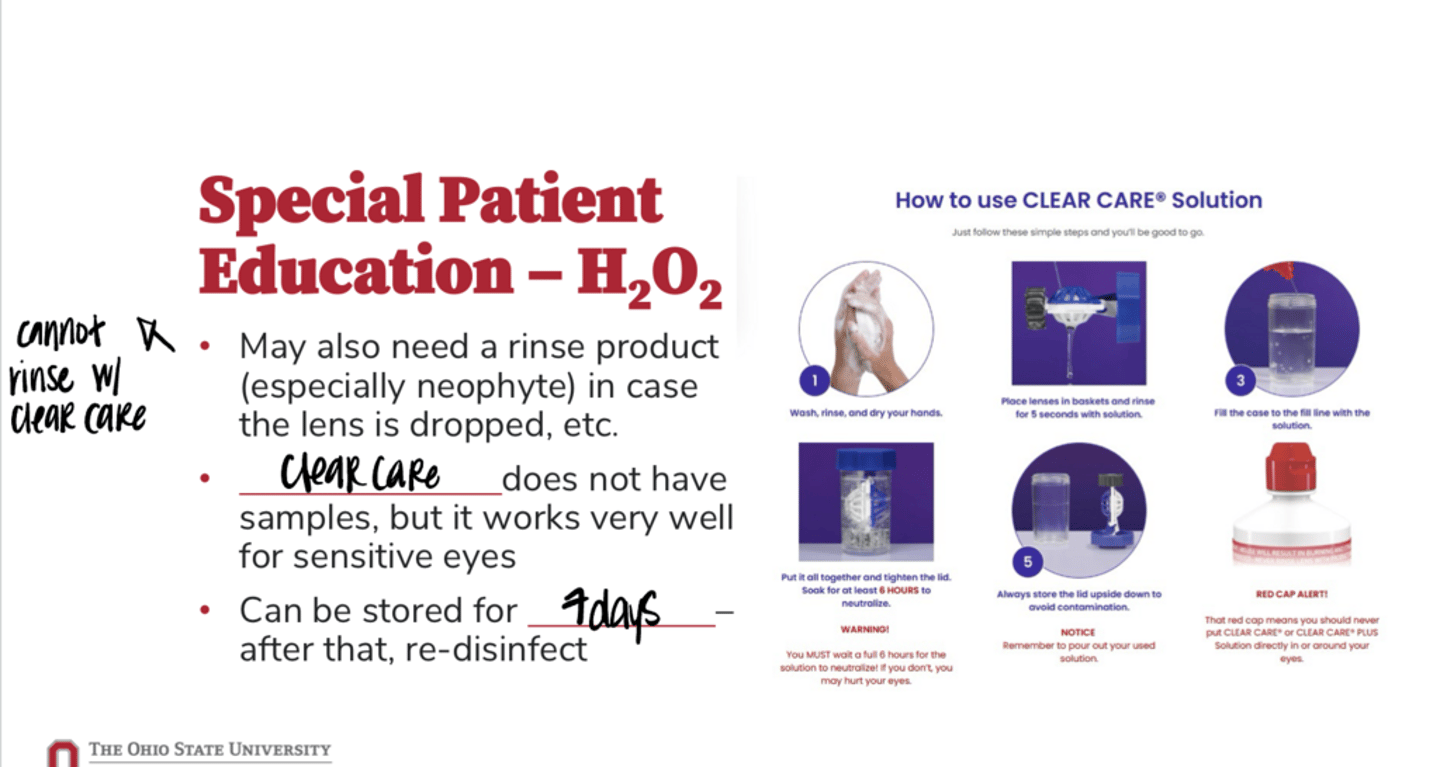
When you recommend hydrogen peroxide (H2O2) you may also need a ________ in case the lens is dropped.
rinse product
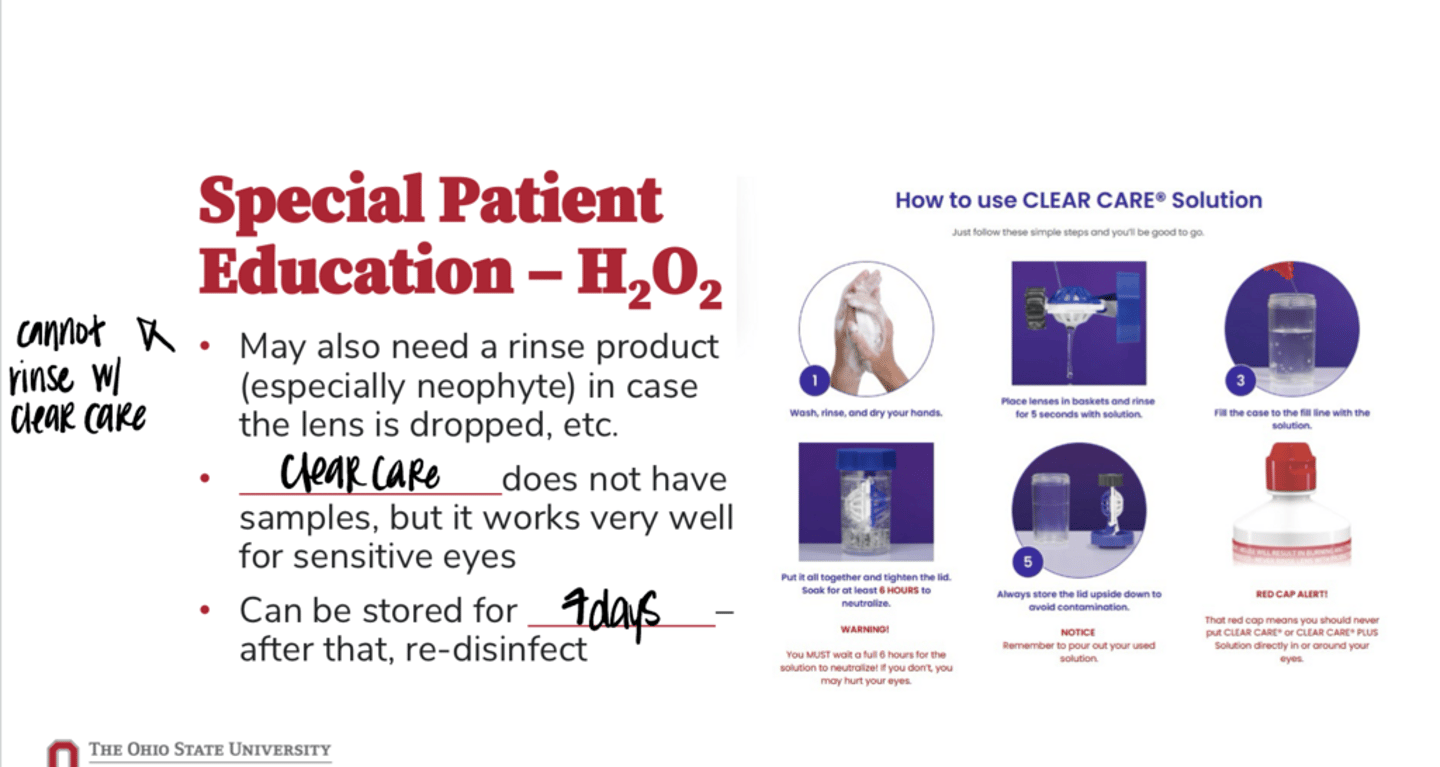
_______ does not have samples, but it works very well for sensitive eyes
ClearCare (not plus)
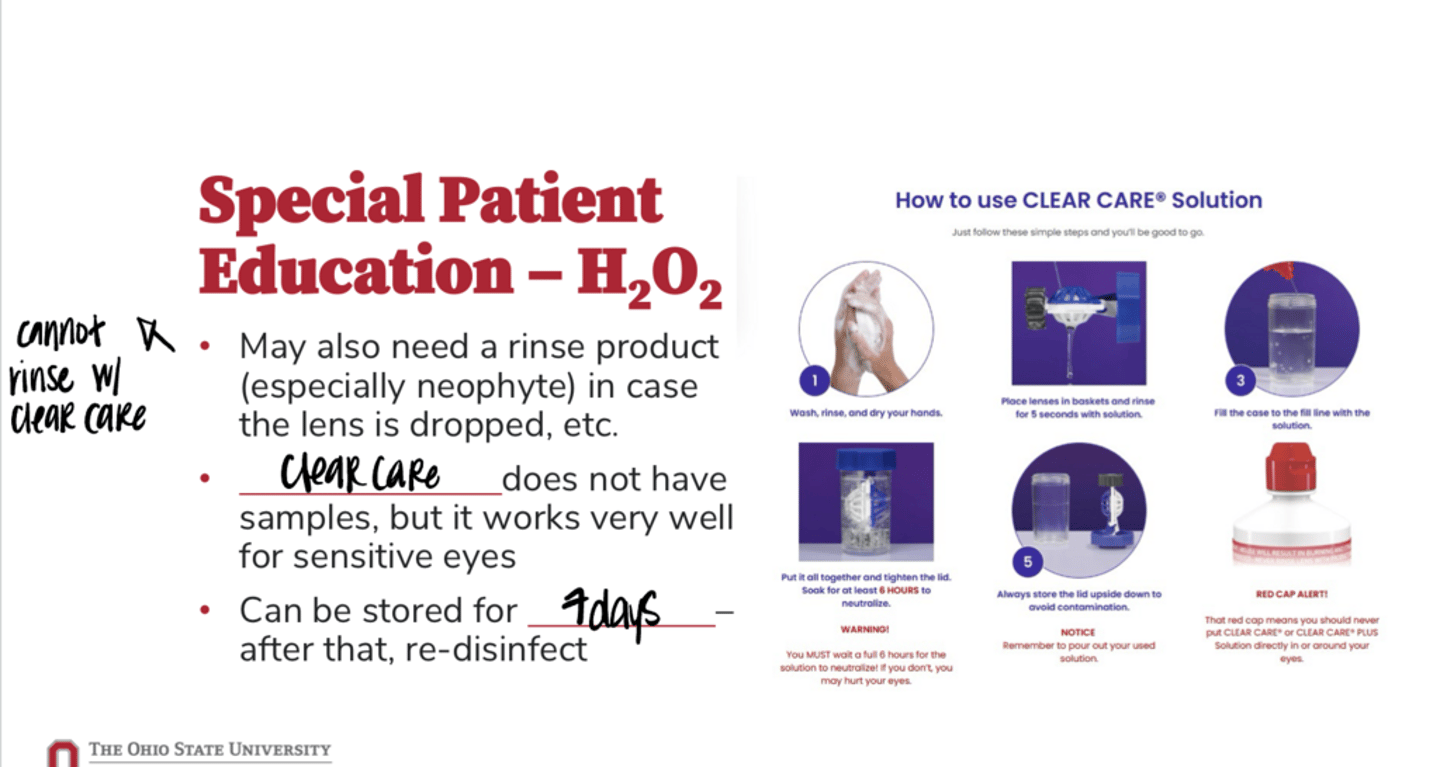
Lenses in H2O2 (ClearCare) can be stored for ______, after this, then you need to re-disinfect
7 days