Aromatic Compunds
 Call Kai
 Learn
Learn Practice Test
 Spaced Repetition
 Match
Match Flashcards
 Knowt Play
1/27

There's no tags or description
Looks like no tags are added yet.
Name | Mastery | Learn | Test | Matching | Spaced | Call with Kai | Chat |
|---|
No analytics yet
Send a link to your students to track their progress
28 Terms
What are the two rules to determine if a compound is aromatic ?
1.) compound must contain planar ring with continuously overlapping p orbitals
2.) the number of electrons must follow Hückel rule (4n + 2 = electron #)
What allows for continuous overlapping p orbitals?
The compound has alternating double bonds and single bonds which, as a conjugated system, allows for delocalization of electrons
The compound has double bonds and an anion with two electrons
The compound has double bonds and a cation which allows for resonance structures
What is Huckel’s rule?
A rule that states a planar cyclic compound is aromatic if it contains (4n + 2) π electrons, where n is a non-negative integer that you solve for
What are the steps for naming monosubstituted benzene derivatives?
parent is benzene
identify substituents, they are prefixes in alphabetical order
**if substituent has >6 C’s, it becomes the parent and the ring is treated as a phenol substituent
What are the steps for naming disubstituted benzene derivatives?
identify any parent groups
identify if there is a ortho-, meta-, or para- orientation of substituents
**this will only apply to disubstituted benzene derivatives
name substituents in alphabetical order
What are the steps for naming polysubstituted benzene derivatives?
identify and name parent
**if there is a common name for parent, use that. The substituent apart of this parent will be #1
identify and name substituents
assign # to each substituent
**make sure 2nd substituent has lowest possible number
arrange substituents alphabetically
Draw toluene

Draw phenol

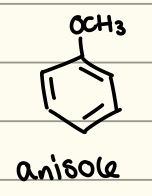
Draw anisole
Draw aniline

Draw benzoic acid

Draw benzaldehyde

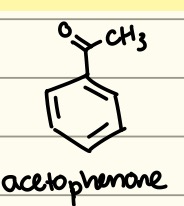
Draw acetophenone
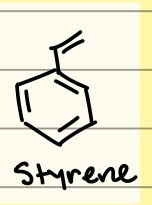
Draw styrene
What are the difference between prefixes ortho-, meta-, and para-?
ortho = when substituents in disubstituted derivatives are at 1 and 2
meta = when substituents in disubstituted derivatives are at 1 and 3
para = when substituents in disubstituted derivatives are at 1 and 4
What is benzene and its derivatives very stable?
due to resonance stabilization provided by aromatic structure
the delocalizaiton of electrons lowers overall energy of the compound making it less reactive
**pKa is lower for > stable/aromatic strucutres
What is the molecular orbital theory?
What are the steps for drawing a molecular orbital?
What does is mean for a compound to be nonaromatic?
What does is mean for a compound to be antiaromatic?
instead of the compound following 4n + 2, it follows 4n.
it will still have continuous overlapping p orbitals
What is an annulene?
What is a benzylic position?
How can oxidation occur at benzylic position?
How can bromination occur at benzylic position?
How can Sn1 reactions occur at benzylic position?
How can Sn2 reactions occur at benzylic position?
How can E1 reactions occur at benzylic position?
How can E2 reactions occur at benzylic position?