Genetic diversity and adaptation
 Studied by 0 people
 Call with Kai
 Learn
Learn Practice Test
 Spaced Repetition
 Match
Match Flashcards
 Knowt Play
1/13

There's no tags or description
Looks like no tags are added yet.
Name | Mastery | Learn | Test | Matching | Spaced | Call with Kai |
|---|
No study sessions yet.
14 Terms
GENETIC DIVERSITY
Genetic diversity is the total number of different alleles of genes in a species or population.
population
A population is a group of individuals of the same species that live in the same place and can interbreed.
species
A species consists of one, or more, populations.
WHY IS GENETIC DIVERSITY IMPORTANT?
The greater the genetic diversity, the more likely that some individuals in a population will survive an environmental change.
This is because or a wider range of alleles and therefore a wider range of characteristics.
This gives a greater probability that some individual will possess a characteristic that is suited to the new environmental conditions.
This allows populations to adapt to their environment. If a population has a low genetic diversity, it may not be able to adapt to a change in the environment and could be wiped out by a single event e.g a disease. This would cause genetic bottle necking.
Genetic diversity is a factor that enables natural selection to occur.
HOW IS GENETIC DIVERSITY INCREASED?
MUTATIONS - New alleles formed. Some of which will be advantageous but others could lead to problems.
MEIOSIS - crossing over and independent segregation.
RANDOM FERTILISATION - random which sperm fertilises which egg.
GENE FLOW - Different alleles being introduced into a population when individuals from another population migrate into it and reproduce.
NATURAL SELECTION
Natural selection occurs when the allele codes for a characteristic that increases the chances of an organism surviving (advantageous allele), its frequency within the population can increase. This leads to evolution.
EVOLUTION
Evolution is the gradual change in species over time. It has led to the huge diversity of living organisms on Earth. Adaptation and natural selection are both key factors in evolution.
THE PROCESS OF NATURAL SELECTION RESULTING IN EVOLUTION IN A POPULATION
Within any population or a species there will be a gene pool containing a wide variety of alleles.
Random mutation of alleles within this gene pool may result in a new allele of a gene which in most cases will be harmful. However in certain environments, the new allele or a gene might give its possessor an advantage over other individuals in the population.
These individuals will be better adapted and therefore more likely to survive in their competition with others so are more likely to obtain the available resources and so grow more rapidly and live longer. As a result, they will have a better chance of breeding successfully and producing more offspring. Only those individuals that reproduce successfully will pass on their alleles to the next generation.
This means that a greater proportion of the next generation inherits the beneficial allele.
They, in turn, are more likely to survive, reproduce successfully and pass on their genes.
So the frequency of the beneficial allele in the population increases from generation to generation with the less advantageous allele decreasing.
Over generations this leads to evolution as the advantageous alleles become more common in the population.
ADAPTATIONS
TYPE | EXPLANATION | EXAMPLE |
BEHAVIOURAL | These are ways an organism acts that increase its chance of survival. |
|
PHYSIOLOGICAL | These are processes inside an organism’s body that increase its chance of survival. |
|
ANATOMICAL | These are structural features of an organism’s body that increase its chance of survival. |
|
SELECTION
Selection is when better adapted organisms survive to breed and less well adapted organisms fail to do so.
Most characteristics are controlled by polygenes (more than one gene) and are influenced by the environment. If the environment changes, advantageous phenotypes will change.
The effect of the environment on polygenes produces individuals in a population that vary about the mean. When you plot this variation on a graph you get a normal distribution curve.
Directional selection and stabilising selection affect this normal distribution curve.
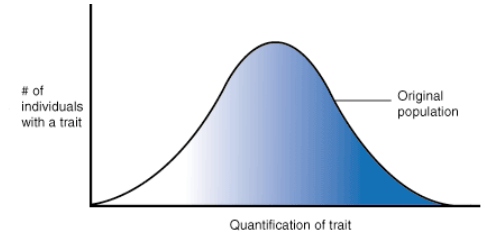
DIRECTIONAL SELECTION
ONE DIRECTION FAVOURED
Change to the environment.
One extreme phenotype favoured
Individuals with alleles towards this extreme more likely to survive and reproduce.
Mean phenotype changes.
Changes characteristics of the population.
EXAMPLE OF DIRECTIONAL SELECTION
BACTERIA EVOLVING ANTIBIOTIC RESISTANCE
Some individuals in a bacterial population have alleles that give them resistance to an antibiotic.
The population is exposed to the antibiotic, killing bacteria without the resistance allele.
The resistant bacteria survive and reproduce without competition, passing on the allele that gives antibiotic resistance to their offspring.
After some time, most organisms in the population will carry the antibiotic resistance allele.
STABILISING SELECTION
AVERAGE PHENOTYPE FAVOURED
Stable environment.
Mean phenotype favoured.
Individuals with alleles for characteristics towards the mean of the range are more likely to survive and reproduce.
Mean phenotype remains the same.
Reduces the range of possible characteristics as extremes are eliminated but preserves the main characteristics of a population
EXAMPLE OF STABILISING SELECTION
HUMAN BIRTH WEIGHT
Humans have a range of birth weights. Very small babies are less likely to survive as they have a high surface area to volume ratio, which means they find it hard to maintain their body temperature. This puts pressure on their respiratory and cardiac systems, which can be fatal.
Very large babies are less likely to survive too. Giving birth to large babies can be difficult because their large size makes it harder for them to fit through the mother’s pelvis. This can lead to complications for both mother and child.
Conditions are most favourable for medium-sized babies, so the weight of human babies tends to shift towards the middle of the range.