Lecture 1: GI and Renal Systems
 Call Kai
 Learn
Learn Practice Test
 Spaced Repetition
 Match
Match Flashcards
 Knowt Play
1/89

There's no tags or description
Looks like no tags are added yet.
Name | Mastery | Learn | Test | Matching | Spaced | Call with Kai | Chat |
|---|
No analytics yet
Send a link to your students to track their progress
90 Terms
Right Hypochondrium Region

Epigastric Region
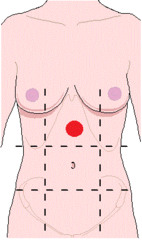
Left Hypochondrium Region

Right Lumbar Region

Umbilical Region

Left Lumbar Region
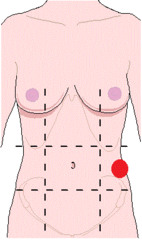
Right Inguinal Region
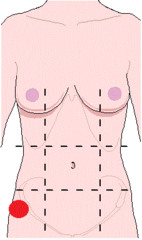
Suprapubic Region

Left Inguinal Region

RUQ
Quadrant that contains:
Liver, GB, pylorus, duodenum, pancreas head, R adrenal, R kidney upper pole, end of ascending colon, beg of transverse colon
LUQ
Quadrant that contains:
Liver L lobe, spleen, stomach, pancreas body, L adrenal, L kidney upper pole, end of transverse and beg of descending colon
LLQ
Quadrant that contains:
L kidney lower pole, sigmoid colon, end of descending colon, L ureter, L ovary, L fallopian tube, L spermatic cord, uterus if enlarged, bladder if enlarged
RLQ
Quadrant that contains:
R kidney lower pole, cecum, appendix, beg of ascending colon, R ureter, R ovary, R fallopian tube, R spermatic cord, uterus if enlarged, bladder if enlarged
Substernal
Where would the pain be?
-esophagus is affected
-ex: esophagitis
Shoulder
Where would the pain be?
-Diaphragm is affected
-ex: Sub-phrenic abscess
Epigastric Region
Where would the pain be?
-Stomach, Duodenum, or gallbladder is affected
-ex: Gastric ulcer, Duodenal Ulcer, Cholecystitis
Epigastric Region
Where would the pain be?
-Liver or pancreas is affected
-ex: Hepatitis or pancreatitis
Right Scapula
Where would the pain be?
-biliary tract is affected
-ex: biliary colic
Midback
Where would the pain be?
-Aorta or Pancreas is affected
-ex: pancreatitis or aortic dissection
Periumbilical
Where would the pain be?
-Small Intestine is affected
-ex: obstruction
Hypogastrium
Where would the pain be?
-colon is affected
-ex: Diverticulitis or Ulcerative colitis
Sacrum
Where would the pain be?
-Rectum is affected
-ex: proctitis or abscess
Meniere's Disease
Emesis with hearing loss and tinnitus may be seen with ________________________
Gastric Ulcer
dark, tarry stools indicate a what?
Absence of bile (Gallbladder disease)
what do pale stools indicate?
Morning
in IBS, when is the patient most likely to be affected?
Malabsorption
floating stool indicates what?
Left
Loose stools indicate diseases of the ________ colon
Hematochezia
-bright red blood
-assoc with tumors, diverticular disease, and ulcerative colitits
Melena
-black tarry stools
-due to bleeding from above the small bowel caused by stomach tumors or ulcer disease
Acholic Stools
-silver colored stools
-assoc with duodenal cancer with sloughing off of tissue
Tenesmus
painful, continued straining during stooling, caused by lesion in distal rectum or anus
Decreased Excreiton of conjugated bilirubin into bile
what causes jaundice?
Hepatitis C
-Pt is jaundiced
-pt has hx of transfusion, IV Drug use, and tattoos
Hepatitis A
-Pt is jaundiced
-pt has recently traveled abroad or ingested raw seafood
Hepatitis B
-Pt is jaundiced
-pt has occupational exposure to carbon tetrachloride and vinyl chloride
Bile Obstruction w/ Stones or Cancer
what does slowing, developing jaundice with pale stools indicate?
Liver disease
what does rapid jaundice with nausea and loss of appetite indicate?
Liver Toxicity
what does liver enlargement without pain to palpation indicate?
Appendicitis
• Diffuse periumbilical pain and anorexia early
• Pain localizes to RLQ as peritonitis develops
• Low grade fever, nausea, and vomiting may not be present
• X-rays and other tests are often negative
Acute Cholecystitis
• Localized or diffuse RUQ pain
• Radiation to right scapula
• Vomiting, constipation, low grade fever
Acute Renal Colic
• Severe flank pain
• Radiation to groin
• Vomiting and urinary symptoms
• Blood in the urine
• Diabetes
• MI
• HTN
• CAD
• Stroke
• CKD
• TB
• Cancers
• Bleeding disorders
• Anemia
• Asthma
• Allergies
• Alcoholism
• Drug addiction
• Mental illness
Family Hx Red Flags
Name, dose, route, frequency, duration, compliance
what all do you need to know about the Patient's medications?
Caput Medusae
-dilation of veins at the umbilicus
-backflow thru veins in the falciform ligament
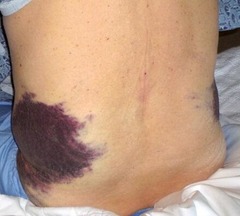
Grey Turner's Sign
-Massive ecchymosis noted on the flanks
-due to pancreatitis
Cullen's Sign
-Bluish discoloration of the umbilicus
-from hemoperitoneum

Sister Mary Joseph Nodule
-Cutaneous matastasis localized to the umbilicus

Ascites
abnormal accumulation of fluid in the abdomen
Up to 2 min or until bowel sounds are heard
how long should you listen to bowel sounds?
5-10 seconds and high pitched
describe normal bowel sounds
Borborygmi
low pitched rumbling bowel sounds
Succussion Splash
• While moving patient side to side a sloshing sound is heard
• Distention of stomach or colon
• Start mid-clavicular and go downward
• Over the liver is dull and over colon more tympanic
• Average length of liver is 10cm
describe percussion of the liver
Traube's Space
-6th rib superiorly
-axillary line laterally
-costal margin inferiorly

Fluid Wave
-indentifies a shifting dullness
-detects ascites
-may see false positive in obese pts
-may cause bulging flanks
Rigidity
-involuntary spasm of abdominal wall
-does not relax with experiation
-indicates diffuse or localized peritoneal irritation
Hyperesthesia
-an area of increased sensitivity that mat be noted with a light stroking of the abdomen
Right Side, C1-C2
What parasympathetic innervations? (region and side)
-pancreas
-liver
-gallbladder
-small intestine
-ascending colon
-Right half of transverse colon
Left Side, C1-C2
What parasympathetic innervations? (region and side)
-esophagus
-stomach
-duodenum
S2-S4 (both sides)
What parasympathetic innervations? (region and side)
-left half of transverse colon
-descending colon
-sigmoid colon
-rectum
Sacral Plexus (S2-S4)
parasympathetic innervation for all viscera from descending colon to rectum
Vagus Nerve (CN X)
parasympathetic innervation for all viscera from pharynx to splenic flexure
Right Side, T3-T6
What Sympathetic innervations? (region and side)
-Esophagus
Left Side, T5-T10
What Sympathetic innervations? (region and side)
-Stomach
Right Side, T6-T8
What Sympathetic innervations? (region and side)
-Duodenum
Bilateral, T5-T9
What Sympathetic innervations? (region and side)
-pancreas
Right side, T5-T10
What Sympathetic innervations? (region and side)
-Gallbladder
Bilateral, T8-T10
What Sympathetic innervations? (region and side)
-Small Intestine
Right side, T9-T12
What Sympathetic innervations? (region and side)
-Appendix
Right side, T11-L1
What Sympathetic innervations? (region and side)
-Cecum and Ascending colon
Left side, L1-L3
What Sympathetic innervations? (region and side)
-Descending colon
Celiac Ganglion
autonomic innervation of the foregut
Superior mesenteric ganglion
autonomic innervation of the midgut
Inferior mesenteric ganglion
autonomic innervation of the hindgut
Celiac Ganglion
• Receives fibers from T5-9
• Feeds: distal esophagus, stomach, proximal duodenum, liver, gallbladder, spleen, portions of pancreas
-Location: mid epigastric below xiphoid process
Superior Mesenteric Ganglion
• Receives fibers from T8-12
• Feeds: distal duodenum, portions of pancreas, jejunum, ileum, ascending colon, proximal 2/3rds of the transverse colon
• Location: Midline along linea alba above umbilicus
Inferior Mesenteric Ganglion
• Receives fibers from T10- L2, via the 3 lumbar splanchnic nerves
• Feeds: distal 1/3 of the transverse colon, descending colon, sigmoid colon, rectum
• Location: Midline along linea alba above umbilicus but below superior mesenteric
Rebound Tenderness
-peritoneal irrritation caused by palpating deepuly and slowely in an area away from the suspected area of inflammation
-palpating hand is removed quickly, and a sensation of pain is felt at area of inflammation
Rovsing's Sign
Pain produced in RLQ when palpating the LLQ
Scratch Test
Listen with stethoscope and use index finger to scratch, as index finger scratches over liver there will be a marked intensity in sound
Hooking
placing both hands at area of dullness and lifting inward and upward while pt inhales
Liver Tap
• Place L hand in RUQ and hit with fist of R hand
• Pain may be felt with inflammatory processes of liver and GB
Murphy's Sign
Pain elicited while palpating liver during inspiration, causing it to halt
Abdominal Aortic Aneurysm (AAA)
• A periumbilical or upper abdominal mass with expansile pulsations that is 3 cm or more wide
• Sensitivity of palpation increases as it enlarges
McBurney's Point
• Pain produced at a point 1/3 the distance from the ASIS to the umbilicus
• 2/3 the distance from the umbilicus to the ASIS
Iliopsoas test
• Patient lies on the unaffected side and extends the other leg against examiner's hand
• A positive test is pain with this maneuver (intra-abdominal irritation)
Obturator test
• Patient is supine and examiner flexes the patient's thigh at the hip with the knee bent and rotates the leg internally and externally at the hip
• Pain is felt if there is inflammation adjacent to the muscle
Digital Rectal Exam
• Patient in standing/bent over table, left lateral recumbent, SIMS, or supine positions
• Patient is asked to relax at first and then strain to examine for hemorrhoids
• Use one hand to hold buttocks and place GLOVED and lubricated index finger of other hand in anal canal
• Allow sphincter to relax and place index finger in entire length
• Examine the entire circumference
Blumer's Shelf
• Intraperitoneal masses may be felt on examination of anterior rectal area
• These tumors may be felt as shelf-like hard projections from the infiltration of Douglas' pouch with neoplastic cells