Psych of Personality Exam 1
 Call Kai
 Learn
Learn Practice Test
 Spaced Repetition
 Match
Match Flashcards
 Knowt Play
1/75

There's no tags or description
Looks like no tags are added yet.
Name | Mastery | Learn | Test | Matching | Spaced | Call with Kai | Chat |
|---|
No analytics yet
Send a link to your students to track their progress
76 Terms
First-born children:
Responsible, leader, bossy, controlling, motivated, conscientious, cautious, reliable
Adler
Middle-born Children (Adler)
feels left out, peacemaker, people-pleaser, rebellious, independent, adaptable, social
Last-born children
uncomplicated, manipulative, self-centered, attention-seeking, fun, outgoing
Only-Children
approval-seeking, sensitive, leader, confident, center of attention, responsible, perfectionist, mature for their age
Secure adult attachment
Comfortable with intimacy and autonomy; self-confident; resolves conflict constructively
positive model of the self and other
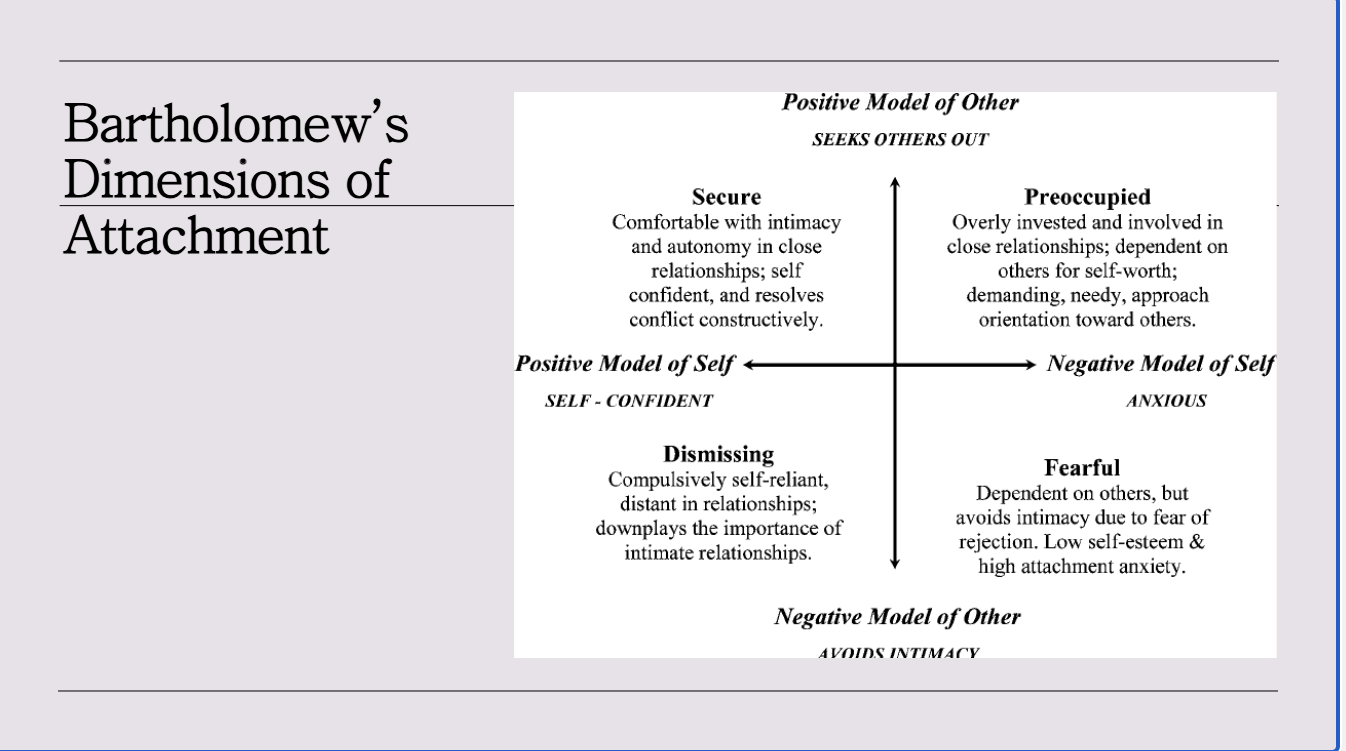
Preoccupied Attachment
Overly invested in relationships; dependent on others for self-worth; demanding, needy
negative model of the self, positive of the other
Strengths of Psychoanalytic Theory
Provides for the discovery and investigation of many interesting phenomena
Develops techniques for research and therapy (free association, dream
interpretation, transference analysis)
Recognizes the complexity of human behavior
Limitations of Psychoanalytic Theory
Fails to define all its concepts clearly and distinctly
• Makes empirical testing difficult, at times impossible
• Endorses the questionable view of the person as an energy system
• Tolerates resistance by parts of the profession to empirical research and
change in the theory
Defining Personality
refers to the psychological systems that contribute to an individual's enduring and distinctive patterns of experience and behavior.
Disposition
Tendencies that are enduring (persist over time) and distinctive (differ across people)
Inner Mental Life
System of beliefs, emotions, values, goals, skills, memories, experiences, and motivations
Intraindividual Functioning
How psychological systems operate within a person
Core task of personality psychology
Identify psychological systems (inner mental life) that explain people's distinctive experiences and actions (dispositions).
Four Areas of Personality Study
structure, process, growth and development, psychopathology and change
Part 1 - Structure
What are the "building blocks" of personality?
Traits, Types, Units of analysis
PS Part 2 - Process
How does personality operate and change?
Motivation, emotion, cognition shifts
PS Part 3 - Growth & Development
How do we become who we are?
nature vs nurture
Challenges: finding universal patterns, understanding factors that explain individual differences
PS Part 4 - Psychopathology & Change
How does personality lead to success and distress? How do people change/RESIST change?
Therapy, behavior change, dysfunction
Evaluating Personality Theories
Theories should:
Organize information about personality
Generate new knowledge
Identify new areas of study
Additional criteria:
Systematic — concepts are logically connected
Testable — can generate falsifiable hypotheses
Comprehensive — must account for the whole person
Sources of Data
L - Life data (records)
O - Observer data
T - Task data
S - Self report
Language (computerized text analysis), Social Media, Brain Data (EEG, fMRI).
Nomothetic Measures
“fixed”
Everyone gets the same items; structured (e.g., True/False)
Idiographic Measures
“flexible”
Participants can indicate level of relevance; structured or open-ended
Freud's View of People
Not inherently "good" — born with certain instinctual drives
Pleasure Principle: Driven to seek pleasure and avoid pain
Society exists to restrict and keep pleasurable drives in check
Mind as an Energy System
Conservation of Energy (influenced by Helmholtz): Energy can be transformed but not destroyed
Needs create tension → person is driven to reduce tension → return to calmer state
Central question: How is mental energy released, and how does it impact the person?
Model of the Mind
Conscious — current awareness
Preconscious — outside awareness but accessible
Unconscious — inaccessible
Id
entirely unconscious; pleasure principle
Ego
mediates Id and Superego; reality principle
Superego
conscience; internalized morals
Psychoanalytic Perspective on unconscious motives
illogical, irrational unconscious processes
motives and wishes
motivated aspects of unconscious functioning
Cognitive Perspective on unconscious motives
No fundamental difference between conscious and unconscious processes
Content emphasis on thoughts
Focus on nonmotivated aspects
Life Instinct
impulse to life
manifested through love and s3x
libido:life-maintaining energy seeking pleasure through s3xual gratification
If flow is blocked → neurotic problems
Death Instinct
desire to die or destroy
manifested through cruelty, aggression, and suicide
creates conflict and anxiety
Free Association
Thoughts without inhibition or falsification; reveals hidden associations; both therapy and scientific method
Catharsis
Release and freeing of emotions by talking about problems
Transference
Development of attitudes toward analyst based on earlier-life attitudes toward significant others; used as an agent of change
directing feelings toward something else
Manifest Content - Dreams
storyline
Latent Content (Dreams)
Unconscious ideas, emotions, drives
Repression
Unconscious blocking of threatening thoughts
ex. Oedipal aggressive thoughts repressed
Denial
Blocking external events from awareness
ex. smoker refuses to admit smoking is bad for you
Projecting
Attributing own unacceptable thoughts to others
ex. blaming someone else for your own short-comings
Displacement
Satisfying impulse with a substitute object
“misplacing” anger
ex. kicking dog when mad at boss
Regression
Moving back psychologically under stress
acting like a baby when mad
Sublimination
Satisfying impulse in a socially acceptable way
martial arts class for your anger issues
Oedipal Complex:
Occurs during Phallic Stage
Repressed, unconscious sexual desire for opposite-sex parent; rejection of same-sex parent
hatred/jealously towards same-sex parent
Freud (duh)
Fixations
“Stuck” in a psychosexual stage because of too much/too little gratification
Oral Stage Fixation
Demanding, impatient, envious, jealous, rageful, depressed (feels empty), mistrustful, pessimistic
Anal Stage Fixation
Rigid, striving for power/control, concerned with possessions, anxiety over waste/loss of control
Phallic Stage Fixation
Male: exhibitionistic, competitive, macho, potent
Female: naive, seductive, exhibitionistic, flirtatious
Subliminal Perception
Duck image within tree branches presented rapidly → influenced subsequent drawings
Exposure Therapy
Exposure to fears outside awareness shows promise (e.g., spider phobia)
with subliminal perception
Perceptual Defense
Physiological responses to emotionally charged words (whore, penis) vs. neutral (apple, dance)
Subliminal Psychodynamic Activation
Women with disordered eating ate more crackers after "Mama Is Leaving Me" vs. control phrases
ED’s are tied to stress/emotional neglect
Challenges of Psychological Assessment
Free Association could take weeks to months
Assumes most aspects of personality are unconscious
Defense mechanisms may prevent direct measurement
Projective Tests
Core assumption: When interpreting ambiguous stimuli, individuals "project" their own personality onto the test item.
Rorschach Inkblot Test
Hermann Rorschach (Swiss psychiatrist)
10 inkblot cards
Assessor interested in content (animals? humans? affection? hostility?) and process (repeated questions? changed answers?)
Thematic Apperception Test (TAT)
Henry Murray & Christina Morgan
Show scene cards → person makes up a story
Can be scored systematically (Murray's scheme)
Particularly strong in assessing achievement motives
Challenges of Projective Tests:
Responses impacted by sociopolitical forces
May not generalize to everyday life
Rater-to-rater reliability questionable
Some argue they should not be used in clinical settings
Alfred Adler
Social drives & conscious thoughts over s3xual instincts
inferiority feelings
"will to power"
birth order
Carl Jung
viewed libido as life energy (pleasure and creativity) rather than s3xual
Less emphasis of childhood conflict, focused on drive
“Collective Unconscious” → experience of past generations are stored in the mind
dual aspects of the self
used to be close w freud
Karen Horney
importance of culture on gender
Coping with basic anxiety was either: 1. Moving toward (anxious for acceptance), Moving Against(Hostile to others, or Moving Away (detached)
rejected freud’s view of women
“womb envy”
Henry Stack Sullivan
emotional experiences are based in relationships, not biological drives
importance of early interactions in forging the self: appraisals vs rejections, good me vs bad me
social acceptance is important even past adolescence
Attachment Behavioral System (ABS)
innate biological drive to be close to caregivers; "secure base" for exploration
Bowlby
early separation
"Strange Situation" study
Mary Ainsworth
70% secure, 20% anxious-avoidant, 10% anxious-ambivalent
Dismissing Attachment style
Compulsively self-reliant; distant in relationships; downplays importance of intimacy
positive model of the self, negative of the other
Fearful Attachment style
Dependent on others but avoids intimacy due to fear of rejection; low self-esteem, high attachment anxiety
negative model of the self and other
Neuropsychoanalysis
Seeks a brain-based understanding of psychoanalytic structures and processes.
Instinctual Drives
Neural systems in subcortical regions contributing to emotional states (anger, sexual desire)
Defense Strategies of the ego
Studies show false memories/beliefs in individuals with frontal lobe damage
Dreams
Dreaming may be distinct from REM sleep; high-level brain mechanisms (memory, thinking) associated with dreaming
Alternative therapeutic methods
Deep Brain Stimulation (DBS) — small electrical device implanted in specific brain regions to treat disorders and distress
Nature
Temperament
Biological and physiological factors (e.g., heritability of traits
Nurture
our environment, which is equally important in shaping who we become
Culture
Social class
Peer relationships
Catharsis
The process of releasing strong, pent-up, or repressed emotions which leads to a lot relief after talking about it
Sigmund Freud used early cathartic methods to help patients bring buried trauma into conscious awareness to reduce anxiety
According to Freud, during which psychosexual stage does the Oedipal Complex occur?
phallic stage
Anna O's case was significant to Freud's work because it demonstrated
The role of hysteria and conversion disorder in understanding the unconscious
22. The Thematic Apperception Test (TAT) asks participants to:
tell a story based on images