Forensic Science
 Call Kai
 Learn
Learn Practice Test
 Spaced Repetition
 Match
Match Flashcards
 Knowt Play
1/17

Earn XP
Description and Tags
Ink chromatography, Fingerprint types & usefulness as evidence, Blood typing (A, B, O), DNA structure and profiling
Name | Mastery | Learn | Test | Matching | Spaced | Call with Kai | Chat |
|---|
No analytics yet
Send a link to your students to track their progress
18 Terms
What is chromatography?
Technique used to separate components in a complex mixture or solution
Stationary phase
Fixed material which stays in place
Stationary phase - function
Holds back certain components of a mixture based on how strong they bind to it.
Mobile phase
Moving fluid that carries a sample mixture through or over the stationary phase.
Mobile phase - function
Dissolves the sample mixture and carries it forward. Components that dissolve better or interact more with the mobile phase travel faster.
Solvent
Substance which does the dissolving - mobile phase (water)
Solute
Substance which gets dissolved (ink)
Why solvent level is below sample spots?
If the sample is submerged it may dissolve directly into solvent rather than being carried up the paper.
Why baseline should be drawn in pencil?
Pencil does not dissolve in the solvent and wont interrupt the chromatogram
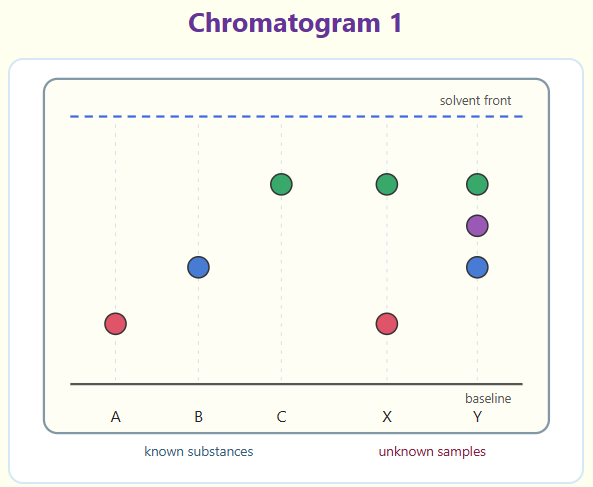
Which substances are present in sample X?
A and C
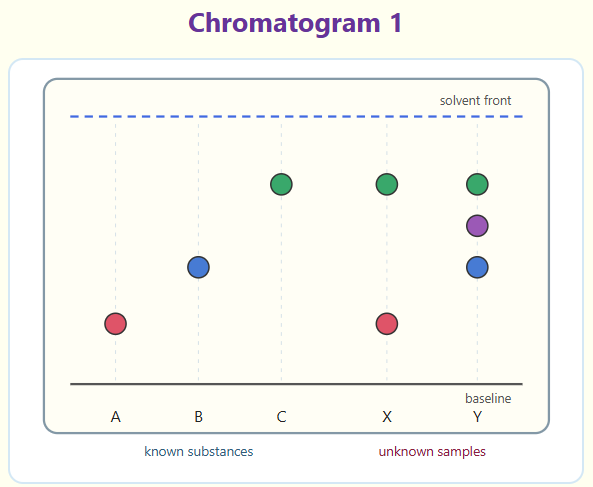
How many substances are present in sample Y?
3
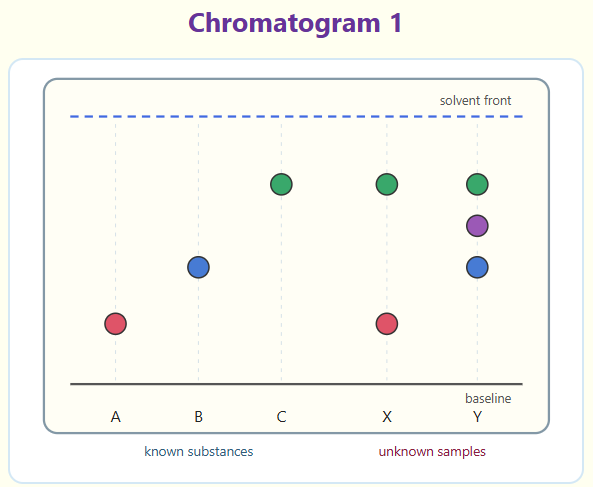
Identify the known substances in sample Y
B and C
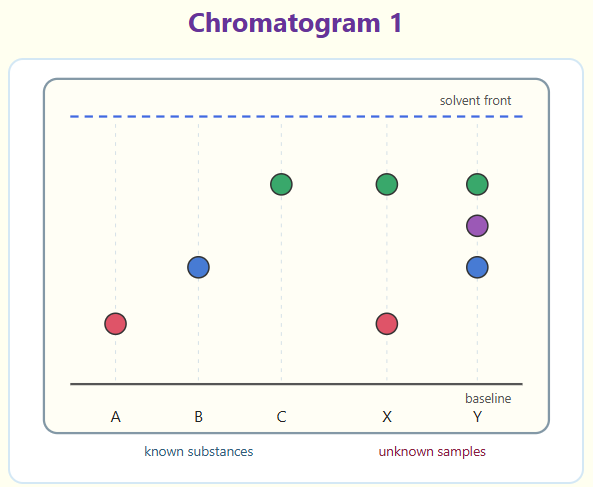
One substance in Y cannot be identified using A, B or C. Explain how the chromatogram shows this.
Y has a third spot which does not line up with any of the known substances A, B or C.
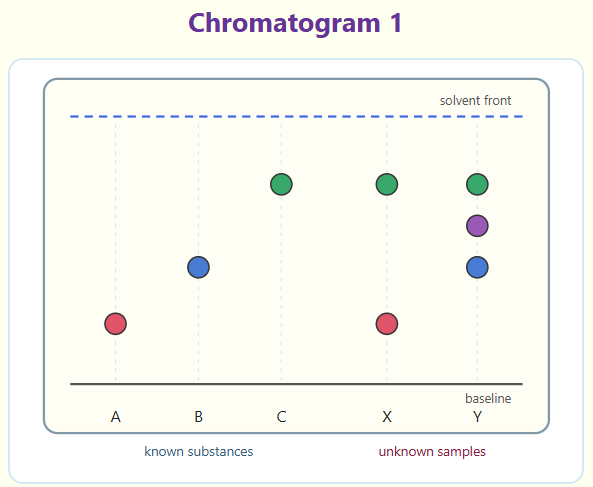
Which of the samples A, B, C, X and Y are mixtures?
X and Y are mixtures because they each produce more than one spot.
Give one reason why substance P may have travelled further than substance Q.
P may be more soluble in the solvent / mobile phase, or it may be less strongly attracted to the stationary phase.
What does separation depend on?
Attraction of substance to chromatography paper and solubility in solvent.
Explain what is meant by saying that a substance spends more time in the mobile phase.
It means that the substance spends more time dissolved in the moving solvent. It is therefore carried further through the chromatography paper by the solvent.