bio lecture 12
 Call Kai
 Learn
Learn Practice Test
 Spaced Repetition
 Match
Match Flashcards
 Knowt Play
1/48

There's no tags or description
Looks like no tags are added yet.
Name | Mastery | Learn | Test | Matching | Spaced | Call with Kai |
|---|
No analytics yet
Send a link to your students to track their progress
49 Terms
osmolarity
-comparing 2 solutions, total concentration of solutes dissolved in a solution
-low osmolarity= fewer solute particles (more H20 molecules)
-high osmolarity= more solute particles (less H20 molecules)
-high and low have the same volume
tonicity
-ability of a solution to make water move into or out of a cell
-a cell in a hypertonic solution= water flows out of the cell
-a cell in a hypotonic solution= water flows into the cell
-cell in an isotonic solution=no net movement of water
osmoregulation
how animals control solute concentrations in the interstitial fluid and balance water gain and loss, tightly controlled
breaking down nitrogenous molecules (proteins and nucleic acids) releases ammonia (very toxic)
excretion
how animals get rid of nitrogenous metabolites and other metabolic waste products
nitrogenours waste varies among animals based on their habitat. what do we know about ammonia, urea, and uric acid?
ammonia- less energy, higher toxicity
urea(us humans)- more energy, lower toxicity
uric acid- most energy, lowest toxicity (white part of bird poop)
special transport ____ are involved in osmoregulation and nitrogenous waste disposal
epithelia
move solutes in controlled amounts in specific directions
excretory function: filtration
water, small solutes, sugars, amino acids, nitrogenours waste etc are filtered out of the blood
-have capillary bed that’s interacting with the specialized epithelia and tubules and things that have to do with waste disposal ++exchange
excretory function: reabsorption
water and useful solutes (sugars, vitamins, amino acids) are returned to the blood via active transport
excretory function: secretion
nonessential solutes or waste are secreted out of the blood via active transport
excretory function: excretion
filtrate is released from the body
In active transport, molecules are always transported from _______ concentration to _________
concentration.
a. Higher; Lower
b. Higher; Higher
c. Lower; Higher
d. Lower; Lower
c. Lower; Higher
goes against gradient and req energy
_____ filter, reabsorb, secrete, and excrete liquid waste
nephrons
water conservation is a _______ adaptation
terrestrial
notice that both active and passive transport are used to exchange water and solute
notice that urine becomes hyperosmotic to general body fluids (blood = 300 mOsm/L), maintaining salt concentration in kidney=energy expenditure
the need for water conservation depends on the _____
-Loop of Henle length positively correlated with water conservation
- Long loops of Henle allows highly concentrated urine (up to 9,300 mOsm/L!)
- Mammals in desert environments (no loose tons of H2) in urine evaportation)
- Short loops of Henle cannot concentrate urine as much
- Birds excrete nitrogenous waste as uric acid (alternate water conservation)
osmoregulatory homeostasis
set point is ~ 300 mOsm/L
dehydration→more concentrated urine
over hydration→more dilute urine
exchanging gases and nutrients with the environment
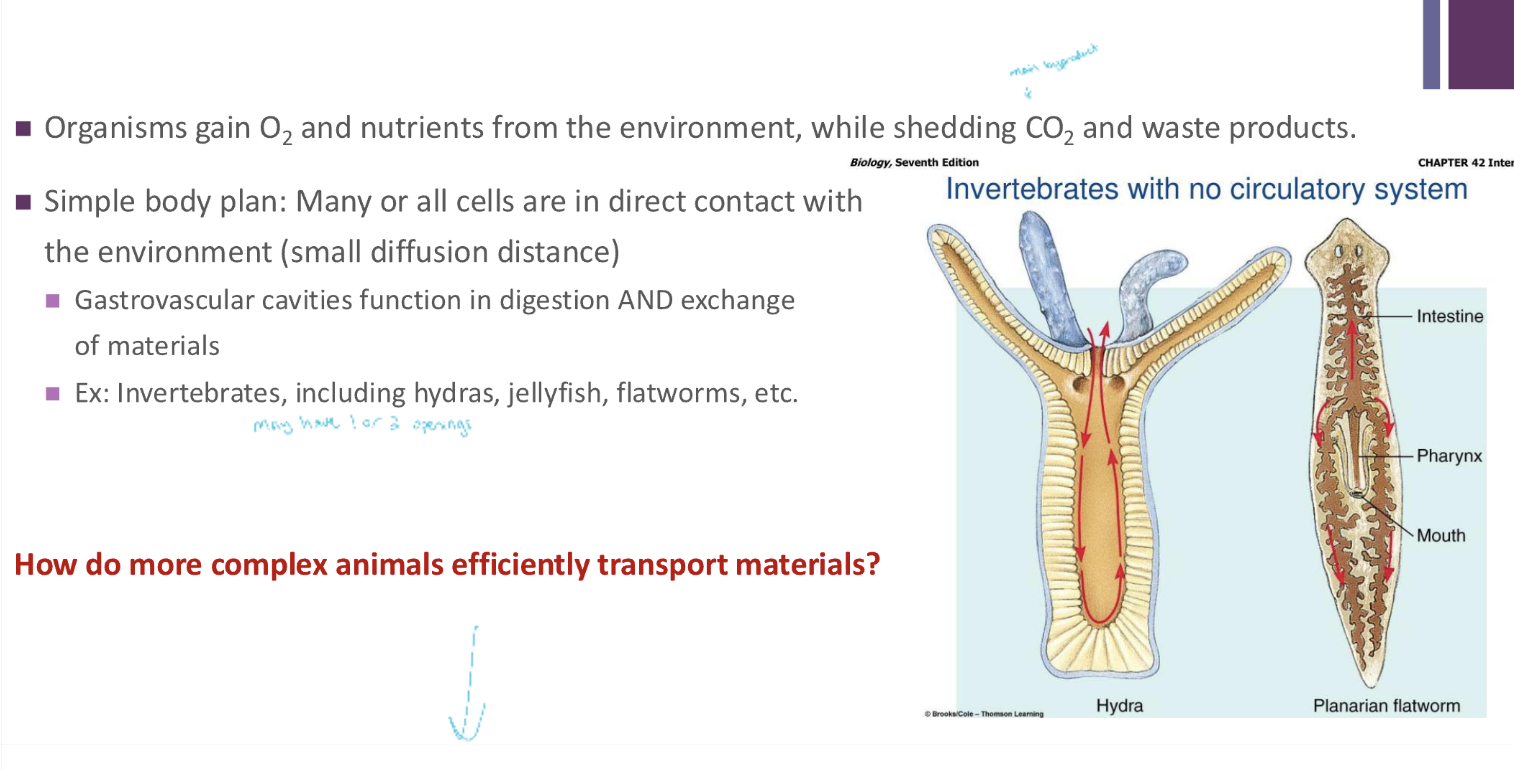
complex body plan
many cells are NOT in direct contact with the environment (larger diffusion distance)- not gonna happen at a very efficient pace
circulatory system
it’s dedicated to transporting materials throughout the body
basic parts- circulatory fluid, interconnecting vessels, and muscluar pump (heart)
open system vs closed system
Open system: circulatory fluid is also interstitial fluid (hemolymph).
Closed system: circulatory fluid (blood) is confined to vessels. (like blood’s threaded thru, not bathing our organs)
cardiovascular system
heart and blood vessels in vertebrates
blood flows in one direction
4 components of cardiovascular
-Arteries carry blood from the heat to organs
Away from the heart
- Veins carry blood from the organs to the heart
Towards the heart
- Capillaries are thin-walled vessels (this allows for more exchange)
Networks (beds) infiltrate each organ
- Atria receive blood entering the heart
- Ventricles pump blood out of the heart
Arteries and veins are distinguished by…
a. Whether they carry oxygenated or deoxygenated blood.
b. Whether they carry blood to or from the heart.
c. Whether they occur in the upper or lower part of the body.
d. Two of the answers are correct
b. Whether they carry blood to or from the heart.
single circulation
blood passes through the heart once in each complete circuit
Two-chambered hearts (atrium & ventricle)
Blood flows through two capillary beds
Ex: Sharks, rays, and bony fish
double circulation
blood passes through the heart twice through two circuits (pulmonary(heart and lungs)and systemic (heart and rest of body)
pulmonary circuit
oxygen poor blood moves from the heart to capillary beds in gas exchange tissues (lungs)(reptiles and mammals)
pulmocutaneous circuit
involves gas exchange in lungs and across skin (amohibians)
systemic circuit
oxygen right blood moves from the heart to the organs
Amphibians and reptiles have ____-chambered hearts
three
Oxygen-poor and oxygen-rich blood mixes in ventricle, so body does not receive fully oxygenated blood.
Birds and mammals have ______-chambered hearts
four
Oxygen-poor blood does not mix with oxygen-rich blood, so only fully oxygen-rich blood is sent to the organs
What’s the difference between amphibians/reptiles and
birds/mammals? And why does this matter?
Amphibians and reptiles are ectothermic & Birds and mammals are endothermic
More energy = More O2 and nutrient demand
so like ectotherms put in less energy to maintain temp
The four-chambered heart is found in mammals who are endothermic. This makes sense because…
a. It is eIective in keeping the temperature equal throughout the body.
b. They have a higher metabolic rate and need a larger oxygen supply.
c. The added fourth chamber allows for blood to be transmitted either to the pulmonary or systemic
circuit, depending on the need of the organism.
b. They have a higher metabolic rate and need a larger oxygen supply.
blood flows in ____ direction
one
O2/CO2 exchange happens in capillary beds
mammal heart is ____ chambered
4
valves prevent backflow
Sound of the heart: Lub-dub, lub-dub, lub-dub
Lub: recoil of blood against closed AV valves
Dub: closing of the semilunar valves
Heart murmur: blood moving back through
defective valve
systole is the _______ phase
contraction
diastole is the ______ phase
diastole
If O2 comes in blood is ____ and if CO2 (the byproduct) leaves blood is ______
O2 comes in → oxygenated blood
CO2 leaves → de-oxygenated blood
Deoxygenated blood arrives at the lung’s alveoli in a __________.
a. Pulmonary vein
b. Pulmonary artery
c. Systemic vein
d. Systemic artery
b. Pulmonary artery
gas exchange in animals
Aerobic Respiration: C6H12O6 + 6O2 → 6CO2 + 6H2O + energy (ATP, heat)
Oxygen needs to be taken in from the environment (water or air)
Carbon dioxide needs to be emitted into the environment
Respiratory surfaces allow this gas exchange
Aquatic organisms: counter-current exchange in gills
Terrestrial animals: ventilation of lungs in mammals
partical pressure
the pressure exerted by a particular gas in a mixture of gases.
Gases cross respiratory surfaces via diffusion
Higher partial pressure (concentration) → lower partial pressure (concentration)
More oxygen available in air than water
Obtaining oxygen from air does not have to be efficient
Obtaining oxygen from water must be efficient
ventilation
-movement of the respiratory medium over the respiratory surface
-water over gills
-gills are outfoldings of the body surface suspend in water
countercurrent exchange
the exchange of a substance or heat between two fluids flowing in opposite directions
-What are the two fluids?
Water travels over capillary beds in the gills: PO2 in water higher than the blood it passes, O2
diffuses into capillaries, > 80% of O2 is extracted from water, very efficient
lungs
-infoldings of the body surface exposed to air
-Epithelial cells lining the trachea and bronchioles are covered by cilia and a thin film of mucus (imp bc allows for O2 exa(?) and protect
- Alveoli are where gas exchange occurs
- O2 dissolves in the film of liquid lining the alveoli
and diffuses into capillary beds
breathing
(ventilation of the lungs): alternating inhalation and exhalation of air.
Mammals use negative pressure breathing
Air is pulled into the lungs (like pulling liquid into a syringe)
Air remains after exhalation, so each inhalation mixes
fresh air with oxygen-depleted air, PO2 of alveoli always less than atmosphere
Only ~25% of O2 is extracted from air (75% exhaled out)
_____ pressure at various sites controls the direction of O2 and CO2 diffusion
partial
O2 and CO2 diffuse from high to low
passive
PP of O2 is always higher in the environ than it is in alveoli
breathing is regulated by ______ mechanisms
-involuntary
-Medulla oblongata regulates breathing, pH is used as an indicator of CO2 concentration, CO2 + H2O ⇌ H2CO3 ⇌ HCO3- + H+
-O2 sensors in the aorta and carotid arteries can trigger the breathing control center (very low O2)
O2 has low solubility in water…and blood…so how do we get the O2 to the tissues that need it?
-Respiratory pigments: metal-bound proteins that transport O2 and CO2 through the blood
-Blue blood found in arthropods and mollusks comes from hemocyanin bound to copper
-Red blood found in many invertebrates and vertebrates comes from hemoglobin bound to iron
Hemoglobin-tetramer with each subunit binding to one O2 molecule (reversible)
Hemoglobin-tetramer with each subunit binding to one O2 molecule (reversible) (v imp bc if you irreversibly bind, how are you going to release the O2 to get into the tissues)
binding enhanced by cooperatively between subunits (needa get one goin to get all goin)
Cells actively consuming O2 will trigger increased O2 unloading from hemoglobin
pH levels drop due to increased CO2
Lower pH = lower affinity for O2
Carbon monoxide, CO, is a gas produced by the incomplete combustion of fossil fuels. CO binds
irreversibly on hemoglobin in our red blood cells and displaces O2. In the US alone, each year ~20,000
people need emergency care due to CO poisoning. What is the physiological eIect of the poisoning?
a. The CO is delivered to our cells, just as O2 is, but cannot be used in aerobic respiration.
b. CO is chemically related to CO2 and will lower the pH of the blood to dangerous levels.
c. As CO displaces O2 from hemoglobin, not enough O2 can be circulated in our bloodstream. The
lack of O2 delivery impairs cells throughout our bodies.
d. CO will interact with specific components of the electron transport chain in cellular respiration
c. As CO displaces O2 from hemoglobin, not enough O2 can be circulated in our bloodstream. The
lack of O2 delivery impairs cells throughout our bodies.