homework practice genetics wrong I need
 Call Kai
 Learn
Learn Practice Test
 Spaced Repetition
 Match
Match Flashcards
 Knowt Play
1/21

There's no tags or description
Looks like no tags are added yet.
Name | Mastery | Learn | Test | Matching | Spaced | Call with Kai | Chat |
|---|
No analytics yet
Send a link to your students to track their progress
22 Terms
Consider an organism that has three pairs of chromosomes. At the start of meiosis Il, each cell would have chromosomes and
chromatids.
six; three
three; six
three; three
six; six
three; six
“Three PAIRS of chromosomes"
A pair means 2 chromosomes.
So:
3 pairs × 2 = 6 chromosomes
So it's a diploid organism with 6 chromosomes total, and a haploid cell has 3 chromosomes.
What are the sex chromosomes for HUMANS?
XY XX
XO XX
ZZ ZW
haploid diploid
XY XX
What are the sex chromosomes for BEES?
XY XX
XO XX
ZZ ZW
haploid diploid
haploid diploid
What are the sex chromosomes for BIRDS?
XY XX
XO XX
ZZ ZW
haploid diploid
ZZ ZW
What are the sex chromosomes for CRICKETS?
XY XX
XO XX
ZZ ZW
haploid diploid
XO XX
Two plants each have a gene that determines pea pod color. In one plant, this gene produces yellow pea pods. In the other plant, this gene produces green pea pods. What are these variations of pea pod genes called?
Gametes
Alleles
Zygotes
Hybrids
Alleles
Gametes
Reason: A gamete is a haploid reproductive cell.Alleles
Zygotes
Reason: A zygote is a diploid cell formed when two gametes fuse.Hybrids
Reason: A hybrid is the offspring that results when two organisms with distinct characteristics are crossed.
A heterozygous genotype would contain two alleles for every gene under consideration.
mutant
dominant
recessive
different
wild-type
identical
different
Hetero = different
Zygous = allele combination
So: Heterozygous = having TWO DIFFERENT alleles for a gene.
The combination of alleles that an individual has is called its
genotype
An alternative form of a gene is called
allele
In pea plants, height is controlled by a single gene with tall being dominant to short. If two heterozygous plants are crossed, what proportion of the tall progeny will be homozygous dominant?
1/4
2/3
1/3
1/2
1/3
All offspring:
25% TT
50% Tt
25% tt
There are 3 tall offspring total.
Of those 3:
1 is TT
Mendel studied the inheritance of seed shape with alleles R and r along with seed color with alleles Y and y. He crossed true-breeding pea plants with genotypes RRYY and rryy to give an Fy generation with the genotype RrYy. If the Fy plants produced equal numbers of four types of gametes, RY, Ry, rY, and ry, this would indicate that the genes for seed color and shape
are closely linked on the same chromosome
are independently assorting
have recombined to form new combinations
are independently assorting
are closely linked on the same chromosome
Reason: Incorrect. Linked genes will result in a greater proportion of gametes with parental genotypes.are independently assorting
Reason: Correct.have recombined to form new combinations
Reason: If these genes were on the same chromosome and the allelic combinations were due to recombination, there would be fewer recombinant gametes and more gametes with the original parental combination.
Alleles of different genes are distributed into gametes independently of one another.
Imagine you're choosing:
Seed shape:
R or r
AND separately:
Seed color:
Y or y
You can get any combination:
R + Y = RY
R + y = Ry
r + Y = rY
r + y = ry
Heterozygous vs Heterogenous
-zygous → genetics/alleles 🧬
-geneous → types/things 🧩
The random arrangement of homologs along the metaphase plate in meiosis I is consistent with Mendel's law of
independent assortment
Mendel analyzed crosses involving two different characters simultaneously: seed shape and seed color. Two hypotheses can explain how the two different genes assort during gamete formation. According to the figure shown here, the genes for seed shape and color.
are on separate chromosomes
are linked on the same chromosome
are independently assorting
have recombined to form new combinations
are linked on the same chromosome
There are TWO possibilities
The question says there are two hypotheses for how these genes behave.
POSSIBILITY 1: Genes are on separate chromosomes
If the genes are on different chromosomes, they can assort independently.
An RrYy plant can make:
RY, Ry, rY, ry
So you'd expect 4 types of gametes.
POSSIBILITY 2: Genes are linked on the same chromosome
If the genes are physically located near each other on the same chromosome, they tend to travel together.
Because the original parents were:
RRYY × rryy
So the F₁'s arrangement is:
RY / ry
If the genes stay together, the F₁ mainly produces:
RY and ry
That's only 2 types of gametes.
The behavior of chromosomes during meiosis explains Mendel's law of segregation. Specifically, a gamete contains only one copy of each type of chromosome because of which of the following?
The homologs segregate during meiosis I and the sister chromatids separate during meiosis Il.
The sister chromatids segregate during meiosis I and then again during meiosis II.
The homologs segregate during meiosis I and then again during meiosis II.
The sister chromatids segregate during meiosis I and the homologs separate during meiosis II.
The homologs segregate during meiosis I and the sister chromatids separate during meiosis Il.
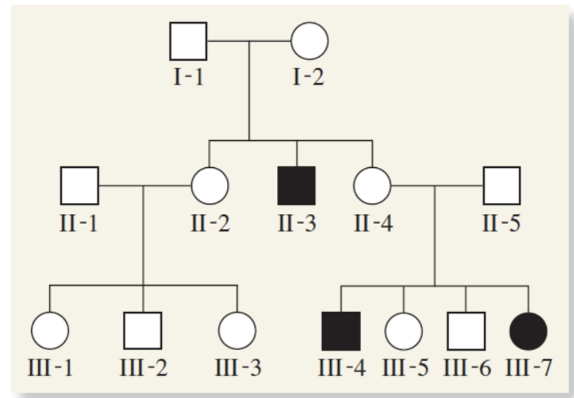
What is the genotype of II-4 based on the following pedigree of a recessive trait?
Homozygous recessive
Heterozygous
Homozygous dominant
Heterozygous
Reason: The female in II-4 is not expressing the trait, but her offspring are. Thus, she cannot be homozygous recessive, but heterozygous.
Mendel's law of independent assortment can be explained by the random alignment of ____ during ____ of meiosis I.
homologous chromosomes
metaphase 1
A cross is made between AaBbCcDD and AABbcDD individuals. Rather than making a very large Punnett square, which statistical operation could you use to solve this problem, and what would be the probability that the cross produces an offspring that is AAbbccDD?
Product rule, 1/64
Product rule, 1/16
Product rule, 1/4
Binomial expansion, 1/64
Binomial expansion, 1/16
Binomial expansion, 1/4
Product rule, 1/16
Gene | Cross | Need | Probability |
|---|---|---|---|
A | Aa × AA | AA | 1/2 |
B | Bb × Bb | bb | 1/4 |
C | Cc × cc | cc | 1/2 |
D | DD × DD | DD | 1 |
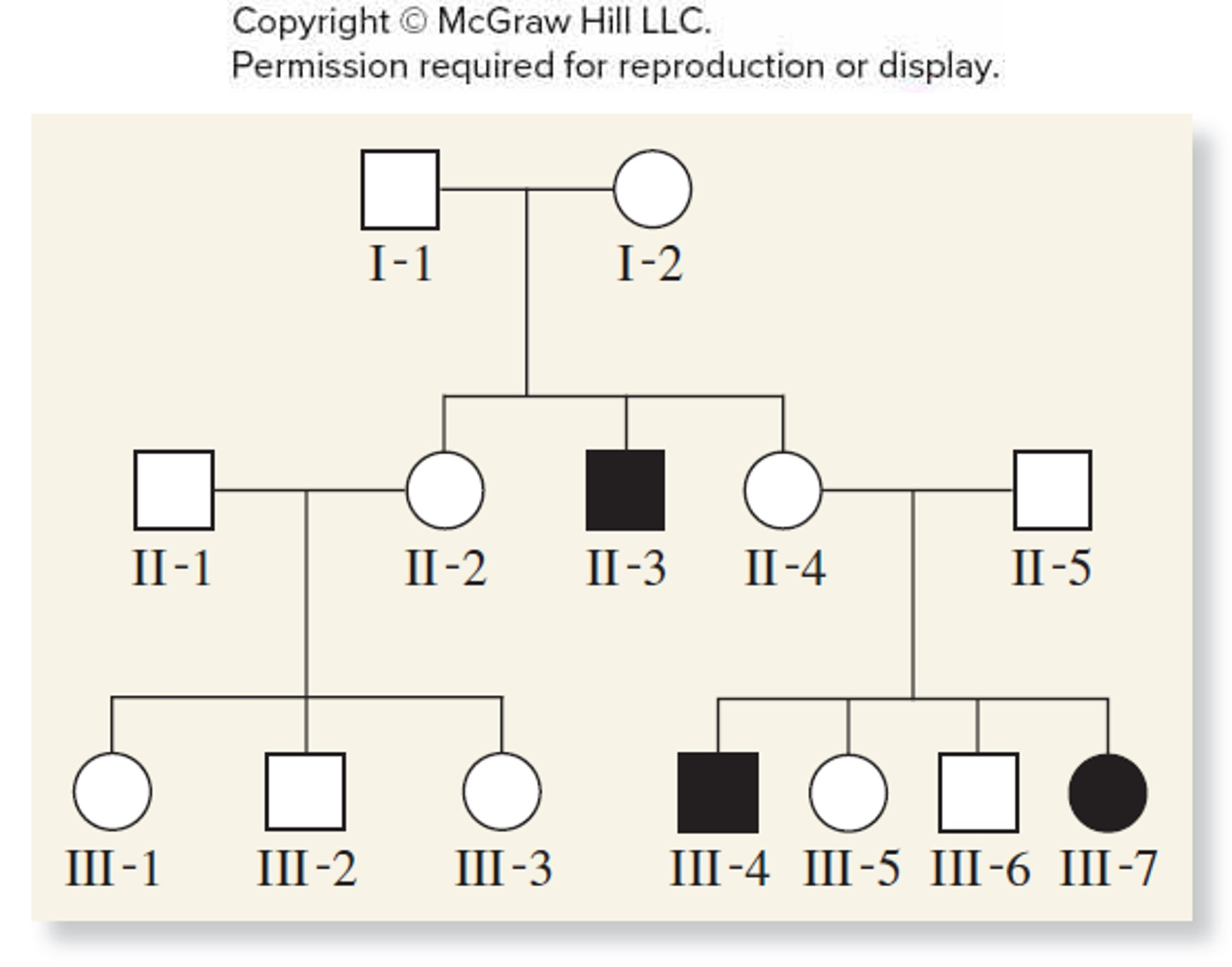
Consider the following pedigree of a recessive trait. What is the genotype and phenotype of II-2?
Genotype: Homozygous dominant;
Phenotype: Expressing the trait
Genotype: Homozygous recessive;
Phenotype: Not expressing the trait
Genotype: Homozygous dominant or heterozygous;
Phenotype: Not expressing the trait
Genotype: Homozygous dominant or heterozygous;
Phenotype: Expressing the trait
Genotype: Homozygous dominant or homozygous recessive;
Phenotype: Expressing the trait
Genotype: Homozygous dominant or heterozygous;
Phenotype: Not expressing the trait
Two true-breeding stocks of corn are crossed. The first parent had purple, smooth grains and the second had yellow, shrunken grains. All the F, individuals were like the first parent. The Fy was allowed to self-hybridize, and the following Fz data were obtained:
Purple, shrunken grains 204
Yellow, shrunken grains 68
Purple, smooth grains 701
Yellow, smooth grains 243
You propose a hypothesis that this cross is an example of a typical Mendelian dihybrid cross in which the two genes assort independently. What is the chi-square value for this experiment?
3.08
5.22
3.53
4.77
4.11
4.77
The probability of producing a short plant from two heterozygous parents is . What is the likelihood that these same parent plants will produce 3 short plants?
¾ 75%
1/32 3.1%
1/8 12.5%
1/64 1.6%
¼ 25%
1/64 1.6%
¼ x ¼ x ¼ = 1/64