oat chem unit 10
 Call Kai
 Learn
Learn Practice Test
 Spaced Repetition
 Match
Match Flashcards
 Knowt Play
1/20

Earn XP
Description and Tags
hello people today we will be talking about the effects of the cosmic hand
Name | Mastery | Learn | Test | Matching | Spaced | Call with Kai | Chat |
|---|
No analytics yet
Send a link to your students to track their progress
21 Terms
arrhenius acids/bases
Acid: any species that dissolves in aqueous solution to produce H+ ions.
Base: any species that dissolves in aqueous solution to produce OH- ions.
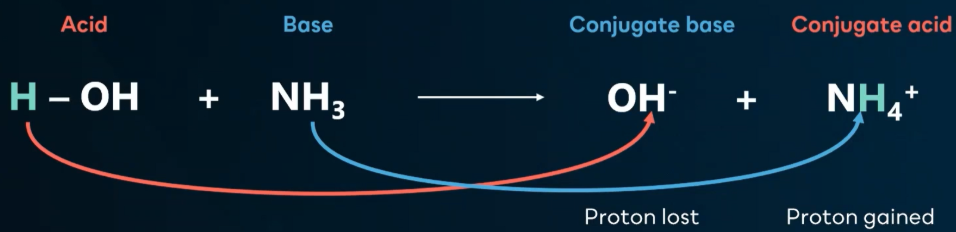
bronsted lowry aids/bases
Acid: any species that acts as a proton donor
Base: any species that acts as a proton acceptor
lewis acids/bases
Acid: any species that accepts a pair of electrons
Base: any species that donates a pair of electrons
conjugate acids and bases
The stronger a base or acid is, the weaker its conjugate is.
The weaker a base or acid is, the stronger its conjugate is.
pH and pOH
power of H or OH, on a scale of 0-14 to describe the acidity or alkalinity of a solution.
Higher concentration of H+ = lower pH.
pH = -log[H+]
[H+] = 10-pH
pOH = -log[OH-]
[OH-] = 10-pOH
pH + pOH = 14
dissociation constant
the extent at which a particular substance dissociates into ions.
Ka = [H+][A-] / [HA] ← acid dissociation constant
Kb = [HB+][OH-] / [B] ← base dissociation constant
Kw = 1 x 10-14 ← water dissociation constant
Kw = KaKb
![<p><span style="background-color: transparent;">the extent at which a particular substance dissociates into ions.</span></p><ul><li><p><span style="background-color: transparent;">K<sub>a</sub> = [H<sup>+</sup>][A<sup>-</sup>] / [HA] ← acid dissociation constant</span></p></li><li><p><span style="background-color: transparent;">K<sub>b</sub> = [HB<sup>+</sup>][OH<sup>-</sup>] / [B] ← base dissociation constant</span></p></li><li><p><span style="background-color: transparent;">K<sub>w</sub> = 1 x 10<sup>-14</sup> ← water dissociation constant</span></p></li><li><p><span style="background-color: transparent;">K<sub>w</sub> = K<sub>a</sub>K<sub>b</sub></span></p></li></ul><p></p>](https://assets.knowt.com/user-attachments/078b7d20-dfec-4c49-b4bf-09e5c6ae92cb.png)
pKa and pKb
measures how strong or weak an acid or base is.
pKa = -log(Ka) ← lower pKa = stronger acid
pKb = -log(Kb) ← lower pKb = stronger base
strong acids/bases
have a Ka or Kb > 1, and dissociate completely in water
weak acids/bases
have a Ka or Kb < 1, and dissociate partially in water
binary acids
includes hydrogen halides like HI, HBr, HCl, and HF. A larger atomic radius means hydrogen can dissociate easier, so HI is the strongest and HF is the weakest.
oxoacids
acids that contain oxygen. More oxygen atoms = more acidic. A more electronegative central atom = more acidic.
neutralization reaction
strong base reacts with strong acid to produce water.
Example: HCl + LiOH → LiCl + H2O.
M1V1 = M2V2
salts
the product of a neutralization reaction between acids and bases.
HCl + LiOH → LiCl + H2O. ← LiCl is the salt.
A strong acid and a weak base make an acidic salt.
A weak acid and a strong base make a basic salt.
buffer
A solution that resists a change in pH when small amounts of acid or base are added to it. It works best when a weak acid and base are equal in concentration.
6 ways to make a buffer
1:1 ratio of weak acid + salt
1:1 ratio of acidic salt and weak base
1:2 ratio of strong acid + basic salt
1:2 ratio of strong acid and weak base
2:1 ratio of acidic salt and strong base
2:1 ratio of weak acid + strong base
henderson hasselbach equation
Used to calculate pH of a buffer
pH = pKa + log([A-]/[HA])
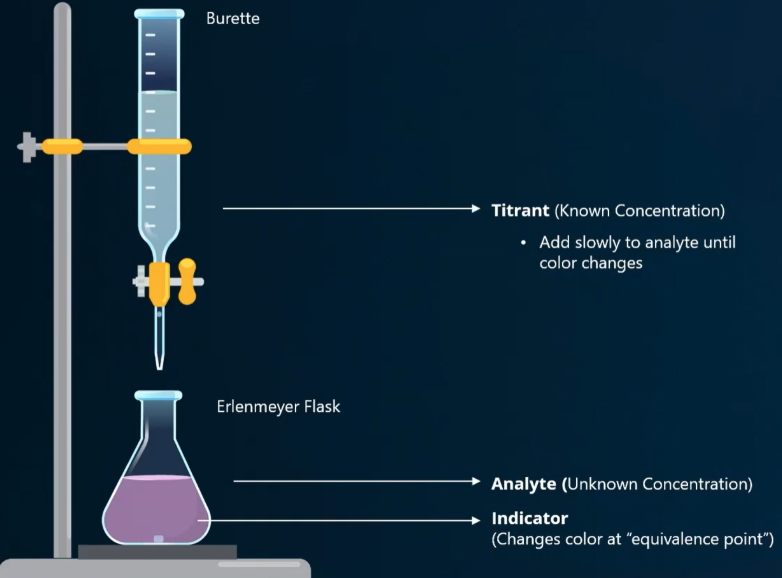
titration
Experiment used to determine the unknown concentration of an acid or base.
equivalence point
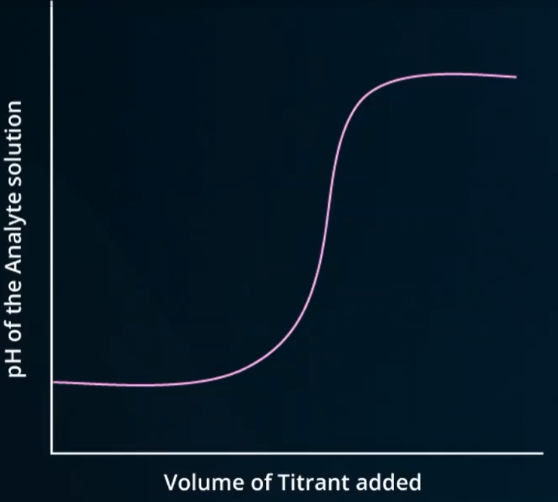
Point in a titration in which the amount of titrant added is just enough to neutralize the analyte solution. It is the steepest part of a titration curve
NtVt = NaVa
N = M * n
half equivalence point
The midpoint of the buffering region where pH = pKa.
polyvalent acids/bases
can donate or accept more than one H+ ion. Their titration curves can feature multiple buffering regions and multiple equivalence points.
acidic boner
you stuff your doodle wang into a bottle of orange juice and swish it around to mix it