Drugs affecting blood flow

0.0(0)
studied byStudied by 0 people
0.0(0)
full-widthCall with Kai
learnLearn
examPractice Test
spaced repetitionSpaced Repetition
heart puzzleMatch
flashcardsFlashcards
GameKnowt Play
Card Sorting

1/115

encourage image

There's no tags or description

Looks like no tags are added yet.

Study Analytics
Name
Mastery
Learn
Test
Matching
Spaced
Call with Kai

No study sessions yet.

116 Terms

1
New cards

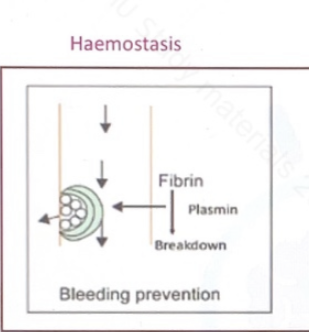
What is hemostasis?

Bleeding prevention by fibrin formation and platelet aggregation
2
New cards
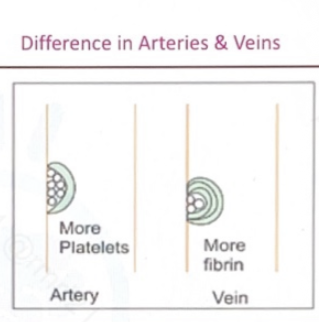
Difference between arteries and veins in thrombosis
Arteries have more platelets while veins have more fibrin
3
New cards

Drug categories that affect blood flow

  • Anti-platelet drugs

  • Oral anti-coagulants /anti-fibrin drugs

  • Injectable anti coagulants/ thrombin inhibitors

  • Thrombolytic drugs

4
New cards
Preferred drugs in arterial thrombosis
Antiplatelet drugs
5
New cards

What injured blood vessels release?

  1. Thromboxane A2 - vasoconstrictor and platelet activator

  2. ADP (adenosine diphosphate) - promote platelet aggregation

  3. GP receptors ( GP lIb/IIIa ) - makes sticky ( Exteriorization)

  4. Thrombin - convert fibrinogen to fibrin→platelet plug formation

6
New cards

Types of Antiplatelet drugs

  1. Drugs acting on Thromboxane A2 - Aspirin

  2. Drugs acting on ADP - Clopidogrel, Ticlopidine

  3. Drugs acting on Gp IIb/IIIa - Abciximab, Tirofiban, Eptifibatide

  4. Drugs acting on PAR-1 receptors of Thrombin - Atopaxar, Vorapaxar

7
New cards
What is the first antiplatelet drug
Aspirin
8
New cards
Normal platelet receptor involved in aggregation
GP IIb/IIIa
9
New cards
Substances released after vascular injury
  • TXA2

  • ADP

  • Thrombin

10
New cards
Effect of platelet activation
Platelets become sticky and aggregate
11
New cards
Drug acting on ADP receptor
  • Clopidogrel

  • Ticlopidine

12
New cards
Drugs acting on GP IIb/IIIa receptor
  • Abciximab

  • Tirofiban

  • Eptifibatide

13
New cards
Drugs acting on thrombin PAR-1 receptor
  • Atopaxar

  • Vorapaxar

14
New cards
TXA2 causes what effect on platelets
Platelet aggregation
15
New cards
PGI2 causes what effect on platelets
Inhibits platelet aggregation
16
New cards
Aspirin mechanism of action
Irreversible inhibition of COX
17
New cards

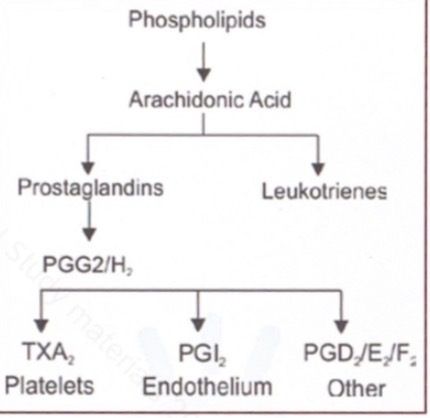
Prostaglandins / arachidonic acid pathway

Arachidonic acid pathway

  1. Cell membrane phospholipids release arachidonic acid via phospholipase A₂ when cells are stimulated (injury, inflammation).

  2. Arachidonic acid is metabolized mainly by two pathways: cyclo-oxygenase (COX) → prostaglandins/thromboxanes, and lipoxygenase (LOX) → leukotrienes.

  3. In the COX pathway, arachidonic acid is first converted to unstable intermediates PGG₂ and PGH₂.

  4. PGH₂ is the common precursor for several prostanoids, depending on the tissue-specific enzymes present.

  5. In platelets, PGH₂ is converted to thromboxane A₂ (TXA₂) → promotes platelet aggregation and vasoconstriction.

  6. In vascular endothelium, PGH₂ is converted to prostacyclin (PGI₂) → inhibits platelet aggregation and causes vasodilation.

  7. In other tissues, PGH₂ forms PGE₂, PGD₂, and PGF₂α, which mediate inflammation, pain, fever, smooth muscle contraction, and other local effects.
<p><span><span>Arachidonic acid pathway </span></span></p><p></p><ol><li><p><span><span>Cell membrane phospholipids release arachidonic acid via phospholipase A₂ when cells are stimulated (injury, inflammation).</span></span></p></li><li><p><span><span>Arachidonic acid is metabolized mainly by two pathways: cyclo-oxygenase (COX) → prostaglandins/thromboxanes, and lipoxygenase (LOX) → leukotrienes.</span></span></p></li><li><p><span><span>In the COX pathway, arachidonic acid is first converted to unstable intermediates PGG₂ and PGH₂.</span></span></p></li><li><p><span><span>PGH₂ is the common precursor for several prostanoids, depending on the tissue-specific enzymes present.</span></span></p></li><li><p><span><span>In platelets, PGH₂ is converted to thromboxane A₂ (TXA₂) → promotes platelet aggregation and vasoconstriction.</span></span></p></li><li><p><span><span>In vascular endothelium, PGH₂ is converted to prostacyclin (PGI₂) → inhibits platelet aggregation and causes vasodilation.</span></span></p></li><li><p><span><span>In other tissues, PGH₂ forms PGE₂, PGD₂, and PGF₂α, which mediate inflammation, pain, fever, smooth muscle contraction, and other local effects.</span></span></p></li></ol><p></p>
18
New cards
ADP receptor on platelets
P2Y12 receptor
19
New cards
Irreversible P2Y12 inhibitors
  • Clopidogrel

  • Ticlopidine

  • Prasugrel

20
New cards
Nature of clopidogrel and prasugrel
Prodrugs
21
New cards
Enzyme activating clopidogrel
CYP2C19
22
New cards
Effect of omeprazole on clopidogrel

Inhibits CYP2C19 and reduces effect ( because clopidogrel activated by CYP2C19)

23
New cards
Safest PPIs with clopidogrel
  • Pantoprazole

  • Rabeprazole

24
New cards
Faster acting ADP inhibitor
Prasugrel
25
New cards
Major risk of prasugrel
Hemorrhagic stroke
26
New cards
Contraindication of prasugrel
Stroke
27
New cards
Reversible P2Y12 inhibitors
  • Cangrelor

  • Ticagrelor

28
New cards
Strongest antiplatelet drugs
GP IIb/IIIa inhibitors
29
New cards

Example of Drugs acting on GP IIb/IIIa

  • Abciximab

  • Tirofiban

  • Eptifibatide

30
New cards
Main action of thrombin
Generation of fibrin
31
New cards
Thrombin receptor on platelets
PAR-1 receptor
32
New cards
Effect of thrombin binding PAR-1
Platelet activation
33
New cards
Oral PAR-1 antagonist used clinically
Vorapaxar
34
New cards
PAR-1 antagonist not used
Atopaxar
35
New cards
Anti-platelet drugs preferred in which thrombosis
Arterial thrombosis
36
New cards
Antifibrin drugs are also called
Anticoagulants
37
New cards
Classification of anticoagulants
  • Oral

  • Parenteral / injectable

38
New cards

Oral anticoagulant group include

  • Vitamin K inhibitors

  • Direct thrombin inhibitors

  • Factor Xa inhibitors

39
New cards

Drugs in vitamin K inhibitors

  • Warfarin

  • Dicumarol

40
New cards

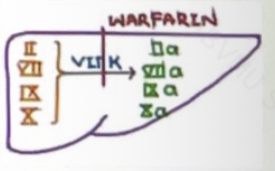
Clotting factors requiring vitamin K to become active

Factors II ,VII ,IX ,X
<p>Factors II ,VII ,IX ,X</p>
41
New cards
Vitamin K function
  • Gamma carboxylation of clotting factors II,VII,IX,X and activate them

  • Activation of anticoagulant proteins C,S

42
New cards
Anticoagulant proteins activated by vitamin K
  • Protein C

  • Protein S

43
New cards
Enzyme inhibited by warfarin

VKOR (vitamin K epoxide reductase)

44
New cards
Initial effect of warfarin
  • Hypercoagulable state / Dermal vascularnecroosis / increased clotting

  • Occur for initial 1-2 days

45
New cards
Reason for warfarin induced hypercoagulation
Protein C deficiency
46
New cards
Warfarin complication causing skin necrosis
Purple toe syndrome
47
New cards

Properties of Warfarin

  • Oral anticoagulant

  • Inhibit vitamin k

  • Need 4-5 days to produce action

  • Mainly for maintainence purpose

  • C/I in pregnancy →prevent osteocalcin action →Fetal warfarin syndrome → skeletal deformity (Microcephaly, Nasal hypoplasia, Microophthalmia)

  • Monitered by PT/INR

48
New cards
Warfarin onset of action
4 to 5 days
49
New cards
Warfarin use
Maintenance therapy
50
New cards
Warfarin acts only in vivo
Yes
51
New cards
Warfarin contraindicated in pregnancy
Yes
52
New cards
Warfarin causes fetal syndrome
Fetal warfarin syndrome
53
New cards
Cause of skeletal deformity in fetus
Inhibition of osteocalcin
54
New cards
Features of fetal warfarin syndrome
  • Microcephaly

  • nasal hypoplasia

  • microphthalmia

55
New cards
Monitoring parameter of warfarin

PT / INR

56
New cards
Why INR is preferred over PT

INR remains same across all labs but PT have different values in different labs

<p>INR remains same across all labs but PT have different values in different labs</p>
57
New cards
Effect of warfarin overdose
Bleeding
58
New cards

Four factor complex / Prothrombin factor complex contains which factors

  • IIa

  • VIIa

  • IXa

  • Xa

59
New cards
Treatment of choice for warfarin bleeding
Four factor complex
60
New cards
Alternative if four factor complex unavailable
Fresh frozen plasma
61
New cards

If both four factor complex and fresh frozen plasma unavailable then

Whole blood is given

62
New cards
Antidote for warfarin
Vitamin K
63
New cards
INR less than 5 management
Stop warfarin
64
New cards
INR 5 to 20 management

Stop warfarin and give vitamin K

65
New cards
INR more than 20 management

Stop warfarin and give four factor complex

66
New cards
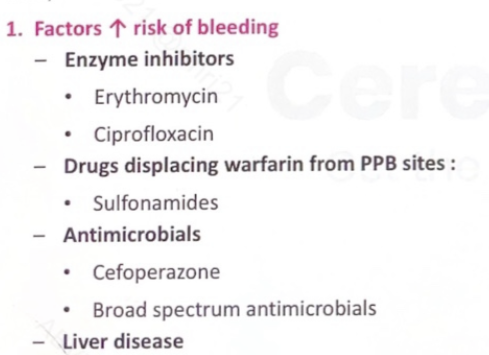
Drugs increasing bleeding risk with warfarin
  1. Enzyme inhibitors

  2. Drugs displacing warfarin from PPB sites

  3. Antimicrobials

  4. Liver disease

<ol><li><p>Enzyme inhibitors</p></li><li><p>Drugs displacing warfarin from PPB sites</p></li><li><p>Antimicrobials</p></li><li><p>Liver disease</p></li></ol><p></p>
67
New cards
Examples of enzyme inhibitors
  • Erythromycin

  • Ciprofloxacin

68
New cards
Drugs displacing warfarin from PPB sites
Sulfonamides
69
New cards
Antibiotic increasing bleeding with warfarin
  • Cefoperazone

  • Broad spectrum antimicrobial

70
New cards
Disease increasing warfarin effect
Liver disease
71
New cards
Drugs decreasing warfarin effect
Enzyme inducers
72
New cards
Examples of enzyme inducers
  • Rifampicin

  • Carbamazepine

73
New cards
Oral direct thrombin inhibitor
Dabigatran
74
New cards
Monitoring required for dabigatran
Not required
75
New cards
Antidote for dabigatran

Idarucizumab (monoclonal antibody)

76
New cards

Direct factor Xa inhibitors drugs

  • Rivaroxaban

  • Apixaban

  • Edoxaban

  • Betrixaban

77
New cards

Riveroxaban

pneumonic - RiverOXABAN

  • River - Reversible

  • O - Oral

  • XA - Xa

  • B - Blocker

  • AN - Antagonist

78
New cards

Antidote for factor Xa inhibitors overdose

Andexanet alfa
79
New cards

Types of injectable anti-coagulants

  • Indirect thrombin inhibitors

  • Direct thrombin inhibitors

80
New cards
Injectable anticoagulants
Heparins
81
New cards
Indirect thrombin inhibitor example
  • unfractioned Heparin (UFH)

  • Low moleculer weight heparin (LMWH)

  • Fondaparinux

82
New cards
UFH effect on clotting factors
Inhibits IIa and Xa
83
New cards
LMWH effect on clotting factors
Inhibits Xa more than IIa
84
New cards
Fondaparinux action
Only inhibits factor Xa
85
New cards
Route of heparin administration
Subcutaneous or IV
86
New cards
Onset of heparin action

Immediate (in acute conditions)

87
New cards
Anticoagulant of choice in pregnancy
Heparin
88
New cards
Monitoring of heparin
APTT
89
New cards
LMWH monitoring required
Usually not required
90
New cards
LMWH monitoring in renal failure
Anti-factor Xa assay
91
New cards
Antidote of heparin
Protamine sulfate
92
New cards
Heparin side effects mnemonic

Pneumonic - BOTHA

  • Bleeding

  • Osteoporosis

  • Thrombocytopenia ( HIT )

  • Hyperkalemia

  • Alopecia

93
New cards

HIT occurs how many days after starting heparin

4 to 5 days
94
New cards
Feature of HIT
Thrombocytopenia with thrombosis
95
New cards
Treatment of HIT
Direct thrombin inhibitors
96
New cards

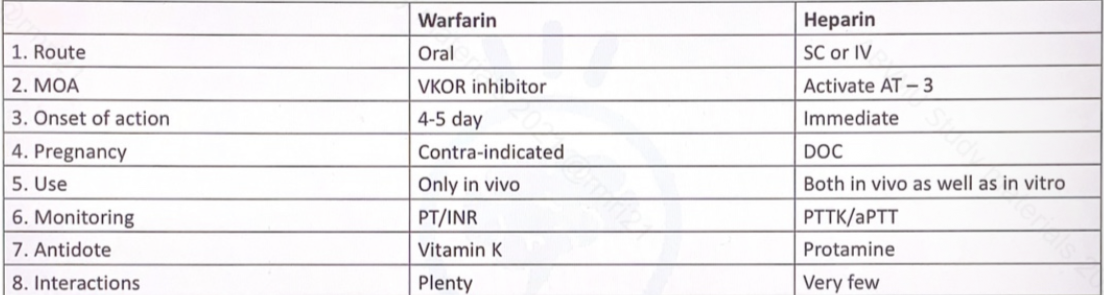
Difference in Warfarin and HEparin

knowt flashcard image
97
New cards
Difference between warfarin and heparin onset
  • Warfarin - slow

  • Heparin - immediate

98
New cards
Warfarin pregnancy safety
Contraindicated
99
New cards
Heparin pregnancy safety
Drug of choice
100
New cards

Direct thrombin inhibitor (injectable)drugs

  • Bivalirudin

  • Argatroban

  • Melagatran